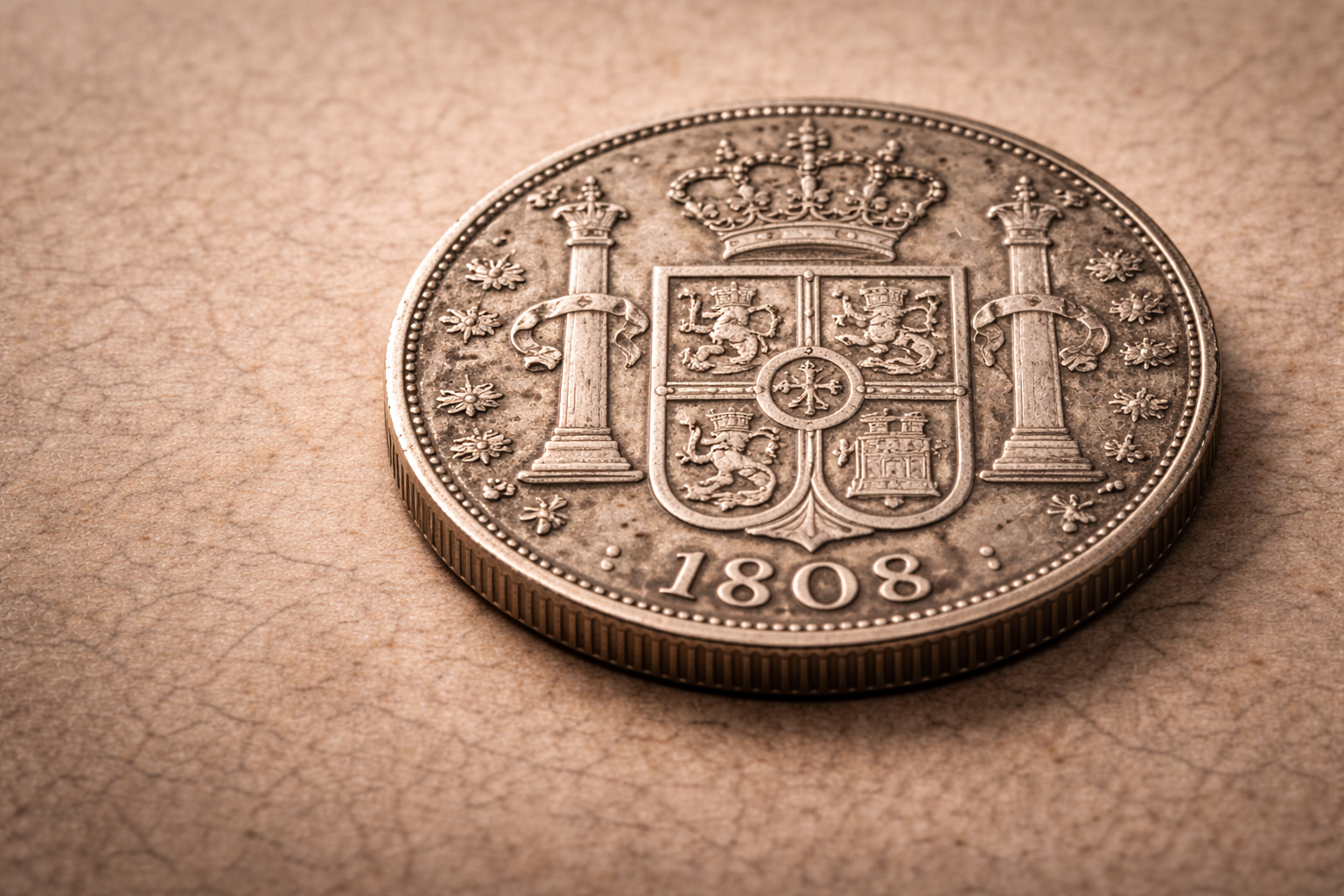
🇵🇪 1808 Peru Silver 8 Reales — The Coin of Two Empires
Estimated reading time: 13 to 15 minutes.
🪙 Some coins belong to a single ruler. Others belong to a single era. The 1808 Peru Silver 8 Reales belonged to two collapsing worlds at the same time.
Often described as The Coin of Two Empires, this silver piece circulated at a moment when imperial authority was fracturing. It carried the symbols of Spain while the ground beneath that empire was already shifting.
📚 This article focuses on history, power, and transition without discussing modern prices or market speculation.
🇪🇸 An empire under pressure
By the early nineteenth century, the Spanish Empire was no longer the unchallenged force it once had been. Wars in Europe drained resources. Colonial administration grew fragile. Communication across oceans slowed decision making.
In eighteen zero eight, events in Europe shook the foundations of imperial legitimacy. Authority fractured at the center. When the center weakens, the edges begin to question their place.
Coins struck during such periods often become historical witnesses rather than simple tools of trade.
🇵🇪 Peru as the silver heart of empire
For centuries, Peru had been one of Spain’s most important sources of silver. Mints in the region supplied coinage that traveled across continents.
The eight reales was not an ordinary coin. It was a global unit. Merchants recognized it. Governments trusted it. Empires relied on it.
By the time eighteen zero eight arrived, Peru was still striking silver, but the meaning of that silver was changing.
🪙 Why the eight reales mattered
The eight reales functioned as a backbone of international trade. Its size, weight, and consistency made it dependable.
Unlike local copper coins, it crossed borders easily. It passed from hand to hand with little explanation. That universality gave it power.
When political uncertainty rises, trusted formats become even more important. This is why production continued even as imperial certainty faded.
⚖️ A coin between two authorities
The 1808 Peru silver issue existed in a legal gray zone. It bore the marks of Spanish authority. Yet the political system that granted that authority was already compromised.
This placed the coin in a unique position. It circulated as imperial money while independence movements quietly gained momentum.
In this sense, the coin belonged to two empires. One official. One emerging.
🌎 Circulation beyond borders
Peruvian eight reales did not remain in South America. They moved through ports, markets, and trade routes.
Their reach extended into Asia, Europe, and North America. This wide circulation diluted political identity while strengthening monetary trust.
A merchant might accept the coin without caring who ruled Peru. What mattered was silver and consistency.
🧠 Collector perspective without obsession
Collectors study the 1808 Peru 8 Reales not for rarity alone, but for context.
- ⚔️ Imperial decline
- 🌍 Global trade networks
- 📜 Transitional authority
- 🪙 Silver as political language
This approach parallels interest in other coins shaped by contradiction, such as the Rare 1974 Penny, where official logic and reality diverged.
🌊 Patterns across regions
Coins produced during periods of transition often share common traits. They are conservative in design. They emphasize continuity. They avoid radical change.
Similar dynamics appear in other regions, including stories found in our Oceania coins collection, where distance and delay shaped monetary identity.
📜 Silver as silent witness
Silver does not argue. It records.
The 1808 issue recorded a moment when power still claimed authority, even as history prepared to rewrite it.
Coins like this one allow modern readers to hold transition in their hands.
⚠️ Reality Check: The importance of the 1808 Peru Silver 8 Reales comes from timing and circumstance, not from mint numbers or survival rates.
🏁 The 1808 Peru Silver 8 Reales stands between two empires. It speaks for a system still functioning while already dissolving.
🌅 Closing reflection
Coins often outlive the governments that create them.
The Coin of Two Empires reminds us that money can continue to circulate long after authority begins to fade. In silver, transition becomes permanent.