🇦🇷 1842 Argentina 8 Escudos — The Sun of the Pampas
Estimated reading time: 12–14 minutes.
☀️ Some coins shine because of gold. Others shine because of meaning. The 1842 Argentina 8 Escudos does both.
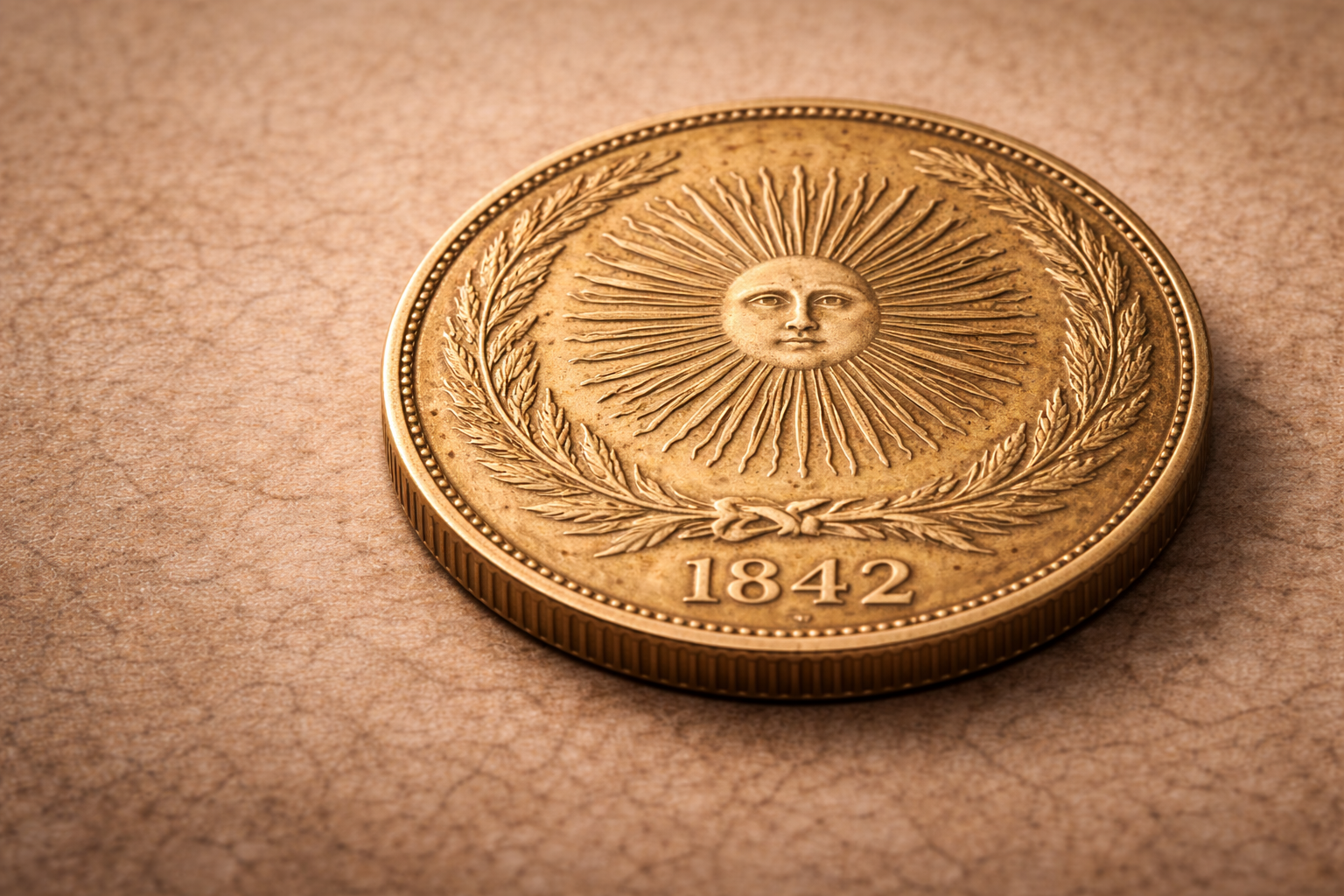
Often referred to as The Sun of the Pampas, this coin reflects a moment when Argentina was defining itself — not just as a former colony, but as a sovereign identity searching for symbols strong enough to unify a nation.
📚 This article explores history, symbolism, and national identity — not prices or modern market speculation.
🇦🇷 Argentina after independence
By the eighteen forties, Argentina was still shaping the meaning of independence. The colonial era had ended, but stability had not yet arrived. Political factions, regional power struggles, and questions of authority defined daily life.
In such periods, coinage becomes more than currency. It becomes a declaration. Every symbol stamped into metal communicates legitimacy, continuity, and control.
The eight escudos was chosen deliberately. It was large. It was powerful. And it carried visual language meant to speak across distances.
☀️ The Sun as a national statement
The sun motif on Argentine coinage did not appear by accident. It was inspired by the Sun of May, a symbol tied to independence movements across the Río de la Plata region.
On the 1842 escudos, the sun does not merely decorate. It dominates. It announces presence. It suggests rebirth, authority, and continuity beyond colonial rule.
For a young nation, this mattered. Symbols had to be instantly recognizable and emotionally resonant.
🪙 Why eight escudos mattered
The denomination itself carried historical weight. Eight escudos had long been associated with high value transactions and state level authority.
By issuing gold in this format, Argentina aligned itself with established monetary traditions while asserting independence. It was a way of saying: we belong to the world of nations, not colonies.
This balance between familiarity and assertion defines much of nineteenth century Latin American coinage.
🌾 The Pampas and symbolic geography
The Pampas were more than land. They were identity.
Wide, open, fertile, and powerful, the Pampas represented Argentina’s promise. By associating gold coinage with national symbols tied to land and sun, the state linked prosperity with territory.
The coin became a portable vision of the nation. Wherever it traveled, it carried the Pampas in miniature.
🏛️ Authority in metal form
Gold coins like the 1842 escudos were instruments of trust. Their weight and appearance reassured users in uncertain political climates.
Unlike small copper coins meant for daily exchange, large gold issues spoke to governments, merchants, and institutions. They anchored confidence.
This explains why such coins were often stored, transported, and used selectively rather than circulated freely.
🧠 Collector perspective beyond obsession
Collectors drawn to the 1842 Argentina 8 Escudos often focus on symbolism rather than survival.
- ☀️ Strong national imagery
- 🌎 Post colonial identity in metal
- 📜 Political history encoded in design
- 🧭 A bridge between empire and nationhood
This approach mirrors interest in other historically “impossible” or symbolic coins. A modern parallel can be found in the story of the Rare 1974 Penny, where context matters more than quantity.
🌊 Regional stories and shared patterns
Across the southern hemisphere, coins often served as tools of identity during periods of transition. Whether in Oceania or South America, metal carried meaning where paper promises failed.
You can explore similar stories in our Oceania coins collection, where geography and symbolism intersect repeatedly.
❌ Myths around gold symbolism
A common misunderstanding is that gold coins were purely economic tools. In reality, they were political statements first.
The 1842 escudos was not designed to impress individuals. It was designed to announce permanence.
⚠️ Reality Check: The power of this coin lies in symbolism and timing, not in circulation volume. Its meaning comes from context, not from how often it changed hands.
🏁 The 1842 Argentina 8 Escudos stands as a golden declaration of identity. It reflects a nation rising under the same sun that still defines it today.
🌅 Closing reflection
The Sun of the Pampas was never meant to be subtle. It was meant to be seen, remembered, and trusted.
Through gold, Argentina stamped its future into metal. And nearly two centuries later, that message still shines.