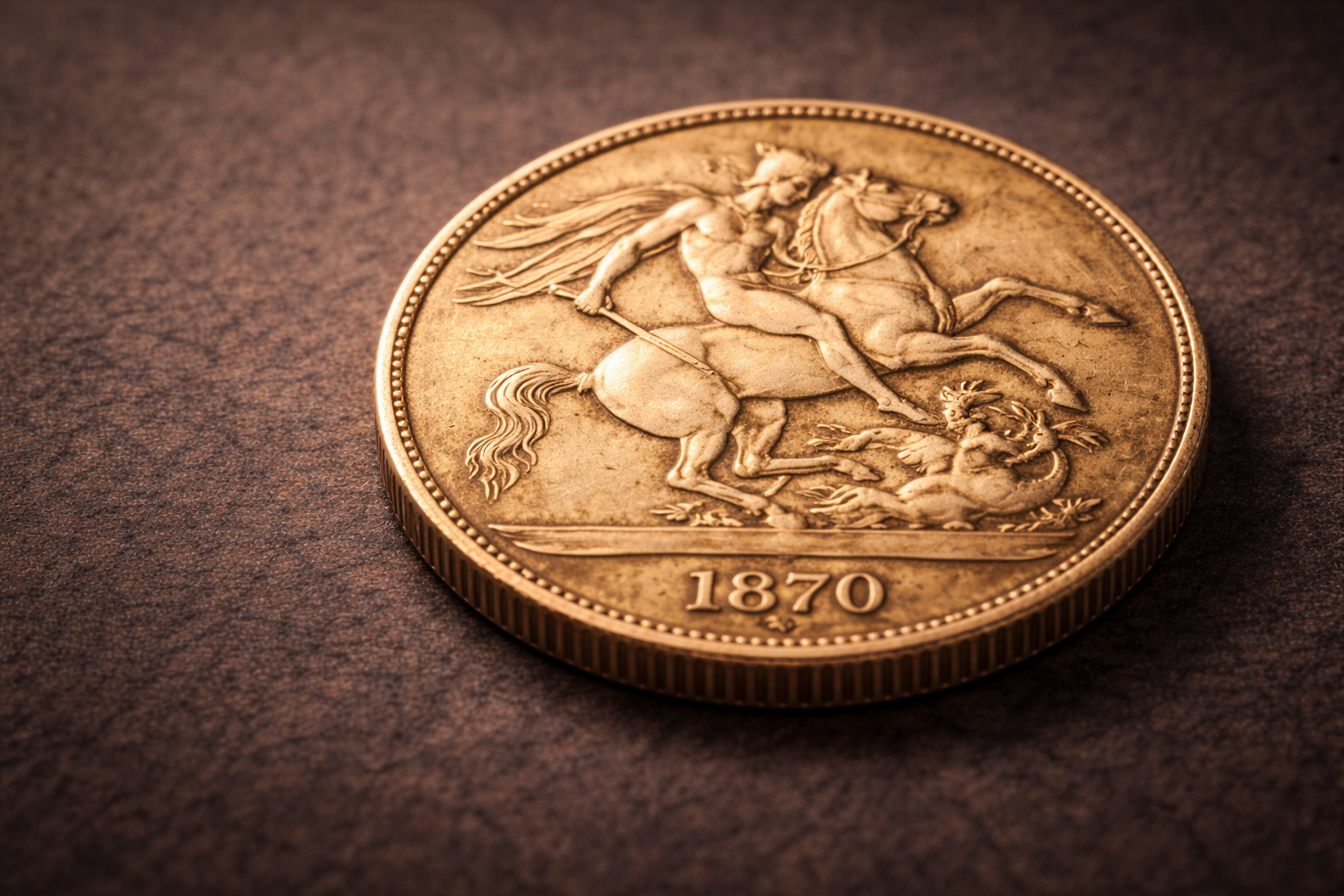
🇦🇺 1870 Sydney Sovereign — The Lost Gold of the Empire
Estimated reading time: 11–13 minutes.
🪙 Gold sovereigns once carried the weight of an empire in their hands. Among them, the 1870 Sydney Sovereign stands apart — not because it dominated circulation, but because so many of its pieces quietly disappeared into history.
Often called the lost gold of the empire, this coin represents a moment when Australia’s gold flowed outward, fueling imperial trade rather than staying within its place of origin.
📚 This article focuses on history, symbolism, and imperial movement — not prices or modern market speculation.
🌏 Australia and the age of imperial gold
By the late nineteenth century, Australia had become one of the world’s most important sources of gold. Sydney’s mint was not just producing coins for local use. It was feeding a global system that relied on precious metal as the backbone of trust.
Gold did not stay where it was mined. It traveled — across oceans, into vaults, and through international trade routes. The Sydney Sovereign was part of this massive movement.
🏭 Why the Sydney Mint mattered
The Sydney Mint operated under British authority, yet its location gave it strategic importance. Coins struck there reduced the need to ship raw gold back to Britain for processing.
This efficiency made Sydney sovereigns widely accepted across the empire. Once released, they rarely returned. They blended seamlessly into imperial circulation, losing their geographic identity.
🧭 The meaning behind “lost gold”
The term “lost” does not imply mystery or theft. It reflects dispersal.
Unlike coins that remain concentrated within a single nation, many Sydney sovereigns vanished into international commerce. They were melted, stored, or reissued elsewhere. Surviving examples are reminders of a one-way journey.
👑 Imperial design and silent authority
The design of the sovereign was intentionally conservative. Consistency mattered more than innovation.
This visual stability ensured instant recognition. A sovereign from Sydney looked trustworthy anywhere the British Empire reached. Design was a tool of confidence, not expression.
🚢 Gold that traveled farther than its makers
Many coins are remembered for where they circulated. The Sydney Sovereign is remembered for how far it traveled.
From colonial trade to international settlements, these coins were absorbed into a system larger than Australia itself. Once absorbed, few retained records of origin.
🧠 Collector perspective without price focus
Collectors who study the 1870 Sydney Sovereign are often drawn to its journey rather than its metal. The coin tells a story of extraction, authority, and disappearance.
- 🌍 Represents global movement of gold
- 🏛️ Symbol of imperial monetary trust
- 🧭 Defined by dispersal, not survival
- 📜 Connects Australia to global finance
This fascination with absence mirrors other historical anomalies. Stories like the Rare 1974 Penny show how coins gain meaning when they break expectations.
🌊 Oceania coins and regional identity
Australia’s sovereigns belong to a broader narrative across the Pacific. Island and regional coinage often reflects external demand more than local use.
If you enjoy these interconnected stories, explore more examples in our Oceania coins collection, where geography and empire frequently collide.
⚠️ Many sovereigns were melted or absorbed into later systems. Surviving pieces often show signs of storage rather than circulation.
🏁 The 1870 Sydney Sovereign is remembered not for staying home, but for leaving it. Its legacy is movement, not presence.
🌅 Closing reflection
The lost gold of the empire was never truly lost. It simply fulfilled its purpose elsewhere.
The 1870 Sydney Sovereign reminds us that some coins matter most not where they end up, but in what they helped build along the way.