🇫🇯 1977 Fiji Silver Proof Set — The Island’s Hidden Treasure
Estimated reading time: 9 to 11 minutes.
🏝️ There are coin sets that feel like museum pieces, and then there are sets that feel like a message in a bottle. The 1977 Fiji Silver Proof Set belongs to the second type. It looks polished and deliberate, yet it keeps showing up in the world like a quiet secret. Not because it is loud. Not because it is trendy. But because it carries a very specific kind of island history that many collectors miss on the first pass.
✅ This article focuses on history, design, collecting logic, and preservation. It does not include price tables, value charts, or selling language.
- Why this set feels hidden
- Fiji in the 1970s and why coins mattered
- What “proof” really means
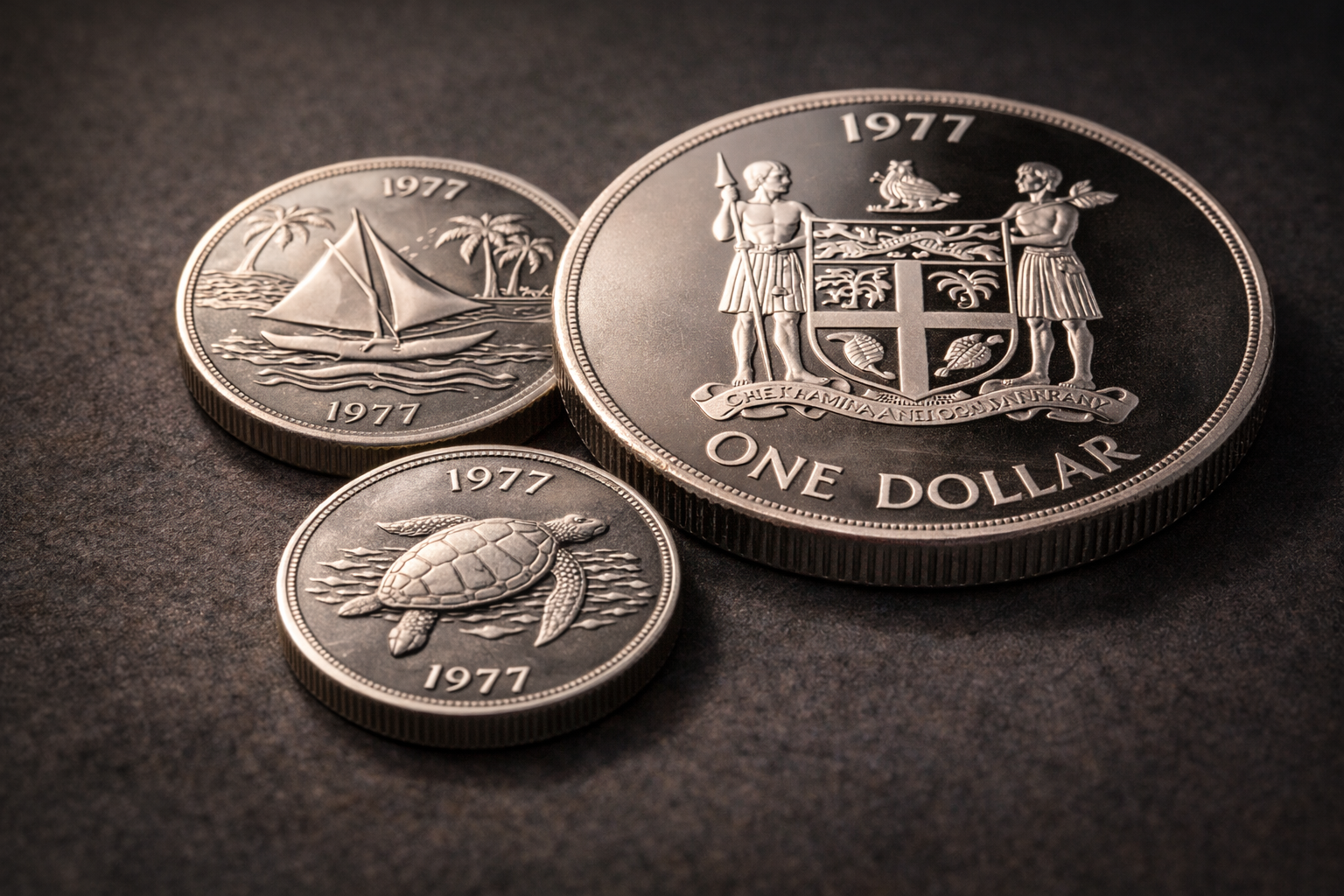
- What you usually see in a Fiji proof set
- The art of contrast and why proof surfaces age differently
- Packaging, certificates, and paper trails
- Why sets get separated and how that changes the story
- Collector checklist without chasing prices
- Care and storage that actually works
- Common myths and mistakes
- FAQ
- Closing thought
🔎 Why this set feels hidden
“Hidden” does not always mean rare in the dramatic sense. Sometimes it means overlooked. Fiji sits in the mental map of many collectors as a beautiful place, but not always as a place with a coin story worth pausing for. That is exactly why a proof set like the 1977 issue can slip through conversations.
Proof sets, in general, are not the coins you find in pockets. They were made to be kept, protected, and remembered. So when a proof set becomes separated, or stored poorly, or simply inherited by someone who does not collect, it can vanish into drawers for decades. Later it reappears in a small box, still shining in places, with the feeling of something preserved by accident.
🧭 Think of this set as a “time capsule format”. It was created to represent a country’s identity in a clean, official way. Even if you never grade a single coin, the set tells a story just by existing intact.
🌊 Fiji in the 1970s and why coins mattered
Fiji’s modern national story moved fast in the 1970s. After independence in 1970, the country was shaping how it wanted to appear to the world. Flags, stamps, banknotes, and coins are not just objects. They are public identity. When a country chooses what appears on its coinage, it is choosing what should be repeated and remembered.
For island nations especially, the visuals often carry layered meaning. The ocean is not background. It is connection and distance at the same time. Local flora and fauna are not decoration. They are a way to say: this is our home, our environment, our rhythm. Even when the coinage includes a monarch portrait, the reverse side can still speak in an island voice.
That is why a Fiji proof set from this era can feel like a curated display. You are not holding “random coins”. You are holding a selection that was meant to represent a currency system as something dignified and exportable.
✨ What “proof” really means
A proof coin is not simply “a shiny coin”. It is a product of a specific manufacturing style. Proof coins are struck with extra care, often using polished dies and carefully prepared planchets. The goal is detail and visual contrast, not speed.
In many proof traditions, you will notice a mirror-like field with frosted devices. That contrast is part of the design language. It makes portraits, crests, animals, and lettering appear crisp, almost like the coin has its own spotlight. This is exactly why proof sets attract collectors who care about artistry, not just dates.
🧪 Proof is a process. Not a promise of perfection. Proof coins can still develop haze, hairlines, milkiness, and spotting over time depending on storage and handling.
🪙 What you usually see in a Fiji proof set
The exact composition and coin lineup can vary by issue and packaging type, and different markets sometimes received different versions. But Fiji proof sets from the era commonly reflect two big design themes.
👑 The official face
Many Commonwealth-linked coinages historically used a reigning monarch portrait on one side. In that context, the portrait is a political and constitutional signal, not a local wildlife statement. On proof surfaces, these portraits often look extremely sharp, and the smallest hair details or lettering edges can become very visible.
🌺 The island voice
The reverse designs are where the island identity often speaks louder. You may see local symbols, fauna, and motifs that feel rooted in place. Even if you do not recognize every plant or creature immediately, the style usually leans toward calm, natural imagery rather than aggressive power symbolism.
- 🦜 Nature motifs tend to age well as art, because they do not rely on politics to feel meaningful.
- 🌴 Island symbols often make a set feel coherent, like a miniature exhibit rather than a pile of denominations.
- 🧩 Repeated design language across denominations helps you spot when a set is incomplete.
🎭 The art of contrast and why proof surfaces age differently
Proof coins can look “perfect” in a photo, then slightly different in real life under changing light. That is not a flaw. It is part of how mirror fields behave. A tiny hairline that is invisible head-on can appear when light hits from the side.
This is where collectors sometimes misunderstand proofs. They assume a proof coin should always look flawless, and if it does not, they conclude it is “fake” or “damaged”. But proofs are sensitive. Their beauty is also their weakness. The same mirror finish that looks amazing can show even the smallest contact.
🔍 The easiest way to think about it. Proof coins are like glossy museum glass. Normal circulation coins are like matte stone. Both can be authentic. They just reveal marks differently.
📦 Packaging, certificates, and paper trails
A proof set is not only the coins. It is also the context. Original packaging, if present, can help you confirm that the pieces were meant to live together. It also helps protect the surfaces from fingerprints and accidental wiping.
If your set includes a case, capsule system, or presentation folder, treat it as part of the artifact. Many collectors focus only on the metal, but the packaging is often the reason the coins survived in proof quality in the first place.
- 📄 Certificates can help establish the intended lineup, even if a coin is missing.
- 🧰 If the plastic looks cloudy or brittle, do not “polish” it with household products.
- 🧤 Handling should be minimal. If you must handle coins, use cotton gloves or hold by the edge only.
🧭 Why sets get separated and how that changes the story
One of the quiet tragedies of proof sets is that they often get separated for reasons that have nothing to do with collecting. A family moves. A box gets wet. Someone thinks the case is “just plastic” and discards it. Or a single coin is removed because it looks nicer than the rest.
The moment a set is separated, its identity changes. The coins become individuals instead of a curated group. That matters for historical storytelling, because the set format was meant to speak as a whole.
If your goal is to keep your site AdSense safe and history-forward, the smartest approach is to lean into this narrative. Focus on why complete sets matter culturally, not what they sell for. That creates safer, deeper content that still satisfies collectors.
🧠 A collector tip that is not about money. If you inherit a set and it is intact, your first job is preservation, not evaluation. The fastest way to lose the “proof feeling” is over-handling and over-cleaning.
✅ Collector checklist without chasing prices
You can evaluate a 1977 Fiji Silver Proof Set in a smart way without turning the article into a marketplace. The trick is to focus on verifiable physical signals and historical context.
🧩 Completeness and consistency
- 🔢 Do the denominations match what the packaging suggests, if packaging exists.
- 🧠 Do the designs feel like they belong to the same era and style.
- 🪙 Are the rims and relief consistent across the set, not mixed with random circulation pieces.
🌟 Surface signals that collectors watch
- 🪞 Mirror field clarity. Proof fields should reflect light cleanly, even if they show small hairlines.
- ❄️ Frosted devices. Many proofs show contrast between frosted design and mirrored field.
- ☁️ Haze or fog. This can happen from storage chemistry and does not automatically mean the set is ruined.
- 🧼 Cleaning evidence. Wiped mirrors often show uniform hairlines across large areas.
🧾 Authenticity checks that do not require tools
- 🔎 Look for crisp lettering edges. Proof strikes often show strong detail.
- 🎯 Check alignment and rim quality. Sloppy rims can indicate damage or mismatched pieces.
- 🧠 Compare designs to reputable references. Focus on layout and inscriptions, not seller photos.
Important note. If you suspect a coin is plated, altered, or misrepresented, avoid home experiments. Better to keep it safe and compare calmly with reliable references than to damage it with tests.
🧊 Care and storage that actually works
Proof sets reward patience. They do not reward “fixing”. The biggest mistake people make is trying to restore shine. Proof shine is not a dirt layer. It is a surface finish. If you rub it, you do not clean it. You change it.
🛑 Simple rule. Never polish proof coins. Never wipe proof coins. Never use household cleaners on proof coins.
📍 Where to store
- 🌡️ Stable temperature. Avoid attic heat and bathroom humidity.
- 💧 Low moisture. Use a dry cabinet or sealed box with safe desiccant packs.
- 🌫️ Low chemical exposure. Avoid storing near perfumes, paints, or cleaning supplies.
🧰 What to store in
- 📦 Original case or capsule system, if it is intact and not degrading.
- 🧾 Archival materials labeled PVC free.
- 🧤 Gloves for handling, but edge holding is still the best habit.
If a set already has haze, the safest choice is usually to leave it alone. Many collectors prefer original surfaces, even imperfect ones, over surfaces altered by “restoration”. Your content can teach that mindset, and it keeps you far away from risky value claims.
🧨 Common myths and mistakes
Silver is one part of the story, not the whole story. Proof sets are collected for finish, completeness, historical context, and design. Metal alone does not tell you what matters.
Proof means carefully made, not magically protected. Time, humidity, and handling can still affect it. The goal is to preserve, not to chase a fantasy of perfection.
Cleaning is the fastest way to remove the proof character. Proof surfaces are like a finish on fine wood. You can destroy the finish while thinking you are improving it.
For storytelling and historical integrity, missing pieces matter. A proof set is a curated group. When one coin is gone, the set becomes an incomplete chapter.
❓ FAQ
No. Proof sets are made as presentation pieces. They are not meant for everyday spending, and their surfaces show that.
Look for mirror-like fields, crisp strike detail, and a deliberate presentation look. If you have original packaging, that helps. Avoid rubbing the coin to “check shine”.
If the original packaging is stable and protective, keeping the set intact is often the better historical choice. Separation increases handling risk and increases chances of micro-scratches.
Use soft light and avoid harsh direct lamps. Photograph through the capsule if possible. Proof mirrors reflect everything, including your phone and room.
Sometimes professionals can help, but home cleaning is risky. For most collectors, stable storage and minimal handling are the safest decisions.
🌺 Closing thought
The 1977 Fiji Silver Proof Set is not just “a silver set”. It is a small museum case that traveled through time. It carries the voice of an island nation shaping how it wanted to be seen, and it does it through design, finish, and careful presentation.
If you want your site to stay clean for AdSense and still satisfy collectors, this is the winning angle. Teach the history. Teach the craft. Teach preservation. Let the set remain a hidden treasure in the original meaning of the word: something valuable because it is a preserved story.