Where Ancient Coins Were Found
⏳ Estimated reading time: 13 minutes
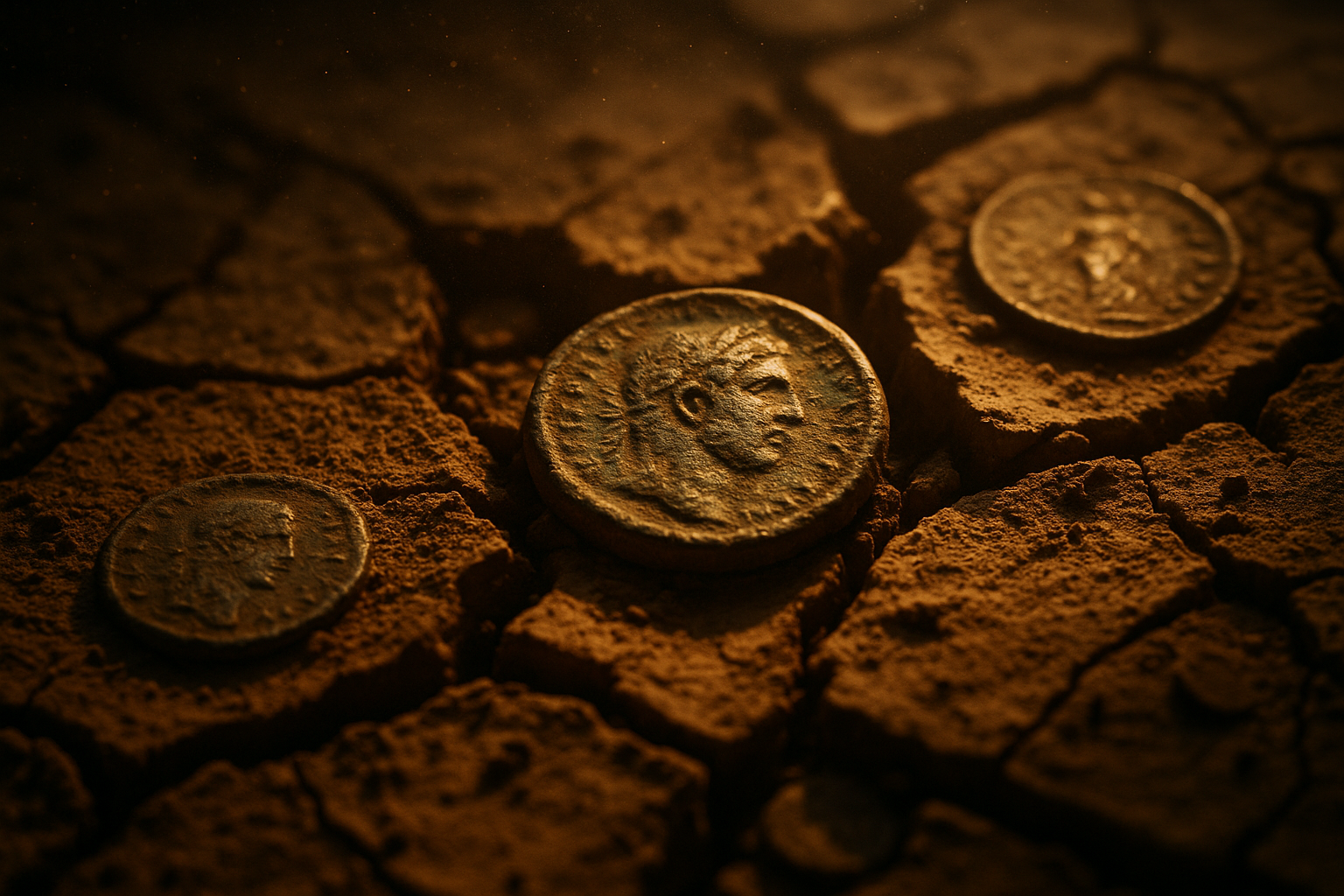
The strangest thing about ancient coins is that they rarely “appear” in grand moments. They slip out of the earth when a farmer turns his field. They cling to the silence of a ruined wall. They wait inside a clay jar that once sat beneath a kitchen floor. And when they finally surface, they do not shout their value they whisper their journey.
If you have ever wondered where ancient coins were found, the answer is never just one place. It is a web of pathways: trade roads, temples, rivers, shipwrecks, borderlands, marketplaces, and homes that vanished. This article is a guided walk through the most common (and most cinematic) discovery routes told like a story, but rooted in how coins actually moved through the ancient world.
- The simple truth about coin discoveries
- Fields, gardens, and the quiet surface
- Rivers and coastlines
- Homes that disappeared
- Hoard finds: why people buried money
- Markets, crossroads, and street layers
- Temples, shrines, and offerings
- Tombs, caves, and sealed places
- Shipwrecks and maritime trade
- Trade routes: the long road of a small coin
- Clues a discovery site can reveal
- Quick guide: pathways and what they usually mean
- Reality Check
- Final Verdict
- Explore more stories
- Recommended internal reads
- Author Box
The simple truth about coin discoveries
Ancient coins do not start their lives as “ancient.” They begin as practical objects: something a traveler can carry, something a merchant can count, something a soldier can spend. That practical beginning is exactly why they end up in so many strange places.
A coin can be lost in a crowd. It can fall from a purse during a storm. It can be hidden in fear. It can be offered in hope. It can survive a fire, a collapse, a flood, a shipwreck, a war, and still remain recognizable centuries later. When we ask where ancient coins were found, we are really asking: where did people live, move, trade, worship, and panic?
The most important idea to keep in mind is this: a discovery site is not just a “location.” It is a snapshot of a human moment — an errand, a journey, an emergency, or a ritual.
Fields, gardens, and the quiet surface
The most common stage for a small ancient discovery is not a dramatic ruin. It is a field. A place that has been used and reused for generations: plowed, planted, harvested, and walked across until the soil turns into a slow-moving archive.
Coins enter fields in ordinary ways. A worker eats lunch near the edge of farmland and drops a small pouch. A traveler cuts across a shortcut. A market day ends and the last footsteps scatter dust over whatever fell. Over time, the earth does what it always does: it swallows small things first.
This is why fields and gardens often produce single coins, not perfect sets. One piece at a time, like crumbs along a forgotten path. Sometimes those single coins are the first hint that something larger lies nearby — a settlement, a roadside stop, or a route that once connected two busy places.
There is also a quiet romance to these surface finds. They feel intimate. They suggest a human hand that did not plan to leave anything behind. A coin lost by accident has a different emotional weight than a coin buried on purpose.
Rivers and coastlines
Water is both a road and a thief. Rivers carried people, goods, and ideas long before paved roads did. But rivers also take what they can. A crossing slips. A bag tears. A flood rearranges everything and in rearranging, it sometimes reveals what was hidden.
River finds often tell stories of movement. Coins near bridges and fords are especially meaningful because crossings were crowded and tense. You watch your footing, you watch your animals, you watch your cart, you watch your children and that is exactly when small things fall.
Coastlines, too, play their own role. Ancient ports were busy mouths of the world: ships arriving, cargo unloading, payments made quickly. One coin into the sand is easy to ignore in the moment. A thousand years later, it becomes a clue to the rhythm of trade.
Homes that disappeared
If you want the most human category of discovery, look at old homes. Not palaces — homes. Floors that were swept every day. Corners that stored jars, tools, food, and the small savings people hoped would last.
A home can vanish for many reasons. A fire. A collapse. A slow abandonment as a city shifts. A sudden departure during conflict. In every case, the same thing happens: the “temporary hiding places” become permanent.
People hid coins in walls, beneath stones, inside containers, under hearths, and under thresholds. Some did it out of habit. Some did it out of fear. And some did it simply because there was nowhere else to keep money safe.
When those homes disappear, the hiding places remain. And when later generations build over old foundations — or when time exposes them coins reappear as if the house itself is exhaling history.
Hoard finds: why people buried money
Hoards are where coin discovery begins to feel like a story with a missing final chapter. A hoard is rarely casual. It is usually intentional, packed, sealed, hidden. The person who buried it had a plan: come back.
The tragedy is that many never did. Maybe the road became unsafe. Maybe the owner died. Maybe the village was emptied. Maybe the boundary shifted and the land became чужд foreign overnight.
Hoards appear in many shapes: clay pots, fabric pouches that rotted away, wooden boxes that collapsed, piles under stones. Sometimes a hoard is neatly stacked like a careful promise. Sometimes it is scattered, as if someone buried it in haste with their heart pounding.
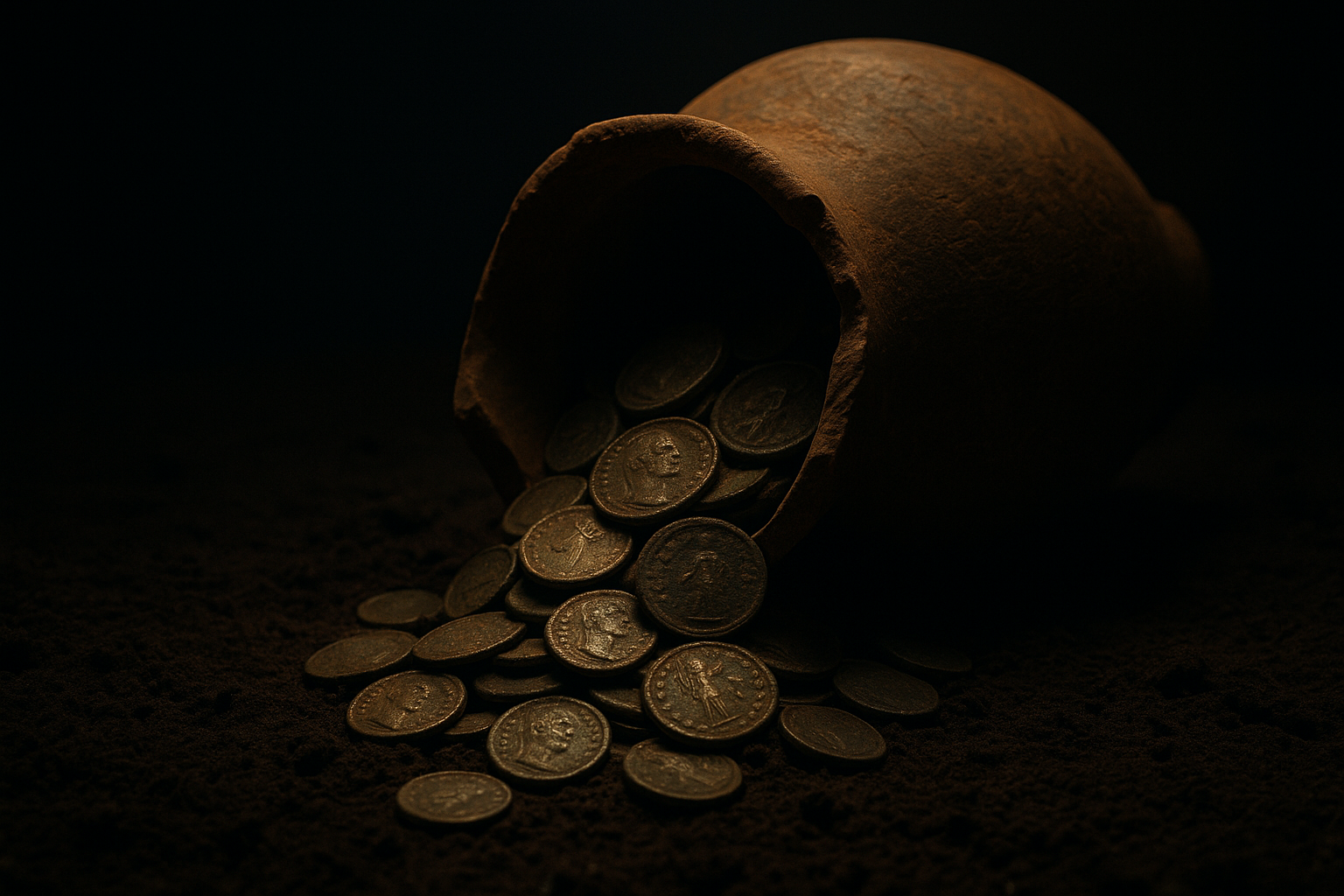
The most important thing a hoard tells us is not only what coins existed, but what people feared. Hoards cluster around uncertain times: political changes, invasions, sudden taxes, local unrest, or the collapse of trust. When trust collapses, money goes underground.
Hoards can also reflect everyday savings. Not every hidden pot belongs to a rich merchant. Some belong to ordinary families who gathered a little at a time. In that sense, a hoard is a portrait of patience: coins saved slowly, hidden carefully, and then abandoned by fate.
Markets, crossroads, and street layers
Markets are designed for loss. Not because people are careless, but because everything is moving at once: hands exchanging goods, crowds pressing forward, voices arguing, animals pulling carts, dust rising.
Coins found in market layers are often worn, handled, and ordinary — and that is their power. They tell us what people actually used. They show the currency of daily life, not the currency of display.
Crossroads matter for the same reason. Where roads meet, stories meet. Inns appear. Vendors gather. Guards collect fees. Messengers stop to rest. And coins, inevitably, slip from pockets and vanish into the dirt between stones.
Over time, streets become layered like a cake. Dirt and debris fill gaps. Repairs add new stone over old. Floods deposit silt. When those layers are uncovered, coins appear like punctuation marks in a long paragraph of human movement.
Temples, shrines, and offerings
Some coins were not lost. They were given. Temples and shrines gathered offerings because offerings are a language — a way to ask for protection, luck, healing, safe travel, forgiveness, or victory.
In many cultures, the coin itself carried meaning beyond its metal. The face of a ruler, a sacred symbol, a mythical creature these images were not decoration. They were messages.
Coins offered at shrines might be placed near statues, dropped into water, tucked into cracks, or left on altars. Over centuries, these places can accumulate layers of small gifts. When discovered, those coins feel different from market finds. They are not merely spent — they are spoken.
Even a single coin found in a ritual context can expand a story: it can indicate pilgrimage routes, regional beliefs, or the spread of an empire’s imagery into spiritual life.
Tombs, caves, and sealed places
Tomb discoveries are often the most emotionally heavy. Coins appear in burials for many reasons: as grave offerings, as symbols, as tokens, as cultural traditions tied to passage and protection.
Caves, too, are natural vaults. People used caves as storage, shelter, hiding places, and ritual spaces. A coin in a cave can be a traveler’s loss, a hidden stash, or a trace of a ceremony.
Sealed places preserve. That is their secret. Once sealed, a space becomes a time capsule. When reopened, it does not simply reveal objects it reveals the way those objects were arranged and understood by the people who placed them there.
Shipwrecks and maritime trade
If the land is where coins live, the sea is where coins become legends. Shipwreck coins are powerful because they are frozen in a moment of sudden disaster. A ship that sank did not “finish the journey.” Everything onboard is a question with no answer.
Coins in shipwreck contexts can reflect trade routes, port connections, and the reality of long-distance movement. A coin minted far away may have traveled farther than any single person aboard imagined.
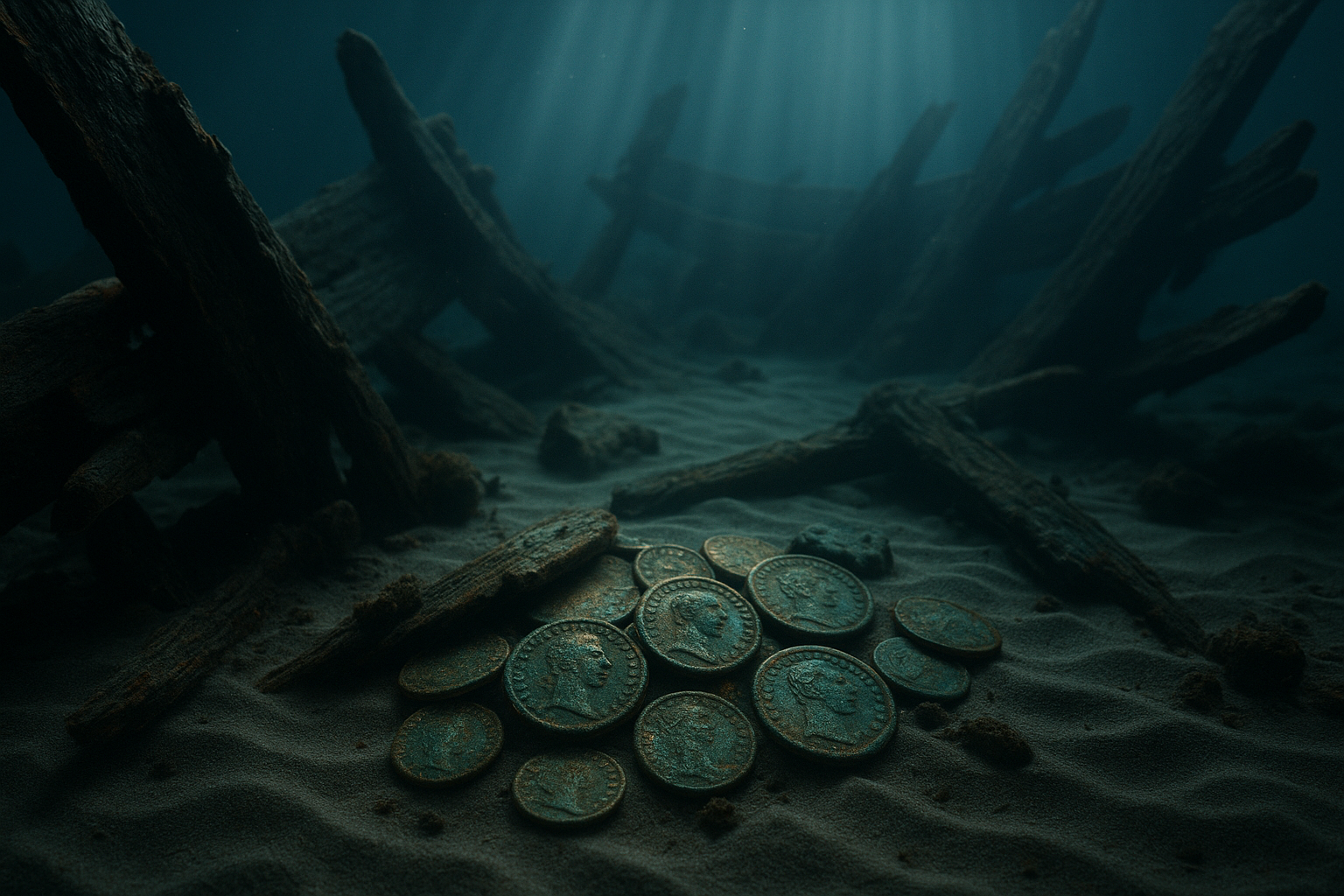
Underwater discoveries also teach patience. The sea does not reveal easily. It covers, protects, erodes, and sometimes returns objects like a slow tide of memory.
One of the most fascinating aspects of shipwreck coin finds is the mix: different regions, different mints, different rulers. That mix is a map. Not the kind drawn on parchment, but the kind written in metal and salt.
Trade routes: the long road of a small coin
Trade routes are the veins of the ancient world. They connected empires, cities, deserts, mountain passes, ports, and border towns. Along those routes, coins moved like tiny passports — stamped proof that something had been exchanged somewhere.
Coins found along trade corridors often appear in clusters near: caravan stops, wells, gates, mountain passes, and fortified points where goods were taxed or inspected.
Imagine a traveler counting coins at dusk beside a fire. The wind rises. A piece slips, disappears into sand. He hears it hit something hard — a stone but darkness wins. The next morning, the caravan moves. The coin remains. Centuries later, it becomes an artifact, and the traveler becomes a ghost in the story.
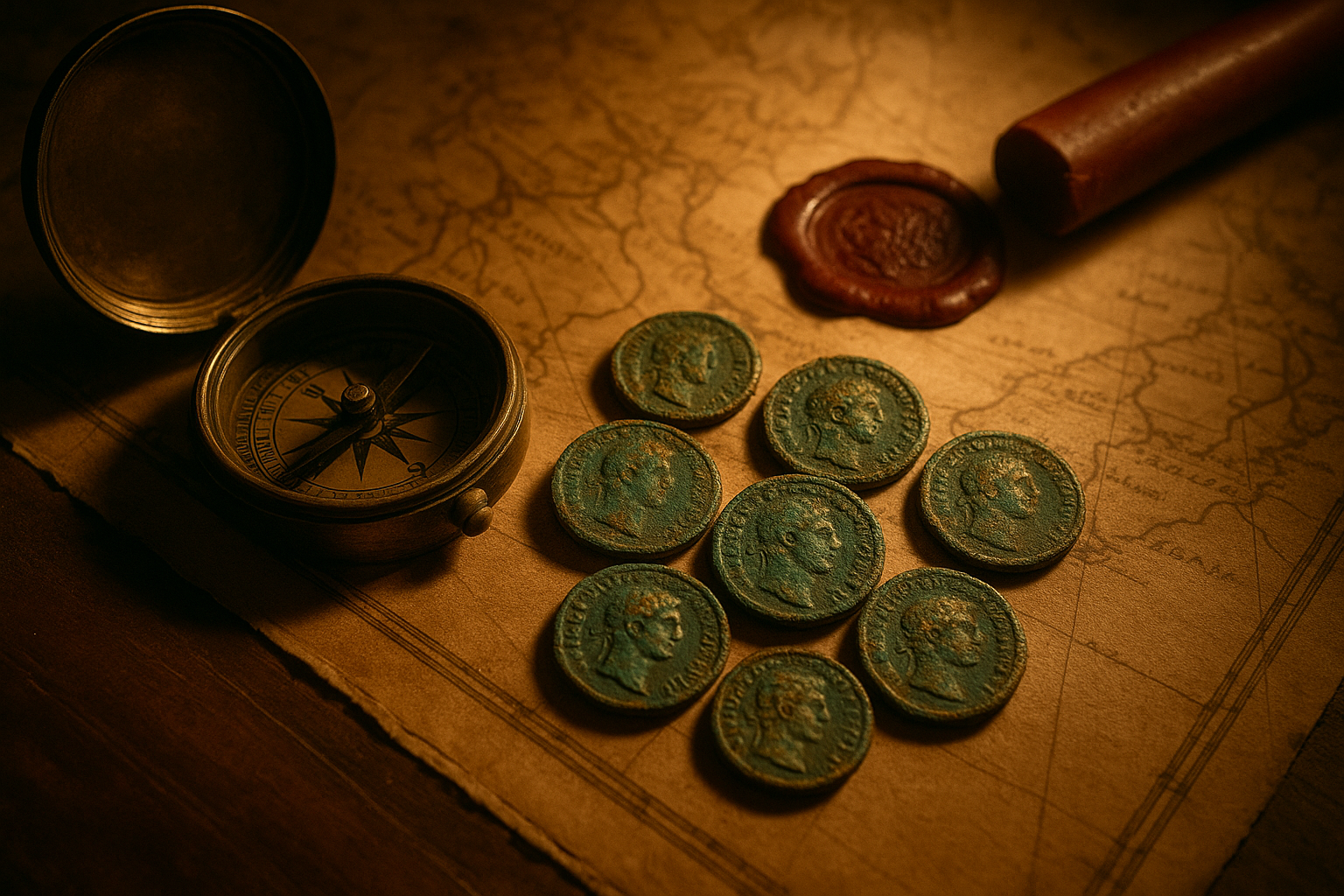
Trade routes also explain why coins appear far outside their “home” regions. A coin does not need an army to travel. It only needs a hand willing to accept it.
That acceptance is not automatic. In some periods, foreign coins were weighed rather than counted. In others, they were accepted at a discount. Sometimes they were melted and reissued. But even when treated as metal rather than money, they still moved — and movement is what creates discovery.
Clues a discovery site can reveal
A coin is a story, but the discovery site is the setting. If you ever read a discovery description, pay attention to these clues:
1) Is it a single coin or a group?
Single coins often point to everyday loss: markets, roads, bridges, homes. Groups suggest intention: savings, emergency hiding, ritual deposits, or stored payments.
2) Is it near a route or a boundary?
Coins near borders can reflect tolls, taxes, soldiers passing through, and trade under pressure. Boundaries also shift over time — meaning a coin can appear “foreign” in a place that once belonged to another power.
3) Is there evidence of water, fire, or collapse?
Environmental events reorder the ground. Floods deposit layers. Fires collapse roofs. Earthquakes bury rooms. Each event creates a “seal” that preserves coins in place.
4) Are the coins heavily worn?
Worn coins suggest long circulation and daily use. Sharper coins can hint at faster loss, storage, or sudden events that ended circulation early.
5) Do the coins mix multiple regions?
Mixed regions often reflect active trade, travel, or military movement. A mixed hoard can be a map of connections, not just a pile of money.
Quick guide: pathways and what they usually mean
| Discovery pathway | What it often suggests | Common “human moment” behind it |
|---|---|---|
| Fields & gardens | Everyday loss, nearby settlement activity | A dropped coin during work or travel |
| Rivers & bridges | Movement, crossings, trade corridors | Coin lost while crossing water or paying a fee |
| Homes & floors | Domestic life, savings, sudden abandonment | Money hidden quickly and never recovered |
| Hoards (pots, caches) | Uncertainty, fear, long-term saving | Emergency hiding with the plan to return |
| Markets & streets | Daily commerce, busy crowd movement | Coin slips from a hand during exchange |
| Temples & shrines | Offerings, ritual behavior, pilgrimage | A coin given as a prayer made visible |
| Tombs & sealed spaces | Burial customs, symbolic use | A coin placed for passage, protection, or tradition |
| Shipwrecks & seabeds | Maritime trade, sudden disaster | A journey interrupted in one irreversible moment |
| Trade routes & passes | Long-distance movement and exchange | Coin lost at a stop, a toll, or a night camp |
Reality Check
Most ancient coins are discovered in ordinary ways — and that is the point. Their power is not in dramatic headlines. It is in the fact that a small object can survive the daily noise of history and still reach us. If you ever hold an ancient coin, try this: forget the “rare” label for a second and imagine the last hand that used it. Somewhere, it paid for bread, passage, a tool, a night’s shelter, or a silent offering. That human moment is the real treasure.
Final Verdict
Ancient coins were found along the same pathways where life happened: roads, rivers, homes, markets, temples, borderlands, and the sea. Every discovery site is a clue about movement and memory. A coin does not just come from the past — it comes from a specific moment in the past. When you learn to read the pathway, you learn to read the people.
Explore more stories
Want more calm, cinematic coin history — without the noise? Explore more stories on HistoraCoin and keep following the trail.
Recommended internal reads
If you enjoyed this “discovery pathways” guide, these two stories pair perfectly with it:
Author Box
HistoraCoin Team
We publish calm, story-first guides about coin history — focused on the human journeys behind metal, not hype. Explore more at HistoraCoin.