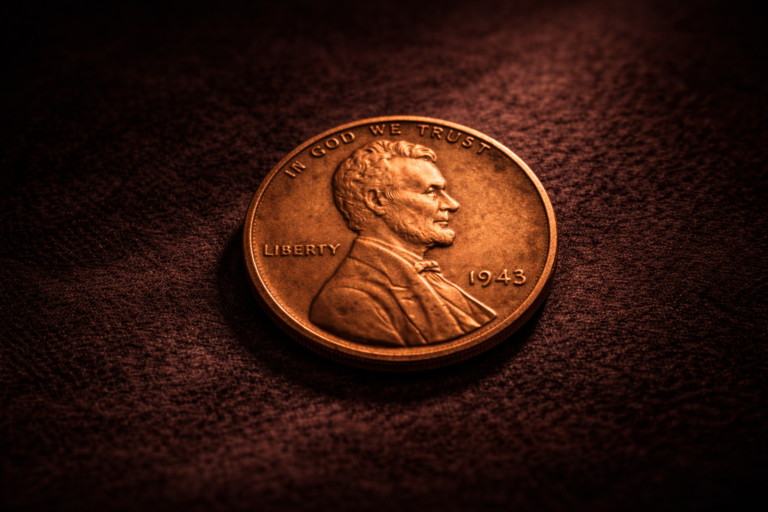
The 1943 Wheat Penny and the Legend It Left Behind

⏳ Estimated reading time: 15 minutes
There are coins that feel like a date stamped in metal. Then there are coins that feel like a moment in human history. The 1943 Wheat Penny belongs to the second kind
In the middle of war, when factories were loud and calendars felt heavy, even a small penny had to change. Not because people asked for something new, but because the world demanded sacrifice in places nobody expected
That is why the 1943 Wheat Penny became a legend. Not because it was meant to be famous, but because it quietly carried a wartime story that still holds attention today
- What was changing in 1943
- Why the Wheat Penny already mattered
- The steel moment and why it happened
- How a different metal changed the feel of money
- How myths grow around ordinary objects
- The legend the 1943 penny left behind
- Where these pennies are usually found
- How to read the story without chasing hype
- Quick guide table
- Reality Check
- Final Verdict
- Explore more stories
- Recommended internal reads
- Author Box
- Share this story
What was changing in 1943
To understand the 1943 Wheat Penny, you do not start with the coin. You start with the year. The world was deep in World War Two. Materials were being redirected. Factories were transformed. Everyday life carried a constant awareness that resources had limits.
When a nation is at war, the obvious sacrifices are visible. People ration food. Fuel becomes precious. Paper is saved. Clothing is repaired instead of replaced. But there are also hidden sacrifices, quiet ones that happen behind the scenes. The metal used for small coins became one of those quiet battlegrounds.
The penny is small. It is easy to treat it as unimportant. But when you make pennies for an entire country, the metal adds up. The question becomes simple and uncomfortable Should a familiar coin stay the same, or should it change to meet a national need
The story of the 1943 Wheat Penny is not only about minting. It is about priorities. It is about how a government protects essential materials. It is also about how quickly a tiny object can become a symbol once its appearance shifts
Why the Wheat Penny already mattered
Before 1943, the Wheat Penny was already part of the American landscape. It lived in pockets, jars, school desks, store counters, and kitchen drawers. People knew its look without thinking. Abraham Lincoln on the front. Two wheat stalks on the back.
That familiarity is what made the 1943 change so memorable. When something is ordinary, you only notice it when it stops being ordinary. The Wheat Penny had a quiet consistency, and consistency is a powerful thing during uncertain times.
The design itself carried meaning. Lincoln suggested unity. The wheat suggested harvest and endurance. It was not a loud design, but it was stable. For many families, it felt like a tiny constant that remained the same even when the world outside did not.
So when the penny changed its material, it felt personal. People did not just see a different coin. They felt the difference in their hands.
The steel moment and why it happened
The 1943 penny is tied to a decision that seems simple at first use a different metal. But simple decisions are rarely simple when they touch daily life.
Copper based materials were important for wartime production and industry. The country needed those materials where they mattered most. A small coin suddenly looked less like a tradition and more like a choice.
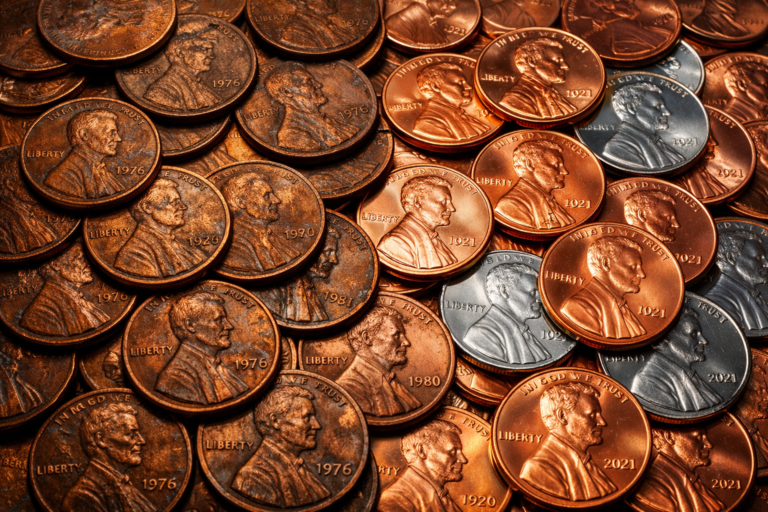
That is where steel enters the story. Steel was available. Steel could be adapted. Steel could be coated to resist quick corrosion. And steel could create pennies without pulling as much copper away from more urgent needs.
The result was a penny that looked different the moment it caught light. It had a bright, silvery tone. It felt unusual next to older bronze pennies. Some people loved it. Some distrusted it. Many remembered it.

That contrast is not only visual. It is emotional. A bronze penny feels warm in the mind because people associate it with earlier years. The steel penny feels colder, sharper, more modern, more urgent. That emotional shift helped fuel the legend.
How a different metal changed the feel of money
Coins are not only images. They are sound and weight. They are the small everyday physics of life. The 1943 penny changed those physics.
When steel pennies met other coins, the sound could feel different. The weight in a handful could feel different. Even the way a coin slid across a counter could feel different.
In normal years, people ignore these sensations. But in wartime, people notice details. Minds become trained to measure small shifts. A different coin becomes another reminder that the world has changed.
That is why some people saved them without planning to. Not out of a commercial mindset, but out of memory. A steel penny felt like a marker. It belonged to a specific era.
How myths grow around ordinary objects
Legends do not always begin with a big event. Sometimes they begin with confusion. A different looking penny triggers questions. People ask why it is different. People tell stories to explain it. Stories travel faster than details.
Add wartime tension, and those stories become sharper. A rumor in a queue. A comment at a diner. A conversation on a porch at night. In that environment, an unusual coin can become the center of a small mythology.
The 1943 Wheat Penny did not need dramatic advertising to become memorable. It only needed to be different in a year when everything else felt different too.
And once people remembered it, the coin gained a second life. Not in circulation, but in storytelling.
The legend the 1943 penny left behind
The legend of the 1943 Wheat Penny is really a legend about change. It represents a moment when necessity reshaped tradition. It reminds people that even the smallest objects are tied to national decisions.
For many, it also became a childhood memory. Someone finds a shiny penny in a jar and feels surprise. Someone hears that it is a wartime penny and feels curiosity. Someone puts it aside and later forgets where it went. These are the quiet ways legends survive.
The story also invites imagination. People picture factories. They picture ration books. They picture trains carrying materials. They picture the feeling of a year that demanded discipline.
In that sense, the coin becomes a doorway. Not to profit, not to speculation, but to context. A small piece of metal that helps the mind step into a different world.
Where these pennies are usually found
Many 1943 pennies survive in ordinary places because they were not exotic objects at the time. They were daily currency. They ended up where daily currency ends up.
In jars and household containers
Families often saved loose change in jars, tins, or drawers. A steel penny could stand out visually, which sometimes led people to set it aside. Even if it was not intentionally saved, it could remain in a jar for decades simply because nobody needed it.
In old collections started by curiosity
Many coin collections begin with one unusual find. A steel penny looks unusual. It becomes the first coin someone keeps. Then a folder appears. Then more coins follow. It is a human pattern.
In mixed lots and forgotten boxes
Over time, objects move between homes. A box in an attic becomes a box in a garage. Then it becomes a box someone opens years later out of pure curiosity. The 1943 penny often appears in these quiet rediscoveries.

How to read the story without chasing hype
The easiest way to misunderstand the 1943 Wheat Penny is to reduce it to a rumor. It is better to treat it as a historical artifact. Ask what it tells you about the year. Ask what it tells you about materials. Ask what it tells you about how quickly daily life can change.
When you hold a steel penny, you are holding a decision. You are holding an era where even copper was not simply copper. It had a strategic meaning.
That is the lasting value of the coin in a cultural sense it turns history into something you can touch.
The legend survives because it is simple a familiar penny changed. People noticed. People remembered.
Quick guide table
| What you notice | What it usually means historically | Why it matters in the story |
|---|---|---|
| Silvery appearance | A different material choice during wartime | Marks the year as a moment of national priority shifts |
| Strong contrast with older pennies | Break in tradition for practical reasons | Creates a memory trigger that keeps the legend alive |
| People often saved one without knowing why | Curiosity and emotional attachment | Explains why so many survived in homes and jars |
| Stories spread quickly about it | Unusual objects attract myths | Shows how history becomes personal through conversation |
If you want the cleanest takeaway, it is this the 1943 Wheat Penny is memorable because it represents a year when necessity reshaped the ordinary. That is the real legend it left behind.

Reality Check
The 1943 Wheat Penny is best understood as history you can hold. Its fame comes from a wartime shift that touched everyday life. The strongest way to appreciate it is to focus on context, not hype. When you follow the context, the coin becomes more than metal. It becomes a small witness to a large moment.
Final Verdict
The 1943 Wheat Penny was not created to be mysterious. It was created because the world demanded changes in the most practical places. Yet that practical decision gave the penny a story that outlived the year itself. A familiar design, a different material, a nation in motion. That combination is why it still feels legendary.
Explore more stories
If you enjoy calm, story-first coin history, explore more articles on HistoraCoin. Which country should we explore next?
Recommended internal reads
Two stories that pair perfectly with this wartime legend
Author Box

HistoraCoin Team
We publish calm, story-first guides about coin history, focused on context and human meaning rather than hype. Explore more at HistoraCoin.