Why Ancient People Trusted Metal More Than Gold
Estimated reading time. About 16 to 18 minutes.
Most people today think of gold as the natural foundation of ancient wealth. It shines, it lasts, and it still symbolizes luxury and power. Yet for most of human history, gold was not the metal people trusted for everyday exchange.
Long before coins and formal currencies existed, communities relied on other metals that were less glamorous but far more practical. These metals shaped early trade, built trust between strangers, and supported economic life in ways gold rarely could.
This article explores why common metal, not gold, became the true backbone of early value systems. It also connects directly to the previous discussion on how people learned to recognize value before money existed, which you can read here: How People Learned Value Before Money Existed.
Gold and the illusion of early wealth.
Gold captures attention. It reflects light, resists corrosion, and carries a visual message of rarity. These qualities explain why later societies associated gold with power and prestige. But those same qualities made gold poorly suited for everyday exchange in early communities.
In the earliest periods of trade, value was not about display. It was about survival, reliability, and usability. A farmer, a hunter, or a craftsperson needed materials that could support daily life. Gold offered beauty, but it offered little practical function in routine tasks.
A metal used in early exchange had to be workable. It needed to be shaped, divided, repaired, and reused. It had to endure handling and transport. It had to appear familiar, not exceptional. Gold was often too soft, too rare, and too symbolically loaded to serve these needs.
For this reason, gold in many early societies remained closer to ornament than to instrument. It decorated. It signaled status. It honored ritual. But it did not easily move through ordinary trade.
Trust in trade grows from repetition. Objects that appear often become dependable. Objects that appear rarely become special. Gold belonged to the second category long before it belonged to the first.
The quiet power of common metal.
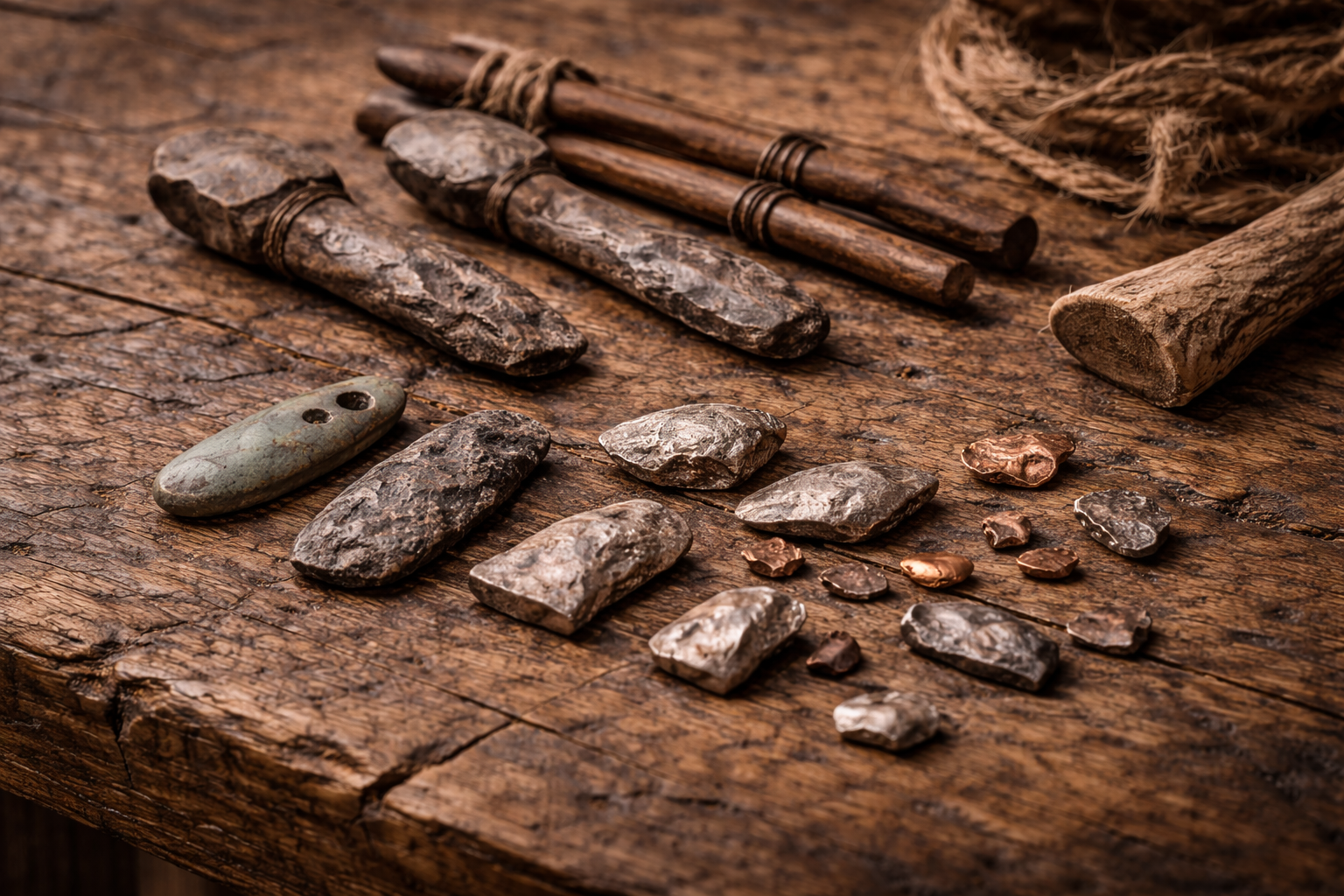
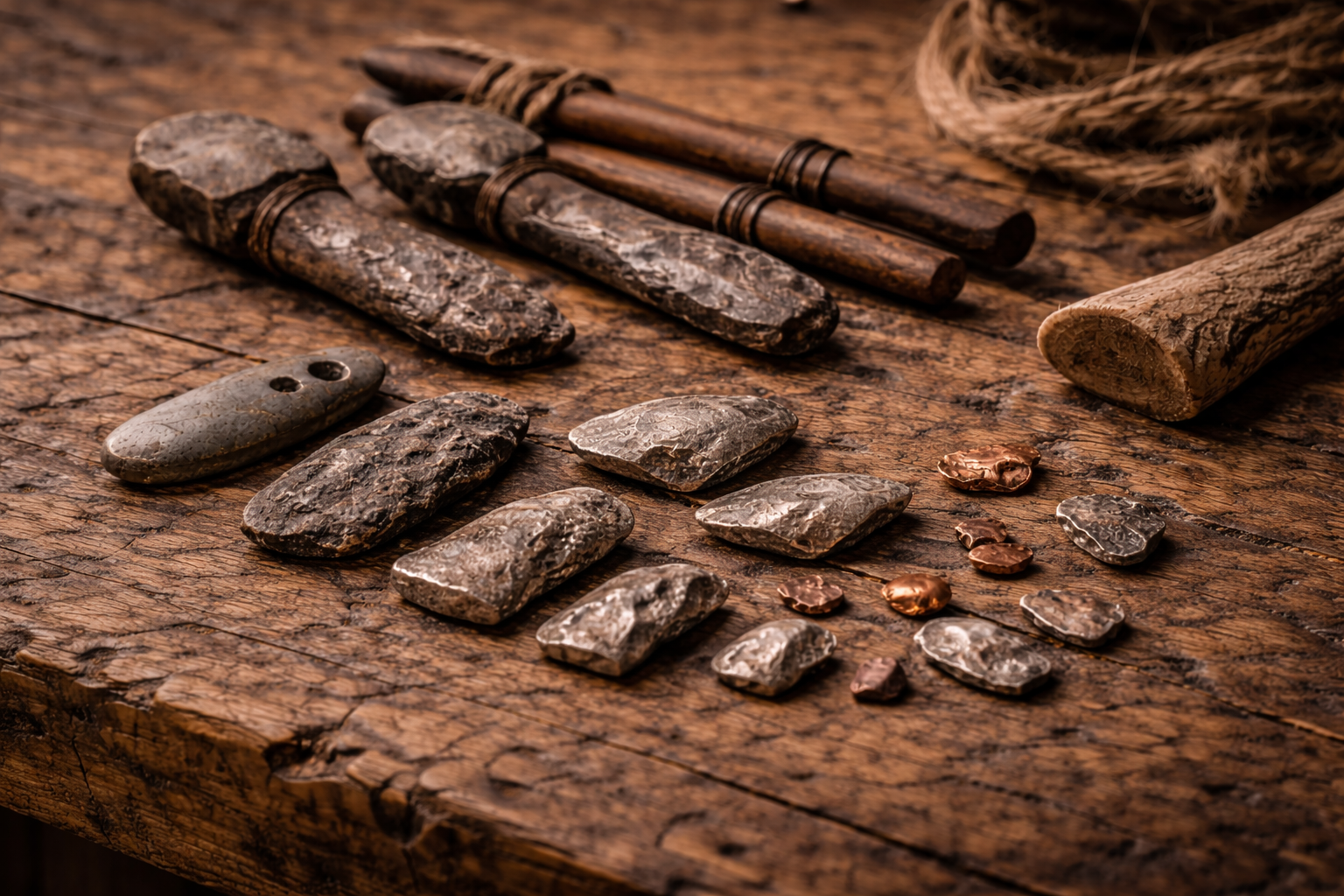
Copper, bronze, iron, and other widely available metals shaped the real economy of early societies. These metals did not shine like gold, but they served essential roles. They became tools, weapons, vessels, and construction materials. Their usefulness was visible and constant.
Because these metals were part of daily life, they also became part of daily exchange. People understood their weight, their durability, and their limits. They knew how long a copper tool might last. They knew how easily a bronze blade could be repaired. They learned what these materials could reliably do.
This familiarity created trust. A metal that can be used to cut, shape, or protect has value even when it is not traded. That inherent usefulness makes it a stable reference in exchange.
When communities needed a medium to bridge different goods, common metal offered a practical solution. It could be divided. It could be stored. It could be carried. It could be recognized. Most importantly, it did not depend on rarity alone to justify its worth.
In many regions, metal fragments, ingots, or unfinished pieces circulated alongside other goods long before formal coinage appeared. They were not money, but they behaved like early carriers of value.
Usefulness before beauty.
Early trade was shaped by necessity, not luxury. A metal that could become a tool was more valuable to a community than a metal that could only become decoration.
A plow blade, a knife, or a simple fastener changed daily productivity. These changes reduced labor, increased output, and improved safety. The value of the metal behind these tools was therefore reinforced every time the tool was used.
Gold did not offer this reinforcement. Its beauty did not feed a family or build a shelter. Its rarity made it impressive, but not essential. In environments where survival depended on efficiency, essential materials earned trust faster than impressive ones.
This is one of the central reasons ancient people trusted common metal more than gold. Trust follows function. Function follows need.
Over time, the repeated usefulness of common metal trained communities to treat it as a reliable store of effort. A piece of metal represented not only material, but the work that could be done with it.
That representation is important. It turns an object into a bridge between labor and exchange. When metal stands for labor, it becomes a natural medium of value.
Durability and the memory of value.
Durability matters in trade. A fragile object loses trust quickly. A durable object preserves the memory of its usefulness.
Common metals resist decay better than organic materials. They do not rot like wood. They do not spoil like food. They can survive long storage and repeated handling.
This durability makes metal suitable for delayed exchange. A farmer can accept metal today and use or trade it later. A craftsperson can store metal until it is needed. A traveler can carry metal across distance without fear of rapid loss.
Gold is durable as well, but its scarcity limits its circulation. A metal that rarely changes hands does not easily become a standard. A metal that moves frequently becomes familiar. Familiarity builds confidence. Confidence builds trust.
The memory of value is reinforced each time an object successfully serves its purpose. Common metal passed this test repeatedly in daily life.
Weight, division, and early equivalence.
Another advantage of common metal lies in its physical behavior. It can be divided into pieces. It can be melted and reshaped. It can be weighed.
These properties support comparison. Two different goods can be related through a measured quantity of metal. This does not require formal currency. It requires only a shared understanding of weight and material.
When communities began to weigh metal, they introduced a powerful idea. Equivalence. Different things can be treated as equal if they match a standard quantity.
This idea is central to economic thinking. It allows trade to move beyond direct barter. It allows value to be portioned. It allows exchange to scale.
Gold, while also divisible, was often too valuable in small quantities and too rare in larger ones. Common metal provided a more flexible range for everyday needs.
In this way, common metal prepared the conceptual ground for later coinage long before coins existed.
Metal as stored effort.
One of the deepest reasons ancient people trusted common metal is that it quietly represented effort. A piece of metal was never just material. It was the result of extraction, transport, heating, shaping, and skill. Even when people did not describe these steps, they recognized them.
When a farmer accepted metal, the farmer was not only accepting substance. The farmer was accepting the promise of work that could be done later. The metal could become a tool. It could repair an object. It could be reshaped. It could be exchanged again.
This is why metal functioned as a store of effort rather than a store of luxury. Gold, in many early contexts, stored status. Common metal stored capability.
Capability has a different kind of value. It is practical. It is flexible. It adapts to need. It survives change.
Societies that depended on agriculture, construction, and craft naturally favored materials that supported those activities. Their trust was not abstract. It was built on visible results.
Stability across time and place.
Trade expands when value travels well. Common metal traveled better than gold for most people.
It could move through different social layers. It could circulate among farmers, artisans, builders, and traders. It was not restricted to elites. It belonged to the working structure of the community.
Because it circulated widely, its meaning became stable. People knew what it could do. They knew how to handle it. They knew how to assess its quality.
Gold, by contrast, often remained confined to ritual, decoration, or high status exchange. Its meaning was powerful, but narrow. Its circulation was limited. Its role in daily life was small.
A value medium that serves only a few cannot organize the economy of many. Common metal could.
Trust grows from frequency, not brilliance.
Trust is not created by beauty. It is created by repetition.
An object that appears in many exchanges becomes predictable. Predictability reduces risk. Reduced risk invites more exchange.
Common metal appeared constantly. In tools. In repairs. In construction. In trade. Its presence became normal.
Gold appeared rarely. When it appeared, it attracted attention. But attention is not the same as reliability.
This difference shaped behavior. People were willing to accept common metal without long negotiation. They hesitated more when gold was involved. They treated it as special, not as routine.
Routine is the foundation of economic life. What is routine becomes trusted. What is trusted becomes standard.
Measurement and shared understanding.
As weighing practices spread, common metal gained another advantage. It could be measured easily in meaningful ranges.
A small weight could serve a small trade. A larger weight could serve a larger one. This flexibility allowed exchange to adapt to different scales of need.
Measurement created shared language. It reduced argument. It shortened negotiation. It made equivalence visible.
Gold, being rare and valuable in small amounts, often resisted this practical scaling. It was either too valuable or too limited for routine measurement in many contexts.
Common metal fit the rhythm of daily life better.

Why gold became powerful later.
None of this means gold lacked importance. Gold became powerful when political authority, long distance trade, and symbolic wealth expanded.
Rulers used gold to represent control. States used gold to represent stability. Large networks used gold to represent concentrated value.
But these are later developments. They depend on institutions that did not exist in the earliest phases of exchange.
Before those institutions, societies needed materials that worked, not materials that impressed.
Common metal met that need.
Connection to the earlier story of value.
The preference for common metal is not separate from the way people learned value itself.
If you have not yet read the earlier article on how communities learned to judge worth before money, it connects directly to this discussion and can be found here: How People Learned Value Before Money Existed.
Both stories describe the same principle. Value grows from shared experience, not from shine.
Final reflection.
Ancient people trusted metal more than gold because metal worked.
It built tools. It repaired objects. It carried effort. It traveled through communities. It adapted to need.
Gold carried beauty and power, but common metal carried life.
Long before coins, long before states, and long before formal currency, this quiet trust shaped the first stable economies.
Understanding this helps us see money not as a sudden invention, but as the formal expression of habits learned through material, labor, and exchange.
FAQ.
Why did ancient societies rely on common metals instead of gold.
Because common metals were useful, durable, widely available, and easy to shape, store, and exchange in daily life, while gold was rare and mostly symbolic.
Was gold completely absent from early trade.
No. Gold existed mainly as ornament, ritual material, and a symbol of status rather than a practical medium for everyday exchange.
How did weighing metal help early economies.
Weighing allowed people to compare value more clearly, reduce disputes, and create shared standards before formal money existed.
Did common metal function as money.
Not exactly. It functioned as a reliable carrier of value and effort, helping trade operate more smoothly before official coinage.
What is the main lesson from this history.
Value grows from usefulness and trust, not from appearance or rarity alone.