2026 Dime Errors: What Collectors Should Look For
A strange mark on a 2026 dime might catch your attention. But before calling it a rare mint error, there is one important question: did it happen at the Mint, or after the coin entered circulation?
The new Emerging Liberty design makes that question especially important. With Roosevelt gone, a dual anniversary date, and an unfamiliar eagle reverse, even perfectly normal details can look unusual.
Some collectors are already examining 2026 dimes for doubled lettering, missing design elements, unusual edges, and striking irregularities. But identifying a genuine mint error requires more than finding something that looks different.
This guide explains which manufacturing errors are possible, how to distinguish them from ordinary damage, and what collectors should check before assigning a value to a 2026 Emerging Liberty Dime.
Quick Answer: What Should You Look For?
When examining a 2026 dime, potential minting anomalies worth investigating include:
- Off-center strikes: Part of the design is displaced, leaving an unstruck area.
- Clipped planchets: A portion of the original metal blank is missing.
- Die cracks and cuds: Raised metal caused by damaged striking dies.
- Struck-through errors: Foreign material interferes with the strike.
- Broadstrikes: The coin is struck without proper collar containment.
- Doubled dies: Genuine duplication incorporated into a working die.
Important: These are established categories of coin manufacturing errors. Their inclusion does not mean that a particular 2026 Emerging Liberty Dime variety has been independently confirmed.
In This Article
- What Counts as a Genuine Mint Error?
- Know the Normal 2026 Dime First
- Off-Center Strikes
- Clipped Planchets
- Die Cracks, Chips, and Cuds
- Struck-Through Errors
- Doubled Die vs. Machine Doubling
- Other Possible Minting Errors
- Common Damage Mistaken for Errors
- 2026-P vs. 2026-D Dimes
- Five-Step Verification Checklist
- Are 2026 Dime Errors Valuable?
- Final Verdict
- Frequently Asked Questions
What Counts as a Genuine 2026 Dime Error?
A genuine mint error originates during the manufacturing process, before the coin leaves the Mint.
Errors can occur when a planchet is improperly prepared, when the striking equipment malfunctions, or when something interferes with the normal movement of metal during striking.
However, collectors should distinguish three different categories.
| Category | What It Means | Example |
|---|---|---|
| Mint Error | An abnormal event during manufacturing | Off-center strike or clipped planchet |
| Die Variety | A distinctive characteristic built into a particular die | Attributed doubled die |
| Post-Mint Damage | Damage occurring after production | Scratches, cuts, bending, or chemical corrosion |
This distinction matters because all three can produce unusual-looking coins, but only the first two are associated with genuine mint-origin characteristics.
Even then, not every manufacturing anomaly commands a significant premium.
A tiny die chip may be common and inexpensive, while a dramatic off-center strike with a complete date may attract much greater collector interest.
Know the Normal 2026 Emerging Liberty Dime First
Before searching for errors, collectors should become familiar with the official 2026 design.
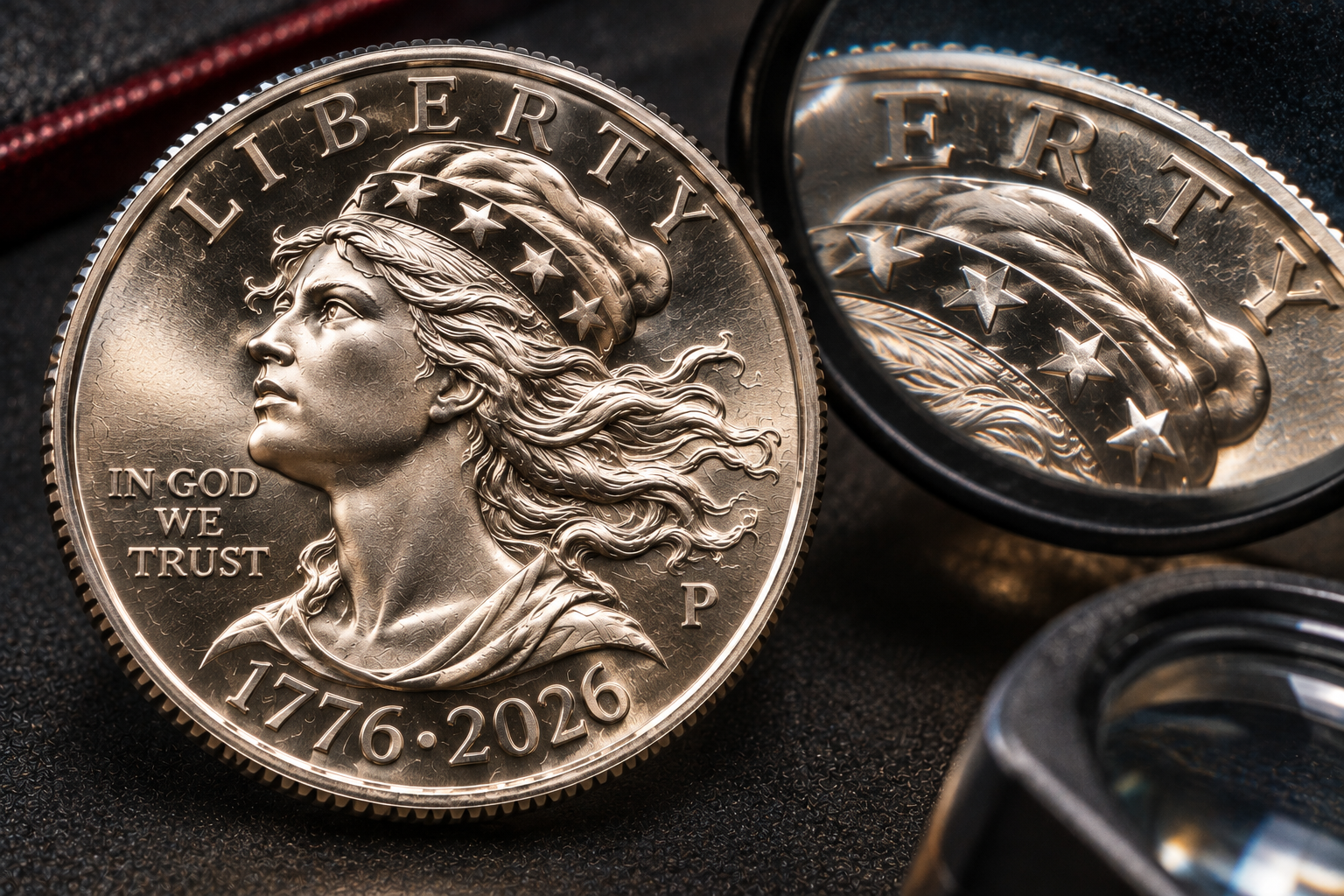
The Emerging Liberty Dime temporarily replaces the Roosevelt dime for America’s 250th anniversary.
Its obverse features Liberty with windswept hair and a cap decorated with stars and stripes. The reverse depicts an eagle in flight carrying arrows.
The coin also features several unusual inscriptions that are completely intentional.
These Details Are Not Errors
- 1776 ~ 2026: The official anniversary date.
- LIBERTY OVER TYRANNY: The official reverse inscription.
- Missing Roosevelt portrait: A planned one-year redesign.
- Flying eagle with arrows: The official reverse artwork.
- P or D mint mark: Normal identification of Philadelphia or Denver production.
- No privy mark: The regular circulation design does not include one.
For a detailed examination of the artwork and its historical meaning, see our guide to the 2026 Emerging Liberty Dime and what makes its design different.
Understanding the normal design prevents collectors from mistaking intentional features for manufacturing defects.
Official Physical Specifications
| Feature | Standard Circulating Dime |
|---|---|
| Denomination | 10 cents |
| Composition | 91.67% copper, 8.33% nickel |
| Weight | 2.268 grams |
| Diameter | 17.91 mm |
| Thickness | 1.35 mm |
| Edge | Reeded, 118 reeds |
| Circulation mint marks | P and D |
| Privy mark | None |
These measurements provide a useful baseline when investigating possible planchet errors.
However, a small difference in weight or diameter does not automatically establish an error. Measurement accuracy, wear, and ordinary manufacturing tolerances must also be considered.
The official specifications are available from the United States Mint.
1. Off-Center Strikes
An off-center strike occurs when the planchet is not correctly positioned between the striking dies.
Instead of receiving the design in the intended location, the coin is struck with part of the design displaced toward one side.
A genuine off-center strike may show a visible unstruck area where the dies never contacted the metal.
What to Look For
- A portion of the design missing because it falls beyond the struck area.
- An unstruck crescent or other blank area of the planchet.
- A displaced design that remains consistent with a single striking event.
- Metal flow and edge characteristics consistent with the error.
Collectors should distinguish an off-center strike from a slightly misaligned die.
In a misaligned-die strike, one side may appear off-center while the opposite side remains normally centered.
A genuine off-center strike generally involves displacement of the planchet relative to both dies.
Severity matters. A small displacement may attract limited interest, while a dramatic example retaining a readable date can be more desirable.
However, a visibly unusual strike should still be authenticated before being marketed as a valuable 2026 error.
2. Clipped Planchet Errors
A clipped planchet originates before the coin is struck.
During blanking, circular coin blanks are punched from strips of metal. If a punch overlaps an area where metal has already been removed, the resulting blank may have a missing section.
Curved clips are among the most recognizable examples, but straight and irregular clips can also occur.
How to Distinguish a Clip From Damage
A genuine clip often displays manufacturing characteristics that differ from a coin cut or broken after production.
Collectors may examine the edge, the shape of the missing area, and the behavior of the rim near the clip.
Some genuine clipped coins show a feature commonly called the Blakesley effect, where the rim opposite the clip is weaker because of changes during the upsetting process.
However, that effect is not present or obvious on every genuine clip.
A coin with a section removed by cutting tools may have sharp, disturbed metal or obvious signs of post-mint alteration.
The missing section alone is not sufficient proof.
3. Die Cracks, Die Chips, and Cuds
Coin dies experience enormous mechanical stress during production.
Over time, cracks or small breaks can develop in the hardened steel.
When metal flows into those damaged areas during striking, the resulting coin may show raised features that were not part of the original design.
Die Cracks
A die crack generally appears as a raised, irregular line on the coin.
That is an important diagnostic clue: because the crack is recessed in the die, it produces a raised feature on the struck coin.
A scratch made after minting usually cuts into the surface instead.
Under magnification, the difference between raised and incuse features can help identify the likely cause.
Die Chips
A die chip is a small piece of missing die material.
It may produce a raised lump or blob on the coin, sometimes near letters or other design elements.
Small die chips are not necessarily rare, and their presence does not guarantee a premium.
Die Cuds
A cud is a more substantial die break involving the rim or edge of the die.
On the coin, it can appear as a raised, unstruck-looking mass connected to the rim, often obscuring part of the intended design.
Collectors should avoid calling every raised mark a cud. A small isolated lump in the field is not the same thing as a major rim-connected die break.
4. Struck-Through Errors and Missing Details
A struck-through error occurs when foreign material becomes trapped between a die and a planchet during striking.
The material prevents the die from transferring its design normally to the affected area.
Depending on the material involved, the result may include a shallow depression, missing lettering, or an unusual surface impression.
Grease and other soft material can sometimes cause weak or missing details.
However, not every weak letter indicates a struck-through error.
Die wear, inadequate striking pressure, and circulation damage can also affect design clarity.
For a 2026 Emerging Liberty Dime, collectors should compare suspicious lettering with normal examples of the same mint mark.
Repeated weakness in the same location across multiple coins may suggest a die-related issue rather than a one-time struck-through event.
5. Doubled Die vs. Machine Doubling
Few potential coin varieties generate as much excitement as doubled lettering.
But not every doubled-looking feature is a doubled die.
A genuine doubled die originates during the preparation of the working die, when design elements become duplicated in the die itself.
Coins struck from that die can repeat the same distinctive doubling.
Machine doubling, sometimes called strike doubling, occurs during the striking process when relative movement between the die and coin affects the design.
It often produces flat, shelf-like secondary impressions.
What Collectors Should Compare
- Shape: Genuine hub doubling may preserve rounded design contours, while mechanical doubling often appears flat or shelf-like.
- Location: Determine whether the suspected doubling occurs in a consistent diagnostic area.
- Repetition: A recognized die variety should show repeatable characteristics on coins struck from the same die.
- Attribution: Compare the coin with reliable variety references before assigning a designation.
These distinctions can be difficult to establish from a single photograph.
Collectors should not assume that a 2026-P or 2026-D dime has a valuable doubled die merely because the lettering looks thick or slightly displaced.
As of this article’s preparation, no specific 2026 Emerging Liberty Dime doubled die is being presented here as an independently verified, widely attributed variety.
6. Other Possible Minting Errors
Several additional error categories are worth understanding, even though they should not be treated as confirmed discoveries for the 2026 dime.
Broadstrikes
A broadstrike can occur when a coin is struck without the collar properly containing the planchet.
The metal spreads outward, potentially creating a coin with an unusually large diameter and an abnormal edge.
Because the dime normally has a reeded edge, unusual edge characteristics may deserve attention.
However, a flattened or widened coin can also result from deliberate damage.
Wrong-Planchet Strikes
A wrong-planchet error occurs when a planchet intended for a different denomination or product is struck by the wrong dies.
Such errors require careful examination of weight, diameter, composition, and striking characteristics.
A dime that weighs slightly less than expected is not automatically a wrong-planchet strike.
Accurate measurements and professional authentication are especially important for this category.
Multiple Strikes
A multiple-strike error can occur when a coin remains in or returns to the striking chamber and receives an additional strike.
The resulting design may show overlapping impressions or significant displacement.
Collectors must distinguish these genuine errors from coins that have been intentionally struck, pressed, or altered after leaving the Mint.
7. Common Damage Mistaken for 2026 Dime Errors
Many unusual coins are damaged rather than incorrectly manufactured.
Because dimes circulate through vending machines, coin counters, pockets, and other mechanical environments, they can develop a wide variety of surface changes.
| Unusual Feature | Possible Explanation | What to Check |
|---|---|---|
| Deep scratches | Post-mint contact with a hard object | Incuse cuts and displaced surface metal |
| Flattened lettering | Wear, impact, or mechanical doubling | Shape and direction of the affected details |
| Missing edge reeds | Wear, grinding, or possible striking anomaly | Edge texture, diameter, and metal flow |
| Unusual discoloration | Environmental or chemical exposure | Surface corrosion and evidence of treatment |
| Bent or distorted shape | Mechanical damage | Impact marks and distortion of the design |
| Apparent missing letters | Wear, weak strike, or struck-through material | Whether the surface is smooth, damaged, or abnormally struck |
One of the most useful habits in error identification is to examine the surrounding metal.
Damage often leaves evidence of force, including scratches, displaced metal, or deformation that affects more than the suspicious feature.
Genuine mint errors usually have characteristics consistent with a particular stage of manufacturing.
That relationship between the feature and the production process is often more informative than the feature’s appearance alone.
2026-P vs. 2026-D Dime Errors: Is One Mint More Important?
Regular circulating 2026 Emerging Liberty Dimes were produced at Philadelphia and Denver.
Philadelphia coins carry the P mint mark, while Denver coins carry D.
Neither letter indicates an error.
Collectors should also avoid assuming that one facility necessarily produced more valuable errors than the other.
The rarity of a particular error depends on the number of affected coins, the severity of the manufacturing anomaly, and how many examples survive.
A dramatic error from either facility could be collectible.
Conversely, an ordinary 2026-P or 2026-D dime with no unusual manufacturing characteristics remains a regular circulating coin.
The correct approach is to identify the coin first, diagnose the anomaly second, and evaluate its rarity only after the evidence supports a genuine mint-origin feature.
Five Steps to Verify a Possible 2026 Dime Error
Before submitting a coin for authentication or offering it for sale, follow a consistent examination process.
- Identify the coin correctly. Confirm the Emerging Liberty portrait, the 1776 ~ 2026 date, the eagle reverse, and the mint mark.
- Compare it with a normal example. Use official Mint photographs and, if possible, another undamaged coin of the same issue.
- Inspect both sides and the edge. Look for raised versus incuse features, abnormal metal flow, incomplete strikes, or signs of mechanical damage.
- Measure carefully. A suitable precision scale and calipers can help identify substantial deviations from standard specifications. Minor differences alone are not proof of an error.
- Seek reliable attribution. For a convincing anomaly, consult established error references or a qualified professional authentication service.
Use a clean, stable examination surface and handle the coin by its edge.
Do not polish, chemically treat, or scrape the suspicious area in an attempt to make the feature clearer.
Cleaning can permanently damage original surfaces and complicate later authentication.
Are 2026 Dime Errors Valuable?
A genuine mint error may be worth more than face value, but the amount depends on the individual coin.
Collectors generally consider several factors:
- The type of error.
- How dramatic and visually recognizable the error is.
- Whether the date and mint mark remain identifiable.
- The coin’s overall condition.
- The number of comparable examples known.
- Actual collector demand and documented sales.
A minor die crack may have little market significance, while a major off-center strike or an unusual authenticated planchet error could attract stronger interest.
However, no universal price can be assigned to every coin in an error category.
Online listings are especially problematic because asking prices are not the same as completed sales.
A seller can advertise an ordinary dime for hundreds or thousands of dollars without establishing that anyone has paid that amount.
For reliable valuation, look for authenticated examples with comparable errors and documented transactions.
When Is Professional Grading Worth Considering?
Professional grading and error authentication can be useful when a coin has a convincing manufacturing anomaly and enough potential market value to justify the expense.
Services such as PCGS and NGC can evaluate eligible coins, but submission fees, attribution charges, shipping, and insurance may exceed the value of a minor error.
For that reason, preliminary research is important.
Do not submit a coin solely because its design looks unfamiliar or because a social media post claims that all 2026 dimes are rare.
Collector Reality Check
- The new Liberty portrait is normal. Roosevelt was intentionally replaced for 2026.
- The dual date is not an error. The 1776 ~ 2026 inscription commemorates the nation’s 250th anniversary.
- LIBERTY OVER TYRANNY is official. It is not a misspelling or accidental inscription.
- P and D are ordinary mint marks. They do not establish rarity.
- Not every raised line is valuable. Minor die cracks and chips can have limited collector demand.
- Not every doubled-looking letter is a doubled die. Mechanical doubling and damage can create similar appearances.
- Unusual color does not prove a mint error. Environmental damage is common.
- Authentication matters. A suspected error should be evaluated through manufacturing evidence, not speculation.
Why the New Design Makes Error Identification More Difficult
The 2026 Emerging Liberty Dime is unusual because collectors are examining a completely different design on a familiar denomination.
For decades, the Roosevelt dime provided a consistent reference. Collectors knew where to expect the portrait, inscriptions, torch, and branches.
With Emerging Liberty, those visual expectations no longer apply.
The new portrait contains flowing hair, a decorated cap, and an unfamiliar arrangement of lettering.
The reverse introduces a flying eagle and a prominent inscription that has never appeared on the traditional Roosevelt dime.
These changes can make normal sculptural details look suspicious to someone unfamiliar with the official artwork.
That is why studying the design is the first step in identifying genuine errors.
Collectors who understand what the Mint intended to produce are better equipped to recognize what might have gone wrong during production.
The goal is not to find an error on every coin. It is to recognize the small number of coins that genuinely deserve closer examination.
Final Verdict
The 2026 Emerging Liberty Dime gives collectors a fresh opportunity to study modern coin production, but identifying a genuine mint error requires patience and evidence.
Off-center strikes, clipped planchets, die breaks, struck-through material, and other manufacturing anomalies are legitimate categories worth understanding.
That does not mean every unusual-looking 2026 dime belongs to one of those categories.
The anniversary date, Liberty portrait, flying eagle, and LIBERTY OVER TYRANNY inscription are all intentional features.
Before assigning a value to a suspicious coin, compare it with official examples, examine its surfaces and edge, and determine whether the feature is consistent with the minting process.
The most valuable skill in error collecting is not spotting something strange. It is understanding why that feature exists.
Frequently Asked Questions
What are the most common possible 2026 dime errors?
Potential manufacturing anomalies include off-center strikes, clipped planchets, struck-through material, die cracks, and certain die varieties. These are general categories, not a confirmed list of errors discovered on 2026 dimes.
How can I tell if my 2026 dime has a real mint error?
Compare the coin with a normal example, inspect both sides and the edge, measure its weight and diameter, and determine whether the unusual feature could have resulted from circulation damage. Professional authentication may be necessary.
Are there confirmed valuable 2026 dime errors?
Specific claims require reliable attribution and documented sales. An unusual feature should not be considered a valuable error simply because it appears on a 2026 coin.
Is the 1776 ~ 2026 date an error?
No. The dual date is an official feature of the Emerging Liberty Dime commemorating America’s 250th anniversary.
Does the 2026 Emerging Liberty Dime have a doubled die?
A specific doubled die variety must be supported by diagnostic evidence and reliable attribution. Thick lettering, mechanical doubling, or surface damage alone does not establish a genuine doubled die.
What does an off-center 2026 dime look like?
A genuine off-center strike would show the design displaced from its intended position, typically leaving an unstruck portion of the planchet. The exact appearance depends on the degree of displacement.
Are 2026-P dime errors worth money?
An authenticated mint error may carry a premium depending on its type, severity, condition, and demand. The P mint mark by itself does not make the coin valuable.
Are 2026-D dime errors rare?
The D mint mark identifies Denver production. It does not establish rarity. Any suspected manufacturing error must be examined and evaluated individually.
Can a damaged dime look like a mint error?
Yes. Scratches, dents, flattened lettering, chemical discoloration, and edge damage can resemble manufacturing anomalies. Examining the surrounding metal helps distinguish damage from genuine errors.
Should I get my 2026 dime professionally graded?
Professional authentication may be worthwhile for a convincing and potentially valuable error. First compare the likely market value with grading, attribution, shipping, and insurance costs.