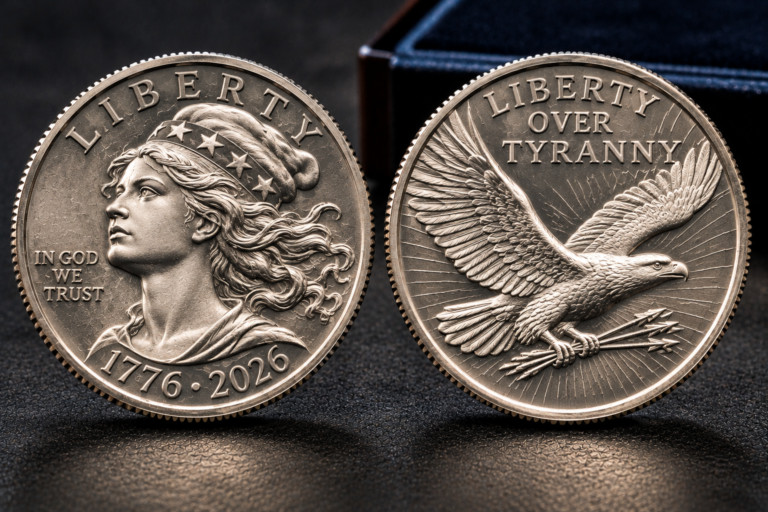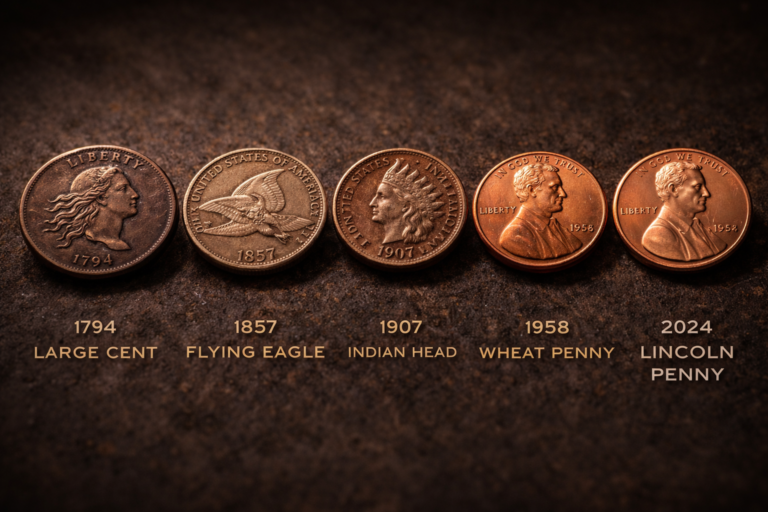
2026 Quarter Designs: All 5 Coins Explained
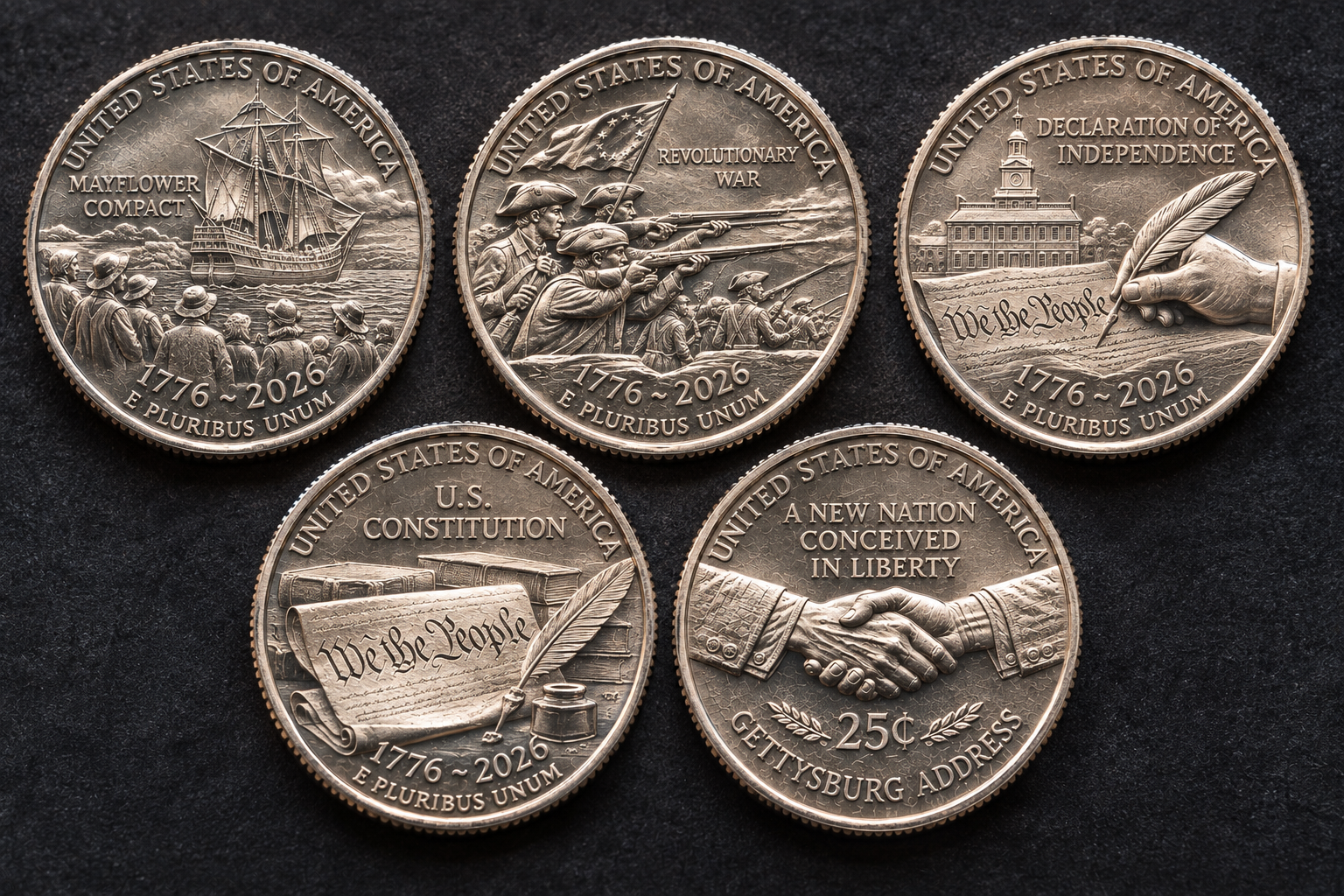
Five quarters. Five different stories. And for the first time in generations, George Washington is no longer the only face of America’s circulating quarter.
The 2026 quarter designs take collectors through more than two centuries of American history, beginning with the Mayflower Compact of 1620 and ending with Abraham Lincoln’s Gettysburg Address in 1863.
What makes this series particularly interesting is that the United States Mint changed both sides of the coins. Rather than keeping a single presidential portrait and rotating the reverse artwork, each quarter presents its own historical identity.
Whether you are building a complete anniversary collection or simply examining unfamiliar coins discovered in pocket change, this guide explains how to identify all five designs, understand their symbolism, and recognize the differences between ordinary circulation issues and special collector editions.
Quick Answer: What Are the Five 2026 Quarter Designs?
The United States Mint issued five circulating quarter designs for America’s 250th anniversary:
- Mayflower Compact: Early colonial self-government.
- Revolutionary War: The struggle for independence.
- Declaration of Independence: The founding of the United States.
- U.S. Constitution: The establishment of constitutional government.
- Gettysburg Address: National unity and the continuing promise of liberty.
All five standard circulation designs carry the anniversary date 1776 ~ 2026 and retain their legal tender face value of 25 cents.
In This Article
- Why U.S. Quarters Changed in 2026
- All Five 2026 Quarter Designs at a Glance
- 1. Mayflower Compact Quarter
- 2. Revolutionary War Quarter
- 3. Declaration of Independence Quarter
- 4. U.S. Constitution Quarter
- 5. Gettysburg Address Quarter
- Why Some Quarters Do Not Show Washington
- 2026 Quarter Release Dates
- Mint Marks and Coin Specifications
- Circulating, Proof, and Silver Quarters
- The Special July 4 Privy Mark Quarter
- 1976 vs. 2026 Anniversary Quarters
- Identifying Possible Mint Errors
- Are 2026 Quarters Rare or Valuable?
- How to Collect All Five Designs
- Final Verdict
- Frequently Asked Questions
Why U.S. Quarters Changed in 2026
The year 2026 marks the Semiquincentennial, the 250th anniversary of the Declaration of Independence.
Under the Circulating Collectible Coin Redesign Act of 2020, the United States Mint received authority to introduce special circulating designs commemorating this anniversary.
The quarter became one of the most ambitious parts of the program. Instead of focusing exclusively on the events of 1776, the five designs explore a broader historical narrative.
They begin with an early agreement about colonial government, move through the Revolution and the founding documents of the United States, and conclude with a moment when the survival of the Union was at stake.
The resulting collection tells a continuing story rather than commemorating a single historical event.
All Five 2026 Quarter Designs at a Glance
| Quarter Design | Historical Period | Obverse | Reverse |
|---|---|---|---|
| Mayflower Compact | 1620 | Two Pilgrims | Mayflower sailing ship |
| Revolutionary War | 1775–1783 | George Washington | Continental Army soldier |
| Declaration of Independence | 1776 | Thomas Jefferson | Liberty Bell |
| U.S. Constitution | 1787 | James Madison | Independence Hall |
| Gettysburg Address | 1863 | Abraham Lincoln | Two hands grasping each other |
The years in the historical period column identify the events represented by the designs, not the years in which the coins were manufactured.
For visual identification, collectors can consult the official United States Mint Semiquincentennial design resources.
1. 2026 Mayflower Compact Quarter
The first quarter depicts the agreement established by Mayflower passengers in 1620.
Because the settlers arrived outside their intended destination, they needed an arrangement that would allow their new community to govern itself. The Mayflower Compact provided a framework based on mutual obligations and agreement among its signatories.
What to Look For on the Coin
Two embracing Pilgrims appear on the obverse. The reverse features their ship crossing turbulent water with its sails extended.
Notice how the design connects the human figures on one side with the uncertainty of their journey on the other.
For collectors, this is distinctive because it replaces the usual presidential portrait with unnamed historical figures. The coin represents an experience shared by a community rather than the achievements of one individual.
2. 2026 Revolutionary War Quarter
The second design returns George Washington to the quarter but places him within a different historical context.
Here, Washington represents his leadership of the Continental Army rather than simply his later position as the first president.
What to Look For on the Coin
The reverse features a Continental Army soldier associated with the winter encampment at Valley Forge in 1777–1778.
Rather than portraying a battlefield victory, the design emphasizes perseverance during a difficult period of the Revolutionary War.
Examine the soldier’s expression, clothing, and the sculptural depth of the portrait. On circulated specimens, those raised areas can also provide useful clues about wear and preservation.
This quarter is particularly interesting when compared with the others because it is the only standard design in the series featuring Washington.
3. 2026 Declaration of Independence Quarter
Thomas Jefferson appears on the third quarter, representing his role in drafting the Declaration of Independence.
The reverse uses the Liberty Bell as the central symbol of the country’s founding.
The Significance of the Bell’s Crack
One of the most important identification details is the visible crack in the bell.
It belongs to the official artwork and should never be mistaken for a die crack simply because it appears as an irregular line on the coin.
Although there is no certainty that the historic bell rang in connection with the Declaration in July 1776, it subsequently became one of the country’s most recognizable symbols of freedom.
Collectors should also note that special anniversary issues use this same basic design with additional identifying features. An ordinary Declaration of Independence quarter and a limited collector edition are not necessarily the same numismatic product.
4. 2026 U.S. Constitution Quarter
The fourth design shifts the historical narrative from declaring independence to establishing a system of government.
James Madison appears on the obverse, reflecting his central role in developing and supporting the Constitution.
The reverse depicts Independence Hall in Philadelphia, the historic setting of the Constitutional Convention of 1787.
Why the Words WE THE PEOPLE Matter
The most recognizable inscription on the reverse is WE THE PEOPLE, the opening words of the Constitution.
The relationship between the inscription and the building is particularly meaningful. One represents the founding document’s political principles, while the other represents the physical location associated with its creation.
When examining the coin, look closely at the architectural details. Fine windows, structural elements, and lettering can become less distinct through wear or differences in strike quality.
Weak architectural detail does not automatically establish a mint error.
5. 2026 Gettysburg Address Quarter
The final quarter moves forward to the American Civil War and the speech delivered by Abraham Lincoln on November 19, 1863.
Lincoln spoke during the dedication of a military cemetery at Gettysburg, connecting the sacrifices of the war with the principles expressed at the nation’s founding.
The Meaning Behind the Two Hands
Lincoln’s portrait appears on the obverse. On the reverse, two hands grasp each other, accompanied by words taken from the Gettysburg Address.
The gesture communicates the effort to maintain national unity without relying on a traditional military scene.
For collectors, the design also offers an unusual opportunity to study how small sculptural features can convey emotion through relief and composition.
Its connection to Lincoln makes it an interesting companion piece to the Lincoln cent, even though the two coins belong to different denominations and design traditions.
Why Some 2026 Quarters Do Not Show George Washington
Washington first appeared on the quarter in 1932. Even when later programs introduced rotating reverse designs, his portrait generally remained the common element across the series.
The 2026 program deliberately breaks that visual pattern.
Each historical subject receives its own obverse. As a result, collectors can encounter Jefferson, Madison, Lincoln, or the two Pilgrims on a perfectly ordinary quarter.
Washington’s absence from these four designs is intentional. It does not indicate a wrong-die strike, a rare variety, or an incorrectly manufactured coin.
The change also makes it possible to identify each issue from either side, rather than having to rely exclusively on the reverse.
2026 Quarter Release Dates
The five designs were introduced progressively throughout 2026.
The following dates refer specifically to the United States Mint’s scheduled commercial releases of circulating-quality quarters in rolls and bags.
| Design | Rolls and Bags Release Date | Series Position |
|---|---|---|
| Mayflower Compact | February 5, 2026 | First |
| Revolutionary War | March 27, 2026 | Second |
| Declaration of Independence | June 16, 2026 | Third |
| U.S. Constitution | August 26, 2026 | Fourth |
| Gettysburg Address | November 13, 2026 | Fifth |
These dates should not be confused with the first shipment of circulating coins to Federal Reserve Banks.
For example, distribution of the Declaration of Independence quarter to the Federal Reserve began on June 1, ahead of its June 16 rolls and bags release.
The complete series has now been released, although individual designs may reach different communities at different times.
Additional product details are available through the official 2026 U.S. Mint product schedule.
2026 Quarter Mint Marks and Specifications
Although the artwork changed substantially, ordinary circulation issues retain the standard physical characteristics of a modern U.S. quarter.
| Specification | Standard Circulating Issue |
|---|---|
| Face value | 25 cents |
| Composition | 91.67% copper, 8.33% nickel |
| Weight | 5.670 grams |
| Diameter | 24.26 mm |
| Thickness | 1.75 mm |
| Edge | Reeded |
| Anniversary date | 1776 ~ 2026 |
| Circulation mint marks | P and D |
| Standard circulation privy mark | None |
| Number of designs | Five |
Philadelphia issues carry the P mint mark, while Denver issues carry D.
Collecting both mint marks for every design produces a basic ten-coin circulation set.
Circulating, Proof, and Silver 2026 Quarters
Collectors should distinguish the historical design from the physical type of coin on which it appears.
| Issue Type | Main Characteristics |
|---|---|
| Circulating clad | Ordinary P and D quarters manufactured for commerce. |
| Uncirculated collector issues | Coins supplied in official Mint sets with an uncirculated finish. |
| Clad proofs | Specially manufactured collector coins with proof surfaces, including San Francisco issues. |
| Silver collector editions | Special products with a silver composition rather than ordinary circulating clad metal. |
The official 2026 Proof Set contains all five quarter designs with the S mint mark.
However, proof describes a manufacturing method and finish. It does not automatically mean that a coin is silver.
Always check the specifications of the particular collector product before drawing conclusions about its composition or value.
What Is the Special July 4 Privy Mark Quarter?
In addition to the regular circulation designs, the anniversary program includes special Fourth of July Declaration of Independence quarters featuring a distinctive privy mark.
A privy mark is an intentional symbol used to distinguish a particular issue. It serves a different purpose from a mint mark, which identifies the production facility.
The special July 4 pieces should therefore be examined separately from ordinary Philadelphia and Denver circulation quarters.
The existence of a special privy-mark edition does not create a sixth basic historical design. It represents a separate issue using the Declaration of Independence theme.
1976 vs. 2026 Anniversary Quarters
America celebrated its Bicentennial with a temporary quarter design produced during 1975 and 1976.
Fifty years later, the Semiquincentennial program takes a considerably broader approach.
| Feature | Bicentennial Quarter | Semiquincentennial Quarters |
|---|---|---|
| Anniversary | 200 years | 250 years |
| Dual date | 1776–1976 | 1776 ~ 2026 |
| Basic designs | One | Five |
| Obverse | George Washington | Five individual designs |
| Reverse | Colonial drummer and victory torch | Five historical themes |
| Collecting approach | One design with different mint and composition issues | Multiple designs, mint marks, and collector editions |
Both programs demonstrate how circulating coins can carry historical messages beyond their monetary function.
The principal difference is that the 1976 quarter commemorated the anniversary through one memorable reverse, while the 2026 program distributes its narrative across an entire series.
Are Unusual Details on 2026 Quarters Mint Errors?
New coin designs create a learning curve for collectors. Details that would have looked suspicious on an older Washington quarter may be completely normal on a 2026 issue.
The unusual portraits, anniversary dates, architectural details, and decorative elements should first be compared with official reference images.
Only after establishing what the normal design looks like should a collector investigate possible manufacturing anomalies.
The same diagnostic principles apply to other redesigned denominations. Our guide to 2026 dime errors and what collectors should look for explains how to distinguish genuine mint-origin features from mechanical doubling, ordinary design details, and post-mint damage.
Those examination methods are equally useful when studying the new quarters.
Collector Reality Check
- Different presidential portraits are intentional.
- The anniversary date is not a date error.
- The Liberty Bell’s engraved crack is part of the design.
- An ordinary P or D mint mark does not establish rarity.
- A missing or weak detail requires examination before being classified as an error.
- A special finish or privy mark may identify a collector issue rather than a manufacturing mistake.
Are 2026 Quarters Rare or Valuable?
A typical circulated 2026 quarter has a face value of 25 cents. A complete five-design circulation collection has a combined face value of $1.25.
The temporary nature of the designs makes them historically interesting, but a one-year issue is not automatically rare.
Collector premiums may depend on preservation, strike quality, production quantities, authenticated varieties, and the characteristics of special collector editions.
Original mint luster and relatively undisturbed surfaces can be desirable, particularly when comparing uncirculated examples.
However, advertised online prices should not be confused with established market values. Completed sales of comparable coins provide a more reliable starting point.
Temporary difficulty finding a particular quarter locally also does not establish nationwide scarcity.
How to Collect All Five 2026 Quarter Designs
One of the advantages of this anniversary program is that collectors can choose how comprehensive they want their collection to become.
| Collection Type | Number of Coins | Combined Face Value |
|---|---|---|
| One example of each design | 5 | $1.25 |
| Complete Philadelphia set | 5 | $1.25 |
| Complete Denver set | 5 | $1.25 |
| Complete Philadelphia and Denver set | 10 | $2.50 |
| P, D, and standard S proof designs | 15 | $3.75 |
The figures above represent legal tender face value, not the purchase price or collectible market value of the coins.
Beginners can start by searching ordinary change and bank rolls. More advanced collectors may compare uncirculated examples from both production facilities before adding proof or silver editions.
Handle promising coins by their edges, avoid cleaning them, and use inert holders that protect their original surfaces.
There is no need to pursue every special edition to build a meaningful historical collection.
Final Verdict
The five 2026 quarter designs represent one of the most substantial temporary changes to America’s quarter denomination in modern history.
Together, they trace the development of the United States from colonial self-government through independence, constitutional government, and the struggle to preserve national unity.
The individual obverse designs make the series particularly distinctive, while the shared anniversary date connects the five historical subjects.
For collectors, the real opportunity extends beyond finding unusual or valuable coins. It lies in understanding how each portrait, inscription, and symbol contributes to the larger historical narrative.
Five ordinary quarters can form an extraordinary historical collection, even if their combined face value is only $1.25.
Frequently Asked Questions
What are the five 2026 quarter designs?
The five designs commemorate the Mayflower Compact, Revolutionary War, Declaration of Independence, U.S. Constitution, and Gettysburg Address.
Why is George Washington missing from some 2026 quarters?
Each 2026 quarter has an individual obverse design related to its historical theme. George Washington appears on the Revolutionary War quarter.
Which 2026 quarter was released first?
The Mayflower Compact quarter was the first design in the 2026 Semiquincentennial quarter series.
What does the 1776 ~ 2026 date mean?
The dual date commemorates the 250th anniversary of the Declaration of Independence. It is an intentional design feature, not a manufacturing error.
Are 2026 quarters made of silver?
Regular circulating 2026 quarters are copper-nickel clad. Special silver collector editions have different compositions and must be identified separately.
Are any 2026 quarters rare?
The anniversary design alone does not establish rarity. Scarcity depends on production quantities, condition, specific collector issues, and authenticated errors or varieties.
How much are all five 2026 quarters worth?
Five regular circulating quarters have a combined face value of $1.25. Collector premiums depend on condition, issue type, and market demand.
Can you collect all five 2026 quarters from circulation?
Yes. All five standard designs were issued for circulation, although local availability and the frequency of discoveries can vary.
What is the difference between the 1976 and 2026 anniversary quarters?
The Bicentennial quarter retained George Washington on the obverse and introduced one temporary drummer reverse. The 2026 program features five different historical themes with individual obverse and reverse designs.
Is the July 4 privy mark quarter a sixth design?
No. It is a special issue associated with the Declaration of Independence design rather than an additional basic historical theme in the five-quarter series.
Will the five 2026 quarter designs continue in 2027?
The Semiquincentennial designs belong to the temporary 2026 anniversary program. Existing coins will remain legal tender after the anniversary year, but collectors should not expect the same five-design program to continue as regular 2027 issues.