The Story Behind the 1804 Silver Dollar
Estimated reading time: 14 to 16 minutes.
The 1804 Silver Dollar has a reputation that feels almost larger than the United States Mint itself. It is often described as a coin surrounded by legend, confusion, and prestige. But the most fascinating part of this story is not a rumor, and it is not a modern market headline. It is a historical twist that connects coin design, government ceremony, and early American diplomacy.
This article is written in an educational style. It intentionally avoids prices, auctions, and investment language. Instead, it explores what the 1804 Silver Dollar actually is, why its date misleads so many people, how it relates to diplomatic gifts, and why historians and collectors still reference it as a cultural symbol.
Table of Contents
- What the 1804 Silver Dollar really is
- The date that created a permanent myth
- The Draped Bust design and its historical mood
- The U.S. Mint in the early nineteenth century
- Diplomatic gift sets and national presentation
- How the “1804 dollars” were produced later
- Understanding the different classes in a historical way
- Why it became a symbol far beyond its metal
- How to read the coin as a historical document
- American identity and the language of early coinage
- A museum approach to appreciating the 1804 dollar
- Common misconceptions and simple clarifications
- Legacy and why the story still matters
- Frequently asked questions
What the 1804 Silver Dollar really is
When people say “1804 Silver Dollar,” they often imagine a coin struck in the year eighteen oh four. That assumption is understandable. Most coins are exactly what their date says. But this coin is a special case in U.S. coin history.
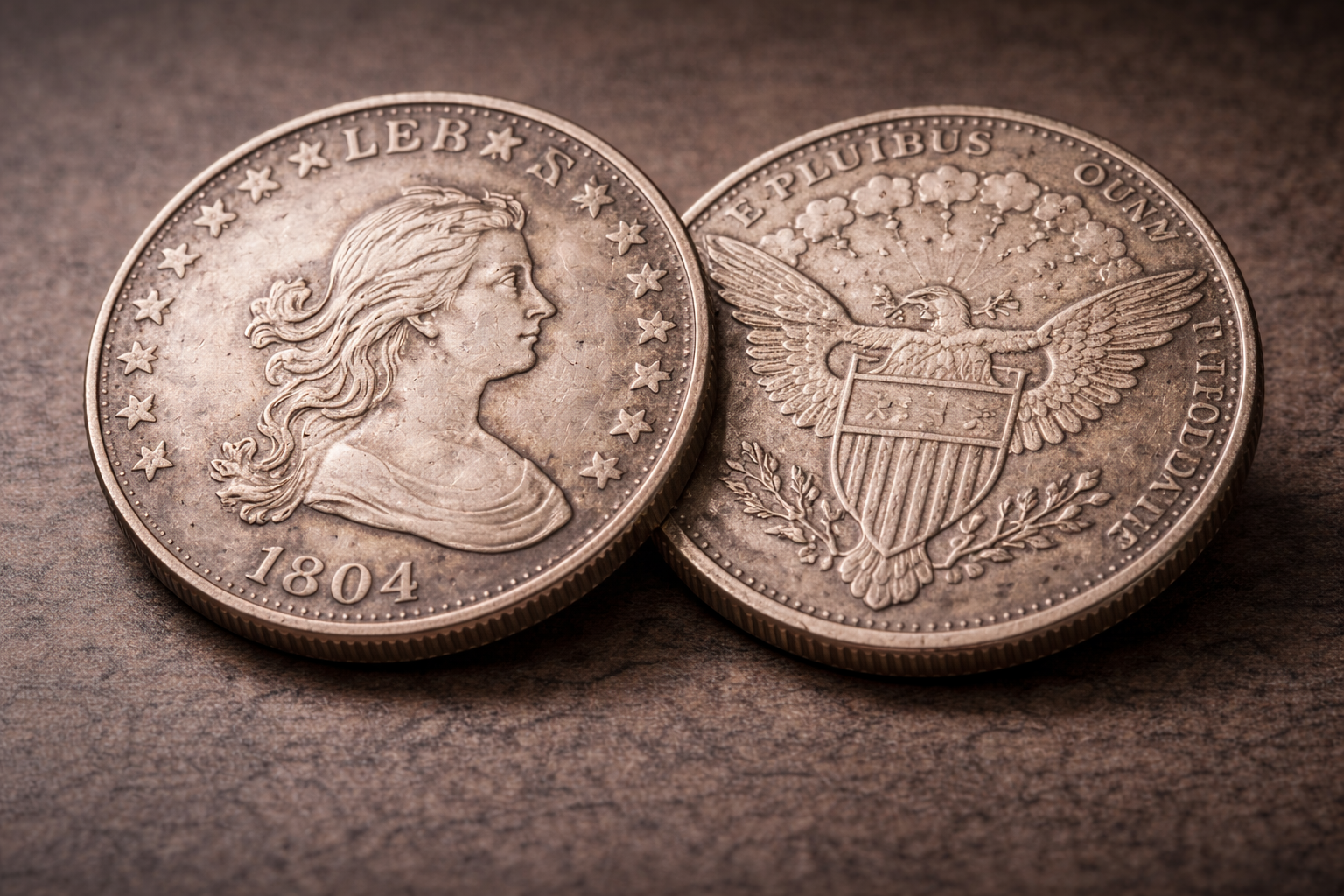
The name “1804 Silver Dollar” is a historical label for a specific type of Draped Bust dollar that carries the date 1804 on its face. The key point is that the most famous examples associated with this name were not produced in that year. They were connected to a later moment when the U.S. government needed impressive objects for official presentation.
In other words, this coin is not primarily a story about ordinary circulation. It is a story about symbolism. About how a young nation chose to represent itself in metal. About how a coin can become a national artifact through context, not everyday spending.
The date that created a permanent myth
The “date problem” is the heart of the 1804 Silver Dollar story. The United States Mint did strike silver dollars earlier in the Draped Bust era. But regular silver dollar production did not continue in a simple, uninterrupted way. Mint output depended on demand, bullion supply, political priorities, and practical decisions.
Over time, records and public memory blended into a simplified narrative. The date on the coin became a shortcut for the story. People repeated the label, and the label became reality in popular conversation. This happens often in history. Once a phrase becomes famous, it can survive even when the details are more complex.
The educational value here is bigger than a single coin. It shows how easily a date can become a myth when it is separated from production context. If you collect or study coins, this is a useful lesson. A coin is not only its date. It is also the “why” behind its creation.
The Draped Bust design and its historical mood
The design associated with the 1804 Silver Dollar belongs to the Draped Bust era. This design language reflects the early republic’s visual choices. Liberty appears in a classical style, influenced by European artistic traditions. The intention was not to copy monarchy, but to communicate seriousness and legitimacy in a world that respected classical symbolism.
The reverse design, with the eagle, carries a different message. It signals sovereignty and national authority. Early American coinage often balanced these two ideas. Liberty as an ideal. The eagle as power and state identity.
If you view the Draped Bust design as a piece of political communication, it becomes more meaningful. The early United States needed symbols that felt stable. It was still proving itself to the world. Coinage was one of the few national objects that would travel widely and speak silently for the nation.
The U.S. Mint in the early nineteenth century
To understand why a later diplomatic set would matter, it helps to understand the Mint’s environment. The early U.S. Mint was not a massive industrial operation like modern mints. It operated within limits. Technology was advancing, but it was not yet standardized at the level we expect today.
Coin production depended on metal supply and political priorities. Different denominations could appear or disappear based on practical needs. A modern reader might expect every year to have every coin. But early national coinage did not work like that. It was shaped by the reality of the era.
This is one reason the 1804 label confuses people. In a modern mindset, a date equals a production year. In early U.S. history, the relationship between dates, dies, and production decisions could be more complicated.
Diplomatic gift sets and national presentation
The diplomatic context is where the story becomes truly distinctive. In the nineteenth century, formal gifts between governments were a serious matter. They were not casual souvenirs. They were symbols of respect. They carried political meaning.
A presentation set of coins could represent national identity in a refined way. It communicated stability, craftsmanship, and legitimacy. It also demonstrated the nation’s ability to produce standardized currency. For a growing country, that message mattered.
When the United States prepared special sets for official presentation, it needed coins that looked impressive and complete. A full set created a narrative of order. It said, “This is who we are, and this is how we represent value, authority, and design.”
How the “1804 dollars” were produced later
The famous twist is that some of the coins associated with the 1804 Silver Dollar name were created later to serve the needs of official presentation. That does not make them fake. It makes them purposeful. They were real products of the Mint, tied to a real governmental intention.
This is an important historical distinction. People sometimes assume that if a coin was made later than its date, something must be dishonest. But in historical manufacturing, dates can reflect design types, die preparation decisions, or ceremonial requirements. What matters is the documented reason and the institutional source.
The result is a coin that became famous not simply because of scarcity, but because it lives at the intersection of national identity and official ceremony. It is a coin that tells a story about how government communicates through objects.
Understanding the different classes in a historical way
Over time, researchers and numismatic historians described distinct groups, often called classes, to explain differences in how these coins were produced and how they entered the historical record. The language of “classes” exists to organize evidence, not to create hype.
If you encounter references to Class I, Class II, or Class III, treat them as historical categories. They are tools for understanding production context. They remind us that the 1804 Silver Dollar is not a single moment. It is a story that unfolded through different decisions and different circumstances.
What matters most is the concept. The 1804 name describes a famous outcome. The classes help explain the pathway that led to that outcome. This is history doing what it does best. It turns legend into a timeline.
Why it became a symbol far beyond its metal
Many coins are old. Some coins are beautiful. Few coins become symbols. The 1804 Silver Dollar became symbolic because it carries multiple stories at once.
It represents early American artistic choices. It represents the diplomatic ambitions of a nation shaping its global relationships. It represents the way objects can gain meaning when they appear in official settings. And it represents how a simple date can grow into a cultural myth.
In a museum mindset, the coin is a small object with a large voice. It tells you what the United States wanted to communicate about itself. It also tells you how historical narratives are formed. Not only by facts, but by repetition and memory.
How to read the coin as a historical document
If you want to appreciate the 1804 Silver Dollar historically, start with observation. Look at the portrait style. Classical Liberty was a deliberate choice. It reflects a worldview where republics borrowed the language of classical virtue to signal legitimacy.
Then examine the eagle. The eagle is not only decorative. It is a statement that the nation sees itself as sovereign. Early American iconography often aimed to feel established, even when the nation was still young.
The lettering, spacing, and overall balance also matter. Coins were not only money. They were state-issued objects that had to look official. A clean, balanced design supported trust. And trust was essential for a national currency to function.
American identity and the language of early coinage
The United States in the early nineteenth century was defining itself. It wanted to be seen as stable, serious, and capable. Coinage helped project that identity because it was portable and visible.
A coin could pass through many hands. It could cross borders. It could be examined by diplomats, merchants, and travelers. In an era before mass media, this mattered. A well-designed coin was a quiet statement of institutional competence.
That is why presentation sets were meaningful. They were not just gifts. They were curated messages in metal. They said, “We belong in the family of nations that produce stable currency and coherent symbols.”
A museum approach to appreciating the 1804 dollar
If you treat the 1804 Silver Dollar like a museum artifact, you free it from modern noise. You do not need numbers to feel the weight of the story. You do not need headlines to recognize the cultural role of the object.
A museum approach focuses on context. Who wanted this coin. Why it was created in a specific ceremonial moment. How it connects to national design language. What it reveals about government presentation in the nineteenth century.
This approach also protects your content strategy. It keeps your article educational. It aligns with an AdSense-safe, history-first identity. And it gives readers a reason to return for stories, not for price hunting.
Common misconceptions and simple clarifications
Misconception one. The coin must have been struck in eighteen oh four. Clarification. The most famous examples associated with this name are linked to later production for official presentation.
Misconception two. If it was produced later, it must be unofficial. Clarification. Historical production can include later striking tied to government needs, especially for presentation and documentation.
Misconception three. The story only matters because of rarity. Clarification. The story matters because it connects design, diplomacy, and national identity. Those themes remain meaningful even in a purely educational reading.
Legacy and why the story still matters
The 1804 Silver Dollar remains important because it sits at a unique crossroads. It is a coin that teaches you how legends form. It is a coin that shows how governments use objects to communicate. It is a coin that demonstrates how design carries political meaning.
In modern times, the story continues to appear in books, museum conversations, and educational content because it is an excellent example of historical complexity inside a simple object. The coin invites curiosity. Then it rewards that curiosity with real context.
If you enjoy coin history, the best takeaway is not a number. It is a method. Always ask two questions. What does the coin show. And why did it exist in the first place. That mindset turns coin collecting into historical understanding.
Frequently asked questions
Was the 1804 Silver Dollar actually made in the year on the coin
The famous story behind the 1804 Silver Dollar involves later production connected to official presentation. The date on the coin became part of the legend. The educational value comes from understanding the production context rather than assuming the date tells the full story.
Why is it so famous in American coin history
It is famous because it connects multiple themes at once. Early American design. Government ceremony. Diplomatic presentation. And the way historical myths grow around simple details like dates.
What should readers focus on when learning about this coin
Focus on context. The design choices. The role of official gift sets. And what the coin suggests about how the United States presented itself to the world in the nineteenth century.
How can I keep my interest historical and not market-driven
Read coins like documents. Compare designs across decades. Study political and cultural context. Ask what messages were intended through imagery and typography. This approach keeps the topic educational and timeless.
Follow HistoraCoin on every platform, because the next story will shock you.