The Pharaoh’s Coin of Eternity – Egypt’s Forgotten Curse

This story is brought to you by HistoraCoin – where every coin tells a secret.
Let me tell you something, my friend — a story whispered by the desert winds, one that archaeologists avoid discussing after dark. It begins with a single coin — not gold, not silver, but something older. They call it The Pharaoh’s Coin of Eternity. Some say it carries the blessing of life. Others… call it a curse that never dies.
This isn’t a tale you’ll find in history books. It’s one that lives between museum whispers and forgotten excavation journals. It’s a story of greed, discovery, and the one thing humans never seem to resist — touching what should be left alone.
🏺 The Unearthed Secret
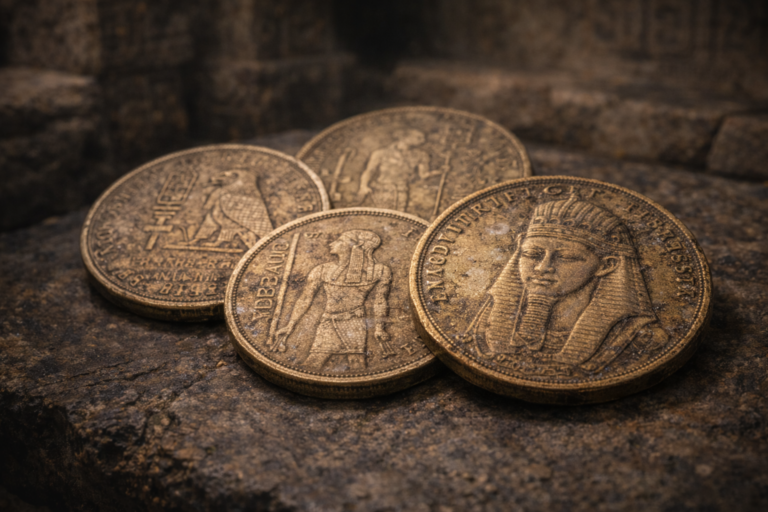
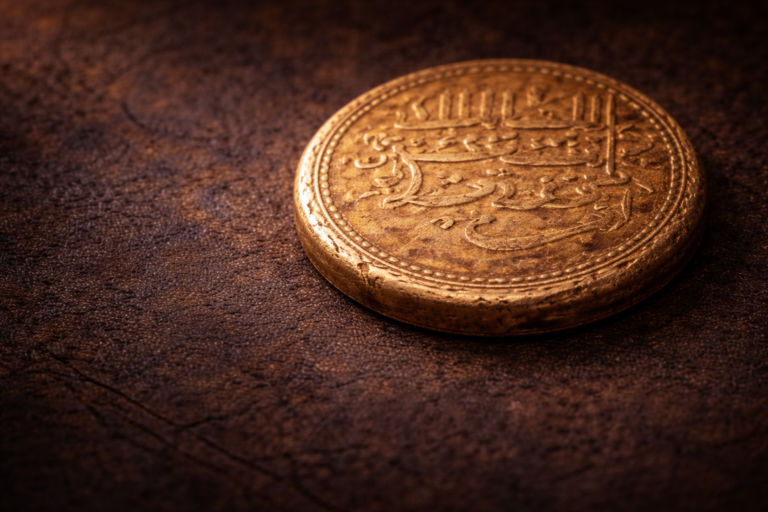
In 1922, when Howard Carter discovered Tutankhamun’s tomb, Egypt was on the lips of every explorer. But not every treasure was catalogued. In a lesser-known dig years later — far from Luxor, near the ruins of Dahshur — a young Egyptian archaeologist named Hassan El-Masry unearthed a small object wrapped in linen. It wasn’t a scarab or a statue. It was a coin — round, black as obsidian, etched with the faint image of a falcon and an eye that seemed almost alive under light.
“It’s nothing,” said the lead excavator, brushing it off. But Hassan kept it. He slipped it into his pocket, thinking it would bring him luck. That night, he dreamed of endless sand dunes moving like waves, and a voice whispering, ‘He who keeps the Pharaoh’s breath will never rest.’
When he woke up, the coin was warm in his hand.
🕯️ The Coin That Refused to Stay Still
Over the following weeks, strange things began to happen. The tools in the tent rusted overnight. Scorpions crawled into sleeping bags. A camel refused to cross the excavation site, kneeling as if terrified of something unseen. Hassan tried to ignore it. But one evening, as he cleaned the coin under a lantern, he saw something impossible — the engraved falcon blinked.
He dropped it instantly. When he picked it up again, the falcon’s eyes had vanished, replaced by hieroglyphs: “Ankh n Djet” — the life that never ends.
By the next morning, two workers had gone missing in a nearby dune storm. Only their footprints were left, circling each other as if they’d been walking endlessly in place.
🌑 The Journal of Madness
Months later, Hassan returned to Cairo, coin still in pocket. He began keeping a journal — fragments of which survive today in the archives of the Egyptian Museum. His writing grows erratic with each entry. He wrote of dreams where ancient voices spoke to him through sand. Of seeing his reflection in mirrors, but older, decaying. Of hearing coins clink where none existed.
One passage stands out, written in shaky ink:
“The coin breathes. I can hear it in the night, humming like wind through a tomb. I tried to bury it by the Nile, but it returned to my bedside. I fear it no longer belongs to me — I belong to it.”
By 1926, Hassan vanished. His belongings were found untouched — except for the coin, which had turned the color of gold, resting neatly on his pillow.
🔱 The Western Collector
In 1934, a British collector named Sir Edmund Carroway bought the coin at a secret Cairo auction. He was fascinated by “cursed artifacts” and claimed he could feel the energy of death on ancient metal. He kept the coin in his London home, displayed under glass beside other relics from Egypt.
Within months, servants began quitting, saying they heard whispering in the halls. Carroway dismissed them — until his own wife saw something. “I saw the coin move,” she said, trembling. “It turned on its own.” He laughed at her. That night, he suffered a heart attack and died clutching his chest. The glass case was found shattered. The coin was gone.
Years later, it resurfaced in a private collection in New York — unlabelled, untraceable. How it crossed the ocean, no one knows.
🌕 The Curse of Eternity
Legends among museum curators describe the Pharaoh’s Coin as the “Ankh of Metal” — a bridge between life and death. Some say it was minted not for trade but for ritual — a token placed in the hands of high priests who sought to preserve their souls in gold. When Tutankhamun’s tomb was sealed, another ceremony took place in the desert, one so secret it was erased from every papyrus. The Pharaoh’s Coin, it’s said, was the key to immortality — but only for the dead.
Those who hold it are cursed to live in echoes — half in this world, half in the next. Their bodies decay, but their dreams remain alive. It’s the kind of tale that makes historians roll their eyes — and yet, every few decades, the coin’s name surfaces again… in a police report, an auction listing, or a collector’s death.
🦂 The Modern Discovery
In 2007, a documentary crew filming near Saqqara interviewed a retired guard who claimed he had once seen the coin. He said it was stored in a sealed vault in the museum’s restricted wing, wrapped in linen. “They keep it where no light touches it,” he whispered. “Because when light hits it, shadows move.”
The crew laughed — but that night, their equipment malfunctioned. Every frame they shot near the vault showed the same distortion — a blur shaped like an eye, open and watching.
When the footage aired, viewers flooded forums asking if the image was real. The producers refused to comment. Weeks later, the museum issued a quiet statement denying the coin’s existence — yet tightened security in that very hall.
👁️ The Unseen Collector
Today, rumors say a private collector in Dubai owns the Pharaoh’s Coin. He reportedly bought it for millions, displaying it only during lunar eclipses. Employees claim the temperature in the room drops suddenly whenever it’s exposed. A visiting scholar fainted after describing seeing her own reflection inside the coin — but older, and smiling.
When asked if he fears the curse, the collector laughed. “Curses are for those who believe in death,” he said. “I collect eternity.”
Weeks later, he vanished while traveling in the Sahara. His jet was found abandoned, controls intact, engines silent. Only one thing was missing — the coin.
🌬️ Whispers from the Desert
Travelers near Dahshur still tell stories. On quiet nights, they say you can hear metal clinking under the sand — as if something is turning beneath the earth. Bedouins avoid that area, calling it “Qabr al-Malak” — the Tomb of the Coin. Some claim it reappears once every fifty years, always found by someone who shouldn’t have found it.
It’s said the Pharaoh’s Coin doesn’t want to be owned. It only wants to be remembered.
🕯️ Between Myth and Reality
Archaeologists often dismiss these tales as superstition, but there’s always a grain of truth buried under the sand. A metal disc matching descriptions of the Pharaoh’s Coin was indeed catalogued in a French museum in 1959 under the label “Unidentified Ritual Token.” Its current location is unknown. The museum records end abruptly — a note simply reading, “Transferred to Egypt, 1963.”
Some believe it’s buried again. Others think it’s waiting to be found — not by accident, but by destiny.
💀 The Curse Endures
So what is the truth, my friend? Maybe it’s all coincidence. Maybe it’s just a story told by the wind. But look at history — how many “coincidences” have we buried under the label of myth?
Coins were always more than money. They were symbols of power, prayers struck in metal. And perhaps this one was a prayer that went too far — a human attempt to trap eternity inside something that could fit in your palm.
The Pharaoh’s Coin of Eternity may never be found again. Or maybe it’s already close — resting quietly in a collector’s drawer, waiting for another hand, another heartbeat, another lifetime.
And if one night you dream of endless sand and a falcon watching you from the horizon, remember what Hassan El-Masry wrote before he disappeared:
“He who holds the coin of the Pharaoh does not live — he continues.”
🌕 The Lesson Beneath the Legend
Maybe, in the end, that’s the real curse — not death, but endless remembrance. To exist forever, never forgotten, never free. The Pharaoh’s Coin reminds us that immortality isn’t always a gift. Sometimes, eternity is just another kind of tomb.
🧭 Reality Check
While no official record confirms the existence of the Pharaoh’s Coin, several real Egyptian artifacts have inspired legends of curses — from Tutankhamun’s tomb to Amarna relics. The idea of eternal life through metal has deep roots in ancient Egyptian philosophy. Whether myth or truth, these stories remind us that history still breathes — just below the surface.
🏁 Final Verdict
The Pharaoh’s Coin of Eternity is more than an object of myth — it’s a reflection of human desire to outlive death. Whether it truly exists or not, its legend endures, shimmering like heat over the desert. In the end, maybe the coin doesn’t belong to Egypt or any collector — maybe it belongs to time itself.
🎥 Watch More on HistoraCoin
If stories like this captivate you — ancient curses, lost coins, and the whispers of forgotten empires — explore more mysterious tales on our YouTube channel: HistoraCoin on YouTube – where history comes alive through rare coins and hidden stories.
❓ FAQ
Is the Pharaoh’s Coin real?
Its existence is debated. Some claim it’s inspired by a real Egyptian artifact, while others see it as pure legend — a story born from the desert’s silence.
Why is it called the Coin of Eternity?
Because the hieroglyphs said to be inscribed on it translate to “Ankh n Djet” — life everlasting. The same words found in tombs of ancient pharaohs.
Has anyone ever found it?
Reports of similar coins have appeared in private collections and museum archives, but none confirmed as the original. It may still lie buried beneath the sands of Egypt.
Are Egyptian coin curses real?
There’s no proof of supernatural curses, but many archaeologists who disturbed tombs faced uncanny misfortunes — fueling Egypt’s most enduring mysteries.
Focus Keyword: pharaoh coin
Keywords: pharaoh coin, egyptian coins, cursed coin egypt, ancient egypt treasure, pharaoh curse, egyptian relics, rare egypt coins, coin of eternity, egyptian mythology coins, mysterious coins egypt