The Lost Coin of Easter Island – The Stone That Spoke
This story is brought to you by HistoraCoin – where history whispers through forgotten treasures.
Let me tell you something strange, my friend — a story from a place where silence speaks louder than words. Far in the middle of the Pacific Ocean lies Easter Island, known for its giant stone statues, the Moai. But among those ancient faces, carved from volcanic rock, there is said to be another relic — smaller, rounder, yet no less mysterious: The Lost Coin of Easter Island.
Some call it a myth, a legend carried by sailors and explorers. Others swear it exists — a stone coin said to whisper in the wind, telling the forgotten secrets of a vanished people.
🗿 The Coin That Wasn’t Metal
Most coins are made of silver or gold, copper or bronze. But this one — if it exists — was carved from basalt, the same dark volcanic rock used to create the Moai statues. According to island lore, the coin was not for trade, but for memory. It carried not value, but voice.
They say it was shaped by the last High Priest of Rapa Nui — the island’s ancient name — during the final days before the great famine. He carved it by hand, whispering prayers into the stone as he worked. When it was finished, he pressed it to his ear — and it spoke back.
Its words? Lost to time. But the legend remains: “Whoever hears the stone speak will never forget, and never sleep again.”
🌊 The Dutch Expedition
In 1722, when Dutch explorer Jacob Roggeveen first reached Easter Island, he wrote of “strange discs of stone, round as coins, engraved with eyes and waves.” Historians dismissed this as exaggeration — until 1891, when British missionary Edward Methuen found a small basalt disc buried near Ahu Tongariki, one of the island’s great ceremonial platforms.
It measured just eight centimeters across — perfectly circular, etched with symbols that matched none of the known Rapa Nui glyphs. Methuen kept it in his satchel. That night, he claimed to hear whispering — not voices, but the sound of waves breaking… indoors. He thought he was imagining it. But when he opened his bag, the disc was warm — and vibrating softly.
He fled the island the next morning, leaving the disc behind. Locals say a fisherman found it later, half-buried in sand, and threw it into the sea “to silence the storm.”
🌑 The Scholar and the Shadows
In 1958, a Chilean archaeologist named Isabel Torres began a study of Rapa Nui petroglyphs. Among her notes, one drawing stands out — a circular stone engraved with two faces: one smiling, one frowning. She wrote, “It represents the breath of the island — one side gives life, the other takes it.”
Weeks later, Torres vanished. Her journal was found in a cave near Anakena Beach. The last page contained a single sentence written over and over:
“It doesn’t sleep anymore.”
The stone she described was never recovered. But her colleagues later noticed something peculiar — the ink from her notes was faintly mixed with grains of volcanic dust, as if she’d written them in the dark beside the very object she was studying.
🔥 The Story the Elders Tell
Among the Rapa Nui elders, the story of the stone coin isn’t one of greed or power — it’s a warning. They say that when their ancestors carved the Moai statues, each one received part of a spirit — Mana. But when the last statue was completed, a piece of Mana remained — restless, without a body. So the High Priest sealed it inside a circle of stone, so it would “watch, but not walk.”
He made only one coin. And he hid it beneath the largest Moai, facing the sea, to guard it forever. When outsiders began moving the statues centuries later, storms destroyed their ships, and fires broke out in their camps. “The coin woke,” the elders said. “And the island remembered.”
💀 The Museum of Echoes
In 1987, a small stone disc arrived at a museum in Santiago, Chile. The curator logged it simply as “Unidentified artifact, basalt, probable Polynesian origin.” He placed it in a display case beside ancient tools. The next morning, he found the glass cracked — from the inside.
Security footage showed nothing unusual, except that at exactly midnight, the temperature in the room dropped by six degrees. The artifact was removed and placed in storage, labeled “Do Not Exhibit.” It remains there today, known internally as Object 1722-A.
Some employees refuse to work near that room. They say it hums — a low, rhythmic sound, like breathing through stone.
🌬️ The Lost Audio Tape
In 2003, a documentary crew visited Easter Island to record local myths. They interviewed an elderly man named Manu Riroroko, who claimed he once saw the Lost Coin as a boy. “It wasn’t metal,” he said. “It was the color of smoke. When you touched it, you could hear your own heartbeat echo back.”
During the interview, the audio recorder malfunctioned. When restored later, the sound engineer noticed something odd — beneath Manu’s voice was another layer of audio: a deep vibration, then faint whispers in Polynesian. Linguists later identified a phrase that repeated three times: “Ko te motu e ora” — “The island is alive.”
🌕 The Modern Discovery
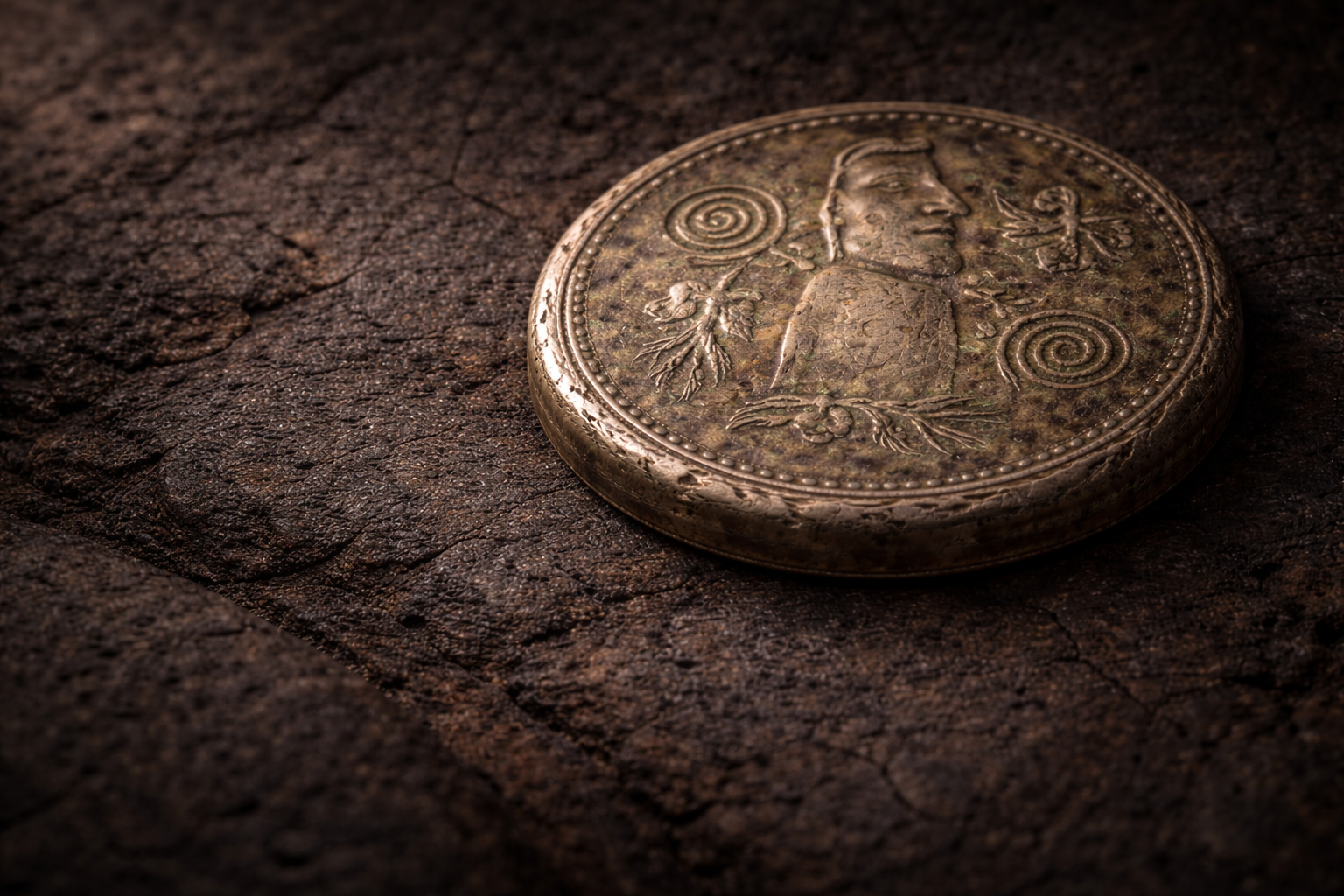
In 2017, satellite scans revealed an anomaly near the base of a fallen Moai — a circular formation just beneath the surface. Archaeologists excavated carefully, uncovering fragments of what appeared to be a flattened stone disc, carved with spiral patterns. One of the workers, a local named Rangi, claimed he saw light flicker from the cracks. Later that night, he awoke screaming, saying the Moai’s eyes were open and staring at him through the tent wall.
The excavation was quietly halted. Official reports blamed “unstable terrain.” But Rangi disappeared two weeks later while diving off Hanga Roa. His last radio transmission was a whisper: “It’s under us.”
🕯️ Between Myth and Memory
Maybe the Lost Coin was never a coin at all — maybe it was an idea, a piece of the island’s spirit trying to remember its name. Easter Island has always been a place of paradox: massive statues staring into the horizon, built by people whose technology seemed too simple for the task. How did they move the stones? Why did they stop? And what made them carve faces that look so human — and so sad?
Some historians believe the “coin” represents communication — the link between human memory and the divine. Others think it’s real — buried deep beneath one of the remaining Moai, still humming, still alive.
💭 The Sound of the Island
Travelers say that when the wind blows through certain caves on Easter Island, you can hear a faint ringing — like metal, though there’s no metal nearby. They call it “The Voice of the Dinaro.” Locals avoid those caves. Tourists call it coincidence. But those who stay long enough begin to feel something else — the rhythm of the wind matching their pulse, the silence growing heavy, as if the island itself were breathing beside them.
Perhaps that’s what the Lost Coin truly is — the island’s heart, carved into stone, beating slow and eternal beneath layers of time and sand.
🌩️ The Curse or the Connection?
Every legend hides a truth. Maybe the Lost Coin isn’t cursed. Maybe it’s a reminder — that every civilization leaves behind something more than ruins. A voice, a presence, a piece of soul embedded in the world itself. And Easter Island, isolated in the vast blue Pacific, still keeps its soul close.
So if you ever stand among the Moai at sunset, and you hear the wind whisper your name, don’t be afraid. It’s not the dead speaking. It’s the island remembering you.
🌕 The Lesson Beneath the Legend
The Lost Coin of Easter Island reminds us that memory outlasts matter. While coins of gold may tarnish, a story — once carved in stone — endures. Some treasures are not meant to be owned; they’re meant to be heard.
🧭 Reality Check
Though no physical “stone coin” has ever been confirmed on Easter Island, many real artifacts of basalt and obsidian bear mysterious engravings tied to ancient Rapa Nui rituals. These myths reflect a deep belief that the island itself is alive — a sacred keeper of memory, spirit, and warning against greed.
🏁 Final Verdict
Whether myth or mystery, the Lost Coin of Easter Island remains one of Oceania’s most haunting tales — a story where silence, stone, and spirit blend into one eternal question: What if the earth itself remembers everything we forget?
🎥 Watch More on HistoraCoin
If this story captivated you — from lost islands to cursed relics — explore more mysterious coin legends and hidden histories on our YouTube channel: HistoraCoin on YouTube – where every coin carries a secret worth hearing.
❓ FAQ
Is the Lost Coin of Easter Island real?
No confirmed artifact has been found, but the legend persists among local oral traditions and archaeological folklore.
Why is it called a coin if it’s made of stone?
In Rapa Nui myth, the “coin” symbolizes memory — a circle of eternity, not currency.
Are there carvings similar to this legend?
Yes, the island contains thousands of petroglyphs depicting circular symbols and faces, possibly tied to ancestral spirits.
Can visitors experience this legend today?
Many locals still share stories about the island’s living spirit; respectful visitors are welcome to learn — but never to dig.
Focus Keyword: easter island coin
Keywords: easter island coin, lost coin legend, oceania coins, mysterious coin easter island, moai treasure, cursed stone coin, polynesian mythology coins, ancient oceania relics, easter island mystery, stone coin legend