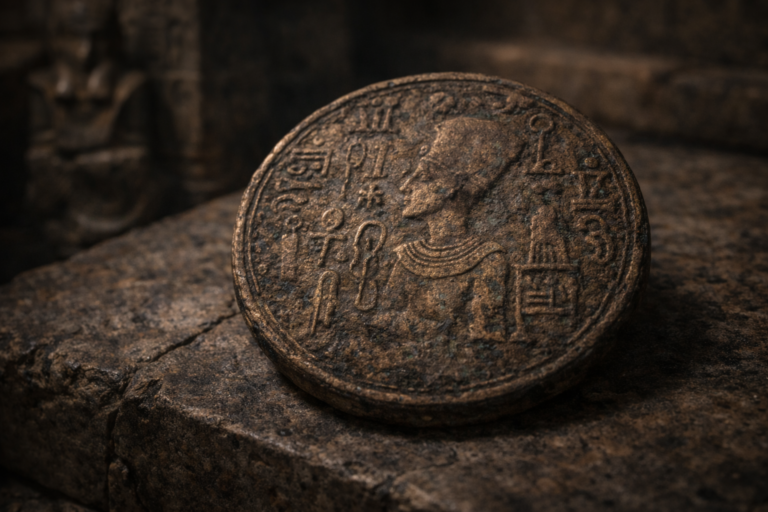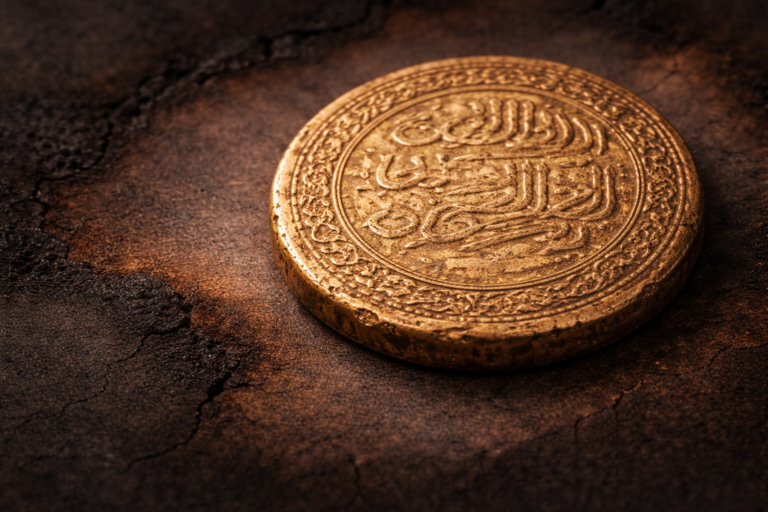
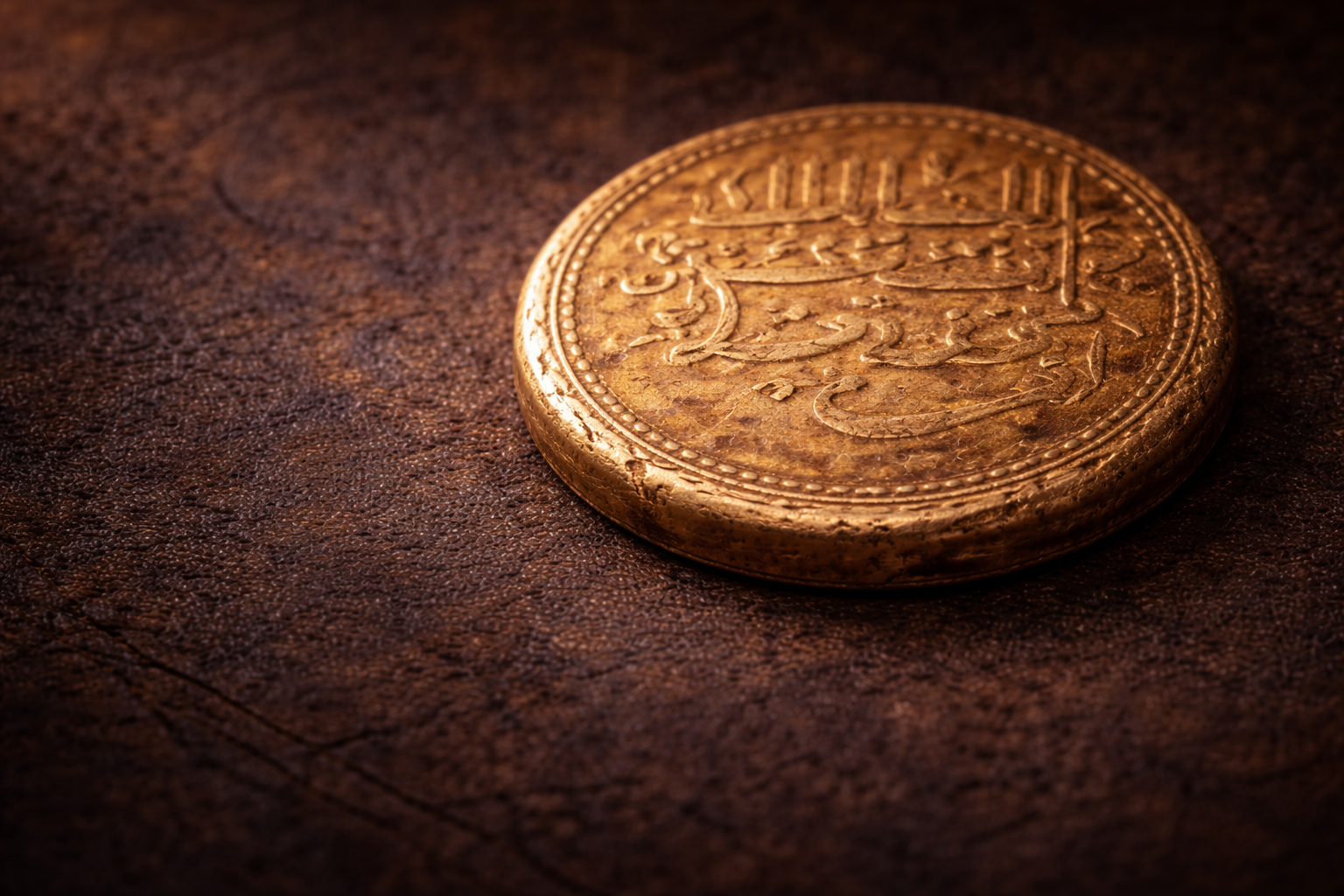
The Blood Dinar – The Curse of the Red Gold
This story is brought to you by HistoraCoin – where every coin has a heartbeat from history.
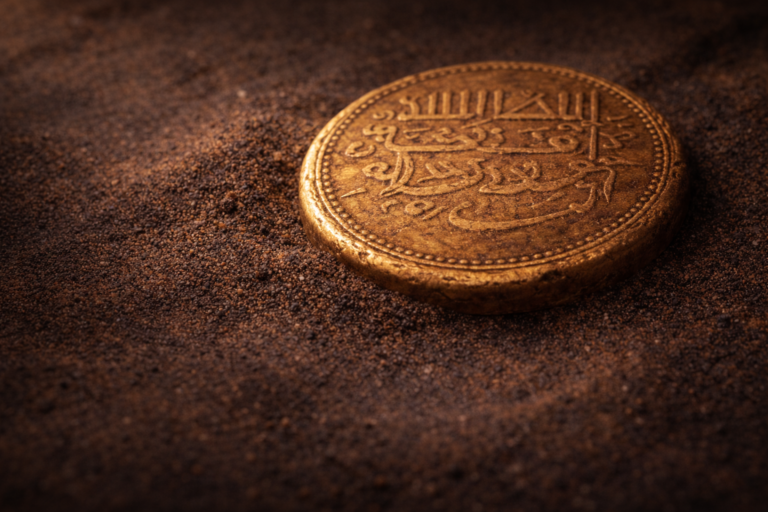
Some coins shine brighter than gold — others, darker than blood. Across the deserts and ancient trade routes of Africa, one legend refuses to die. It’s called The Blood Dinar — a coin said to be forged not in fire, but in sacrifice. They say it brings power, desire, and ruin to anyone who dares to claim it.
Its surface glows with a red shimmer under sunlight, and turns black under moonlight. No one knows who made it — a king, a priest, or a god — but everyone who’s ever held it has vanished, leaving only whispers and ash behind.
🩸 The Birth of the Blood Dinar
The story begins more than a thousand years ago, in the lost kingdom of Garamanté — deep in the sands of what is now southern Libya. It was a city of gold and salt, where the sun never forgave and the wind sang of forgotten gods.
According to oral tradition, King Maruba ruled the Garamantes with an iron will. He wanted a coin that would make his name eternal — one that would never tarnish, never lose its glow. When his goldsmiths failed, he turned to the priests of the underworld god, Kharu, who demanded an unthinkable price:
“A coin that lives must be born from life.”
That night, the king’s youngest son was taken to the altar. When dawn came, the priests emerged carrying a single coin — red as sunrise, warm to the touch, pulsing faintly like a heartbeat.
They called it the Dinar al-Dam — “The Blood Dinar.” The king held it high before his people and declared, “As long as this coin exists, my line will never die.” He was right… but not in the way he expected.
🔥 The Fall of Garamanté
In the years that followed, the land withered. The wells ran dry, and the sky turned to iron. The people whispered that the gods were angry — that the blood in the coin still cried for release. But the king refused to destroy it. He kept it locked in a golden box and slept beside it every night.
Then one morning, his palace burned without flame. The walls turned black, the sand melted into glass. When the smoke cleared, there was no body — only a molten throne, and in its center, the coin, perfectly intact and glowing.
The kingdom vanished within a generation. Caravans passing through the ruins claimed to see a red light flickering in the desert at night — like the heartbeat of something that refused to die.
🌕 The Trader from Timbuktu
Centuries later, the Blood Dinar resurfaced in Timbuktu, the jewel of West Africa’s trade routes. A merchant named Ahmad al-Zein bought it from a Tuareg nomad who said it was found “in the bones of a buried city.” Ahmad was fascinated by its warmth and strange glow. He carried it in a pouch of camel leather, calling it his “luck.”
Within months, his fortune tripled. Gold flowed into his house, spices filled his storehouses, and foreign traders sought his name. But soon he began to change. His servants whispered that he stopped sleeping, his skin shimmered faintly red, and his eyes turned glassy like the desert sun.
One night, his wife awoke to find him kneeling before the coin, whispering to it. When she touched his shoulder, he turned — smiling — and said: “It speaks, and I must answer.”
By morning, his home was empty. In the courtyard, the sand was scorched black, and the coin lay on the ground, cool and spotless.
💀 The Curse Spreads
Word of the Blood Dinar spread like wildfire across North Africa. It was said to pass from hand to hand — merchants, warlords, even sultans — each rising to greatness before vanishing into ruin. Every owner thought they could master it. None did.
In 1530, a Moroccan general brought the coin to Fez after conquering a Berber tribe rumored to guard it. He displayed it proudly in his court. That same night, lightning struck his palace, though no storm was seen for miles. When his servants rushed in, they found him kneeling before a mirror, his reflection grinning though his face did not move. The coin lay beside him, smoking slightly, a thin line of blood running from its edge.
🌩️ The French Expedition
In 1884, during the colonial scramble for Africa, French explorer Étienne Leclair heard tales of a “living coin” buried beneath the Sahara. He led a caravan of thirty men into the desert. Only two returned.
They said Étienne had found the ruins of an ancient palace buried in sand. Inside, at the top of a stone altar, sat a coin glowing red. When he touched it, a sandstorm rose from nowhere, screaming like a thousand voices. They tried to flee, but the sky caught fire. One survivor claimed the last thing he saw was Étienne standing still, laughing, as the storm swallowed him whole.
When the survivors reached Algiers weeks later, the only item in their pack was a single coin — dull and heavy. But under candlelight, it flickered red, like something sleeping.
🕯️ The Museum Fire
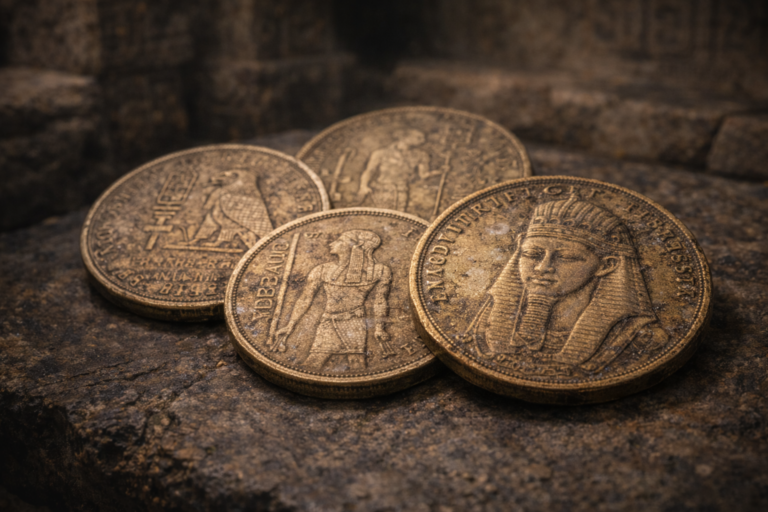
In 1936, the Blood Dinar appeared in the Museum of Antiquities in Cairo, labeled “Unknown African Currency, Pre-Islamic Era.” It attracted immediate attention from scholars — and strange incidents began. Staff reported hearing soft humming near the display case, and one night guard claimed he saw his reflection smile at him when he walked past.
On July 12, 1938, the museum caught fire. Every artifact melted — except one. When the ruins were sifted, archaeologists found the Blood Dinar resting on a bed of white ash, unburned and glowing faintly, as if pleased.
The curator resigned and had it sealed in a lead vault. He wrote in his final report:
“It is not a coin. It is a promise — and a punishment.”
🌕 The Return of the Red Gold
In the 1990s, during restoration near Ghat, Libya, archaeologists uncovered an ancient tomb. Among the relics was a small golden coin that turned red when exposed to sunlight. A local guard pocketed it and disappeared days later. His tent was found miles away — empty, the ground scorched in a perfect circle.
Authorities dismissed it as heatstroke and desert lightning. But a single photograph from the dig shows the coin resting in the sand, faintly glowing — and around it, the sand looks almost… alive, forming ripples like breath.
💭 The Meaning of the Legend
Maybe the Blood Dinar isn’t cursed at all. Maybe it’s a mirror — reflecting the hunger that burns in those who crave power. Gold is never just metal; it’s desire made solid. And what greater curse could exist than never being satisfied, even when you hold the world in your hands?
The Blood Dinar endures because greed endures. Every age has its kings, its merchants, its dreamers — all believing they can master the fire that built them. But some fires don’t warm; they consume.
And when they’re done, only the coin remains — still glowing, still waiting for the next hand to claim it.
🌕 The Lesson Beneath the Legend
The Blood Dinar teaches one haunting truth: the price of power is always blood — sometimes spilled, sometimes silent. We chase gold thinking it will make us eternal, but in the end, it’s the gold that remembers, not us.
🧭 Reality Check
While no record confirms the Blood Dinar’s existence, real African empires such as Mali and Garamantes minted gold coins of extraordinary purity. Legends about cursed treasure often reflect moral lessons about greed, sacrifice, and the divine — echoing across centuries of trade and conquest.
🏁 Final Verdict
Whether it was born of ritual, myth, or warning, the Blood Dinar remains one of Africa’s darkest legends — a story where gold gleams not with light, but with memory. Perhaps it’s still out there, buried beneath the dunes, waiting for another dreamer brave — or foolish — enough to awaken it.
🎥 Watch More on HistoraCoin
If tales of cursed treasure and forgotten empires fascinate you, explore more haunting legends and mysterious coins on our YouTube channel: HistoraCoin on YouTube – where the past still glows in the dark.
❓ FAQ
Is the Blood Dinar real?
No confirmed evidence exists, but similar gold coins from North and West Africa date back over a thousand years, inspiring countless myths.
Why is it called the Blood Dinar?
Because it’s said to have been forged in human sacrifice, glowing red as if still alive.
What happens to those who own it?
Legends say fortune follows briefly — then ruin, as the coin “feeds” on greed and desire.
Where could it be today?
Unclear. Some believe it’s hidden beneath Saharan ruins, others think it lies locked in museum vaults, still warm to the touch.
Focus Keyword: blood dinar
Keywords: blood dinar, cursed coin africa, red gold legend, african treasure myth, mysterious africa coin, ancient african coins, haunted gold coin, lost dinar curse, african mythology relic, rare gold coin legend