The Shadow Stater – Forgotten Greek Coin Found in Tombs and Caves
⏳ Estimated reading time: 11 minutes
The Shadow Stater – Forgotten Greek Coin Found in Tombs and Caves
They say every coin has two faces—one for the living, one for the dead.
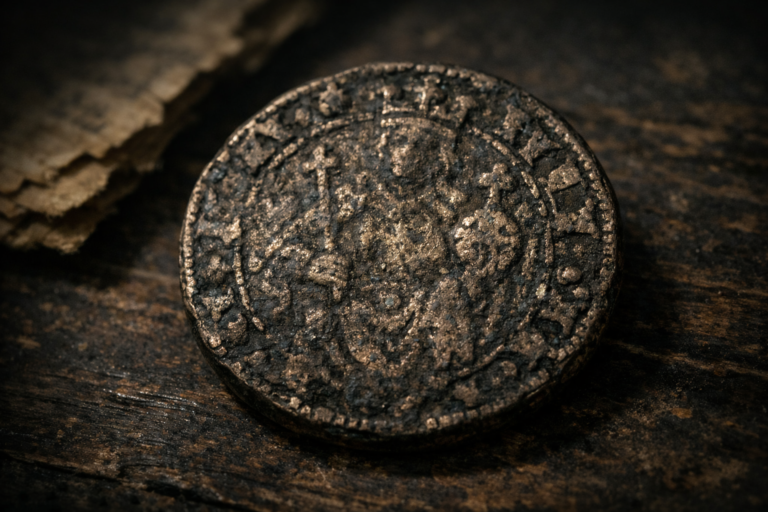
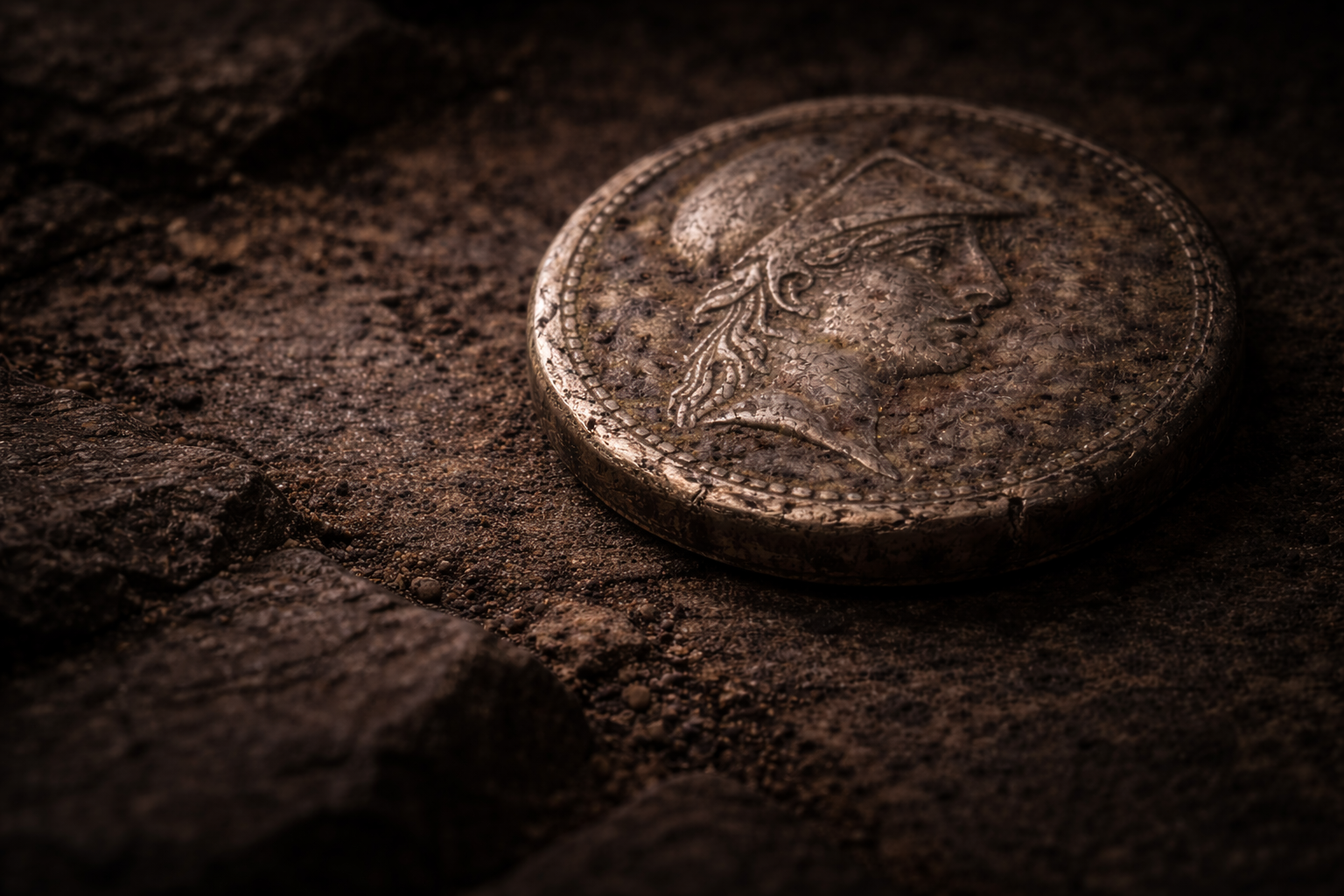
Among the limestone cliffs of northern Greece, explorers uncovered a sealed chamber untouched since antiquity. Inside, beneath piles of broken amphorae and collapsed stone, they found a handful of coins that should not have survived the centuries. One in particular caught the light—a dull silver piece etched with figures too faint to name. When lifted from the dirt, its surface turned dark as ink.
Scholars called it The Shadow Stater—a coin so ancient it predated the classical mints of Athens and Corinth. Its metal composition defied explanation, a mix of silver and something blacker, denser, almost volcanic. But the locals had another name for it: Nomisma ton Skion—the Money of Shadows.
🏺 The Tomb Beneath the Olive Grove
In 1921, archaeologist Petros Alvanos led a dig near Pella, seeking a forgotten royal burial site. Instead, his team uncovered a narrow staircase descending into a chamber with carved walls depicting both gods and mortals, locked in a spiral dance. At the center lay a marble sarcophagus—and beside it, a single coin resting on a skull.
It was small, unassuming, and yet the air in the chamber grew heavy when it was lifted. The workers claimed the lamps dimmed. One man fainted. Alvanos wrote in his notes: “The coin does not reflect light; it swallows it.”
Within days, strange phenomena plagued the camp—voices in the tunnels, footprints appearing in fresh dust, and the feeling of being watched. When the crew fled, Alvanos remained behind, determined to study his discovery. He compared it to several known staters from Greek treasure legends but found no match.
👁️ The Inscription of Shadows
Under magnification, faint Greek letters appeared around the rim, forming a phrase that chilled even the skeptics: “Phos ginetai skia.” — “Light becomes shadow.” The reverse side bore an image of a man holding a torch, but when the coin was turned upside down, the same figure appeared again—reversed, extinguishing the flame.
Such duality fascinated historians and occultists alike. The torchbearer was identified as Hermes Psychopompos—the guide of souls to the underworld. Some suggested the coin was an offering, meant to pay Hermes for safe passage. Others feared it was something else entirely: a token forged not for the dead, but by them.
When a reporter from Thessaloniki visited the dig site, he noted that Alvanos refused to leave the chamber at sunset. “He says the light hurts the coin,” the journalist wrote. “He speaks to it as if it listens.”
⚰️ The Vanishing of Alvanos
Weeks later, Alvanos disappeared. His tent was found intact, his journal still open to a half-written line: “They come only when the lamps are low…” The coin was gone. The site was abandoned and later sealed by authorities after several workers reported nightmares of faceless figures offering them coins in exchange for silence.
Fifty years later, a collector in London displayed a coin matching the description at a private auction. Before bidding could begin, the lights in the hall failed. When they returned, the coin had vanished from the case—leaving only the imprint of its shadow on the velvet cushion.
The story spread quickly through archaeological circles, compared to other cursed finds such as The Phantom Aureus and The Alchemist’s Gros, whose own tales of obsession and loss seemed eerily similar. But unlike those coins of gold, the Shadow Stater held something colder than greed—memory itself.
Part 2 will continue the legend—revealing the curse’s return in the modern age, the lost caves beneath Pella, and how light itself betrayed its seekers.
🌒 The Return of the Shadow
In 1978, a spelunker named Alexandros Petrou claimed to have found a “mirror coin” while exploring an uncharted cave system near Mount Olympus. He said the object was lodged between stalactites and emitted a faint silver glow even in total darkness. When he brought it to the surface, his companions noticed that their shadows no longer matched their movements. Days later, Petrou vanished. His climbing rope was found neatly coiled at the cave’s mouth—his shadow, according to witnesses, still flickered on the rock face at dusk.
By the 1980s, stories of a forgotten Greek coin that could “store shadows” had reached collectors and museums alike. A few experts dismissed it as folklore, but others noticed a troubling pattern: wherever reports surfaced, light-sensitive photographic film malfunctioned, and reflected images appeared several seconds out of sync, as though the world itself were delayed.
🕯️ The Curator’s Dream
One of the last credible accounts came from Dr. Helena Markou, a curator at the Hellenic Museum of Antiquities. She received an anonymous package containing a single blackened coin wrapped in parchment. The note inside read: “Returned from the depths. Do not expose to dawn.”
That night, Helena dreamed of walking through endless corridors lit by dying torches. A figure followed her, whispering in Greek, “Phos ginetai skia”—light becomes shadow. When she awoke, the coin was gone, and every mirror in her apartment was fractured from the center outward.
🌗 The Cave Beneath the City
In 2012, engineers digging for a metro expansion in Thessaloniki broke through a forgotten passage leading to a massive limestone cavity. Inside, they found carvings identical to those recorded in Alvanos’s 1921 journal—and a single inscription on the wall, scrawled in soot: “He paid in light.” No coin was recovered, but one worker reported his phone’s flashlight refusing to switch off for hours afterward, even without a battery.
Scholars now argue the Shadow Stater was less an artifact and more an ancient metaphor—an emblem of duality, the line between illumination and ignorance. But collectors still whisper that the coin appears once every few decades, drawn to places where light and darkness collide: theaters, tunnels, eclipses, screens.
And somewhere, they say, Hermes still waits at the mouth of the cave, torch in hand, smiling as he trades one more coin for one more shadow.
💀 Reality Check
While no verified “Shadow Stater” has been cataloged, several ancient coins from Macedon and Thessaly display imagery of Hermes Psychopompos and torches used in funerary contexts. Greek burial customs often included ancient coins in tombs placed on the mouth or eyes of the deceased to pay Charon or Hermes for safe passage to the underworld. Caves near Pella and Olympus were indeed used for mystery rites dedicated to gods of transition and death, strengthening the myth’s archaeological plausibility. The legend’s imagery—light, shadow, and reflection—may symbolize the eternal tension between knowledge and fear in Greek mysticism.
💭 Final Thought
Light defines shadow, and shadow gives light its meaning. The Shadow Stater reminds us that truth, once unearthed, always carries its echo in the dark. Some coins are minted to spend, others to remember—and a few, like this one, to remind us that curiosity itself has a price.
🔗 Discover more ancient coin legends on the HistoraCoin YouTube Channel
Read also: The Phantom Aureus, The Alchemist’s Gros, and The Eclipse Denarius.