🟠 The Oracle of Bronze — The Coin That Predicted an Empire’s Fall
⏳ Estimated reading time: 11 minutes
The Oracle of Bronze — The Coin That Predicted an Empire’s Fall
Every empire listens to its prophets—until the prophecy speaks in metal.
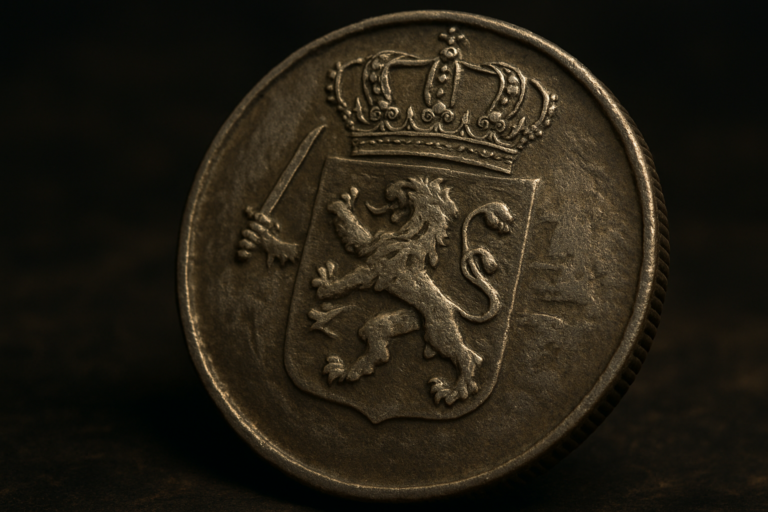
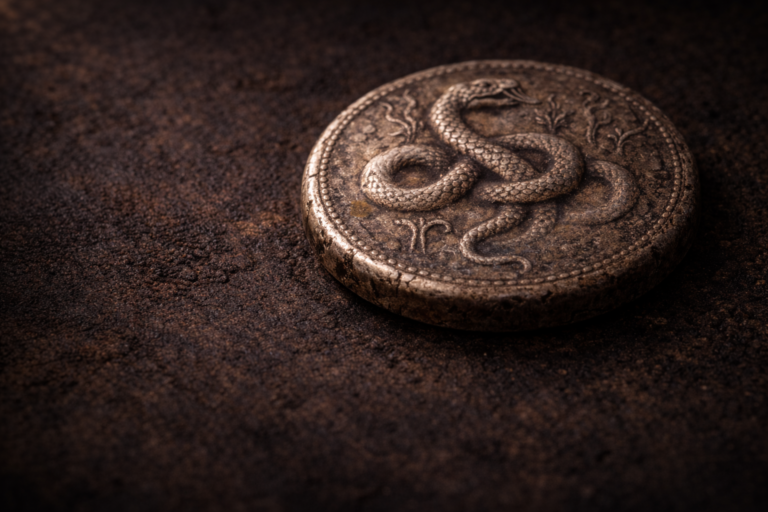
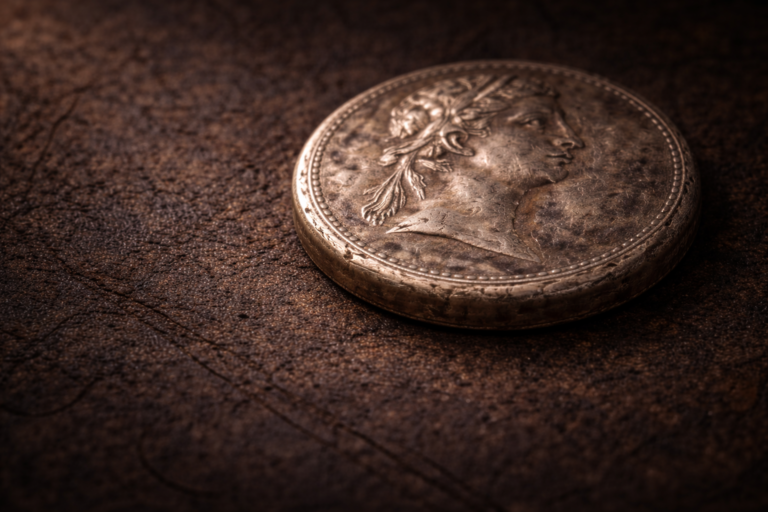
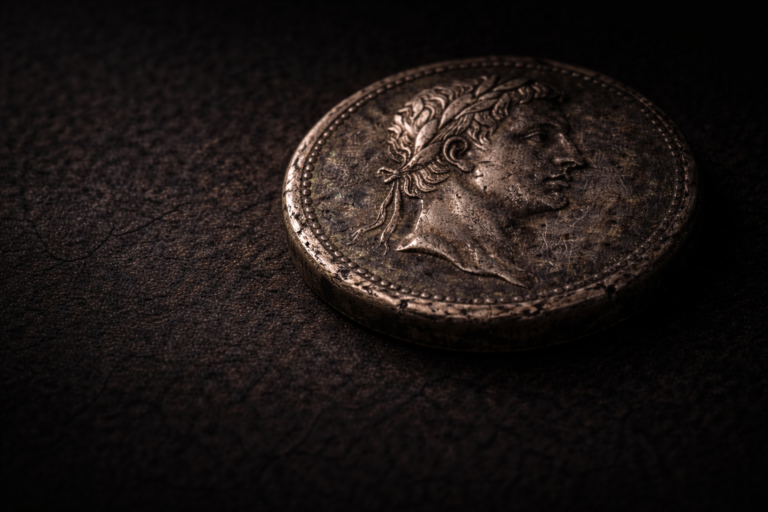
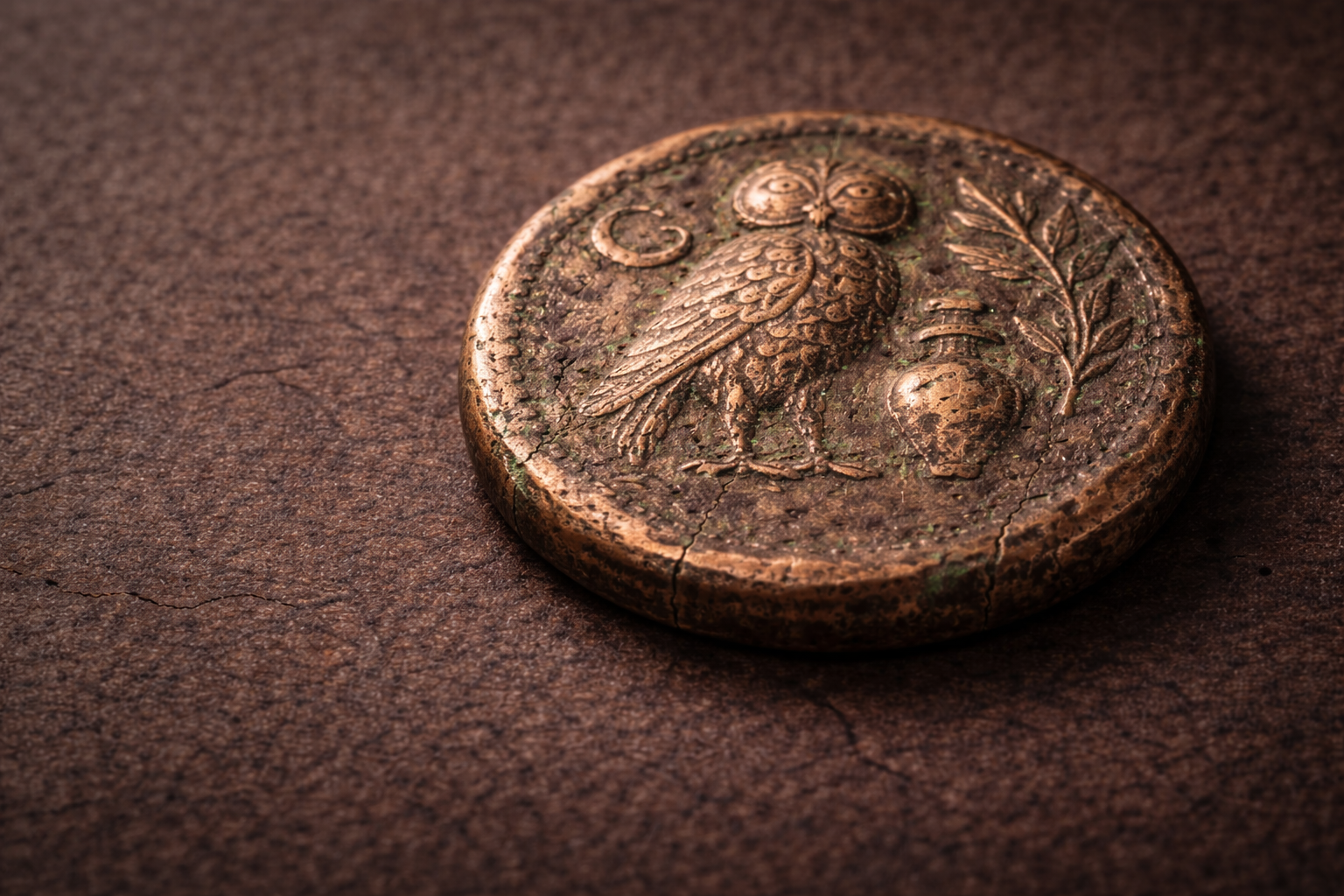
In 1911, during excavations near the ancient city of Antioch, archaeologists unearthed a bronze coin unlike any known Roman issue. Its surface bore no emperor’s likeness, only an image of a crumbling wall and a burning eagle. Around the edge, an inscription in archaic Latin read: “Quando avis cadet, imperium morietur.” — “When the bird falls, the empire dies.”
The artifact was immediately nicknamed “The Oracle of Bronze.” Historians believed it to be a symbolic warning minted during a time of rebellion. Yet metallurgical testing revealed the coin’s age to be far older—possibly dating back to the late Republic, centuries before any recorded prophecy of Rome’s decline.
🪙 The Emperor’s Omen
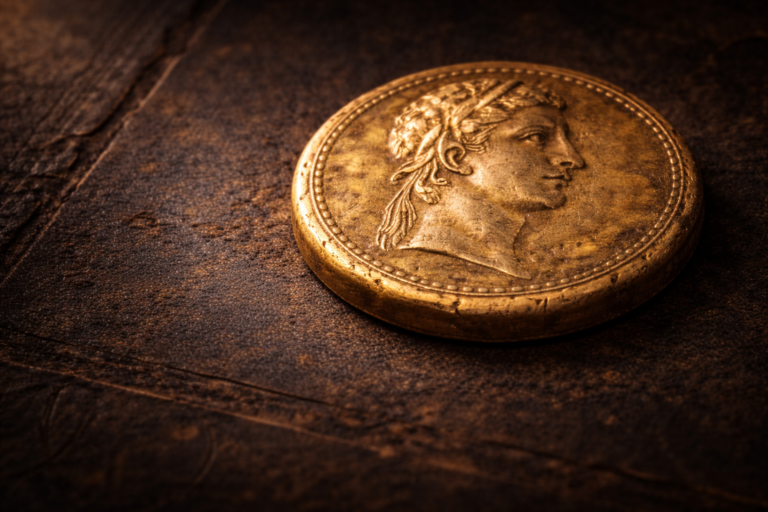
According to lost fragments of the Chronica Arcanum, Emperor Marcus Aurelius was once presented with a coin that “spoke of Rome’s last breath.” The description matched perfectly: bronze, heavy, bearing the image of a burning eagle. The emperor, deeply superstitious, ordered the coin destroyed. But when the hammer struck it, the metal cracked without breaking, releasing a faint ringing sound that echoed for minutes.
That same night, an earthquake shook the city—cracking statues, splitting temples, and toppling the eagle that crowned the Capitoline gate. The emperor called it coincidence. The priests called it a warning.
He ordered the coin sealed inside the Temple of Jupiter beneath molten bronze, declaring: “Let prophecy drown in silence.” Yet, according to temple records, the coin was stolen within a year. Every priest who had handled it died within months—each from heart failure during a thunderstorm.
🌩️ The Rediscovery
When the artifact reappeared in 1911, it was unearthed from a layer of ash and rubble dating to the final siege of Antioch in the 13th century. Strangely, its inscriptions remained sharp and uncorroded, while the rest of the bronze nearby had turned green with age. The discoverer, Dr. Heinrich Volmer, described hearing a “low humming” when he touched the coin—a vibration that grew stronger during storms.
Within a week of its discovery, Volmer’s expedition camp was struck by lightning, killing two men and setting fire to the tent where the coin had been stored. The artifact was recovered intact, lying in the ash, still warm to the touch.
Part 2 will reveal how modern researchers linked the Oracle of Bronze to a hidden Roman prophecy, the strange experiments that tried to decode its “sound,” and how one historian’s final message predicted its return.
🌘 The Sound of the Prophecy
In 1978, the Oracle of Bronze was brought to the University of Bologna for acoustic testing. Researchers suspected that its faint humming might be caused by electromagnetic resonance within impurities of the ancient alloy. Using sound frequency mapping, they discovered that the coin vibrated naturally at 432 Hz—the same pitch used in ancient Roman hymns to Jupiter.
But as the experiment continued, the instruments began picking up irregular pulses. Every few minutes, a distinct metallic tone emerged—six short beats followed by one long, resembling the pattern of a Roman military signal. When converted into Latin numerals, the sequence spelled the year “MMXIV.”
At first, the researchers thought it was an anomaly. But when one of them, Professor Giuliano De Sanctis, pointed out that “MMXIV” translated to 2014, he joked, “Perhaps that’s when our empire will fall.” Within days, De Sanctis suffered a fatal heart attack during a thunderstorm—the same pattern that haunted the priests centuries before.
⚡ The Final Translation
After his death, De Sanctis’s assistant reviewed his notes and found one final entry: “The coin does not predict the fall of Rome—it predicts the fall of every empire that hears it.”
Since then, the Oracle of Bronze has vanished once again. Some believe it lies sealed in the archives of the Vatican; others claim it was buried in concrete beneath the old city walls of Rome to prevent further catastrophe. Yet, during heavy storms, visitors to the ruins of Antioch still report hearing a faint metallic ringing in the wind—steady, rhythmic, like a warning repeating through centuries.
💀 Reality Check
Although there is no verified record of a prophetic “Oracle of Bronze,” several ancient Roman and Greek coins featured symbolic imagery of eagles, lightning, and collapsing walls—representations of divine wrath or imperial decline. Bronze coins are also known to produce resonance when struck, a property that may have inspired legends of “speaking metal.” The connection between acoustic vibration and prophecy appears in Roman ritual texts, where priests interpreted the sound of struck bronze as omens. The myth of the Oracle of Bronze likely merges these ancient superstitions with modern fascination for cursed artifacts and lost empires.
💭 Final Thought
Empires rise on silence and fall to echoes. The Oracle of Bronze reminds us that even history has a heartbeat—and when it stops, the world listens. Maybe prophecy isn’t spoken by gods at all, but by the metal that remembers their voices.