All Australian Rare Coins | History, Stories, and Historical Significance
Estimated reading time: 12 minutes.
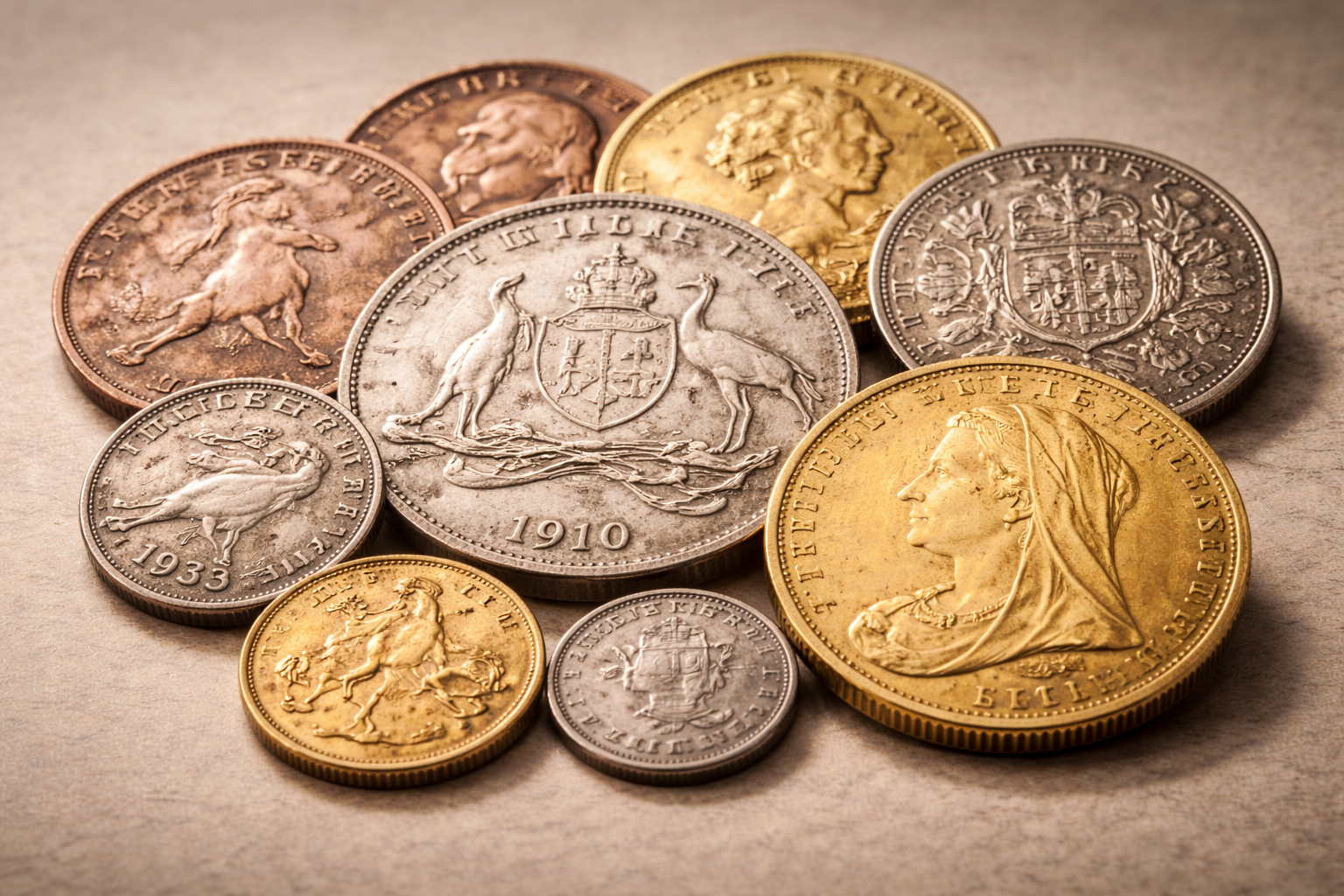
Australia’s coin history is not defined by numbers alone. It is shaped by geography, migration, political change, and the gradual formation of a national identity.
Some Australian coins became notable because of when they were introduced. Others became notable because of how they reflected moments of transition.
This article explores Australian coins that stand out for historical and cultural reasons, not because of modern market interpretations.
Australia Before a National Coinage
Before Australia issued its own coins, the continent relied on a mixture of foreign currencies.
British coins circulated alongside Spanish dollars and other international pieces, reflecting Australia’s early dependence on global trade.
This chaotic system shaped the need for a distinct monetary identity.
The Birth of Australian Coin Identity
With federation in the early twentieth century, Australia began to express itself through coinage.
Coins became tools of communication, carrying symbols meant to unify a geographically vast nation.
Native animals, monarch portraits, and national emblems played a central role.
The Penny and Halfpenny Era
Early Australian pennies and halfpennies mirrored British traditions while slowly introducing local symbolism.
These small denominations were the backbone of daily commerce.
Their wear tells stories of everyday Australian life rather than official policy.
Coins as Witnesses to Economic Change
Australia’s coinage evolved alongside global economic shifts.
Material changes reflected shortages, technological improvements, and changing priorities.
Coins quietly recorded these adjustments long before history books did.
Notable Silver Issues in Australian History
Silver coins marked an important phase in Australia’s monetary development.
They were symbols of trust at a time when physical currency mattered deeply.
Their eventual withdrawal marked the beginning of a new financial era.
The Decimal Transition
The move to decimal currency reshaped how Australians interacted with money.
Designs became more accessible and distinctly national.
This transition remains one of the most important chapters in Australian numismatic history.
Animal Symbolism on Australian Coins
Australia’s wildlife plays a unique role in its coinage.
Kangaroos, emus, and other native species communicate identity without words.
These choices helped differentiate Australian coins from colonial predecessors.
Commemorative Issues and National Memory
Some coins were issued to mark anniversaries and events.
These pieces serve as physical reminders of shared experiences.
They were never meant to circulate endlessly, but to preserve memory.
Coins That Reflect Political Authority
Portraits of monarchs reflect Australia’s constitutional structure.
Changes in portrait style reveal evolving relationships between tradition and modernity.
Coins act as silent political documents.
Why Some Coins Become Notable Over Time
Notability is rarely planned.
It develops through circumstance, survival, and context.
Coins gain meaning long after they leave circulation.
Historical Significance Over Modern Interpretation
At HistoraCoin, emphasis is placed on understanding coins within their historical moment.
Australian coins reveal how a young nation learned to express itself visually.
Their importance lies in representation, not exchange.
Coins as Cultural Artifacts
Coins belong to museums as much as they belong to wallets.
They preserve choices made by artists, governments, and societies.
Each design is a snapshot of national thinking.
Australia’s Coins in a Global Context
Australian coinage did not evolve in isolation.
It responded to international trends while maintaining local character.
This balance defines its uniqueness.
What Studying Australian Coins Reveals
Coins reveal what nations value symbolically.
They show how identity is communicated subtly and consistently.
Australian coins tell a story of independence shaped by heritage.
Final Thoughts
Notable Australian coins are not defined by numbers or rankings.
They are defined by story, context, and survival.
By studying them historically, we gain a deeper understanding of Australia itself.
And in those small details, history continues to speak.