American Eagle Silver 1 Oz Coin | Design, Symbolism, and Modern Minting
Estimated reading time: 11 minutes.
Some coins are created to circulate through countless hands. Others are created to represent an idea.
The American Eagle Silver one ounce coin belongs firmly to the second category. It is not a relic of ancient commerce, nor a forgotten artifact of a distant empire. Instead, it is a modern expression of national identity, symbolism, and minting tradition.
To understand this coin properly, one must look beyond numbers and focus on what it was designed to communicate.
The Rise of Symbolic Coinage in the Modern Era
By the late twentieth century, coinage in the United States had already undergone dramatic transformation.
Daily transactions relied increasingly on paper currency and digital systems, while coins took on a more symbolic and commemorative role.
This shift allowed mints to focus not only on utility, but on storytelling, heritage, and visual identity.
The American Eagle Silver coin emerged from this cultural transition.
Why the American Eagle Was Chosen
The eagle has long served as a national emblem of the United States.
It represents strength, independence, and continuity, qualities deeply woven into American political imagery.
Choosing the eagle for a modern silver coin was not a coincidence.
It connected contemporary minting to centuries of symbolism without relying on spoken language.
The Walking Liberty Design
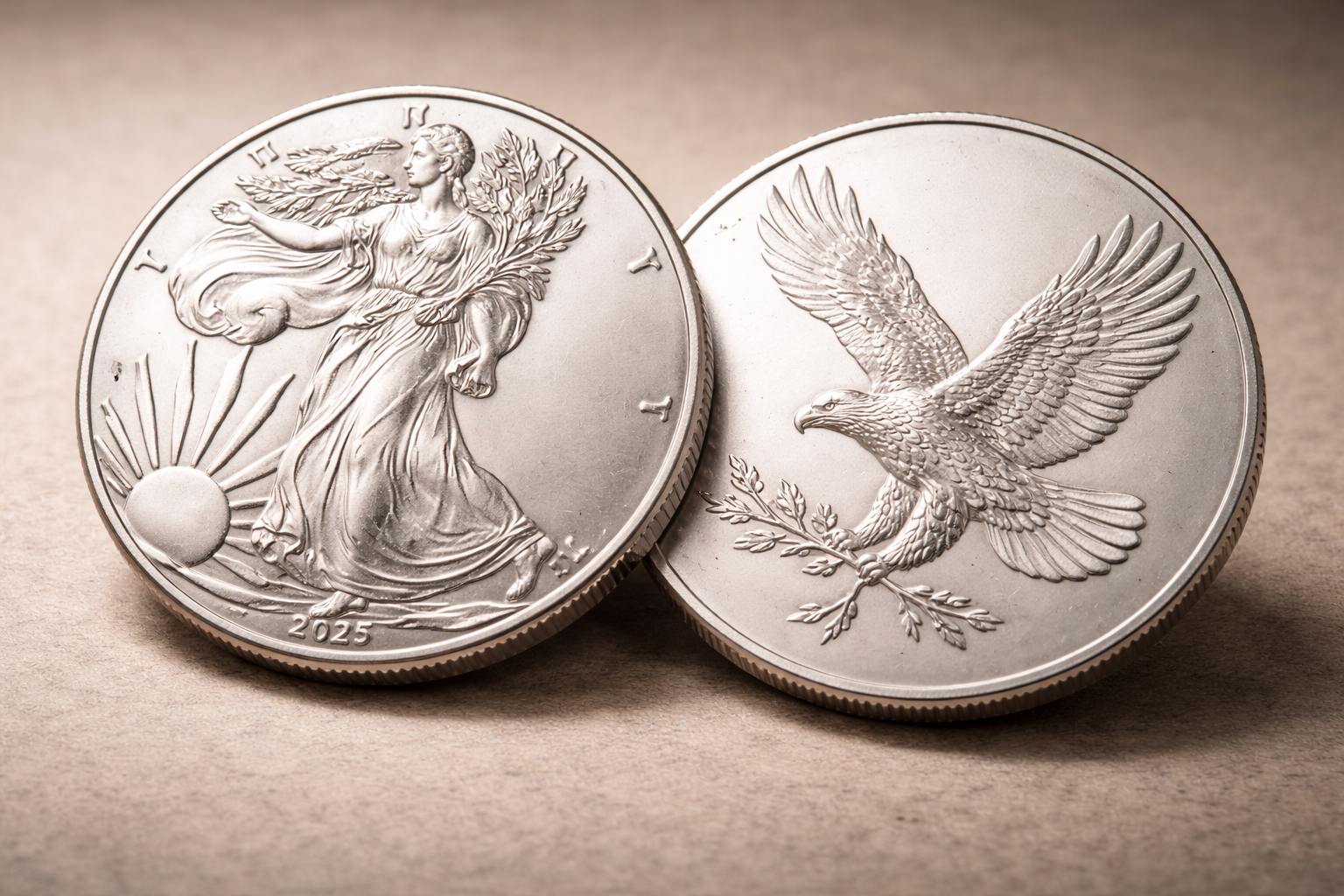
One of the most striking features of the American Eagle Silver coin is its obverse design.
Walking Liberty, originally created in the early twentieth century, portrays a forward moving figure wrapped in the American flag.
The image suggests progress rather than power, movement rather than dominance.
This choice reflects a philosophical shift in how modern nations present themselves.
A Design Rooted in Earlier Coinage
Although the coin itself is modern, its artistic roots reach back decades.
By reusing a historic design, the United States Mint created continuity between past and present.
The coin does not attempt to reinvent national identity.
Instead, it reinforces a familiar visual language that Americans recognize instinctively.
The Reverse and National Authority
On the reverse side, the eagle appears in a more formal and heraldic style.
This contrast between motion on the obverse and authority on the reverse creates visual balance.
Together, both sides communicate freedom guided by structure.
It is a subtle but deliberate message.
Modern Minting Standards
Unlike historical coins struck under variable conditions, modern minting follows strict technical standards.
Precision, consistency, and quality control are central to contemporary production.
This reflects a broader change in how governments approach manufacturing and public trust.
Coins are no longer merely functional. They are representations of institutional reliability.
The Role of the United States Mint Today
The U.S. Mint no longer exists solely to supply circulating currency.
It also acts as a curator of national imagery.
Each design decision passes through layers of review, ensuring alignment with historical values and public expectations.
The American Eagle Silver coin is one result of that careful process.
A Coin Without Circulation Pressure
Unlike pennies or quarters, this coin was never intended for everyday transactions.
Its purpose is representational rather than transactional.
This allows it to exist outside the wear and loss that shape circulating coinage.
As a result, its condition remains stable across time.
Educational Value Over Practical Use
From an educational perspective, the American Eagle Silver coin offers insight into modern national symbolism.
It shows how governments continue to use physical objects to express identity in a digital age.
This is particularly important as fewer people interact with coins daily.
Physical symbols still matter.
What This Coin Represents Culturally
Coins have always been more than metal.
They are statements of authority, belief, and collective memory.
The American Eagle Silver coin communicates stability and continuity at a time when many systems feel temporary.
Its message is subtle but enduring.
The Difference Between Historic and Modern Coin Stories
Historic coins tell stories of survival, trade, and empire.
Modern coins tell stories of identity, design, and institutional values.
Both are important, but they speak different historical languages.
Understanding this distinction prevents misinterpretation.
Why Modern Coins Still Deserve Study
It is easy to dismiss modern coinage as uninteresting.
Yet future historians will rely on these objects to understand our era.
They reveal what societies chose to preserve and display.
Silence, too, is a form of historical evidence.
Beyond Numbers and Measurements
Focusing solely on weight or composition misses the broader picture.
The true value of studying this coin lies in interpretation, not calculation.
It invites questions about symbolism rather than exchange.
That makes it a legitimate subject of historical inquiry.
The Coin as a Time Capsule
Every era leaves behind artifacts that summarize its priorities.
The American Eagle Silver coin reflects an age focused on design clarity, heritage, and controlled production.
It does not shout.
It reassures.
Final Thoughts
The American Eagle Silver one ounce coin is not a relic of the distant past.
It is a mirror of modern values expressed through traditional form.
By studying it historically rather than financially, we gain insight into how nations speak through objects.
And in that quiet language, much can be learned.