Coin Stories That Bring History to Life
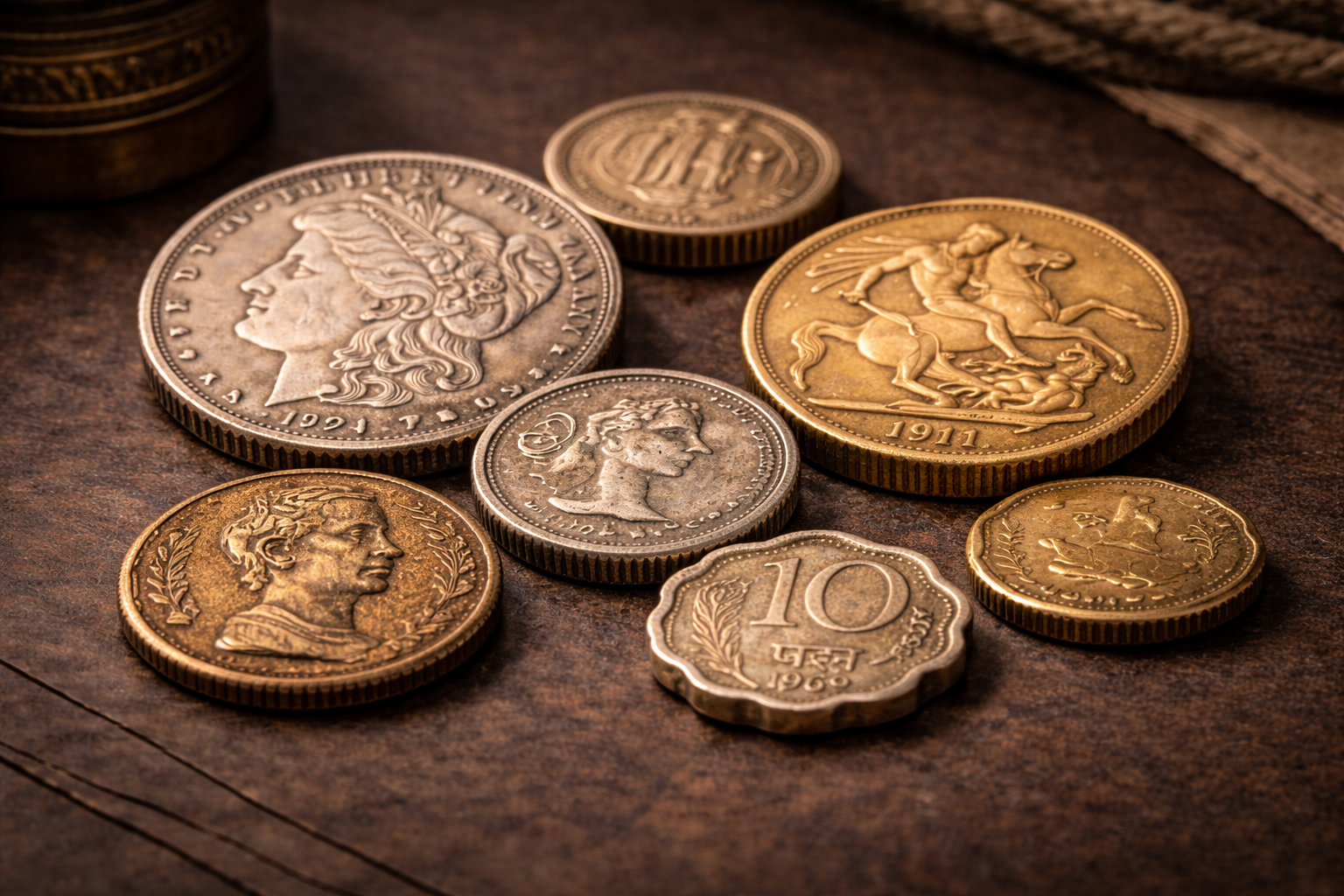
Coin Stories That Bring History to Life
True-to-life tales where metal meets memory—told like a friend sharing a good story over coffee.
Some people read history. Others hold it. A coin can be small—no larger than a button—yet it carries decades, centuries, sometimes entire empires in its details. In this collection of stories, we’re not chasing prices or charts. We’re following people, places, and moments: the handwritten note tucked in a coin envelope, the thrill of a flea-market find, the quiet weight of something genuine. If you’ve ever paused to admire a worn date or a portrait softened by time, these are your kind of stories.
A Family Letter and a Faded Sovereign
The first story begins in a shallow wooden drawer—one of those old desks with squeaky runners. Inside, a cloth pouch, a folded letter, and a gold sovereign dulled by fingerprints. The letter was dated 1942, wartime. A grandfather wrote to his young bride from overseas: “If this coin ever reaches you, it means I found a way to keep a promise.” Years later, the family discovered the note and the coin together, tucked in with ration books and a black-and-white photograph.
No auction house needed to tell them its value. The sovereign had a story minted on one side and handwritten on the other. When they passed it down again, it wasn’t “just gold.” It was a memory you could hold, a circle of trust that outlived the war, the decades, and the drawer.
The Flea Market Miracle
You know that feeling when you’re not looking for anything in particular—and find something you’ll never forget? That’s what happened to Maya at a Sunday flea market. A cardboard box of mixed foreign coins sat under a table, a hand-scribbled sign: “All coins, one price.” She almost walked past. Almost. A thin silver edge caught the light, and she paused.
Inside was a small, slightly off-center silver coin with a design she didn’t recognize. The vendor shrugged; he had no idea. Maya bought it for the price of a sandwich and took it home. That evening, she matched the symbols to an old mint mark—turns out it was a modest but scarce provincial issue, not a fortune, but a genuine survivor from a century and a half ago. What mattered most wasn’t the resale value; it was the moment of discovery. She had rescued a story from a dusty box.
The Teacher and the Copper Cent
Mr. Alvarez kept a battered copper cent on his desk—the kind you’d skim past in a pocketful of change. Every year, on the first day of class, he’d hold it up and ask, “What’s this worth?” Someone would say, “One cent.” Another would say, “Probably nothing.”
Then he’d turn the coin under the classroom light and talk about the year stamped on it: what life looked like then, what people earned, what they feared, what they dreamed. “It’s not worth one cent,” he’d say at the end. “It’s worth a conversation.” Students remembered the lesson long after they forgot the test date. The coin stayed the same. The meaning grew.
An Heirloom’s Second Chapter
Not every heirloom arrives shiny or celebrated. Jay inherited a shoebox: scattered coins, some tarnished, some common, a few in paper flips with cryptic pencil notes. At first, it felt like a chore—sorting, looking up dates, trying to decode abbreviations. But the notes were the map. “Granddad’s first silver dollar—found at the depot, 1956.” “Saved from the July overtime.” “Traded for the missing year.”
By the time Jay finished, the shoebox was a biography—of patience, of small sacrifices, of a hobby that stitched years together. He put the notes back with the coins and added his own line: “Box reorganized with coffee and care, 2025.” That’s how heirlooms stay alive: one more note, one more chapter.
When a Scratch Becomes a Signature
Collectors love perfection, but stories don’t always come mint state. Lena bought a silver piece with a noticeable scratch across the field. She hesitated—should she pass? The seller told her the scratch likely came from a coin-counting machine decades ago, back when the piece was still doing its job in the world.
She kept it. Later, she realized that scratch made it hers. Every time she looked at it, she pictured the coin’s working life: change trays, bus fares, market stalls, ordinary hands doing ordinary things. That imperfection wasn’t damage; it was a signature from its journey.
The Moment the Past Says “Hello”
Ever notice how some coins make you lean closer? A date barely visible, a portrait softened by circulation, a rim nick that somehow points to a particular year’s minting rush. You tilt the coin, and the past says “hello.” That’s the thrill many of us chase—not just ownership, but contact. We’re not only collectors of metal; we’re collectors of moments.
How to Listen for a Coin’s Story
- Ask where it’s been: Flea market? Family drawer? Dealer tray? The trail matters.
- Read the edges: Inscriptions, reeding, even little bumps hint at use and origin.
- Notice the tone: Natural silver toning can be a timeline—colors grow with years.
- Keep the notes: Dates, places, and people turn a coin into a chapter you can pass on.
- Accept the human parts: A nick, a rub, a fingerprint—sometimes that’s the best line in the story.
Care That Preserves the Tale
A story fades if you smudge the ink. Same with coins. Hold them by the edges. Store them in inert holders or capsules, somewhere dry and stable. Avoid harsh cleaning—especially the kind that erases detail to force a shine. Patience beats polish. Let the coin keep its voice.
Why These Stories Matter
In fast-scroll times, coins slow us down. They ask for a second look and give us a second chance at understanding—our families, our neighborhoods, our shared past. We learn that value isn’t only measured in melt price or auction comps. Sometimes, value is an afternoon spent with a shoebox, or a promise smuggled through a war, or a classroom of teenagers realizing that history fits in a pocket.