Early Exchange Systems in South America

Long before colonial coins, South America already had working systems for paying, trading, gifting, and settling promises. The surprise is not that people exchanged goods. The surprise is how stable and repeatable those exchanges could be.
If you want the deeper foundation of what counted as value before coins arrived, start with this story first. Before Modern Money in South America. Then come back here, because this article zooms in on how the system actually behaved on the ground, day by day.
Table of contents.
- What exchange meant before modern money.
- The trusted goods people accepted again and again.
- Routes that turned local goods into shared standards.
- The social rules that protected fairness.
- How people measured value without coins.
- What a real market day likely felt like.
- What changed when coins entered the picture.
- FAQ.
What exchange meant before modern money.
When we say “exchange system,” it sounds like a cold diagram. But in real life it was warm, social, and sometimes emotional. It was the way a family secured tools for a season. It was how a traveler prepared for risk. It was how communities maintained alliances without writing contracts.
In many places, exchange was not a single act. It was a relationship stretched across time. One transaction created an obligation. The next transaction confirmed reputation. And a third transaction might settle a balance without anyone needing to say “this is a debt.” The system worked because people remembered.
This is why pure barter is not enough as an explanation. Yes, people swapped fish for cloth and salt for pottery. But successful exchange systems are never only about objects. They are about repeatable rules. They are about what a community will accept without a fight.
The trusted goods people accepted again and again.
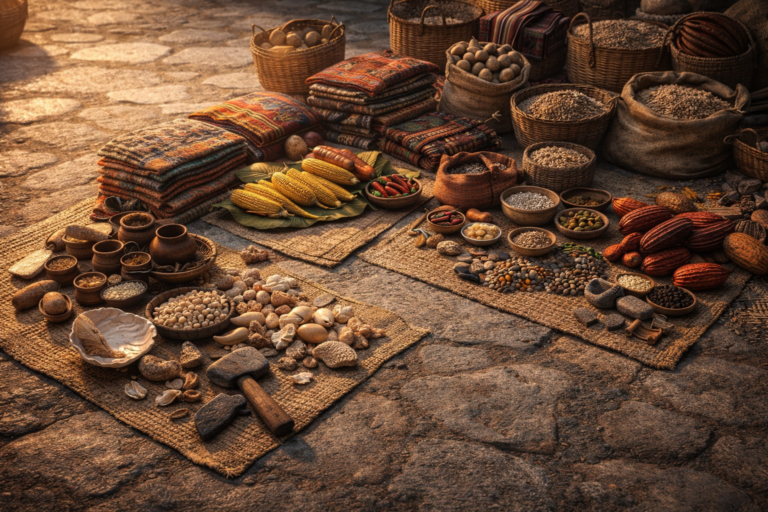
A good “money like” item does two jobs at once. It must be useful or desirable, so people genuinely want it. And it must be recognizable, so people feel safe accepting it from strangers or distant partners.
In South America, different regions favored different goods, but the pattern repeats. The most effective exchange goods were portable. They were hard enough to fake that reputation mattered. And they carried cultural meaning, because meaning creates demand.
| Exchange good. | Where it showed up. | Why it could function like money. |
|---|---|---|
| Textiles and woven goods. | Highlands and organized communities. | Labor intensive, storable, and valued for both utility and status. |
| Shells and marine valuables. | Coasts and inland trade corridors. | Distinctive, rare inland, and easy to recognize in trade. |
| Botanical goods. | Valleys and lowlands. | Countable, portable, and connected to daily life and ritual. |
| Crafted metal objects. | Regions with metallurgy traditions. | Durable, divisible by size or form, and tied to skill and prestige. |
| Pigments, feathers, symbolic items. | Amazon networks and elite exchange. | High status value, difficult to obtain, and socially powerful. |

Notice something important. None of this requires a stamped coin to work. What it requires is shared recognition. Shared recognition is the real technology. The goods are just the carriers.
Textiles are a perfect example. Cloth can be worn. Cloth can be gifted. Cloth can be stored. Cloth can be used to settle obligations. If a community respects the quality and pattern, cloth becomes a language of value. People do not need a mint to understand it.
Shells and coastal valuables show another principle. Rarity is geography. An item common on the coast becomes precious inland. The moment a route reliably moves that item inland, it becomes a repeating signal. That signal is what lets people trade faster.
Routes that turned local goods into shared standards.
The quiet secret behind early exchange systems is movement. A valuable object that never leaves your village is only a treasure. A valuable object that keeps moving between communities becomes a standard. Standards are created by repetition.
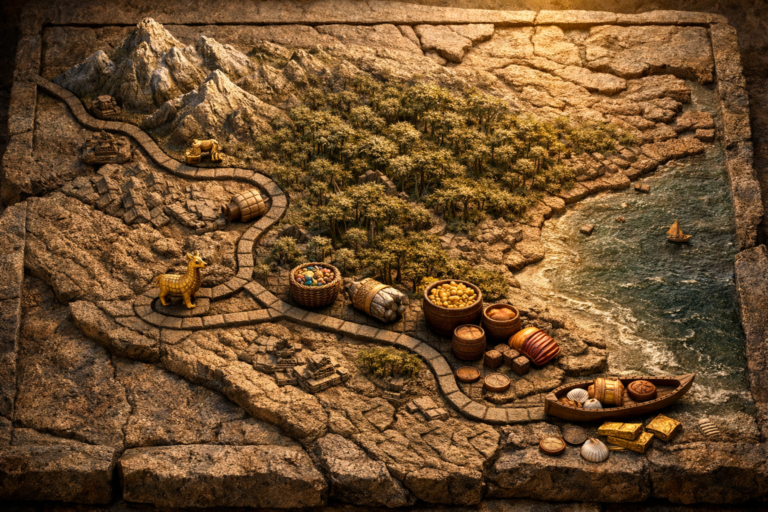
South America is a map of sharp contrasts. Mountains, coasts, deserts, forests, and river systems exist close together. That diversity creates trade pressure. One region has what another lacks. And once people learn that a route works, they keep using it.

In the Andes, elevation itself created a trade logic. Highlands produced certain animal products, fibers, and cold climate crops. Lower valleys offered different plants and materials. Coastal regions carried marine goods and salt and fish. The same community could maintain relationships across these layers because the geography encouraged it.
In the Amazon, rivers played the role of roads. Movement followed water. Exchange goods followed the same channels. When a river corridor connected many groups, it encouraged a shared sense of what was valuable, because travelers needed items they could trade for food, shelter, and safe passage.
This is also where reputation becomes real. If a trader shows up every season with the same quality of goods, they become part of the system. If a route becomes known for safety, the goods traveling on it become safer to accept. In that way, routes do not only move objects. They move confidence.
The social rules that protected fairness.
A functioning exchange system needs enforcement, but not always in the form of police or written law. Many societies enforce fairness with memory and visibility. If trade is public and repeated, cheating becomes expensive. Not because someone will arrest you. Because people will stop trading with you.
Think of it like this. In a coin based system, trust hides inside the object. In a non coin system, trust is the conversation around the object. People ask where it came from. They notice craftsmanship. They judge freshness, purity, rarity, and honesty. Those judgments are the security layer.
Another rule is reciprocity. Many exchanges were not meant to be equal in the moment. They were meant to be balanced over time. That changes everything. If you are building a relationship, you do not need a perfect calculation today. You need a future expectation that the relationship will remain fair.
This is also why certain goods become “payment goods.” They are the easiest way to restore balance without reopening a negotiation. You give something widely respected and the conversation becomes shorter. The network stays smooth.
How people measured value without coins.
People often assume that without coins there is no measurement. In practice, measurement simply takes a different form. Instead of a fixed unit stamped in metal, measurement is built through comparison and custom.
A woven textile might have categories everyone recognizes. Quality grades exist even without written labels. A shell type might be more prestigious than another. A botanical good might be counted by bundles, handfuls, or containers that become standardized through habit. Standardization can be cultural, not official.
| Measurement style. | How it worked. | Why it was enough. |
|---|---|---|
| Bundles and containers. | Goods were traded in known amounts by basket, bag, or tied bundle. | Habit creates a shared sense of what a “normal” amount looks like. |
| Quality categories. | Craft and freshness signaled higher or lower value. | People can judge quality quickly in public exchange. |
| Comparable equivalents. | Communities learned repeatable equivalences for common trades. | Repeated markets train shared expectations. |
| Obligations over time. | Some exchanges were balanced later rather than immediately. | Relationships become the ledger. |
The main point is simple. A coin is not the only way to create a unit. Any community that trades repeatedly will invent mental units. Those units might be named or unnamed, but they exist. And they guide behavior.
What a real market day likely felt like.
Imagine arriving early, before the heat. The market is not only commerce. It is news. It is social checking. It is relationship maintenance. Someone is trading goods. Someone is watching for reputation. Someone is deciding who they can trust next season.
You would see familiar patterns. People grouping around trusted traders. People inspecting quality with practiced hands. People using conversation like a contract. And you would also see something that modern money hides. You would see value being negotiated in human language.
A traveler might carry a small set of accepted goods precisely because they want flexibility. They might not know what the next community needs. But they know what that community respects. So they carry goods that are most likely to be accepted. That is the logic of early exchange systems.
This is also why coins can spread quickly once they appear. The mental framework already exists. People already know how to rank quality. People already know how to punish cheating. People already know how to create shared expectations. A coin is simply a new tool placed into an old human pattern.
What changed when coins entered the picture.
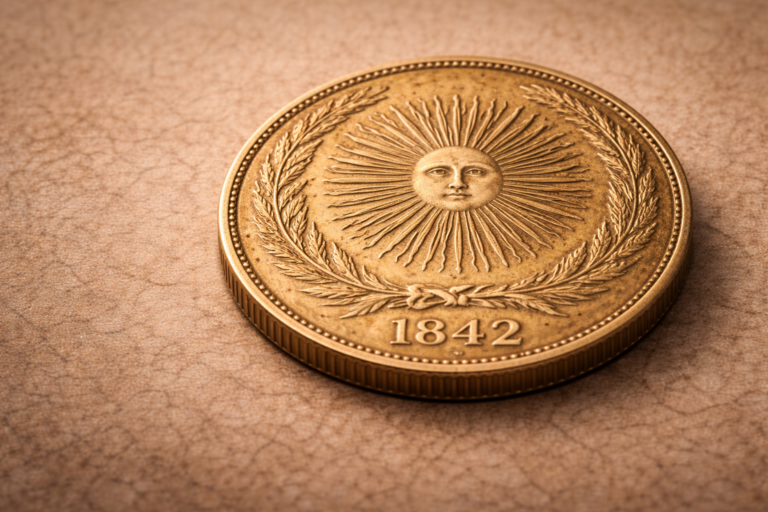
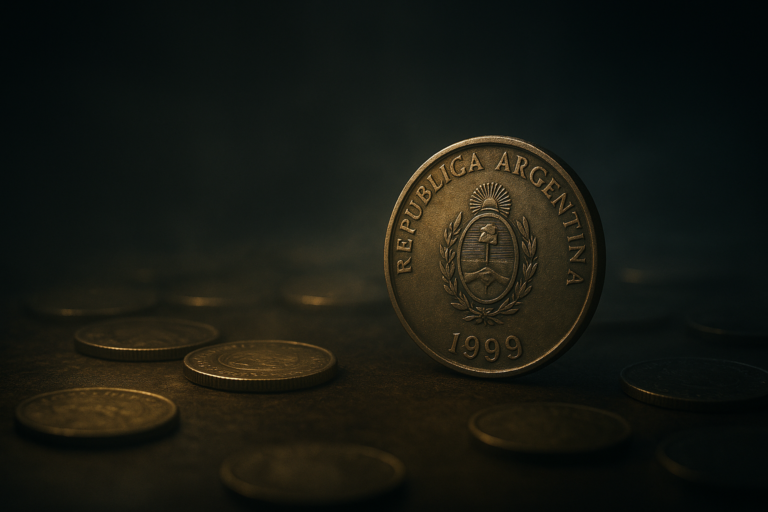
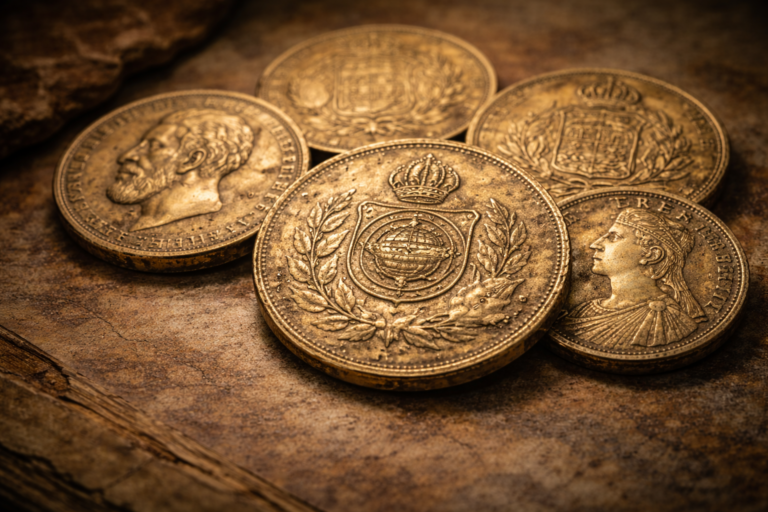
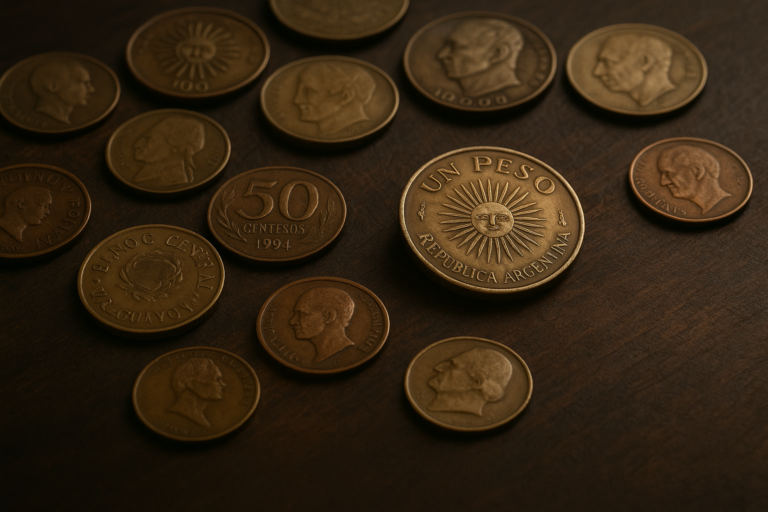
When coins entered South America through colonial systems, they brought a very specific advantage. They made exchange easier with outsiders who did not share local relationships. If you do not have time to build reputation, a standardized object helps.
Coins also enabled a different kind of control. Taxes and debts become easier to demand when a unit is enforced. In many historical situations, measurability is not neutral. It can be used for coordination, but it can also be used for extraction.
But older exchange habits did not vanish overnight. People keep what works. In many communities, trusted goods continued alongside coins for a long time. That is normal human behavior. Systems overlap. Standards compete. Daily life chooses the most practical option.
Related HistoraCoin stories.
FAQ.
Was it only barter.
Not only. Direct swapping happened, but many systems relied on widely accepted valuables, reputation, and obligations balanced over time. That is why some goods acted like money without being coins.
What made an exchange good trustworthy.
Recognition, portability, durability, and social meaning. The strongest goods were those that many communities agreed on repeatedly, especially along reliable routes.
Did these systems have standards.
Yes, but often cultural instead of official. Standards appeared through repeated market behavior, quality categories, bundles, and shared expectations about fair equivalents.
Did coins replace older systems immediately.
No. Older exchange habits often continued alongside coins for a long time because daily life keeps what is practical and trusted.