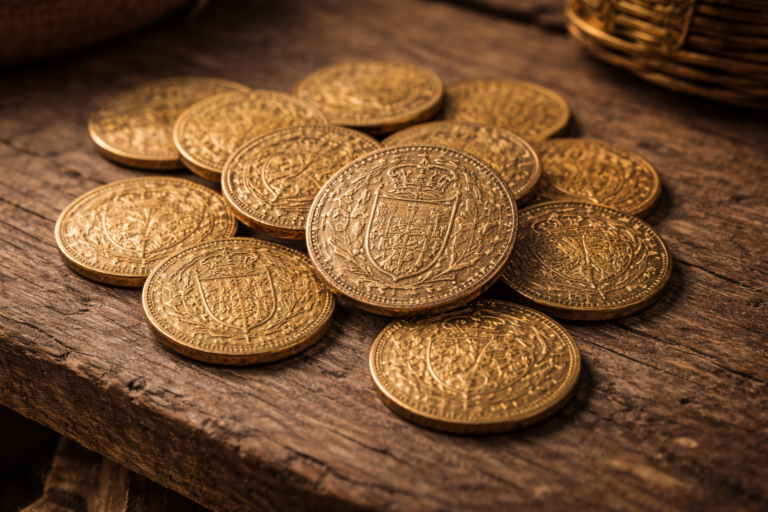
How Medieval People Paid Without Coins
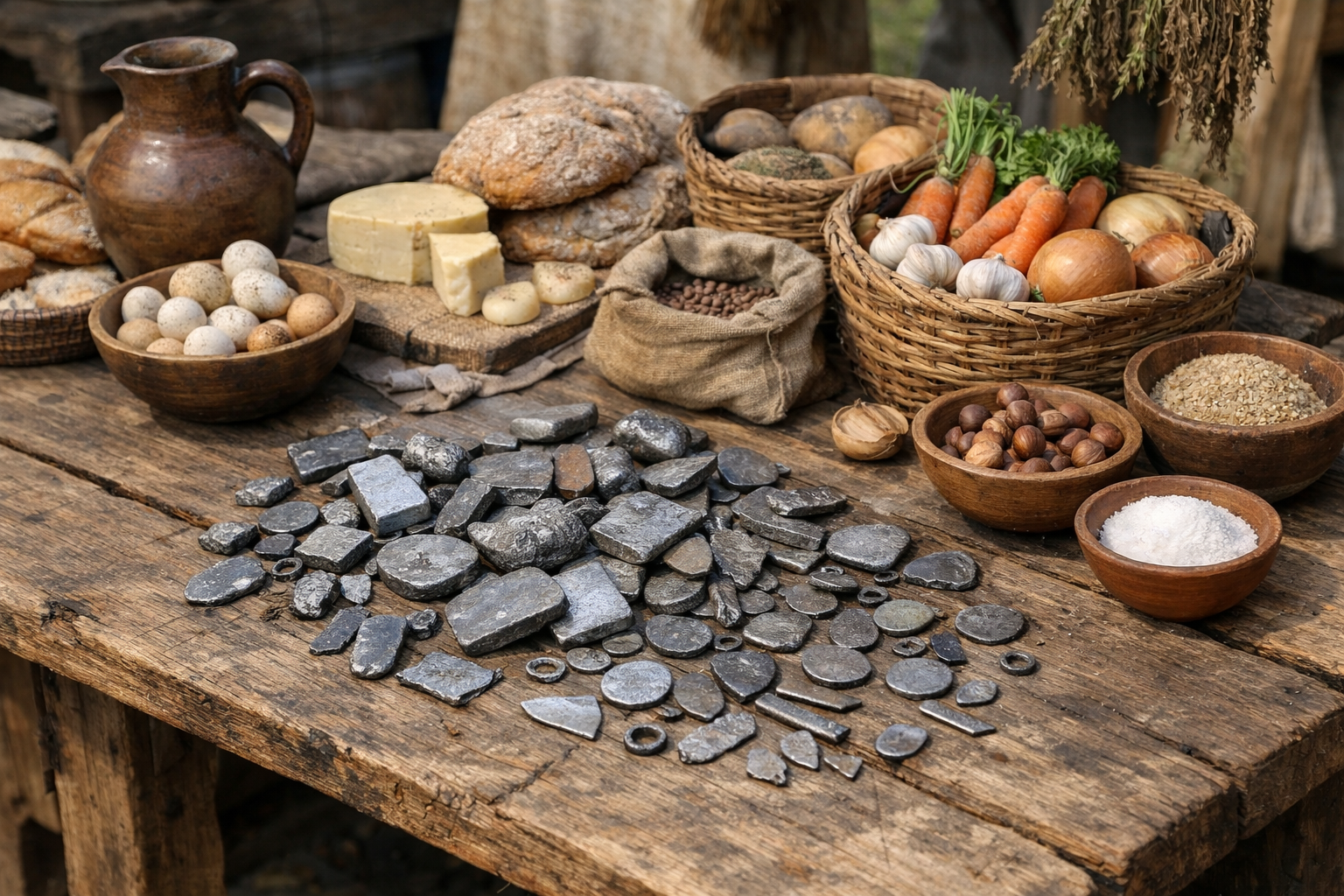
Estimated reading time. About 15 to 18 minutes.
When we imagine the Middle Ages, we often picture heavy purses filled with coins, clinking in the hands of merchants and travelers. This image feels natural, but it is not entirely accurate.
For much of medieval life, coins were not always available, not always convenient, and not always trusted. People learned to pay, trade, and settle obligations using methods that relied more on materials, labor, and social agreement than on stamped currency.
This article continues the historical path explored in the previous study on why ancient people trusted metal more than gold, which can be found here: Why Ancient People Trusted Metal More Than Gold.
Coins and the medieval misconception.
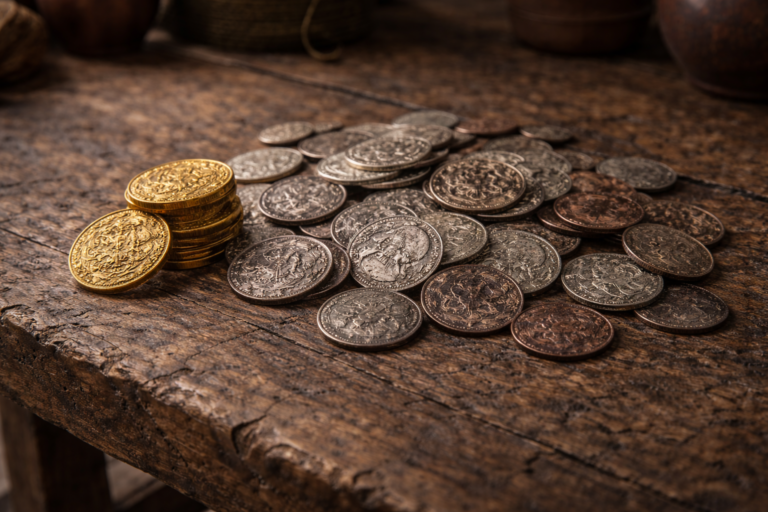
The presence of coins in medieval Europe varied widely by region and period. Mints existed, but their output was limited. Coins traveled unevenly. In many rural areas, people might rarely see new coinage at all.
Political instability, local shortages of precious metal, and the high cost of minting all restricted the steady flow of coins. Even where coins existed, they were often hoarded, saved for large transactions, or controlled by elites rather than used for daily exchange.
This meant that ordinary people could not rely on coins alone to manage everyday economic life. They needed alternatives that worked under conditions of scarcity and uncertainty.
Those alternatives did not represent failure. They represented adaptation.
Payment as practice rather than object.
In medieval communities, payment was not always a physical transfer of a coin. It was often a process, a relationship, and sometimes an agreement extended across time.
A farmer might provide labor in exchange for future use of land. A craftsman might repair tools in return for grain at harvest. A tenant might owe rent in produce rather than money.
These arrangements depended on trust, memory, and social obligation. They worked because people shared expectations about fairness and responsibility.
In such systems, value was measured less by immediate possession and more by reliability. A promise could function as effectively as a coin when supported by reputation.
Metal as everyday settlement.
Where material payment was needed, common metal remained central. Iron, copper, and other workable metals circulated in forms that were not official coins but were widely understood.
Metal fragments, bars, tools, and semi finished pieces could settle debts, pay wages, or balance accounts. Their usefulness made them acceptable. Their durability made them trustworthy.
This practice connected directly to the earlier pattern of valuing metal for its function rather than its shine. The medieval economy inherited that logic.
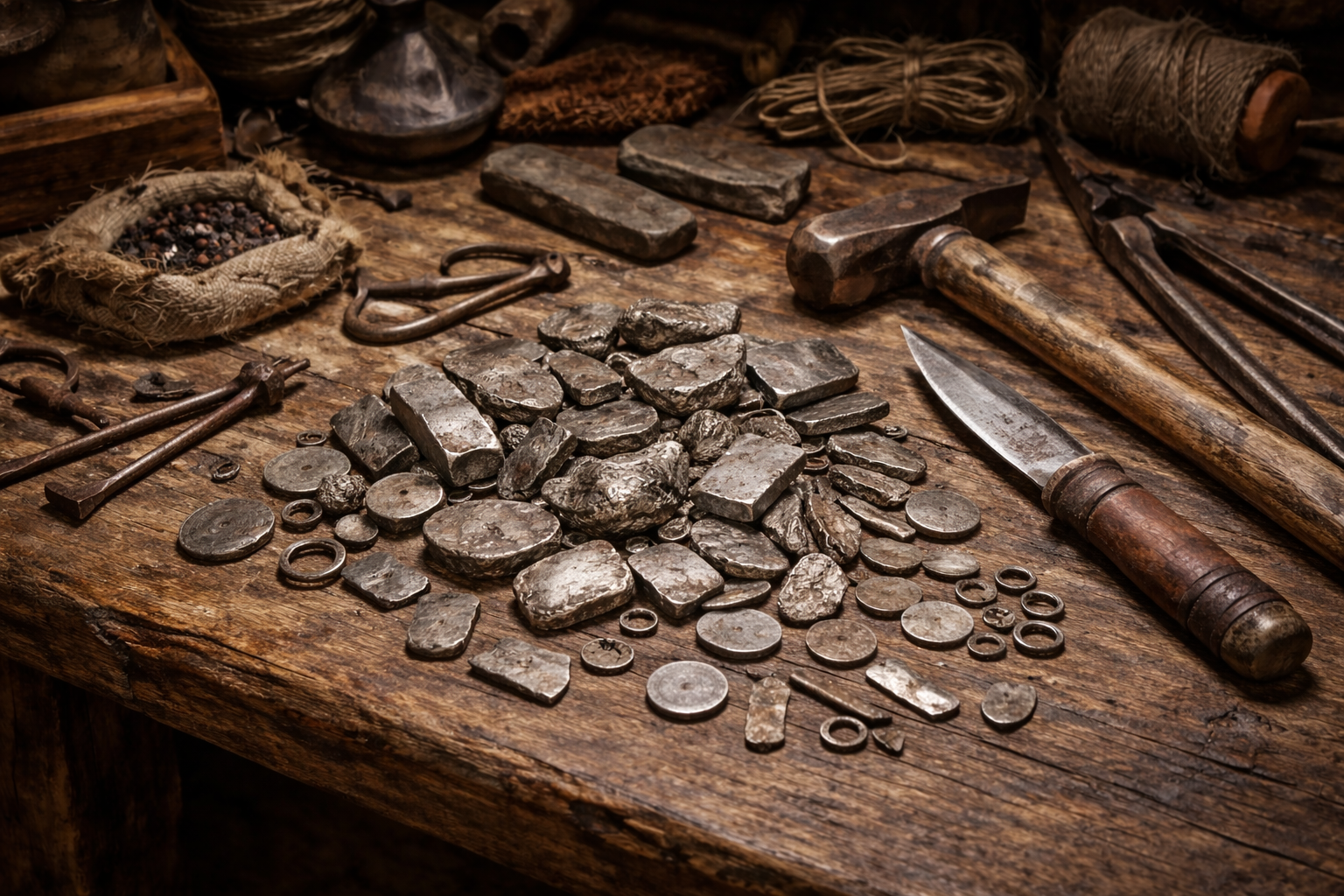
Metal in this form was flexible. It could be reshaped, repaired, and reused. It represented effort and potential rather than decoration.
In a world where production mattered more than display, such characteristics defined real value.
The role of weight and measure.
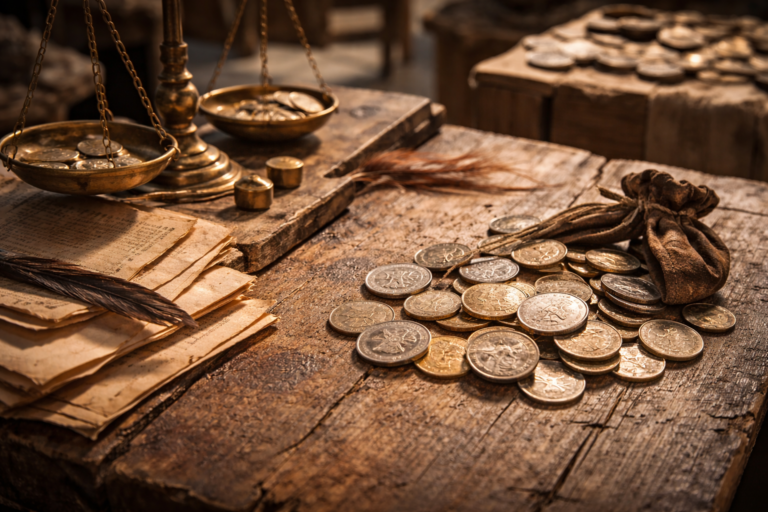
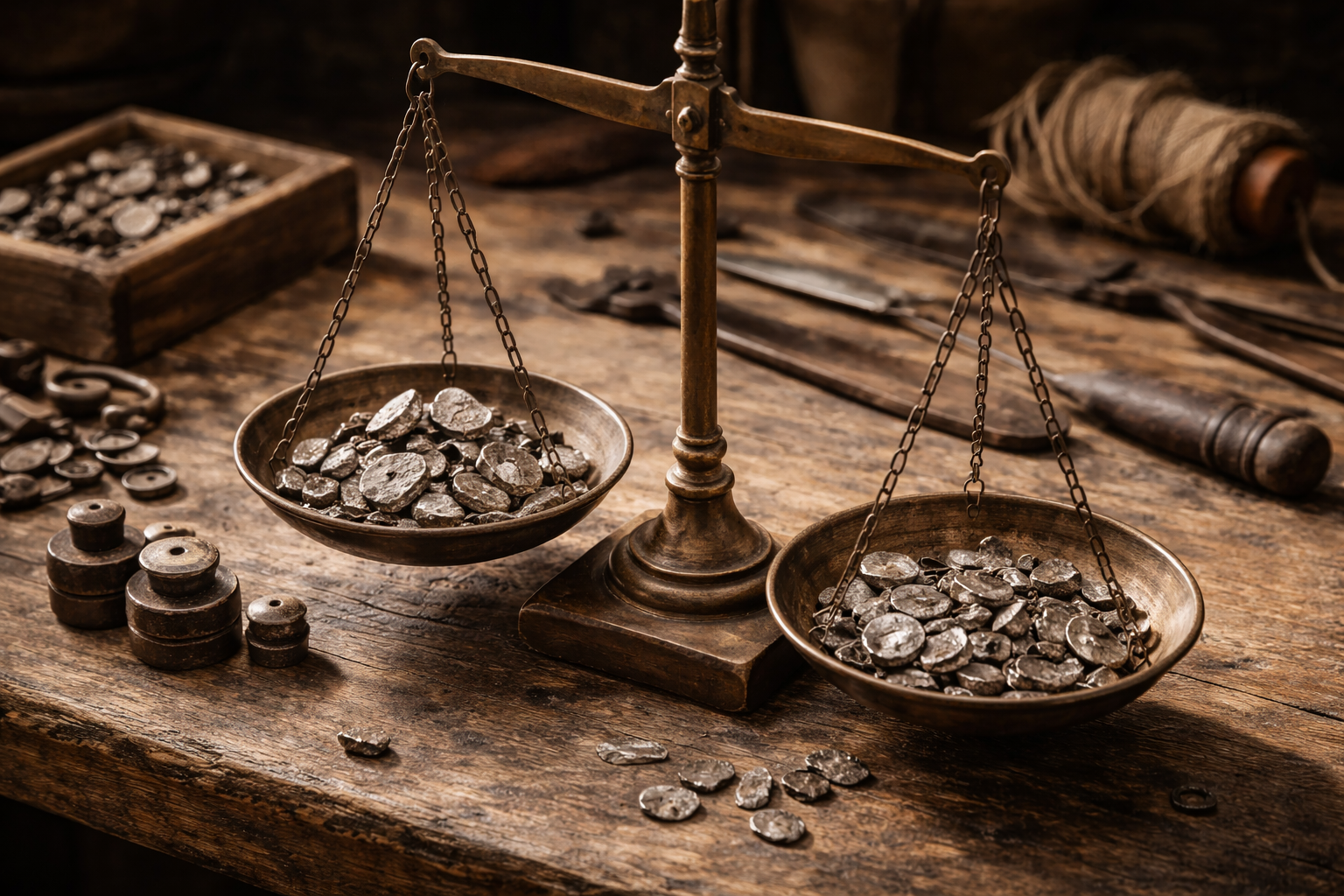
As medieval trade expanded, weighing practices became increasingly important. Even without standardized coinage, people needed a way to compare quantities and settle disputes.
Simple balances and known weights allowed metal to be assessed fairly. They reduced argument and made exchange more transparent.
Measurement introduced a sense of equivalence. Different goods could be related through a shared material standard.
This habit strengthened trust and allowed trade to move beyond purely local relationships.
Local markets and social regulation.
Medieval markets were not anonymous spaces. They were social institutions.
Rules, customs, and communal oversight shaped exchange. Fair dealing was expected. Dishonest behavior damaged reputation quickly.
In such environments, payment methods did not need to be perfectly uniform. They needed to be socially accepted.
Coins, metal, goods, and labor could all function as payment when supported by shared norms.
Work, obligation, and delayed payment.
Much of medieval payment did not happen instantly. Economic life was deeply tied to seasons, harvests, and long production cycles.
A worker might be compensated after the harvest. A tenant might pay rent in produce rather than in money. A craftsman might receive materials first and deliver work later.
These arrangements depended on obligation rather than immediate exchange. Obligation was enforced not by contracts in the modern sense, but by reputation, community pressure, and shared expectation.
In such systems, trust was more valuable than coin. A person known for keeping promises could function economically even with little physical currency.
The limits of coin circulation.
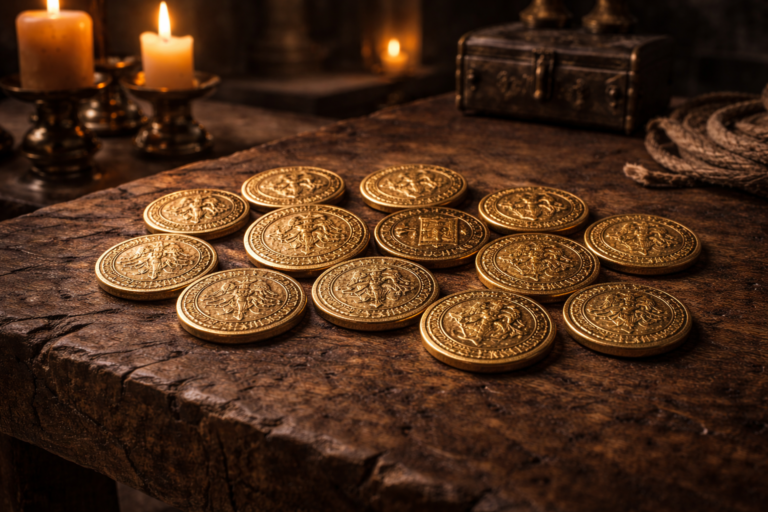
Even where coins existed, they did not flow evenly. Political fragmentation, local mints, and regional authority meant that different coins carried different weights and levels of trust.
People often tested, weighed, or discounted unfamiliar coins. Some were clipped. Some were worn. Some were accepted only by weight, not by face.
This uncertainty reduced the practical advantage of coins in everyday exchange. Common metal and goods remained more predictable.
In many cases, coins were reserved for taxes, rents, or long distance trade, while local exchange relied on more flexible methods.
Measuring fairness in medieval trade.
Fairness mattered deeply in medieval markets. Without reliable uniform currency, communities developed other ways to judge balance.
Weights, customary ratios, and public oversight played key roles. Disputes were settled through known standards rather than pure negotiation.
This reinforced the idea that payment was a social process, not merely a material transfer.
The more transparent the measure, the stronger the trust.
Why these methods survived.
The methods described here were not temporary solutions. They were stable systems adapted to medieval conditions.
They survived because they worked under scarcity, uncertainty, and limited institutional support.
They balanced flexibility with trust. They allowed economic life to continue even when coinage was unreliable or insufficient.
These practices remind us that money is only one tool among many. Exchange can function without it when social structures are strong.
Connection to earlier economic traditions.
Medieval payment systems did not appear in isolation. They inherited ideas from earlier periods when metal, labor, and obligation formed the basis of value.
The preference for common metal and measured exchange connects directly to older traditions discussed in this article: Why Ancient People Trusted Metal More Than Gold.
Together, these histories show continuity rather than rupture in economic thinking.
Final reflection.
Medieval people paid without coins not because they lacked money, but because they understood value in broader terms.
They trusted materials that worked. They trusted labor that produced results. They trusted obligations supported by reputation.
Coins would later become more dominant, but the habits that made coins meaningful were already in place.
The medieval economy teaches us that trust, not metal, is the true foundation of exchange.
FAQ.
Did most medieval people use coins daily.
No. Many relied on goods, labor, metal by weight, and obligation based arrangements for everyday exchange.
Why was common metal preferred in many cases.
Because it was useful, durable, widely recognized, and easier to measure and reuse than precious metals.
How were disputes settled without uniform currency.
Through weights, customary standards, public market oversight, and community reputation.
Was gold important in medieval economies.
Yes, but mainly for large scale, political, or symbolic transactions rather than routine market exchange.
What is the main lesson from medieval payment systems.
That economic life can function effectively without constant reliance on formal currency when trust and standards are strong.