The Serpent Tetradrachm – The Coin of Eternal Betrayal
The Serpent Tetradrachm – The Coin of Eternal Betrayal
In every civilization, betrayal has a price. In ancient Greece, that price was paid not in blood—but in silver. The story of The Serpent Tetradrachm begins, as all tragedies do, with devotion that turned to sin.
Centuries ago, in the island city of Rhodes, a high priest named Theron served in the Temple of Apollo. His duty was to protect the sacred treasury, where offerings of gold and silver were kept as tributes to the gods. But greed, like a whispering serpent, found its way into his heart. When famine struck the land, and faith faltered, Theron took one silver coin from the altar—just one—to feed his starving sister.
That night, the serpent god of vengeance came to him in a dream. Its scales shimmered like molten silver, and its voice coiled through his mind:
“You have stolen not from man, but from eternity. The silver you took shall remember you. And so shall all who touch it.”
🐍 The Birth of the Coin
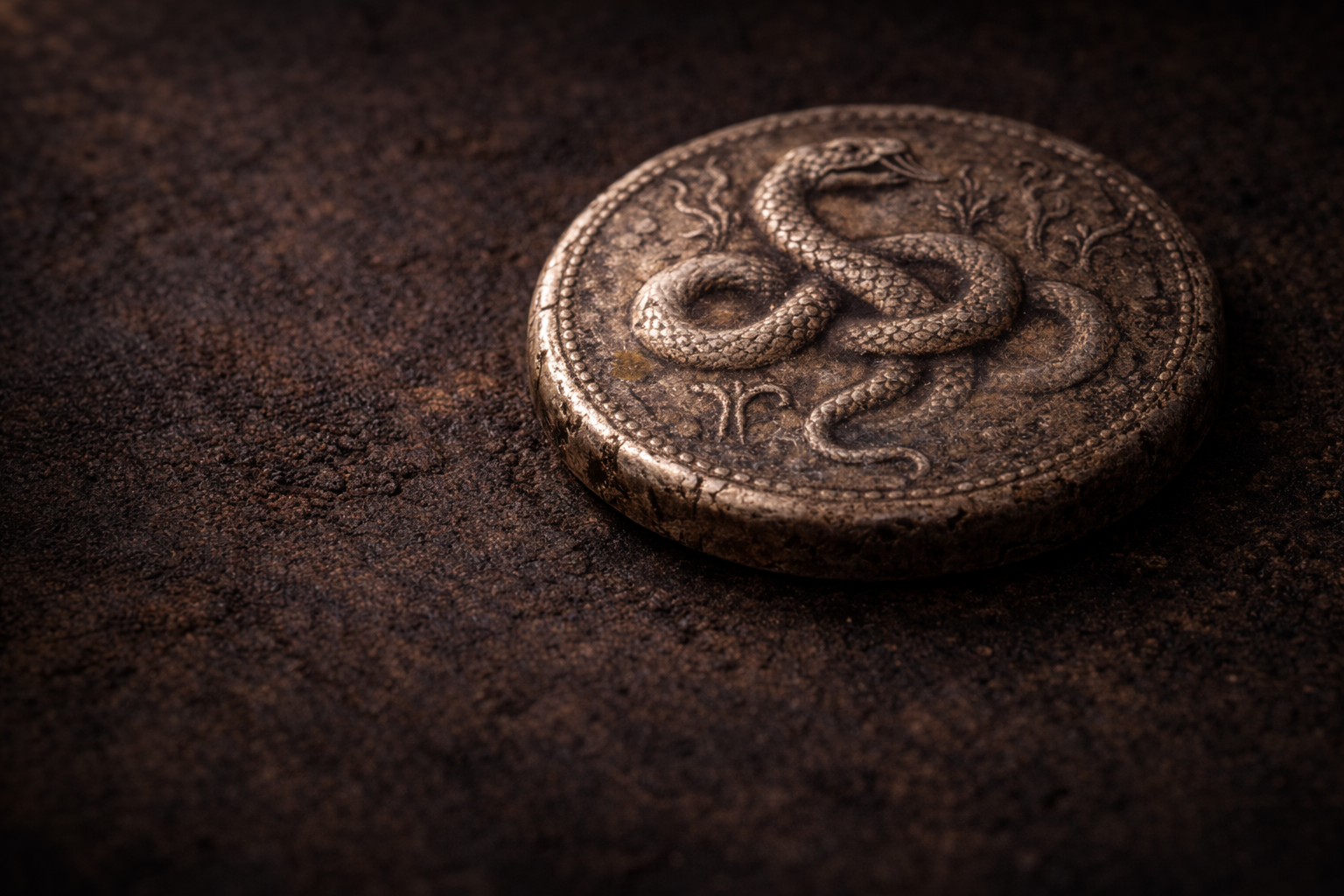
Wracked with guilt, Theron returned the coin to the temple and tried to cleanse it in sacred fire. But the flame turned green, and when it died, the coin had changed. The face of Apollo was gone—replaced by the image of a serpent devouring its own tail: the Ouroboros, symbol of infinity and endless punishment.
Horrified, Theron hid the coin within the temple walls and confessed his crime to no one. Yet the temple’s treasury soon fell under a shadow. Priests began accusing one another of theft. Friend turned against friend. Within weeks, the holy order of Apollo collapsed in chaos.
And though the temple burned to ashes, the coin survived, glimmering in the ruins like a cold eye that never blinked.
⚱️ The Archaeologist’s Discovery
Two thousand years later, the ruins of Rhodes became a paradise for archaeologists. Among them was Professor Leonidas Valtos, a scholar known for his obsession with Greek myths. In 1972, during an excavation beneath the remains of the old temple, his team uncovered a sealed clay amphora. Inside were fragments of silver offerings, all melted together—except for one coin, perfectly preserved.
It bore no emperor, no city mark, only a serpent biting its tail. Around its edge were faint Greek words, burned into the metal: “Ο φίλος θα γίνει εχθρός” — “The friend shall become foe.”
Valtos was captivated. He called it The Serpent Tetradrachm and displayed it in his private study, away from museum hands. But his journals, later found by his assistant, tell a far darker story.
📜 The Journal of Leonidas Valtos
In the weeks following the discovery, the professor’s writings became increasingly erratic. He described hearing hissing sounds whenever he entered his study, and dreams of a silver serpent wrapping around his throat. Most chilling were his notes about his colleagues—each entry accusing them of betrayal, theft, or deceit, with no evidence at all.
Then came the final entry, written in trembling ink:
“It spoke to me last night. The serpent said, ‘All men betray. The difference is when.’ I woke to find the coin warm in my hand.”
Days later, Leonidas Valtos vanished. His assistant reported that every coin in the professor’s collection had been scattered across the floor—except one, resting neatly on the desk, gleaming faintly under the moonlight.
💔 The Curse Spreads
Rumors soon spread through the academic world. Those who handled the Serpent Tetradrachm began to suffer strange misfortunes—partners turning against them, colleagues stealing credit for their work, friends spreading lies behind their backs. Each betrayal seemed to follow the next, like venom traveling through a shared bloodstream.
Eventually, the coin disappeared from official records once more. Some say it was melted down, others claim it was buried again beneath the stones of Rhodes. Yet, collectors whisper that it still surfaces from time to time, passed quietly between those desperate enough to believe they can control its curse.
But the serpent never dies. It only waits to taste the hand that feeds it.
🕯️ The Collector’s Fall
In 1998, a private collector named Adrian Kole purchased a mysterious Greek coin from a black-market dealer in Athens. Its edges were worn smooth, yet the serpent emblem remained untouched—as if the metal refused to age. Kole, a man fascinated by forbidden artifacts, displayed it proudly in his library. But soon after, strange patterns began to unfold in his life.
His business partner accused him of fraud. His wife filed for divorce. His closest friend vanished after taking half his fortune. Adrian believed it was coincidence—until he noticed something impossible. The serpent’s eye on the coin had moved. Where once it faced its tail, it now looked outward, staring directly at him.
He tried to sell it, but no buyer would touch it. The few who saw it claimed to feel dizzy, as though the room itself bent inward. Desperate, Adrian threw the coin into the sea from a cliff near Rhodes. Yet that night, as he packed to leave Greece, the customs officer opened his luggage and found it resting atop his clothes—cold, dry, and gleaming.
“The serpent returns to the hand that feeds it.” — Fragment from the “Kole Tapes,” recovered after his disappearance.
⚔️ The Last Betrayal
By the turn of the millennium, the Serpent Tetradrachm had earned its new name: The Coin of Eternal Betrayal. Its legend spread through online forums of collectors, whispered about in academic circles as a hoax, yet feared by those who knew the truth. A Greek historian, Dr. Myra Pantelis, was the last to claim she held it.
In her final public lecture at the University of Thessaloniki, she spoke of it not as a curse—but as a reflection of human nature.
“The serpent does not create betrayal,” she said. “It merely reveals it. Each of us carries a serpent within—the moment we doubt, it awakens.”
She vanished three days later. Her students found her office locked from the inside. On her desk, a single silver coin glowed faintly beneath a cracked glass frame. The serpent had turned once more, its tail broken. The cycle, it seemed, was complete.
🌘 The Coin’s Legacy
Today, no official museum lists The Serpent Tetradrachm among its catalogued relics. Yet anonymous reports claim a similar coin appeared briefly in a private exhibit in Geneva in 2019. It was quickly withdrawn after a staff member accused the curator of theft and destroyed part of the display in a fit of rage.
Whether myth or madness, the pattern remains unchanged. The coin appears, men betray, and it disappears again—like the serpent that eats its own tail, never dying, never satisfied.
Somewhere, perhaps in a sealed vault or forgotten drawer, the Serpent Tetradrachm waits once more to be found. And when it is, the circle will begin again.
💀 Reality Check
While no verified record of a “Serpent Tetradrachm” exists, several ancient Greek coins from Rhodes and Ephesus feature serpent imagery linked to Apollo and Asclepius, the god of healing and transformation. The symbol of the serpent biting its own tail—the Ouroboros—appeared frequently in Greek mysticism, representing eternal cycles of life and death. In some temples, coins were indeed used as ritual offerings, believed to absorb divine energy. The legend of betrayal surrounding a sacred coin may stem from these historical rites, blended with centuries of mythmaking.
💭 Final Thought
Betrayal is the oldest human currency. We trade trust for desire, loyalty for gain, and peace for power—again and again. The Serpent Tetradrachm reminds us that no curse is as eternal as our own weakness. And perhaps that’s why its legend endures: not because of the silver, but because of the mirror it holds to the human heart.
🔗 Discover more mysterious legends on the HistoraCoin YouTube Channel