The 1989 Yugoslavian 100 Dinara – HistoraCoin
The 1989 Yugoslavian 100 Dinara – A Piece of a Vanished World
Imagine holding a coin that once belonged to a country that no longer exists — a coin that witnessed the final heartbeat of a collapsing federation. That’s exactly what the 1989 Yugoslavian 100 Dinara represents: not just metal, but memory. It’s money that outlived the very nation that printed it.
In 1989, Yugoslavia was already trembling under the weight of history. The once-proud socialist federation of six republics — Slovenia, Croatia, Bosnia and Herzegovina, Montenegro, Macedonia, and Serbia — was fracturing politically, economically, and culturally. Yet, even as disunity spread, the mint in Belgrade continued striking coins like this 100 dinara, symbols of a unity that was rapidly fading away.
The Final Years of Yugoslavia’s Currency
To understand the story of this coin, you first need to understand the story of Yugoslavia itself. Founded after World War I as the “Kingdom of Serbs, Croats, and Slovenes,” it later became the Socialist Federal Republic of Yugoslavia after World War II, under the leadership of Josip Broz Tito. Tito managed to unite the region’s diverse nationalities under a single banner — and for decades, the Yugoslav dinar stood as a symbol of stability and pride.
But after Tito’s death in 1980, things began to unravel. By the late 1980s, economic crises, rising nationalism, and corruption were tearing the federation apart. Inflation began eating away at people’s savings. The once-strong dinar started losing its value so quickly that new notes and coins had to be issued almost yearly.
The 1989 100 dinara coin was part of that desperate attempt to maintain monetary order in a time of chaos. It wasn’t just currency — it was an echo of the last breath of a dying dream.
The Design and Symbolism
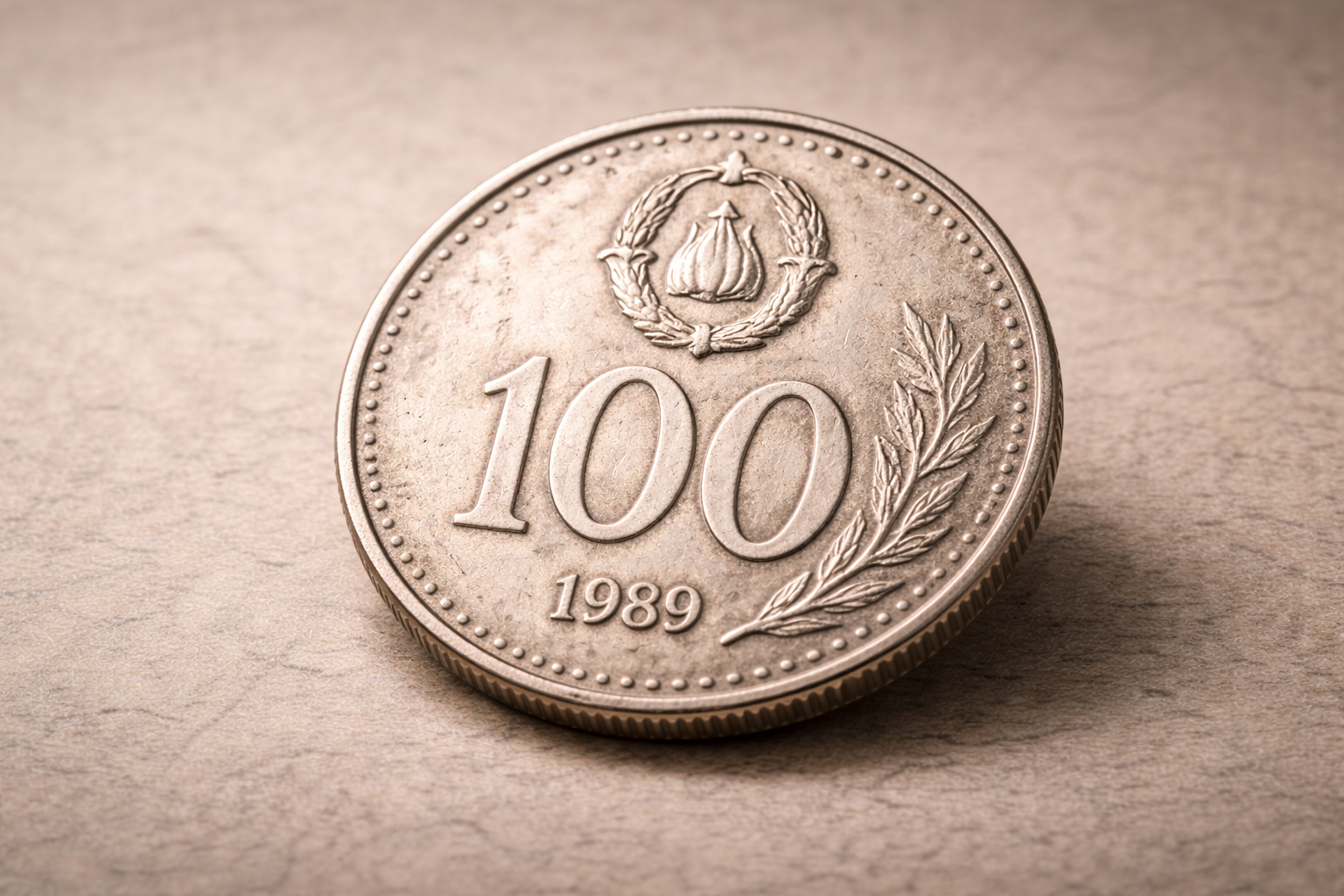
When you hold this coin, the design tells you a lot about its identity. On the obverse side, you’ll see the national coat of arms of Yugoslavia: six flames merging into one larger flame — symbolizing the unity of the six republics. It’s a beautiful and haunting emblem, especially when you realize that just a few years later, those flames would separate into six new countries.
The reverse features the denomination “100 Dinara” in both Latin and Cyrillic scripts — another reminder of Yugoslavia’s multicultural nature. Around the rim, inscriptions in Serbo-Croatian reflect both the Western and Eastern European influences that defined the nation.
The coin itself was made of nickel-brass, giving it a golden tone. It was solid, modern, and meant to inspire trust. But in truth, trust was already fading.
Economic Turmoil and Hyperinflation
By 1989, inflation was raging. Prices doubled within months. Workers were paid with stacks of near-worthless banknotes. The government kept issuing new denominations — 500 dinara, 1000 dinara, even 5000 dinara — but they couldn’t keep up with reality. The 100 dinara coin, which once had decent purchasing power, quickly became pocket change, and then, essentially, a relic.
Still, people used it every day. To buy bread, milk, or a tram ticket. For many Yugoslavs, that coin carries memories of their final “normal” years — before the wars, before the separation, before everything fell apart.
It’s strange how a simple object can hold such emotion. A 100 dinara coin minted in 1989 wasn’t just money — it was the last symbol of an idea that had already begun to fade away.
The Collapse of a Nation
Just two years after this coin entered circulation, the entire country of Yugoslavia began to disintegrate. Slovenia and Croatia declared independence in 1991, followed by Bosnia and Herzegovina, Macedonia, and later Montenegro. The world watched as the Balkans plunged into a decade of war and economic devastation.
With every republic that broke away, the Yugoslav dinar lost its meaning. New currencies appeared — the Slovenian tolar, Croatian kuna, Bosnian mark — each trying to build a new identity on the ruins of the old one.
By the mid-1990s, the dinar had undergone several revaluations. At one point, inflation hit over 300 million percent. People carried banknotes in bags just to buy a loaf of bread. The 1989 100 dinara coin became completely obsolete — yet today, collectors around the world treasure it, not for its metal, but for its story.
What the 100 Dinara Means Today
Today, holding a 1989 Yugoslavian coin feels like opening a time capsule. It’s not just a relic of a country that vanished — it’s a reminder of how fragile nations can be, and how quickly history can change.
For collectors, it’s an affordable yet emotionally powerful piece. You can still find it on marketplaces like eBay or VCoins for a few dollars, often uncirculated. But its true worth isn’t in its price — it’s in the weight of memory it carries.
Think of it this way: every scratch on that coin might have passed through the hands of someone from a different republic — a Croatian worker, a Bosnian student, a Serbian shopkeeper — all using the same money, unaware that in just a few years, their nations would be divided.
Reality Check
The 1989 Yugoslavian 100 dinara isn’t rare in a numismatic sense — millions were minted — but its historical rarity lies in what it represents. It’s the tangible ghost of a country that tried to balance unity and diversity, socialism and freedom, East and West — and failed under the pressure of time and politics.
In the collector’s world, this coin reminds us that value isn’t always about scarcity. Sometimes, it’s about the story.
Final Verdict
The 1989 Yugoslavian 100 Dinara is more than just money — it’s a message. It tells the story of pride, crisis, and identity. It’s a small metallic witness to the fall of an empire built on ideals of unity. Holding it is like touching history itself — a history that warns, teaches, and fascinates all at once.
For coin collectors, it’s one of the most emotional pieces you can own — because it doesn’t just come from a vanished currency, but from a vanished world.
Frequently Asked Questions
Q: Is the 1989 Yugoslavian 100 Dinara valuable?
A: Financially, it’s modest — usually under $10 — but historically, it’s priceless. Its story and symbolism make it a collector’s favorite.
Q: What is it made of?
A: Nickel-brass alloy, giving it a golden appearance. It was designed to be durable and modern for its time.
Q: Why did Yugoslavia collapse?
A: A mix of nationalism, economic crisis, political instability, and the absence of Tito’s unifying leadership after 1980.
Q: Can I still use it?
A: No, the dinar ceased to be legal tender decades ago. But as a historical artifact, it continues to circulate among collectors worldwide.