⚖️ The Curse of the Twin Denarii — Two Coins That Shared One Fate
⏳ Estimated reading time: 11 minutes
The Curse of the Twin Denarii — Two Coins That Shared One Fate
Two coins. One life. And a curse that would not let them part.
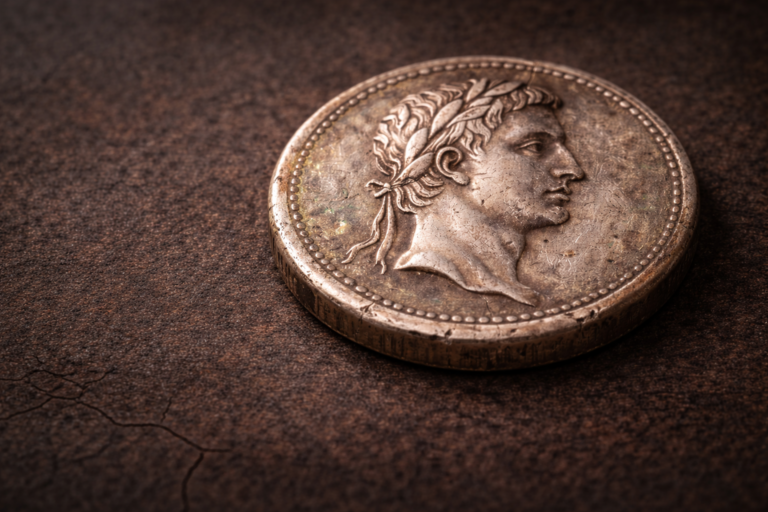
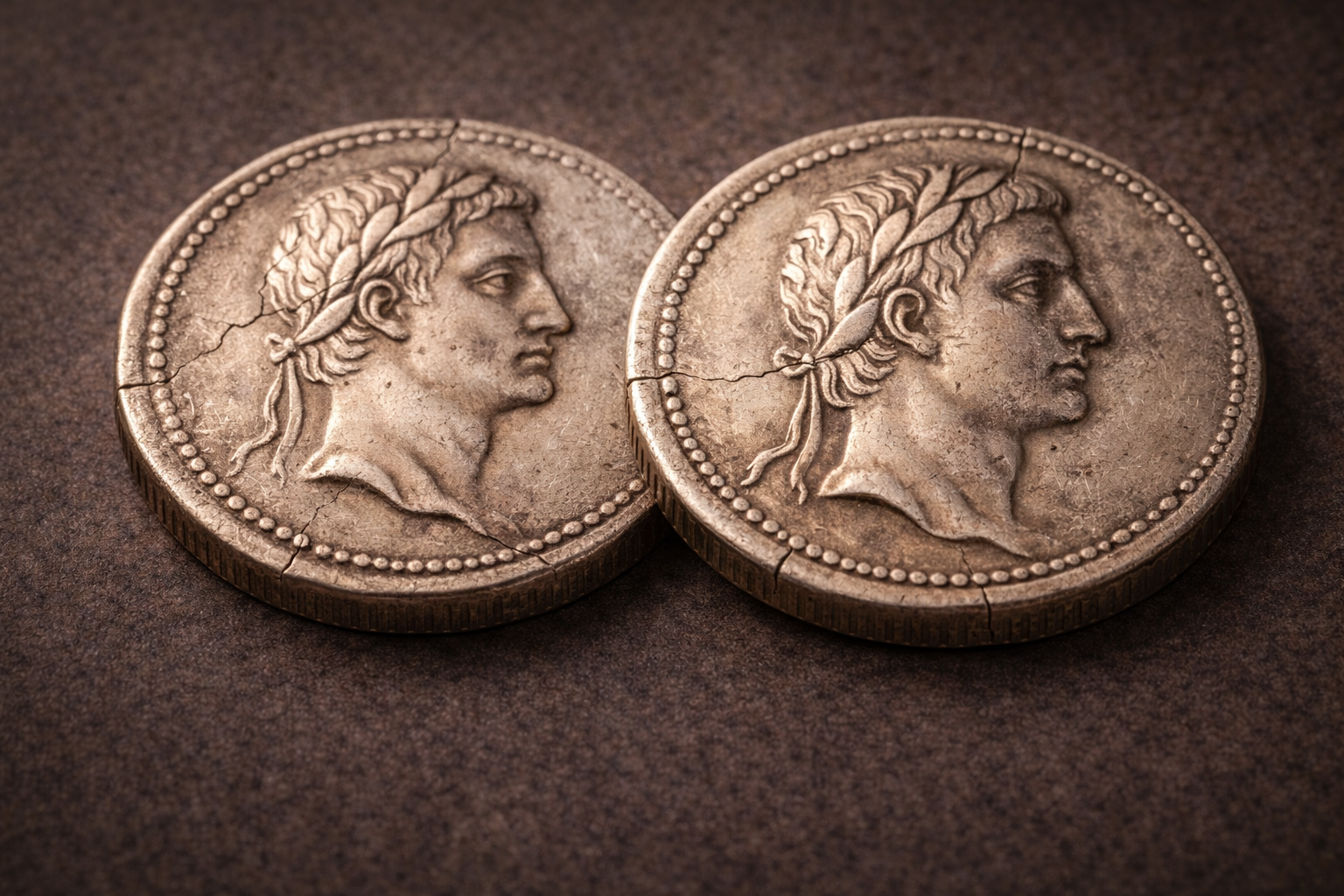
In 1883, near the ruins of Pompeii, archaeologists uncovered a pair of silver denarii buried inside a single clay jar. Both coins bore the same markings—Emperor Hadrian’s profile on one side, and on the reverse, two clasped hands encircled by the Latin inscription: “Una anima, duo corpora.” — “One soul, two bodies.”
The coins appeared identical in weight, size, and detail—so much so that experts concluded they were struck from the same die, a rarity in Roman minting. They quickly became known as “The Twin Denarii.”
However, within weeks of their discovery, strange reports began to surface. One of the coins, kept in Naples, developed a faint red stain along the emperor’s neck. The other, displayed in London, began to darken—its surface turning a deep, unnatural gray.
🩸 The Bleeding Coin
On the night of June 6th, the curator of the Naples museum was found unconscious beside the display. The glass case was cracked from within, and droplets of crimson liquid marked the floor beneath it. Laboratory tests could not identify the substance—it wasn’t blood, nor any known corrosion. Yet the curator claimed he had heard whispering just before the case shattered, saying: “We are not apart.”
Meanwhile, in London, the sister coin fell from its mount the same night. Its surface had brightened suddenly, as if polished by unseen hands. When workers picked it up, they noted it was warm to the touch, though the room was cold.
By morning, both coins showed identical new marks—tiny cracks along the edge, like veins connecting invisible skin.
🌙 The Historian’s Theory
In 1892, historian Dr. Walter Grieves published a controversial paper linking the Twin Denarii to an obscure Roman myth recorded in fragments of the Libri Maledicti. The text spoke of two brothers, condemned by a priestess for betraying their legion. Their souls were bound into coins and separated forever—each feeling the other’s fate until the world forgot Rome.
According to Dr. Grieves, the curse could only be broken if the coins were reunited under the same moonlight in the city where they were struck. His proposal was dismissed as superstition, yet he persisted—collecting funding to bring the two coins together again.
In 1893, the London museum agreed to lend its coin for the experiment. It arrived in Naples on October 13th. That night, a violent storm struck the city. The power failed. The next morning, both display cases were found empty—no coins, no glass, no trace of anything but a thin circle of ash on the marble floor.
Part 2 will reveal what happened when fragments of the Twin Denarii resurfaced decades later—and how modern experiments proved their link was more than legend.
🌒 The Return of the Twins
In 1976, a private collector from Florence claimed to have purchased a fragment of a silver coin at an estate auction. The fragment bore half of Hadrian’s profile and the faint letters “DUO CO—”. Metallurgical testing revealed that its composition matched precisely the denarii recovered from Pompeii a century earlier. The collector sent it to the Rome Institute for further study.
On the same day, across the Mediterranean, a diver exploring the Bay of Naples discovered another fragment—identical in size and curvature, as though the two had once belonged to the same coin. When researchers aligned the photos of both pieces, the edges fit perfectly, forming the complete phrase: “DUO CORPORA.”
Both fragments were placed in separate containers for transport to Rome. During the journey, flight instruments aboard one of the cargo planes malfunctioned, forcing an emergency landing in Sicily. Upon inspection, the pilot reported a faint metallic hum inside the hold and a smell like burning silver. When technicians opened the crate, they found only gray dust—and a faint red stain along the interior lining.
🩶 The Experiment of Reflection
Years later, in 2009, an attempt was made to digitally reconstruct the Twin Denarii using high-resolution scans. The resulting 3D model revealed something never noticed before: when mirrored, the inscriptions formed a hidden pattern around the edge that read in Latin, “Nos unum sumus.” — “We are one.”
Strangely, the rendered model began to glitch during testing, the pixels blurring into a crimson hue before the system abruptly crashed. When rebooted, the hard drive contained an audio file with no known origin—just a single sound: two metallic objects striking each other, followed by silence.
Experts concluded the coincidence was the result of corrupted data, but those familiar with the legend believed differently. They said the coins had finally found each other—in a way no one could ever separate again.
💀 Reality Check
While there is no verified record of “twin” Roman coins sharing supernatural links, the phenomenon of duplicate die strikes is well-documented. Coins struck from the same die during the same session often show nearly identical imperfections and wear patterns. Ancient Romans sometimes inscribed twin motifs—like clasped hands or paired figures—symbolizing unity or brotherhood. Over time, such artifacts inspired myths of shared fate or mirrored curses, blending technical coincidence with human imagination. The Twin Denarii legend endures as a poetic reminder of how deeply people once believed that even metal could feel loss.
💭 Final Thought
Some bonds can’t be broken—not by time, distance, or death. The Twin Denarii remind us that history repeats in pairs, and every reflection hides a heartbeat waiting to reunite with its other half.