The Dragon Coin of the Forbidden Temple – Asia’s Hidden Legend

This story is brought to you by HistoraCoin – where every coin hides a legend.
Have you ever heard a story that feels more like a dream than reality? Let me tell you one, my friend. It’s a story about a coin unlike any other — a coin that breathes fire into legend and mystery. They call it The Dragon Coin of the Forbidden Temple. Some say it was forged in heaven’s lightning. Others whisper that it was cursed by the monks who guarded it for a thousand years. But everyone agrees on one thing — whoever finds it, never stays the same again.
Our story begins deep in the jungles of Southeast Asia, where the air hums with the sound of cicadas and ancient temples sleep beneath vines and time. Locals say one of those temples — hidden in the Shan Mountains — holds the oldest coin in Asia. Not gold, not silver, but something alive, something that remembers.
🐉 The Temple That Should Not Exist
In 1932, an explorer named Jonathan Hale set out from Rangoon on what he called “a journey to touch eternity.” He’d heard rumors from traders about a temple that appeared and vanished with the monsoon fog — a temple guarded by a dragon carved from stone. Locals refused to guide him. “That place isn’t meant for men,” one said. “The monks sealed it with blood.”
But Hale was a man of curiosity — and arrogance. After weeks of trekking through swamps and jungle, he found it: a crumbling stairway swallowed by roots. Statues of serpents lined the path, their eyes filled with rainwater, their scales glowing faintly in moonlight. He lit his lantern and stepped inside.
The silence inside was heavy. Every sound — his breath, his steps, the flame — felt wrong. On the far end of the chamber, there was an altar. Upon it rested a small golden coin — round, thin, and etched with a dragon coiling around a single word in ancient Chinese: “Longsheng” — Born of the Dragon.
🔥 The First Awakening
When Hale picked up the coin, the air changed. The temperature dropped. He swore he heard a hiss echo through the walls. And then — silence again. Laughing nervously, he pocketed it, believing he’d found the greatest treasure of his career.
That night, under the temple’s shadow, he couldn’t sleep. He dreamed of fire — not normal fire, but gold fire — swirling around a massive eye that watched him. When he woke, his hands were covered in soot. The coin in his pocket was hot to the touch.
He tried to clean it, but the more he rubbed, the more the dragon’s design seemed to move. It wasn’t engraved — it was alive, writhing beneath the surface like something trapped inside the metal. Hale wrote in his journal:
“The coin hums when the moon rises. It feels… aware.”
🌩️ The Journey Home
Hale returned to London with the coin hidden among relics. He presented everything else to the museum — but kept the coin secret. “It’s mine,” he told his assistant, “and it’s not ready to be seen.”
Weeks passed, and his health began to fail. He complained of hearing whispers in Mandarin though he spoke none. The lights in his home flickered when the coin was near. Once, a maid saw shadows shaped like scales moving along the walls. When she screamed, the coin rolled off Hale’s desk — by itself — and came to rest beside her feet. It was warm, almost pulsing.
By the end of that year, Hale was dead — burned in his bed. The fire was localized to his body alone. The rest of the room was untouched. The coin was never found.
🕯️ The Coin Resurfaces
Decades later, in 1975, a collector in Hong Kong named Liang Wei purchased a strange coin from a black-market dealer. It matched Hale’s descriptions perfectly — a dragon encircling an ancient inscription. He placed it in a glass case in his study. His family said he began acting differently — isolating himself, muttering about voices that spoke from “beyond the veil.”
He became obsessed with finding the temple it came from. In his final letter, Liang wrote:
“I have seen it. The dragon does not guard treasure. It guards time itself. The monks tried to stop it, but eternity cannot be sealed.”
Liang disappeared two months later during an expedition to Myanmar. His team found no trace of him — only an empty tent and a burned circle in the grass where his lantern had been.
🌑 The Dragon’s Curse
Legend says the coin was never meant to be touched. It was forged during the reign of Emperor Qin Shi Huang — China’s first emperor — by a sect of alchemists who sought immortality. When they failed to create the elixir of life, they poured their essence into metal, trapping their souls in the shape of a dragon.
The coin was hidden in a temple guarded by monks for generations. They called it the “Heart of the East Wind.” It was said to contain both wisdom and destruction — a dual nature. Whoever held it could see the future… but lose their present.
Some believe Hale and Liang were only the latest in a chain of victims stretching back centuries — from emperors to monks to thieves. Every few decades, the coin surfaces again, only to vanish in fire, flood, or madness.
⚡ The Modern Expedition
In 2018, a group of archaeologists from Singapore claimed to have rediscovered the Forbidden Temple after analyzing satellite imagery. They described structures eerily similar to Hale’s notes. The team sent back drone footage before entering — and what they captured silenced the academic world for months.
In the footage, a small altar can be seen under a shaft of sunlight. Something metallic flashes briefly — a coin, circular and gold. But as the camera zooms closer, the signal cuts. The drone drops. Before transmission ends, one frame freezes: a faint outline of a dragon’s eye glowing red in the dark.
When the team entered to retrieve the drone, it was gone. Only the smell of smoke lingered in the air.
🕊️ Between Myth and Metal
Experts debate what the Dragon Coin really is. Some say it’s an ancient ceremonial token used by Taoist monks to symbolize transformation — death and rebirth. Others claim it’s a lost imperial coin struck during the Han Dynasty, representing the Emperor’s divine right. But there’s one account, buried in a Qing dynasty manuscript, that chills the spine:
“When the dragon sleeps, man prospers. When the dragon awakens, the empire burns.”
Every time the Dragon Coin has been reported, major change followed — fires, political collapse, or storms destroying cities. Coincidence? Maybe. But those who’ve seen it say the dragon’s eye seems to move depending on who looks at it — as if it’s measuring the worth of your soul.
🌕 The Keeper’s Tale
There’s a monk in Northern Thailand, old and blind, who claims his order once protected the Dragon Coin. When a journalist asked him about it, he smiled and said, “The dragon does not sleep in gold. It sleeps in men.”
He explained that the coin wasn’t cursed — people were. It merely reflected what already existed inside. Those with greed saw power. Those with fear saw death. Those with wisdom… saw peace. “That is why it cannot be possessed,” he said. “It chooses who to reveal itself to.”
When asked if the temple still exists, the monk laughed softly. “Temples crumble. Legends don’t.”
🔥 The Return of the Dragon
In 2021, social media posts surfaced showing an artifact identical to the Dragon Coin being auctioned in Macau. The listing disappeared within hours, but screenshots remain. Some users noticed something odd — the coin’s engraving glowed faintly in each photo, even under different lighting. Experts dismissed it as a trick of exposure. Others weren’t so sure.
One collector claimed to have bought it anonymously. He uploaded a short video showing the coin spinning on a table. “It never stops spinning,” he wrote. Two days later, the account was deleted. Authorities confirmed his apartment had caught fire — source unknown.
Now, rumors say the coin has returned to where it began — somewhere deep in the mountains of Myanmar, waiting for the next curious soul.
💭 The Message in the Metal
So what does it all mean, my friend? Maybe the Dragon Coin is just a story — a metaphor for mankind’s obsession with power and eternity. Or maybe it’s real, hiding where it’s always been, in the ruins of a forgotten temple, humming softly beneath the roots and rain.
Every legend starts with a coin — and every coin hides a choice. The dragon’s eyes, they say, see your truth. If you look too long, you might see not what you desire, but what you fear most. And if one day you ever find a coin that hums under your touch, remember what the monk said — “The dragon does not sleep in gold. It sleeps in men.”
🌩️ The Lesson Beneath the Legend
The Dragon Coin teaches a truth older than temples: that greed turns blessings into curses. Perhaps the coin never needed magic — only the human heart to make it dangerous. Every civilization that sought eternal power fell under the weight of its own desires. The dragon doesn’t destroy — it waits.
🧭 Reality Check
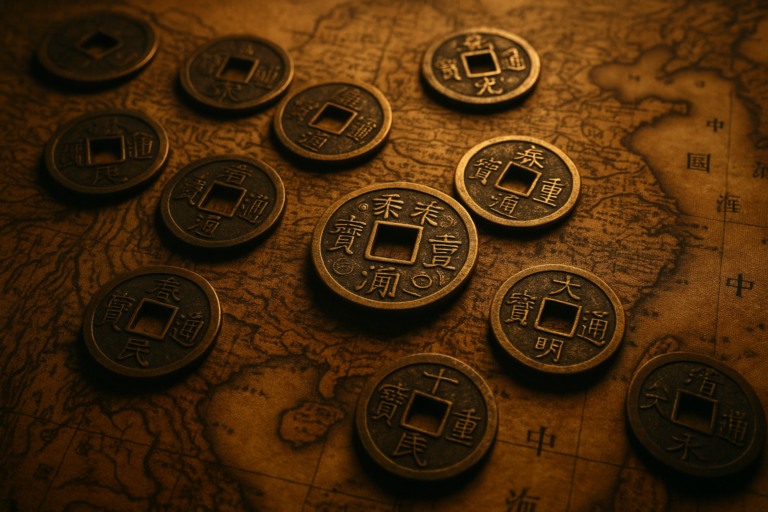
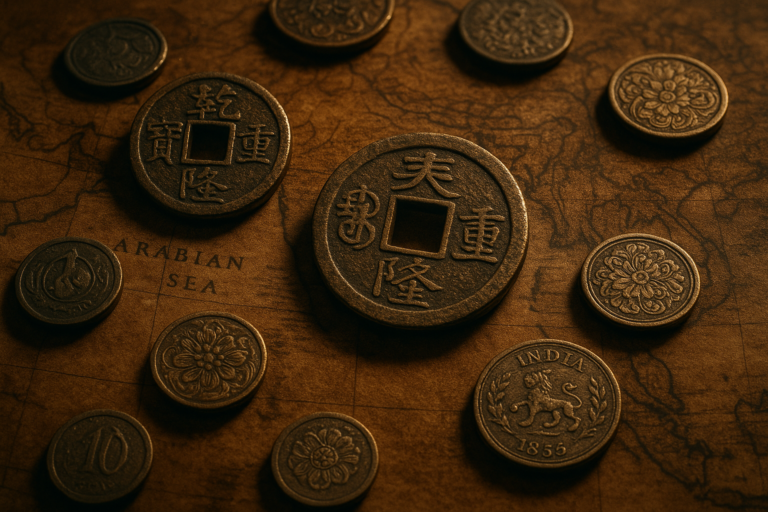
While there’s no official record of a “Dragon Coin,” several Asian dynasties minted coins featuring dragon motifs, symbolizing imperial power and divine protection. Temples across China, Thailand, and Myanmar hold myths of coins that bring fortune or doom depending on intent — proof that legend often hides behind truth.
🏁 Final Verdict
Whether myth or memory, the Dragon Coin remains a powerful reminder that not all treasures are meant to be claimed. Some are meant to be told — whispered from one believer to another, carried not in gold, but in the stories we share. Perhaps that’s where the dragon truly lives — not in a temple, but in us.
🎥 Watch More on HistoraCoin
If this story ignited your imagination — from ancient myths to lost treasures — dive deeper into the world of mysterious coins and forgotten legends on our YouTube channel: HistoraCoin on YouTube – where every coin has a story waiting to be told.
❓ FAQ
Is the Dragon Coin real?
No verified record exists, but several artifacts in Asian history feature similar dragon engravings believed to represent divine power.
Where is the Forbidden Temple?
Its location remains unconfirmed. Reports place it between Northern Thailand and Myanmar’s Shan State — an area still largely unexplored.
What does the inscription “Longsheng” mean?
It translates to “Born of the Dragon” — a phrase symbolizing creation, wisdom, and transformation in Chinese mythology.
Why do legends about coins persist?
Because coins are eternal. They outlive empires and carry stories long after their owners are gone — symbols of both greed and glory.
Focus Keyword: dragon coin
Keywords: dragon coin, asian coins, chinese mythology coins, forbidden temple, rare asia coin, cursed coin legend, ancient asia treasures, dragon relic, oriental coins, mysterious coins asia