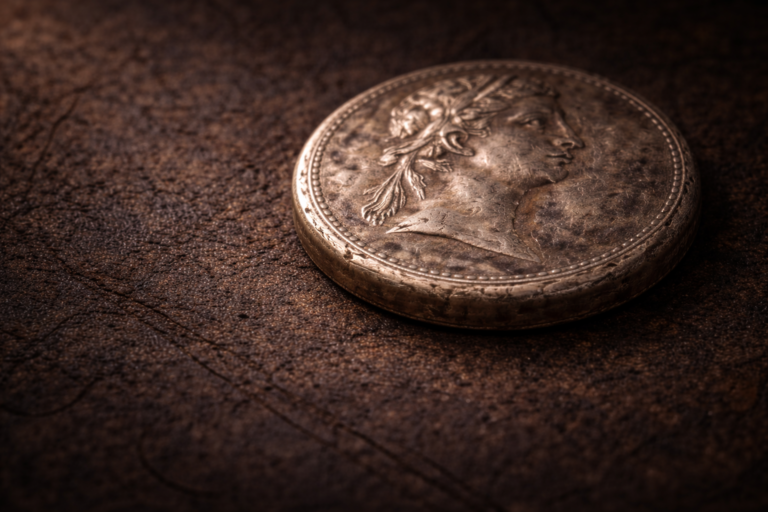
The Eclipse Denarius – When the Sun and Moon Wept Silver
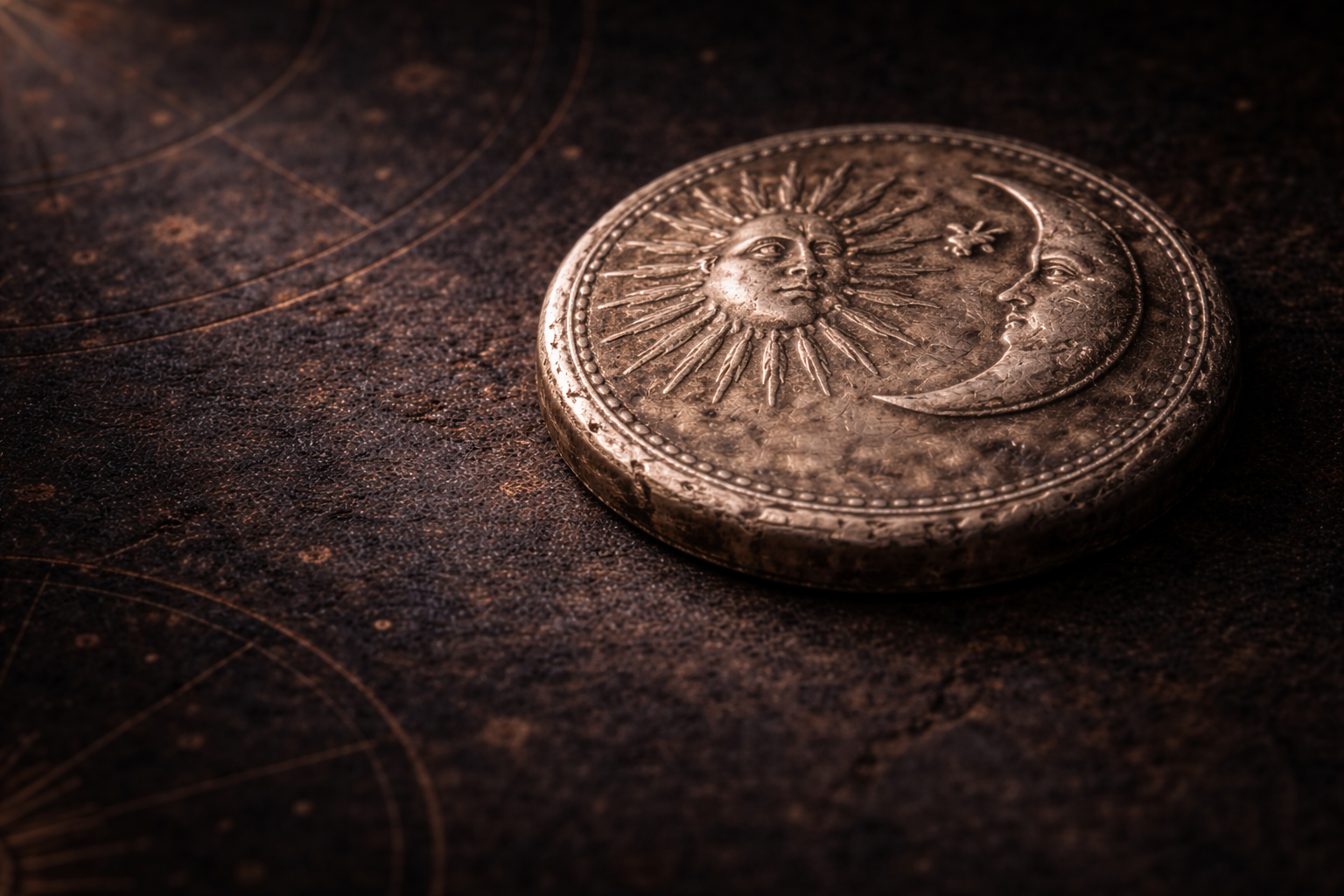
The Eclipse Denarius – When the Sun and Moon Wept Silver
On a summer morning in 218 AD, the skies over Rome darkened without warning. The citizens froze in the streets, staring upward as daylight bled into twilight. The air turned cold. Birds vanished from the sky. It was the day the sun and moon embraced—the day Emperor Marcus Severus ordered the forging of the Eclipse Denarius.
The emperor believed the eclipse was no omen but a message—proof that the gods had chosen him to unite light and darkness under his reign. He commanded his mint masters to create a coin unlike any ever struck, one that captured the exact moment the world stood between day and night.
🌘 The Forging Under the Black Sun
The process began as the eclipse reached totality. Priests chanted in Latin hymns as molten silver poured like liquid moonlight into the molds. Witnesses said the air crackled with energy; the flames in the furnaces flickered blue, and shadows lengthened even though there was no light to cast them.
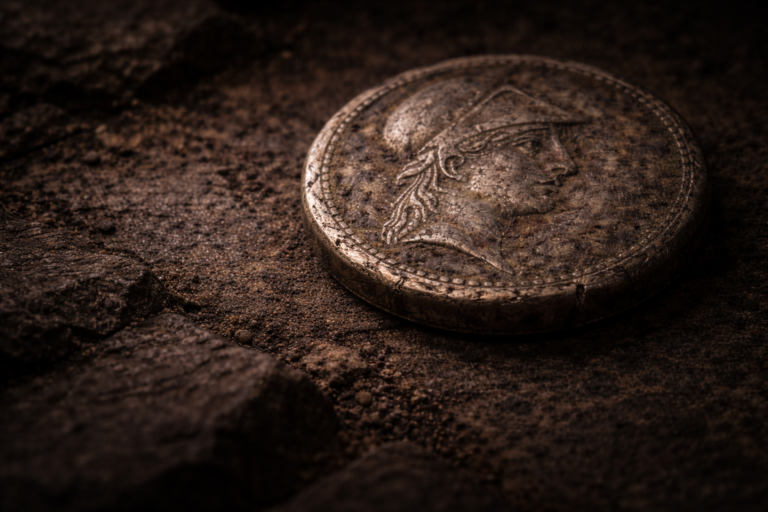
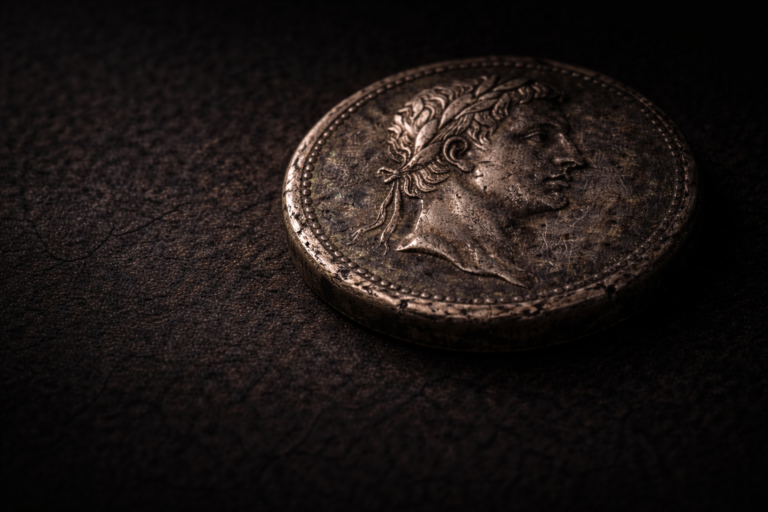
When the first Denarius cooled, it bore an image never before seen on a Roman coin: the face of Sol, the sun god, half-shrouded in darkness. On the reverse side, the crescent of Luna intertwined with the rays of Sol—a marriage of opposites, bound in silver.
Marcus Severus named it “Denarius Eclipsis.” Only 100 were struck. Each was blessed—or cursed—under the shadow of the eclipse. And though their craftsmanship was flawless, the imperial mint workers swore they could hear whispers from the silver as they cooled, like the sighs of something alive inside.
🔥 The Emperor’s Obsession
From that day, Severus was never the same. He carried one coin with him at all times, claiming it gave him visions of the gods. His advisors reported he would stare at it for hours, muttering to himself, as though he were speaking to someone only he could see. He began to dream of two celestial figures—a man of light and a woman of shadow—calling to him from opposite ends of the void.
He commissioned temples of silver and marble, declaring that the sun and moon were lovers separated by mortal time, and that he, Marcus Severus, was their vessel made flesh. His court grew fearful; his wife left him; his generals whispered that he had gone mad. But still, he would not release the coin.
When the next eclipse approached, he gathered his council on the Palatine Hill to witness it. As the sky dimmed again, Severus raised the Denarius toward the heavens and shouted:
“Let them weep silver, that I may rule the space between light and shadow!”
In that moment, the sun vanished completely—and when light returned, the emperor was gone.
🕯️ The Lost Denarius
His body was never found. The palace guards swore he had simply dissolved into air, leaving behind only the Denarius resting on his throne, glowing faintly. It was locked away in the imperial vaults, where it remained for centuries—until Rome fell, and its treasures were scattered to the winds.
Legend says the coin reappeared in Constantinople during the reign of Theodosius, and again in Venice in the 15th century. Each time, it brought with it an eclipse of misfortune—rulers assassinated, plagues spreading, and the sky darkening unexpectedly. Scholars began to call it “Lacrima Lunae”—the Tear of the Moon.
Those who claimed to have seen it described a chilling detail: the coin’s surface would darken over time, as though absorbing the shadows around it. Some swore that when held under moonlight, the faces of the sun and moon appeared to move—one turning away as the other wept silver tears.
In 1899, a British explorer named Arthur Kellington allegedly discovered the Eclipse Denarius inside a crypt near Antioch. His journal entries describe his descent into obsession:
“It does not shine, it breathes. I see my reflection in its silver, and behind it—two eyes. One weeps light, the other weeps dark.”
Two weeks later, he disappeared at sea on his return voyage. The ship was found adrift, every clock on board frozen at 12:07 PM—the exact minute of the solar eclipse recorded that day.
And so the curse began anew.
🌒 The Scholar’s Curse
In 1923, the coin resurfaced once more, this time in the hands of Dr. Elias Corvin, a Roman historian at the University of Athens. The Eclipse Denarius was found wrapped in seaweed among shipwreck relics near Cyprus—its surface untarnished despite centuries underwater.
Dr. Corvin was enthralled. He believed the coin held astronomical knowledge lost to time—a coded message from ancient Rome linking eclipses to divine prophecy. He placed it beneath a telescope lens during a lunar observation. At the precise moment the moon entered Earth’s shadow, the silver flared with a ghostly light.
Witnesses later said Corvin cried out, claiming to see the emperor’s face staring back at him, mouth open in silent agony. Moments later, every light in the observatory went out. When power was restored, the coin lay on the floor, and Corvin was gone—his chair overturned, his notes burned to ash.
Only one phrase survived, scribbled across the wall in Latin:
“Sol et Luna flent in argento.” The Sun and Moon weep in silver.
🩸 The Silver Eclipse
Modern researchers who trace the coin’s alleged path have noted an eerie coincidence: every time the Eclipse Denarius has been reported in private collections, an eclipse—solar or lunar—has occurred within weeks. In some cases, the coin has even been photographed under strange conditions: its surface reflecting an inverted image of the sky, as if the heavens themselves were looking down through it.
In 2017, a rare photograph surfaced online showing the coin inside a collector’s vault in Milan. Within days, the image vanished from the internet, and the owner was found unconscious beneath a shattered skylight. His final words, recorded by paramedics, were barely a whisper:
“They met again… and the world turned cold.”
To this day, no one knows where the coin is. Some say it lies sealed beneath the Vatican, others claim it orbits the earth, trapped aboard a lost satellite. But one thing remains constant: whenever the sun and moon align, the legend returns to life.
🌗 The Eternal Alignment
Perhaps the curse was never about power or punishment. Perhaps it was a reminder—a reflection of the balance between opposites. For every light, a shadow; for every victory, a loss; for every creation, a cost. The Eclipse Denarius was both a triumph of art and a warning from the gods: that man should never try to bind heaven in silver.
So if one day, during the hush of an eclipse, you feel the air grow cold and a shimmer of light at your feet—do not look down. For some reflections, once seen, cannot be unseen.
💀 Reality Check
No documented Roman coin has ever been confirmed to depict an eclipse, but several denarii from the Severan dynasty show celestial motifs—stars, crescents, and solar rays—representing divine authority. Ancient Romans viewed eclipses with awe and fear, often linking them to imperial deaths or omens. The notion of “forging under an eclipse” appears in rare inscriptions describing rituals meant to capture cosmic balance. The legend of the Eclipse Denarius may have evolved from these real historical beliefs, mixing astronomy with superstition.
💭 Final Thought
Some myths burn bright, others hide in shadow. The Eclipse Denarius stands between them—a reminder that light and darkness are not enemies, but reflections of each other. Perhaps the true curse was never in the coin, but in our desire to control what should only be witnessed.
🔗 Explore more mysterious coin legends on the HistoraCoin YouTube Channel