The Emperor’s Silver Tear — A Roman Coin That Wept Blood
⏳ Estimated reading time: 11 minutes
The Emperor’s Silver Tear — A Roman Coin That Wept Blood
They said Rome’s glory was stamped in silver—until one coin began to bleed.
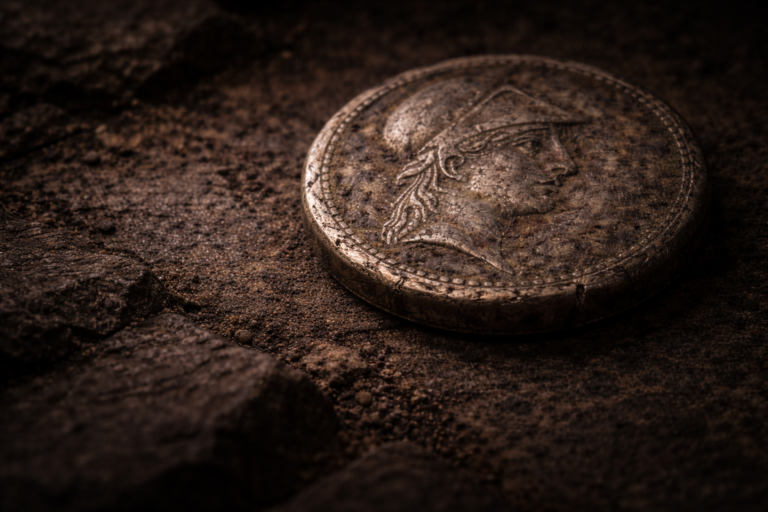
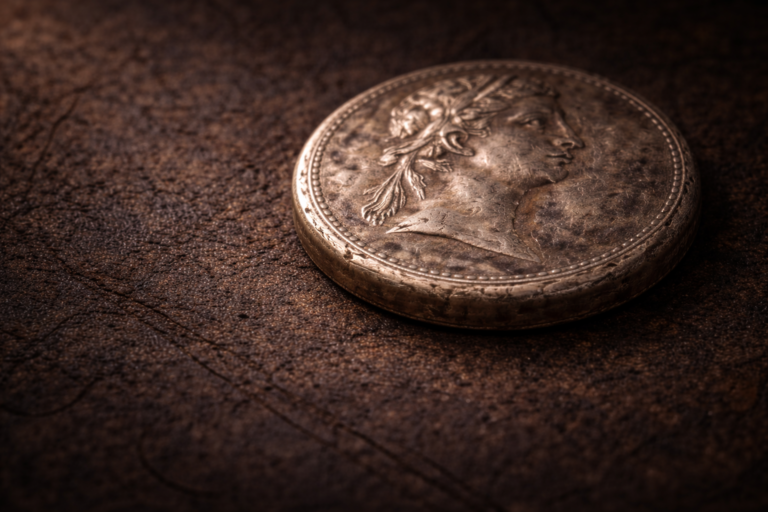
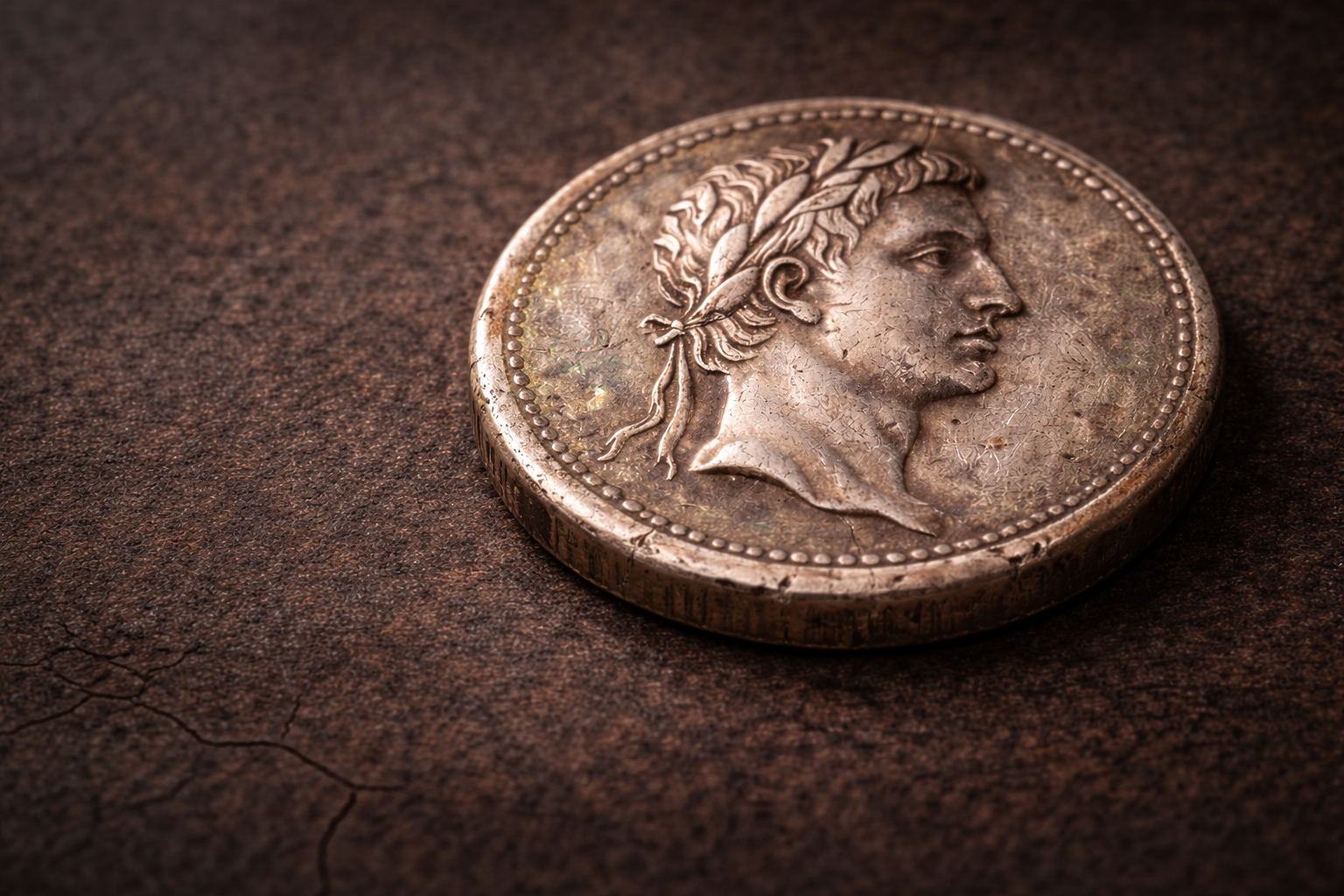
In 1879, during a renovation near the ancient Palatine Hill, workers uncovered a sealed clay jar hidden within the ruins of what was once a Roman noble’s villa. Inside the jar were eleven silver coins, all bearing the image of Emperor Nero. Ten appeared ordinary. The eleventh was different—its eyes seemed wet, and a faint crimson stain ran from the emperor’s cheek down to the coin’s edge.
The foreman, thinking it a trick of oxidation, wiped the coin with a cloth. The red mark smudged like liquid. He dropped it instantly. Witnesses swore the coin left a tiny scarlet spot on the ground—one that didn’t dry for hours.
🩶 The Blood of the Emperor
When scholars examined the coin, they found traces of a metallic compound mixed with an unknown residue resembling dried blood. The artifact was quickly named “Lacrima Argentea”—The Silver Tear. Historians linked it to a passage in the Historia Secreta, describing how Nero, overcome with guilt after his mother’s death, ordered a single series of coins to be minted “in his sorrow.”
According to legend, the emperor had a drop of his own blood mixed into the molten silver as the first coin was struck. The mint’s chief smith refused to continue, claiming the metal hissed and turned dark as it cooled. Days later, the smith was executed for “disobedience in sacred duty.”
Only twelve coins were ever completed. Nero ordered eleven to be buried with him and kept one in his chamber—a “mirror of repentance,” he called it. When he died, the coin vanished from imperial records.
⚰️ The Weeping Artifact
After its rediscovery, the Silver Tear was transported to the Capitoline Museum in Rome. But within a week, guards reported strange occurrences—drops of red liquid forming on the display glass at night, even after cleaning. On the seventh night, the curator entered to find the case cracked from within. The coin sat on the floor, gleaming faintly, surrounded by a halo of darkened marble.
In his report, he wrote: “It watches me. The face changes. It smiles when the lights dim.”
Two days later, lightning struck the museum roof during a clear evening sky, setting part of the archives ablaze. The coin disappeared in the confusion. Weeks later, a traveler claimed to have seen it in Naples—held by a merchant who swore it “cried before the earthquake.”
🕯️ The Merchant’s Warning
The merchant, known only as Lucio Ferrante, kept the coin in a small glass vial, claiming it “mourned” for the dead. He told customers that before every disaster, the silver wept. In the days preceding the 1908 Messina earthquake, multiple witnesses saw a red bead forming along the emperor’s cheek on the coin. After the quake struck, killing over 80,000, the merchant vanished, leaving only an empty vial shattered in his shop.
Decades later, collectors and priests whispered that the Emperor’s Silver Tear had resurfaced again—still weeping, still waiting for Rome to fall once more.
Part 2 will reveal the coin’s modern rediscovery, the scientific tests that failed to explain its bleeding metal, and the chilling prophecy that connected it to Nero’s curse—along with the Reality Check and Final Thought sections.
🌘 The Return of the Tear
In 1974, a fragment of the Emperor’s Silver Tear appeared in the private collection of an Italian cardinal. He claimed it was a relic of redemption—a coin that had “cried” during prayer. The Vatican’s archivists, however, treated it as a forbidden object. They sealed it in a glass reliquary deep beneath St. John Lateran Basilica. For decades, it remained undisturbed—until the night of a lunar eclipse in 1999.
That evening, a caretaker discovered droplets of red fluid condensing on the inner glass of the reliquary. The liquid analysis later revealed traces of oxidized iron, but no organic material. Still, witnesses swore they smelled copper and smoke—the scent of Roman forges. The relic was removed and stored in a lead-lined vault. The fluid never appeared again.
🩸 The Modern Investigation
In 2010, a British archaeometallurgist, Dr. Adrian Cole, received permission to examine the remaining fragments under spectrographic light. His report stated that the coin’s surface contained microscopic inclusions resembling hematite—iron crystals often found in volcanic rock. Yet one area, near the emperor’s cheek, showed an anomaly: a porous cavity containing dried residue, red in color and distinctly organic.
“If genuine,” he wrote, “it suggests contact with human blood—perhaps even infused during casting.” But the most chilling line appeared at the end of his notes: “The residue is fresh.”
Days later, Dr. Cole’s laboratory burned down in an unexplained electrical fire. The Silver Tear fragment was never recovered. Rumors claimed the flames had a crimson hue, and that molten metal flowed from the remains of the safe—dripping like tears.
🔥 The Emperor’s Curse
Throughout history, emperors were seen as divine reflections of Rome’s will. Nero’s legend, however, was different—he tried to bind his guilt in silver. Some believed the Silver Tear was never meant to exist outside his tomb. The blood, they said, was not his remorse but his rage—forever crying for vengeance against those who disturbed his rest.
Today, collectors whisper that a single coin still exists, passed secretly among those who dare to hold it. They say that under the light of a dying candle, the emperor’s eyes glisten red—and if you watch long enough, it will blink.
💀 Reality Check
While no proven artifact matching the Emperor’s Silver Tear has been recorded, historical sources confirm that Emperor Nero minted several experimental silver denarii between 64 and 66 AD. Some of these coins exhibit unusual discoloration, possibly from impurities or mercury contamination during the smelting process. Ancient writers, including Suetonius, noted Nero’s fascination with “living metals” and his belief that divine essences could be bound in coinage. This fascination likely gave rise to myths linking his coins with blood, fire, and madness. The tale of the Silver Tear endures as a poetic metaphor—Rome itself bleeding through the ages.
💭 Final Thought
Every empire leaves behind coins—but only Rome left behind mirrors. The Emperor’s Silver Tear is more than a legend; it’s a reminder that power and guilt are metals that never cool. Perhaps, in the molten depths of history, every ruler’s face still waits to weep again.
🔗 Explore more cursed coin legends on the HistoraCoin YouTube Channel
Read also: The Coin of Shadows, The Black Denarius, and The Ferryman’s Obol.