The Phoenix Coin – The Fire That Never Dies
This story is brought to you by HistoraCoin – where history is reborn through legend.
Fire destroys, but it also creates. That’s the paradox at the heart of one of Asia’s oldest and most beautiful myths — the legend of The Phoenix Coin. They say it was forged in the ashes of a fallen dynasty, glowing red like sunrise, carrying within it the soul of immortality itself. Whoever holds it, the legend says, will never truly die — but neither will they ever truly live.
It’s a tale whispered across temples, passed through empires, and rediscovered by those who mistake light for luck. A coin that burns, revives, and disappears — only to return again, centuries later, as if reborn from its own ashes.
🔥 The Birth of the Phoenix Coin
Our story begins in the final days of the Han Dynasty. War, famine, and betrayal had turned the once-great empire into ruins. In the city of Luoyang, a dying emperor named Liu Xian summoned his court alchemist, Wei Shun, and gave him a single command:
“Forge me a coin that remembers — so that when the empire dies, I may return.”
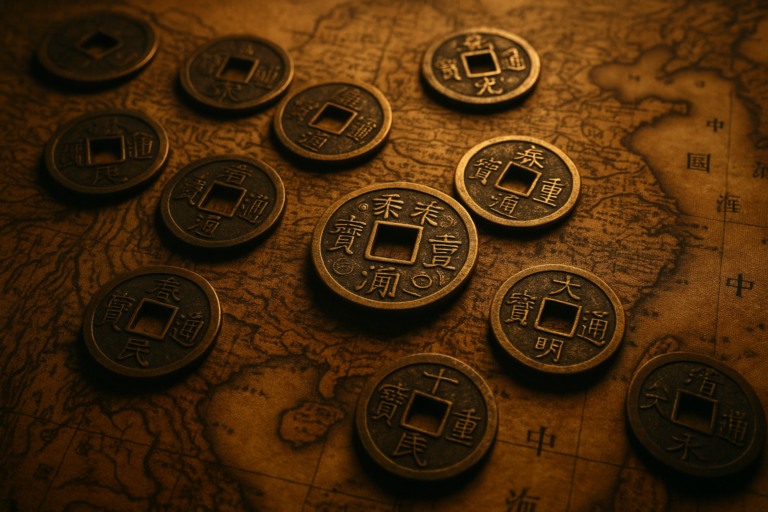
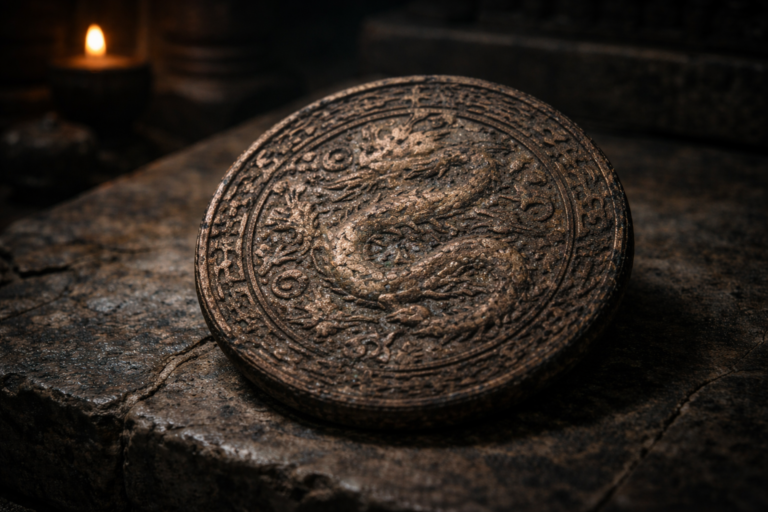
Wei Shun worked for forty days and forty nights, mixing gold, cinnabar, and crushed phoenix feathers burned in sacred oil. When the coin finally cooled, it glowed red — alive. Upon one side, he carved the image of a bird in flight. On the other, a rising sun. He whispered a prayer to the gods of rebirth, then placed it in the emperor’s hand.
The next morning, the palace burned to the ground. No body was found — only a single coin, resting unscathed in the ashes.
🌕 The Coin That Wouldn’t Melt
Centuries later, during the Tang Dynasty, a monk named Huineng discovered a strange relic buried beneath a ruined pagoda. It was a coin, smooth as glass, glowing faintly like embers in the dark. When he tried to melt it down to make offerings, it refused to burn — instead, it sang. A low, melodic hum filled the air, like wind through bamboo.
Frightened, the monk locked it inside a wooden chest and buried it deep under the monastery floor. That night, the temple caught fire. When the ashes cooled, the chest was gone — and at the center of the ruins, the coin sat atop a stone, untouched, warm, and shining brighter than before.
The monks began to call it the Huo Sheng Qian — “The Living Fire Coin.” They believed it was a spirit reborn, a fragment of divine flame that could not die.
🕊️ The Samurai’s Curse
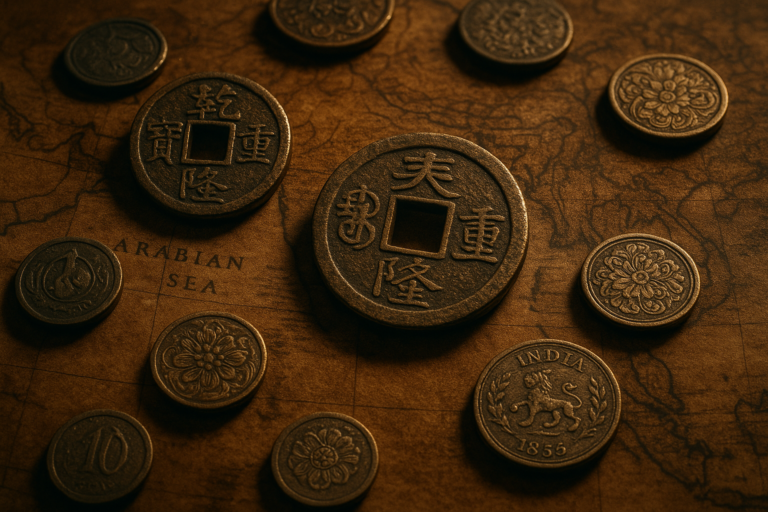
In the 13th century, the Phoenix Coin found its way to Japan through Silk Road traders. A young samurai lord named Masaru Ito bought it from a Chinese merchant who claimed it came from “a burning temple of gods.” Masaru carried it into battle, believing it would grant him victory.
For years, he never lost. His enemies fell like autumn leaves. But he never aged, either — not a day. His soldiers called him the Man of Eternal Dawn. Then, one winter night, he set fire to his own castle. When the flames died, Masaru’s armor was found empty, his blade melted — yet the coin lay on the ground, shining red as blood.
Local legends say his spirit still walks the hills of Kyoto, searching for it, whispering, “I can’t die if I can’t rest.”
🌩️ The Alchemist of Fire
In the 1600s, during the Ming Dynasty, the Phoenix Coin was rediscovered by Xu Liang, a scholar obsessed with immortality. He studied it under moonlight, noting that it grew warmer in his hand the longer he held it. He wrote in his journal:
“The coin is breathing. When I close my eyes, I see wings of fire behind my eyelids.”
Neighbors began hearing strange sounds — fluttering wings, crackling heat — coming from his workshop. Then, one morning, his house was gone, burned to its foundation. In the center of the ruins stood a single wooden table, unburned. And on it — the Phoenix Coin, glowing softly, surrounded by a circle of ash shaped like feathers.
🌄 The Colonial Expedition
In 1898, a British explorer named Thomas Everly led an expedition to Southeast Asia to study “ancient artifacts of transformation.” He purchased a small red coin from a monk in Burma who begged him not to keep it. Everly laughed and tucked it into his coat.
His journal, recovered years later, tells what happened:
“It hums. I feel it under my skin, like a pulse. My lantern went out but the coin glows brighter now. It whispers in a tongue I can almost understand. It says… rise.”
Weeks later, his entire team vanished in a jungle fire. When rescue crews arrived, the forest was still smoking. They found no bones, no camp — only a single metal disc resting on blackened earth, gleaming as though freshly minted.
🪶 The Museum of Flames
In 1953, the coin surfaced in the Shanghai Historical Museum, cataloged as “Unknown Dynastic Relic – Composition Anomalous.” Scientists studying it noted it emitted low-frequency vibrations and faint heat even at room temperature. At night, the glass case fogged from inside, as though something alive were breathing.
When a fire broke out in the archives in 1956, the entire wing burned — except the display room of the Phoenix Coin. Witnesses swore the flames bent away from it. One guard resigned, saying, “It wasn’t fire that burned the building. It was fire that wanted to live.”
🌕 The Legend Renewed
Today, believers say the Phoenix Coin is a symbol of rebirth — not destruction. It appears only when eras end — during wars, revolutions, or the fall of empires — as if marking the world’s next beginning.
In 2020, during restoration of an old temple near Xi’an, workers uncovered a sealed copper jar. Inside, wrapped in silk, was a small circular object — red, metallic, and warm. When photographed, the image came out blurred, as if the lens couldn’t focus. A single character was inscribed on its surface: Shēng — “Life.”
The artifact was quietly transferred to a research institute. Unofficial reports claim it glowed for three nights before fading to dull bronze — only to regain its red hue every sunrise.
💭 The Message of the Coin
The Phoenix Coin isn’t about fire or immortality. It’s about renewal. About the endless cycle of fall and rise — of civilizations, of souls, of hope. Every time humanity burns its world to ashes, something in us insists on being reborn.
Maybe the coin never existed physically. Maybe it’s an echo — a symbol of the spirit that refuses to die, reborn in art, memory, and legend. But maybe… just maybe… it’s still out there, waiting for the next age to end, ready to rise again from the flames.
🌕 The Lesson Beneath the Legend
The Phoenix Coin teaches us the oldest truth — that death is never final, only transformation. The same fire that consumes also creates. And in every ending lies the beginning of something new, glowing quietly in the ashes of what was.
🧭 Reality Check
No historical record confirms the existence of a “Phoenix Coin,” but similar relics from Han and Tang dynasties feature bird and sun engravings symbolizing rebirth and divine protection. Legends of fire and transformation remain central to Asian mythology, from the Chinese Fenghuang to Japan’s immortal Ho-ō.
🏁 Final Verdict
Whether myth, metaphor, or miracle, the Phoenix Coin continues to ignite imaginations across centuries. Because, like the bird it represents, its story refuses to die — and perhaps that’s its greatest magic of all.
🎥 Watch More on HistoraCoin
If this tale of fire and rebirth fascinated you, explore more ancient legends, lost coins, and timeless treasures on our YouTube channel: HistoraCoin on YouTube – where every coin rises from history’s ashes.
❓ FAQ
Is the Phoenix Coin real?
There’s no verified artifact, but historical coins featuring phoenix motifs symbolize rebirth in Chinese and Japanese mythology.
Why is it called the Phoenix Coin?
Because it’s said to survive destruction, glowing again after every disaster — just like the mythical bird that rises from fire.
Where is it now?
Some believe it’s sealed in a temple vault in Xi’an; others think it appears only during moments of great change in history.
What does it symbolize?
Transformation, immortality, and the eternal flame of renewal — the same ideals the Phoenix has embodied for thousands of years.
Focus Keyword: phoenix coin legend
Keywords: phoenix coin legend, asian coins, ancient asia treasure, mythical coin asia, cursed coin legend, rebirth coin, phoenix mythology coin, mysterious asian relic, rare asian coin, immortal coin story