The Queen’s Lost Dinar – The Curse of the Desert Gold

This story is brought to you by HistoraCoin – where every coin tells a story buried in time.
There’s a saying in the Sahara, whispered by the desert tribes when the wind turns cold — “Gold remembers.” And among the many legends carried by the dunes, one shines brighter, darker, and far more dangerous than the rest. It is the story of The Queen’s Lost Dinar — a coin of impossible beauty, said to belong to a queen whose name was erased from history… because she defied the gods.
Some call it myth. Others call it cursed truth. But everyone who went searching for it — never came back unchanged.
👑 The Forgotten Queen of the Sands
Our story begins more than a thousand years ago, when the Kingdom of Takrur ruled the western edges of the Sahara. Its queen — Zahara al-Nur — was known for her wisdom and cruelty in equal measure. Legends say she possessed a coin unlike any other, forged from the heart of a fallen star. It wasn’t just gold — it shimmered with a strange red glow under the sun, and in moonlight, it appeared alive.
The priests called it the “Dinar of the Sun”, a divine token said to grant eternal rule. But Zahara defied their warnings. She kept the coin close, wearing it on a golden chain over her heart. She said, “If the gods fear it, then it must be powerful.”
And for a while, she was right. Her crops flourished, her enemies vanished, and her kingdom grew rich beyond belief. But then… the river dried, the sands rose, and her people began to disappear one by one — swallowed by the desert that had once obeyed her.
🔥 The Fall of Zahara
One night, the queen stood atop her palace walls, clutching the Dinar. Lightning danced in the distance — though the sky was clear. She raised the coin to the heavens and cried, “If this power is cursed, then let it take me!” The next morning, the palace was gone. No one saw Zahara again.
Only the Dinar remained, half-buried in the sand, gleaming like a dying sun. The desert reclaimed her kingdom, and with it, her name. The few survivors told a single story: “The queen traded her soul for a coin that outlived her.”
🌪️ The Discovery
Centuries later, in 1931, French explorer Étienne Durand led an expedition into the Mauritanian desert after hearing whispers of a “golden relic that glows in darkness.” He found ruins — towers eaten by sand, doorways that led nowhere, carvings of a queen with a burning coin above her head. And then, in a half-collapsed chamber, he found it.
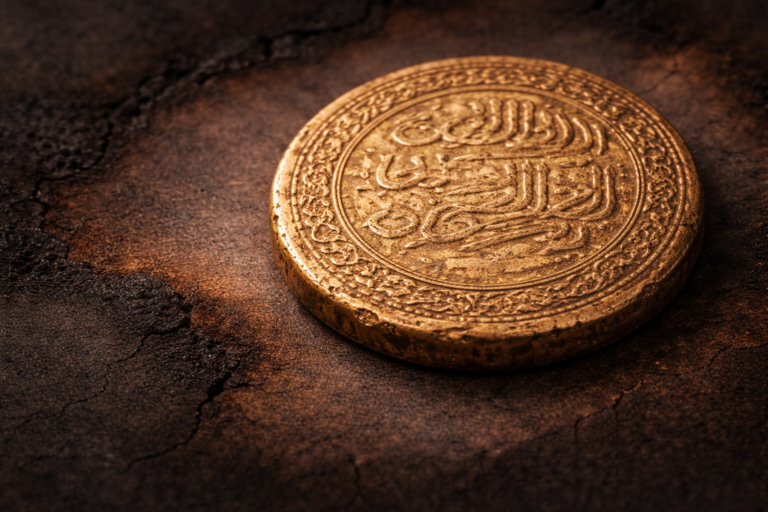
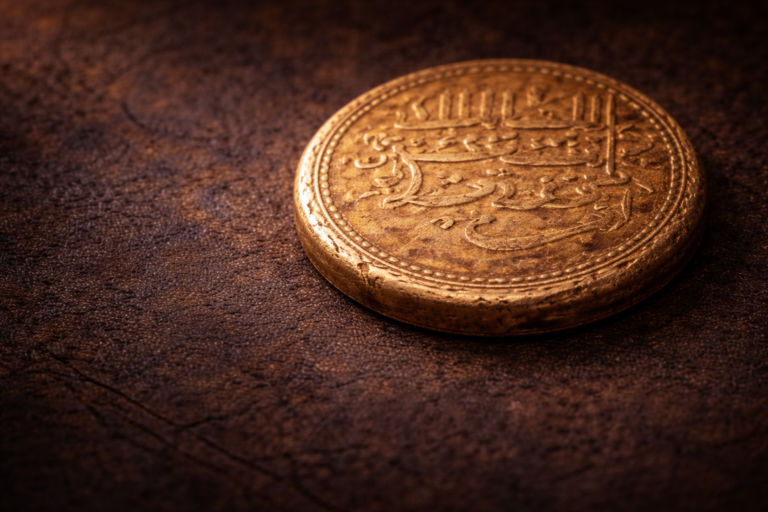
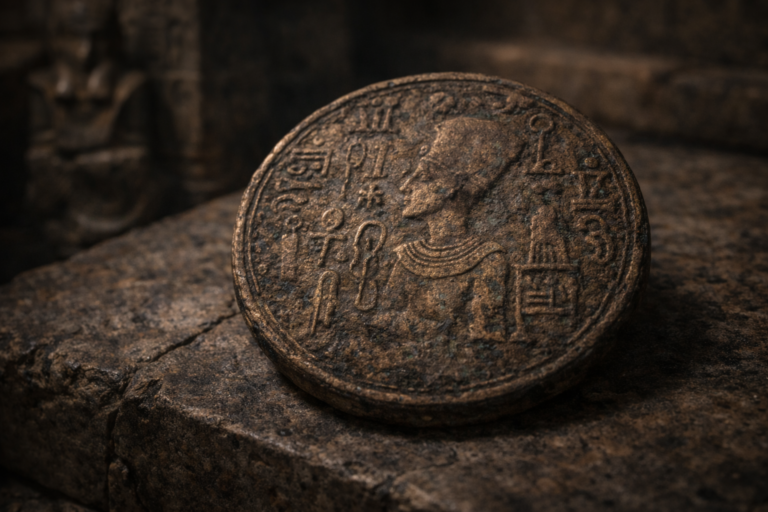
It was small, perfectly round, its surface etched with symbols unknown to any script. In the center, a woman’s face — eyes closed, lips slightly parted — as though asleep. Étienne held it up to the light… and it pulsed once, faintly, like a heartbeat.
“C’est vivant,” he whispered. “It’s alive.”
His team laughed — until that night, when their camp caught fire. Two men vanished. Étienne’s journal, later recovered, contained only one final entry:
“She spoke my name in a dream. I think the coin remembers her — and now it remembers me.”
🌕 The Coin That Glows in the Dark
For decades, no one saw the coin again. Rumor says it was taken to Paris and placed in a private collection. Museum records mention a “North African gold dinar with luminescent properties,” but it was never displayed. In 1952, a fire broke out in that collector’s mansion. The entire wing turned to ash — except for one thing found in the rubble: a single gold coin, glowing faintly, untouched by flame.
The maid who found it refused to touch it bare-handed. “It hums,” she said. “Like something trapped inside is trying to breathe.”
🌬️ The Curse of the Desert Gold
Every legend has a price. The Queen’s Lost Dinar, they say, grants fortune to its holder — but it feeds on memory. Each day you keep it, you forget something important. One man who owned it for a week forgot his son’s name. A scholar who studied it for a month forgot how to read. And a thief who stole it was found wandering the dunes, repeating one phrase over and over: “The Queen waits for her coin.”
The coin, according to the Tuareg elders, is not cursed. It is loyal. It seeks its queen, and punishes those who steal her glory. “It returns,” one elder told a journalist in 1979, “like the wind. You can’t trap it. You can only delay it.”
🌄 The Mirage Expedition
In 1996, a young archaeologist named Layla Karim claimed she had located the ruins of Zahara’s lost city through satellite scans. “The sand hides more than bones,” she told reporters. Her team vanished three days after setting camp. Only her camera was found, half-buried, its film strangely undeveloped except for one frame — a woman’s silhouette, standing alone in a storm of gold dust, holding something small that shimmered.
Experts called it a lens flare. The desert tribes called it the queen’s return.
🌑 The Dinar in the Museum
In 2011, an artifact surfaced in the Cairo Museum under the label “Unverified North African Coin – 10th Century.” It was kept under dim light, behind reinforced glass. Scientists noted that under UV rays, faint hieroglyphs appeared around its edge — not Egyptian, but Sahelian script translating roughly to: “She who holds eternity owes it back.”
Visitors reported odd sensations — warmth, dizziness, whispers. Some swore they saw the coin’s surface ripple like water. The museum denied these claims, calling them “optical illusions caused by lighting conditions.” Still, after hours, guards refused to patrol that section alone.
💭 What Does It Really Mean?
Perhaps the Queen’s Lost Dinar was never a coin at all. Perhaps it was a story — a warning disguised as gold. The tale of a woman who tried to own power that belonged to the universe itself. In every culture, there’s a myth like hers: power gained, balance broken, price paid.
But the Dinar endures because it feels possible. Gold buried beneath desert sands is real. Forgotten queens are real. And every explorer, no matter how rational, knows that some treasures are found not by luck — but by invitation.
🕯️ Between Myth and Memory
Layla’s camera now sits in a private archive, its sand still clinging to the lens. No one knows who sent it. In her last recorded message, recovered from a damaged tape, she says softly in Arabic: “I saw her. She wasn’t angry. She was waiting.”
After that, the tape ends. But for years, people near the Adrar Plateau reported seeing strange lights under the dunes — golden flickers moving like embers in the wind. The locals call it “Zaharat al-Rimal” — the Flower of Sand — but among historians, it has another name: The Queen’s Breath.
💀 The Curse Continues
So where is the Queen’s Lost Dinar now? Some say it’s buried again, deep beneath Mauritania’s sands. Others claim it’s locked in a vault in Paris, still humming quietly, waiting for someone foolish enough to wake it.
Maybe it’s not a curse, but a mirror — showing us what happens when we confuse power with ownership. After all, the Queen didn’t lose her coin. The world did.
And perhaps, somewhere tonight, as desert winds howl over forgotten ruins, that coin still glows — remembering her name when no one else does.
🌕 The Lesson Beneath the Legend
The Queen’s Lost Dinar teaches a haunting truth: not all treasures are meant to be found. Some stories are warnings carved in gold. History repeats itself when we stop listening — and the desert, patient as time itself, keeps every secret we forget.
🧭 Reality Check
While no verified artifact called “The Queen’s Lost Dinar” has been found, real gold coins from ancient African kingdoms like Mali and Takrur exist, showcasing remarkable craftsmanship. Their legends — blending royalty, divinity, and desert mystery — continue to inspire collectors and historians alike. The line between truth and myth in African numismatics remains beautifully blurred.
🏁 Final Verdict
Whether myth or reality, the Queen’s Lost Dinar remains one of the most compelling tales of power, pride, and loss. It reminds us that history doesn’t always belong to the victors — sometimes, it belongs to the sand, and to the gold that refuses to forget.
🎥 Watch More on HistoraCoin
If you enjoyed this legend — where ancient Africa’s treasures meet timeless mystery — explore more incredible coin stories on our YouTube channel: HistoraCoin on YouTube – where every coin tells a forgotten story waiting to be rediscovered.
❓ FAQ
Is the Queen’s Lost Dinar real?
It remains unverified, though inspired by real African gold coins from early kingdoms like Mali and Takrur.
What was special about this coin?
Legends claim it glowed and carried a curse of memory — rewarding wealth while erasing the owner’s past.
Could it still exist?
Possibly. Desert conditions preserve metal well, and undiscovered ruins could still hold lost treasures beneath the sands.
Why do such legends endure?
Because gold and mystery are timeless — and the human heart will always chase both, no matter the cost.
Focus Keyword: queens lost dinar
Keywords: queens lost dinar, african coins, gold dinar legend, cursed coin africa, lost treasure africa, desert gold coin, african mythology coins, ancient africa relics, rare africa coins, mysterious coins africa