
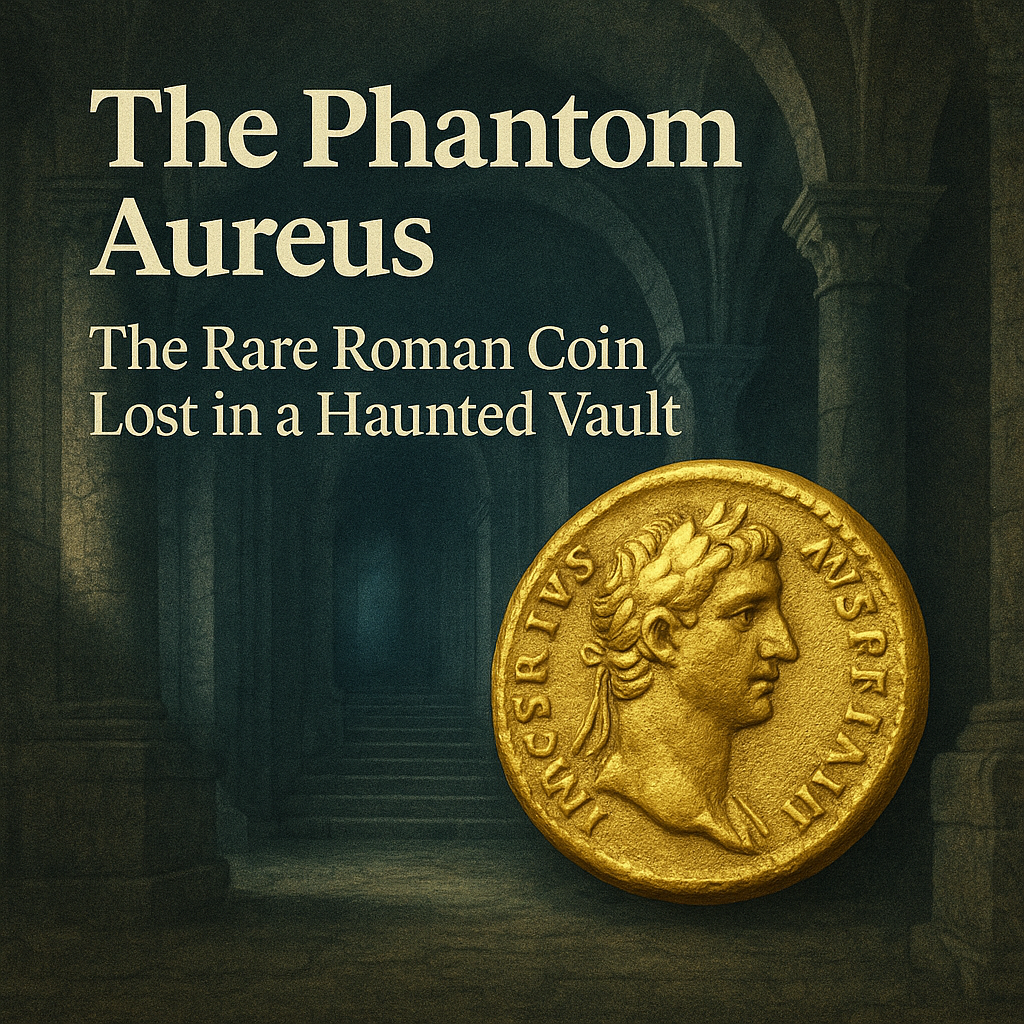
The Phantom Aureus – The Rare Roman Coin Lost in a Haunted Vault
⏳ Estimated reading time: 11 minutes
The Phantom Aureus – The Rare Roman Coin Lost in a Haunted Vault
Some treasures don’t shine—they whisper.
It is said that once every hundred years, a golden coin glows faintly in the darkness beneath the ruins of an old Roman vault in Naples. Locals call it The Phantom Aureus—a coin that refuses to stay buried, forged not by mortal hands but by vengeance itself.
For centuries, the vault has remained sealed, its entrance hidden beneath layers of marble and fear. Yet, on moonless nights, passersby swear they hear the faint clink of metal echoing from underground—like coins being counted by invisible hands.
🏛️ The Emperor’s Secret Mint
The story begins during the reign of Emperor Decimus Valerius, a ruler obsessed with wealth and immortality. He believed that gold could hold a man’s soul if melted under the right celestial alignment. To prove his theory, he ordered a secret mint to be built beneath his palace—where only he and his most trusted treasurer, Aelius Varro, could enter.
Every full moon, the emperor descended into the vault to oversee the forging of new aurei—gold coins that bore not just his likeness, but something else. Witnesses claimed that when held to the light, a faint shadow appeared behind his portrait—an echo of another face, weeping.
Varro grew fearful and begged the emperor to stop. But Decimus had already gone too far. One night, after sealing the final batch of coins, he whispered a vow over the molten gold:
“Let my glory never fade, even when flesh turns to dust.”
When the gold cooled, the mint workers found the emperor dead, his face reflected perfectly in the surface of the last coin struck. His eyes were still open—burned into the metal like a mirror of fire.
🕯️ The Vault That Wouldn’t Die
After Decimus’s death, Aelius Varro ordered the vault sealed with iron and curses. Every worker who had touched the gold was executed to “protect the empire’s sanctity.” But superstition spreads faster than flame. Rumors claimed that the vault echoed with the sound of hammering long after it was sealed, as if unseen hands continued minting in the dark.
Years passed. Empires fell. And yet the legend endured—that beneath the marble ruins of the emperor’s palace, the coins still multiplied on their own, fed by the souls of the greedy.
📜 The Discovery in Naples
In 1882, during the excavation of a Roman bath complex in Naples, workers stumbled upon a collapsed tunnel lined with soot-black stones. At its end was a massive bronze door covered in Latin inscriptions. One phrase was still readable:
“Aurum audit, sed non reddit.” — “Gold listens, but does not return.”
Behind the door, archaeologists discovered a small chamber filled with charred remains, shattered amphorae, and a single golden coin resting atop a stone altar. The coin’s surface shimmered faintly, as though it were breathing. On one side was the face of Emperor Decimus. On the other, an image of a man chained in shadow, mouth open in an eternal scream.
The lead archaeologist, Dr. Matteo Lorusso, documented the find in his journal, writing that the air inside the vault “smelled not of decay, but of fear.” That night, he took the coin back to his tent for study.
🪞 The First Night
At precisely midnight, Lorusso’s assistant heard him speaking softly, as if reciting to someone unseen. The next morning, the tent was empty. Only the coin remained, glowing faintly in the dim light. The excavation team sealed the chamber again, and the artifact was transported to the Naples Museum.
Three days later, the museum’s curator reported hearing footsteps echoing through the vault at night, though it was locked and guarded. When the guards checked, they found a trail of golden dust leading to the display case—empty.
Since that day, the Phantom Aureus has never stayed in one place for long. Each time it is found, something—or someone—disappears with it.
🕳️ The Vanishing Coin
Decades later, in 1936, the Phantom Aureus appeared again—this time in the private collection of a wealthy banker named Giorgio Mancini. He purchased it from an anonymous dealer who claimed the coin had “found its way” back from the ruins of Naples. Mancini kept it in a velvet-lined box inside his study, where it became his most prized possession.
Within weeks, strange things began to happen. His servants heard metallic clinks coming from the locked cabinet at night. His reflection in the mirror began to shift, showing a faint golden glow behind his eyes. He wrote in his diary that the coin whispered to him when the lights went out, promising eternal prosperity—at a price.
“It speaks like a man trapped in gold,” he wrote. “It knows my name.”
One stormy night, the neighbors reported hearing screams echoing from Mancini’s mansion. When authorities arrived, they found his body slumped over his desk—his face frozen in terror, his hand clutching an empty box. The Phantom Aureus was gone.
🏺 The Vault Awakens
After the war, rumors spread that the vault beneath the ruins of the emperor’s palace had been reopened by treasure hunters seeking Nazi gold. Locals warned them that “something sleeps beneath the marble,” but greed always wins over caution. The group vanished without a trace.
In 1950, a police search discovered only their equipment—and a single photograph showing the interior of the vault. The image revealed hundreds of coins scattered across the floor, glowing faintly, though no light source was visible. Forensic experts later confirmed the photo had not been altered. The site was sealed once again under government order.
⚰️ The Last Reflection
Today, the location of the vault is officially unknown, but residents of Naples still tell the story of the coin that moves on its own. Some say it appears to those who desire wealth above all else, offering them a glimpse of the emperor’s promise—and their own ruin. Others believe it waits for the next century to complete its curse.
And if you ever find yourself walking the quiet alleys of Naples on a moonless night, and you hear the faint clinking of gold beneath your feet—don’t follow the sound. The Phantom Aureus doesn’t need to be found. It finds you.
💀 Reality Check
Though no confirmed record exists of a “Phantom Aureus,” Roman emperors such as Decius and Valerian were known to strike aurei with intricate solar and death motifs during the third century AD. Many Roman vaults were indeed discovered beneath palaces and temples, often rumored to contain cursed treasures. The tale of a coin tied to a ruler’s obsession with immortality likely evolved from real funerary mints where coins were buried with emperors to “pay passage” into the afterlife. As with most legends, a spark of truth fuels centuries of fear.
💭 Final Thought
Gold preserves more than wealth—it preserves desire. The Phantom Aureus reminds us that greed, once awakened, never dies. Perhaps that is why some treasures are never meant to be found—they are made to test the living, not honor the dead.
🔗 Watch more mysterious coin legends on the HistoraCoin YouTube Channel