🪙 The Whispering Obol — The Coin That Spoke from a Tomb
⏳ Estimated reading time: 11 minutes
The Whispering Obol — The Coin That Spoke from a Tomb
They say the dead speak through silence. But this coin never stopped whispering.
In 1927, a group of archaeologists excavating a burial site near Thebes unearthed a sarcophagus unlike any other. It was sealed not with wax or lead, but with layers of compacted ash and honey—a preservation ritual mentioned only once in Hesiod’s lost texts. Inside, the remains of an elderly priest rested in near-perfect condition. Between his teeth lay a small silver coin coated in dark patina.
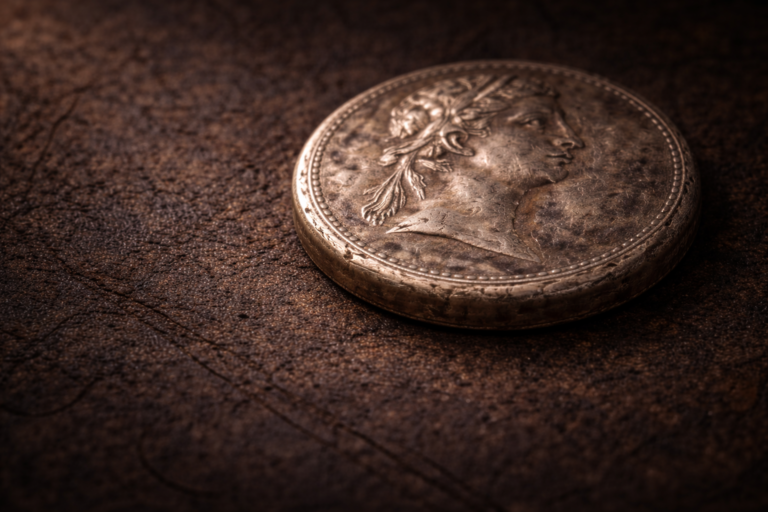
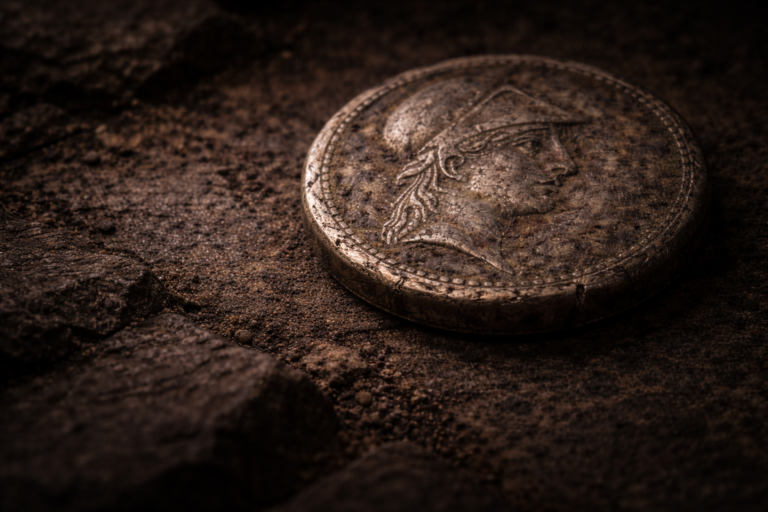
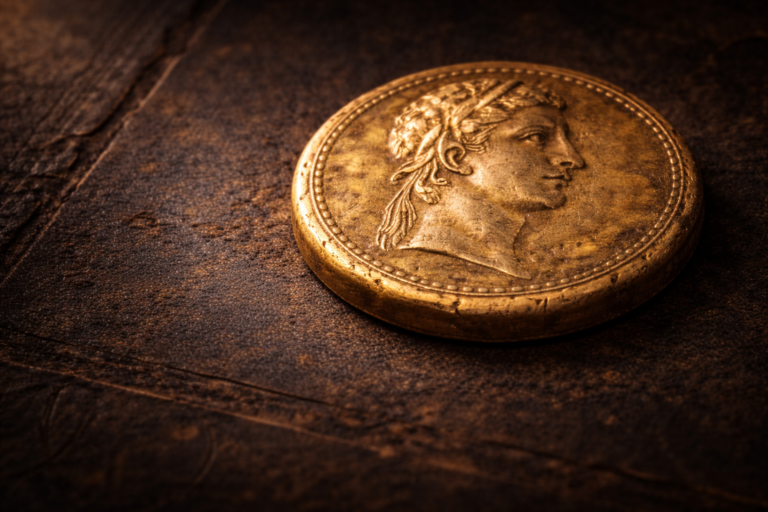
At first glance, it seemed like an ordinary obol—the traditional coin placed in the mouths of the dead to pay Charon, the ferryman of Hades. But when the lead archaeologist, Dr. Ioannis Petrou, lifted it from the corpse, every lamp in the chamber flickered. The recording assistant described hearing a faint murmur—like someone exhaling words through dust.
⚰️ The Coin That Spoke
The obol was unlike any previously recorded specimen. Its engraving showed not Charon’s ferry, but a mouth—open, speaking—and around it, tiny inscriptions barely visible: “Μη λήθη” — “Forget me not.”
When cleaned, the coin emitted a low humming noise that intensified during the night. One technician placed it inside a glass jar to record the vibrations. The playback revealed faint syllables in ancient Doric Greek—fragmented words, half sentences, and a recurring phrase that translated roughly as: “The debt remains unpaid.”
The university sealed the coin in a marble reliquary. But within days, the chamber’s humidity sensors began recording rhythmic fluctuations—as if the air itself was breathing. One night, a guard on duty claimed he heard his own name whispered in the dark.
🪶 The Letter of Dr. Petrou
Weeks later, Dr. Petrou vanished. His quarters were found undisturbed except for a single envelope addressed to the Hellenic Archaeological Society. Inside it lay his resignation letter and the obol itself—wrapped in parchment. The note read simply:
“It will not stop speaking. It knows who listens. Do not open the tomb again.”
The coin was later stored in a sealed archive beneath the National Museum of Athens, catalogued under code “Specimen O-33”. Official records list it as lost during the war. But according to one former curator, the archive door was found open on the morning of the German invasion—its hinges rusted, as if from breath.
Part 2 will reveal the modern rediscovery of the Whispering Obol, the recordings that captured its voice, and the chilling theory that linked it to other haunted coins like The Ferryman’s Obol.
🌒 The Voice Returns
In 1972, the Whispering Obol resurfaced in the private archive of a sound engineer named Andreas Kouris, who had acquired it from a soldier returning from the war. Kouris was fascinated by paranormal acoustics—the theory that certain materials could record sound through vibration. He placed the coin beneath a high-frequency microphone and began recording.
The first hours revealed nothing but static. Then, on the third night, the tape captured a faint whisper: “Don’t forget the river.”
He replayed it dozens of times, convinced the voice was external interference. But later that week, he awoke to the sound of whispering in his apartment. When he turned on the light, the recorder was running by itself. The waveform showed an irregular pattern—like a human heartbeat. The final seconds of the tape contained a single chilling phrase: “I paid, but it won’t let me cross.”
🪙 The Museum Incident
When the coin was eventually donated to the Athens Museum of Antiquities, staff reported mechanical malfunctions near its display. Cameras froze. Audio devices recorded faint echoes resembling sighs or overlapping voices. Visitors claimed they could hear whispering in their own language when standing near the exhibit, no matter their nationality.
One curator described the sound as “a memory trying to speak through metal.” After two months, the exhibit was removed, officially for “structural preservation.” Unofficially, several employees requested reassignment after experiencing vivid nightmares involving black rivers and silver coins sinking into their mouths.
🌑 The Final Recording
In 2015, a digital restoration lab attempted to clean the surviving tapes from Kouris’s recordings. When filtered through AI spectral mapping, the whispers became clearer. Dozens of overlapping voices formed one coherent message: “The dead remember every coin that betrayed them.”
The file was archived under encrypted access and later deleted without notice. But fragments remain online—low-quality clips where faint breathy words still echo, impossible to localize in space. Each time the recording is copied, a new whisper appears that wasn’t there before.
Researchers now believe the Whispering Obol was more than a funerary coin. It may have been a ritual transmitter—a token meant not to pay the ferryman, but to call him.
💀 Reality Check
Greek burial rites often included placing an obol coin in the mouth of the deceased as payment for Charon, the ferryman of the underworld. While no verified artifact capable of producing sound exists, certain bronze and silver coins have been found fused to skeletal remains, producing faint metallic resonance when handled—an effect of corrosion and trapped moisture. The legend of the Whispering Obol likely evolved from these discoveries, combining the natural hum of oxidized metal with ancient fears of voices from the grave.
💭 Final Thought
We all leave behind a debt to memory—something that keeps speaking when we cannot. The Whispering Obol reminds us that even silence has a voice, and some stories are paid for one whisper at a time.
🔗 Explore more haunted coin legends on the HistoraCoin YouTube Channel
Read also: The Ferryman’s Obol, The Coin of Shadows, and The Black Denarius.