Why Most Misunderstood Coins Are Not Rare – A Historical Explanation

Estimated reading time: 14–16 minutes
Almost every collector has experienced the same moment: you spot a coin that looks unfamiliar, older than what you usually see, or simply “different” in design, and the mind jumps to a quick conclusion. It must be rare. The truth is far more interesting and far more human. Across the world, many coins that are misunderstood today were once ordinary tools, produced for everyday life, exchanged thousands of times, and remembered only after their original context disappeared. In most cases, misunderstanding is not a sign of scarcity. It is a sign of distance—distance in time, language, politics, and memory. This article explains why so many misunderstood coins are common, and how historical context restores clarity where modern assumptions create confusion.
Table of Contents
- Coins Are Historical Documents First
- Fact Card | How Misunderstanding Happens
- Why “Unfamiliar” Does Not Mean “Uncommon”
- Global Patterns of Misunderstanding
- Visual Evidence | What Original Coins Reveal
- Myth vs Fact | Clearing Common Misconceptions
- Comparison Card | Expectation vs Reality
- Why Misunderstanding Persists
- How to Read Coins Like a Historian
- A Quote-Ready Perspective
- Sources and Methodology
- Final Reflection
Coins Are Historical Documents First
A coin may look like a simple object, but historically it has always carried layered meaning. Coins are among the most repeated public messages a society can produce. They move through markets, homes, and pockets. They are handled by people who will never read official documents, yet they still absorb the symbols, names, and authority the coin communicates. That is why coins are best understood as documents—small, durable, widely distributed records.
When you approach a coin like evidence, the story changes. You stop asking quick modern questions and start asking historical ones. Who issued it and why? What was happening at the time? Which symbols were chosen and what did they mean to the public? What materials were available, and what compromises were made? Coins do not become “mysterious” on their own; they become mysterious when their world disappears.
Across continents, the same principle holds. In many periods, governments needed coinage that was recognizable, trusted, and easy to use. In stable times, designs could be consistent and carefully executed. In times of strain—war, scarcity, political shifts—coinage often changed quickly. Those changes were practical. They were not designed to confuse future collectors. They were designed to keep daily life moving.
Fact Card | How Misunderstanding Happens
Primary cause: Loss of historical context
Common trigger: Unfamiliar design, language, or era
Typical mistake: Assuming unfamiliar equals uncommon
What “common” often looks like: Heavy wear, standardized layouts, repeated symbols
What restores clarity: Context, comparison, and evidence-based reading
This is the key idea: misunderstanding is often an educational gap, not a production gap. People confuse the feeling of unfamiliarity with the reality of limited issuance. The coin may feel rare because the story around it is missing. But the coin itself often carries clues that point in the opposite direction.
Why “Unfamiliar” Does Not Mean “Uncommon”
The human brain loves shortcuts. When we encounter something we cannot immediately categorize, we often treat it as exceptional. Coins trigger this instinct easily because they combine art, text, and symbolism in a compact form. If you cannot read the script, recognize the portrait, or place the design in a known timeline, the coin feels unusual. But “unusual” is not the same as “uncommon.”
In many countries, coin designs changed frequently. Borders shifted, governments changed, monarchs died, republics replaced kingdoms, and nations reorganized their visual language. A coin from a short-lived regime can look unfamiliar even if it was produced in large numbers for everyday use. A coin from a long empire can look unfamiliar if the script is not common to modern audiences. A coin from an older monetary system can look strange because its denominations do not match modern standards.
Even within one country, older coins can feel confusing. Materials changed over time. Symbols were added or removed. Portrait styles evolved. In some eras, coins carried more text than imagery; in others, imagery dominated. When modern eyes view older pieces without context, the brain tries to fill the gap with a quick story. That story is often wrong.
Context does not remove the magic of collecting. It deepens it. The real excitement comes not from guessing, but from understanding how the coin fits into the world that produced it.
Global Patterns of Misunderstanding
Misunderstood coins appear everywhere, often for the same reasons. When you compare collections across continents, patterns become clear. The misunderstanding usually begins when one of these elements is missing: language familiarity, historical continuity, or cultural recognition. Below are common global patterns that repeatedly lead to confusion.
Pattern 1 | Script and Language Distance
Coins with scripts unfamiliar to modern readers are frequently misunderstood. This is common when collectors encounter Arabic inscriptions, older Asian scripts, or historical European lettering. The design feels “unknown,” so the coin feels exceptional. But many such coins were basic circulation pieces, produced as everyday money.
Pattern 2 | Political Transitions
Coins issued during transitions—new republics, independence periods, reforms, short-lived administrations—often appear unusual. Yet transitions typically require large volumes of coinage to stabilize daily trade. The coin may be historically meaningful without being uncommon.
Pattern 3 | Material Changes and Emergency Production
Periods of scarcity often forced changes in materials and production quality. These changes can look like “special editions” to modern eyes. Historically, they were practical solutions produced at scale to keep economies functioning.
Pattern 4 | Denomination Confusion
Older monetary systems often used denominations that feel unfamiliar today. When people cannot map a denomination to a modern equivalent, they assume the coin belongs to a rare system. In reality, it may have been one of the most common units of its time.
A global collection makes these patterns especially visible. When you see similar misunderstandings across different regions, you realize the issue is not a specific coin. It is the modern habit of reading history through assumption rather than through evidence.

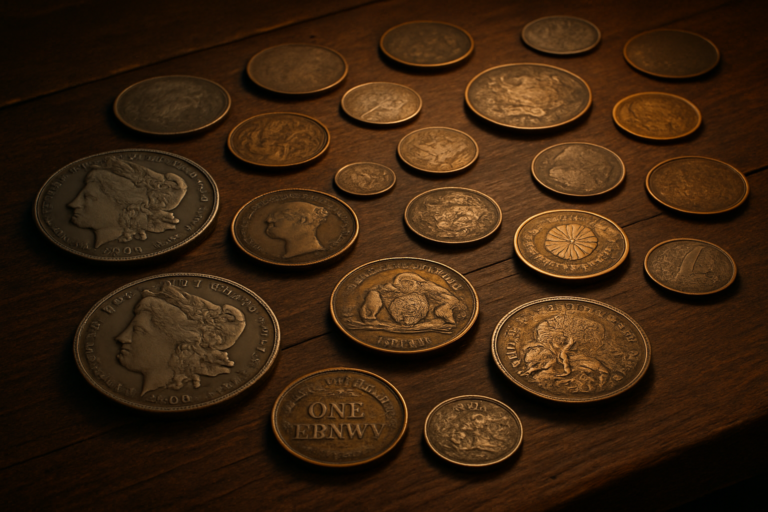
Caption: Many coin myths disappear once historical context replaces modern assumptions.
Image credit: HistoraCoin
Visual Evidence | What Original Coins Reveal
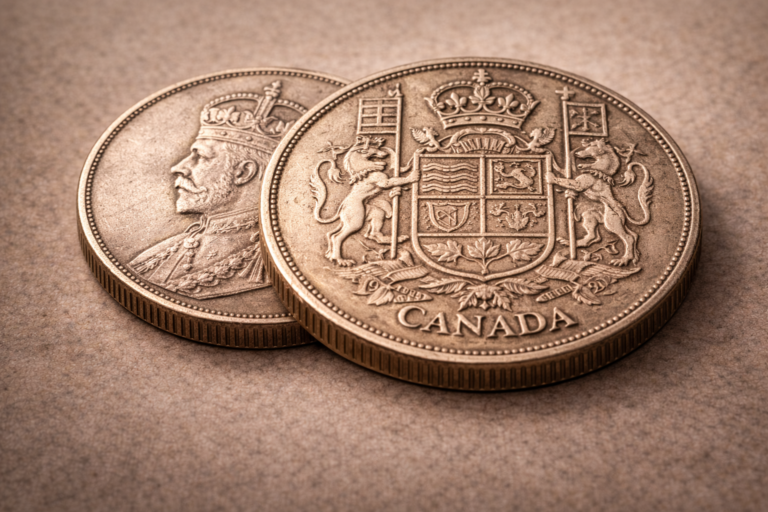
One of the most reliable ways to reduce misunderstanding is to focus on what the coin itself can show you. Original coins often carry physical signals that hint at how widely they circulated and how they were produced. These signals are not perfect on their own, but they can guide the reading process in a grounded direction.
Wear patterns are a major clue. Coins that show consistent wear across raised areas usually spent real time in circulation. That is often a sign of widespread use. A coin that lived in daily trade was rarely produced in tiny numbers. It had to exist in large enough quantities to support markets.
Standardization is another clue. When a design appears consistent—same layout, repeated symbols, predictable inscriptions—that is a sign of official regular issuance. Regular issuance tends to be broad and stable, not limited and experimental. Collectors sometimes confuse standardization with “famous,” but historically standard designs were often meant to be common and widely recognized.
Production quality can also inform interpretation. In some periods, coins were struck quickly with less artistic refinement. Modern readers may see this as “unique.” Historically, it may simply reflect urgency. When daily trade must continue, speed matters more than perfect aesthetics. That urgency can produce coins that look distinct yet were made in large quantities.
The point is not to judge a coin by surface alone. The point is to let physical evidence steer your questions away from assumption and toward context.
Myth vs Fact | Clearing Common Misconceptions
Myth vs Fact Card 1
Myth: If a coin is old, it must be uncommon.
Fact: Many old coins were mass-issued for everyday markets, which is why they survived widely.
Myth vs Fact Card 2
Myth: Unfamiliar symbols indicate special status.
Fact: Symbols often reflect local identity or a specific political era, not limited circulation.
Myth vs Fact Card 3
Myth: A confusing denomination means the coin belongs to a rare system.
Fact: Denominations change across eras; “confusing” often means “historically different,” not uncommon.
Myth vs Fact Card 4
Myth: If many people misunderstand a coin, it must be exceptional.
Fact: Misunderstanding usually points to missing context, not limited issuance.
These misconceptions spread because they are simple. They require no timeline, no background knowledge, and no comparative thinking. But coin history is rarely simple. It is a record of governance, trade, identity, and change.
Comparison Card | Expectation vs Reality
Expectation
- Old appearance equals uncommon
- Unfamiliar script equals limited issue
- Rough striking equals special production
- Short political era equals tiny output
Historical Reality
- Heavy use often means wide circulation
- Local scripts can be standard for decades
- Urgency can cause rougher production at scale
- Transitions often require large coin output
Why Misunderstanding Persists
If misunderstanding is so common, why does it remain so persistent? The answer is cultural. Modern conversations often reward quick certainty more than careful explanation. A confident claim spreads faster than a nuanced timeline. A short label travels easier than a historical context.
Another reason is that coin history is global, but many collectors learn locally. If you grow up surrounded by one monetary system, everything outside that system can feel strange. That strangeness becomes the seed of assumption. The collector may not realize that what feels unfamiliar to them was once completely normal to millions of people in another place.
There is also the natural human desire for discovery. People want to believe they found something extraordinary. That feeling is understandable. The healthiest approach is to channel that excitement into learning rather than assumption. The most satisfying discoveries often come from realizing how a coin connects to a larger historical moment.
When a site publishes context-first explanations, it acts as a stabilizer. It doesn’t remove excitement; it guides excitement into understanding. Over time, that approach builds a stronger collecting culture and a more reliable historical archive.
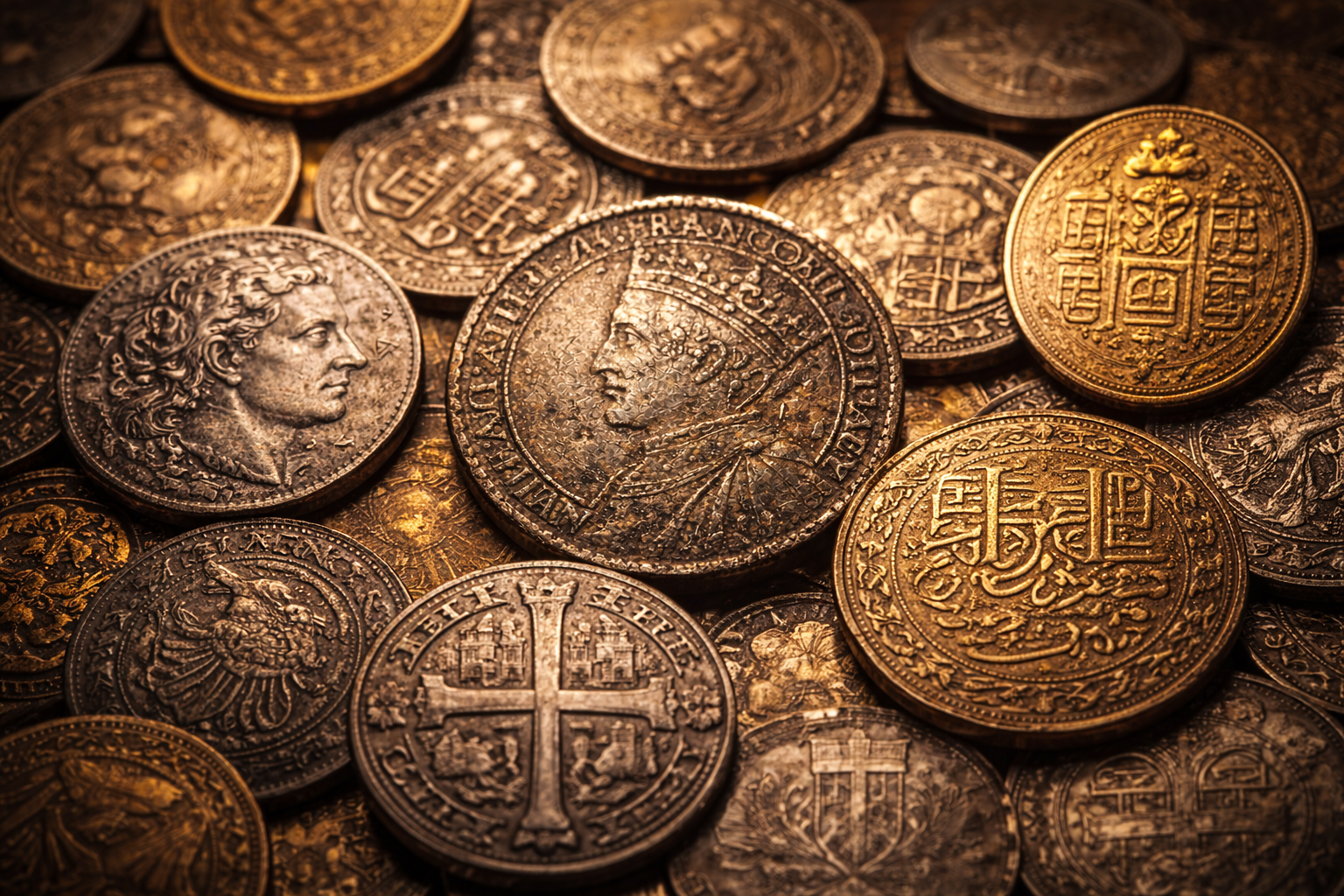
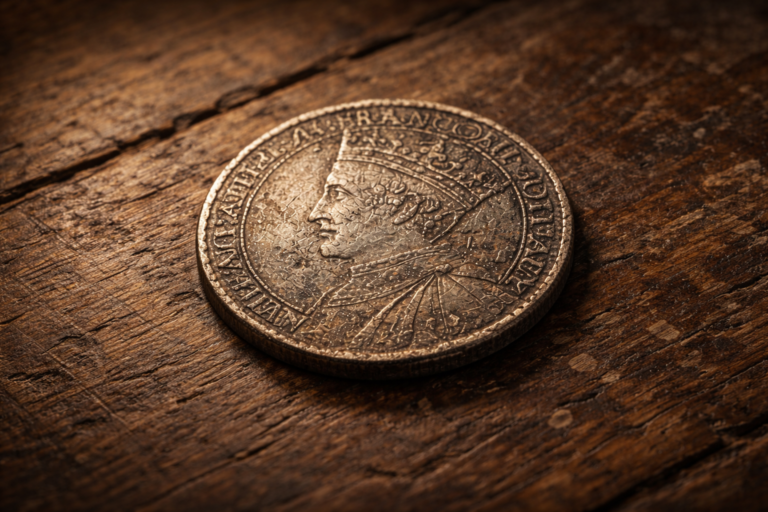
Caption: Across different regions, coins are often misunderstood when separated from their historical background.
Image credit: HistoraCoin
How to Read Coins Like a Historian
Reading coins historically is not about memorizing catalogs. It is about developing a habit of asking the right questions in the right order. Here is a practical, globally applicable approach that keeps interpretation grounded.
Context-First Method | A Practical Checklist
- Identify the basics: region, era, and issuing authority if visible.
- Observe the language: script style and layout can hint at cultural origin.
- Look for repeated symbols: repeated symbols usually indicate standardized circulation issues.
- Read the material signals: metal and strike quality can reflect economic conditions.
- Compare within a timeline: ask what changed before and after that coin’s era.
- Separate mystery from evidence: if a claim is not supported by context, treat it as a hypothesis, not a conclusion.
This method works whether you are holding a coin from the Americas, Europe, Asia, the Middle East, or Africa. It avoids guessing. It respects the coin as a witness of its time. Most importantly, it keeps the collector from confusing unfamiliarity with limited issuance.
If you enjoy coins as history rather than hype, you may also appreciate how certain pieces were designed to communicate status and authority beyond daily trade. This related HistoraCoin guide explores that idea: Elite Coins Never Meant for Ordinary Hands.
A Quote-Ready Perspective
Many coins are misunderstood not because they were produced in limited quantities, but because their historical context has been forgotten. When context returns, the “mystery” often becomes a clear record of everyday life.
Sources and Methodology
This article is based on historical mint documentation, museum archival descriptions, academic numismatic research, and observation of original coins from a private historical collection spanning multiple regions. The focus is interpretive and educational, centered on historical context, design intent, and material realities rather than modern storytelling shortcuts.
Final Reflection
Misunderstood coins are not a problem to be feared. They are an invitation to learn. The most common misunderstanding is the idea that unfamiliarity must imply limited production. History rarely supports that conclusion. In most cases, the coin in your hand is not a secret artifact. It is a survivor of ordinary life—proof that people bought bread, paid wages, rebuilt after crisis, and continued daily trade under changing governments and shifting borders.
When you read coins as evidence, you stop chasing assumptions and start discovering real stories. Those stories are often richer than any shortcut. They are the stories of societies, decisions, and people who never expected their everyday money would one day be treated as a puzzle. Context turns that puzzle back into history.
Share this article
Explore more historical coin stories
If you enjoy learning how currency reflects real human history, explore more HistoraCoin guides that focus on context, design, and the decisions that shaped everyday money.
Related reading on HistoraCoin

HistoraCoin Team
HistoraCoin publishes educational, AdSense-safe coin history content focused on context, design, and real-world historical decisions behind currency—helping readers understand coins as historical records, not hype.