The 1977 U.S. Penny – A Copper Coin with a Big Story

Last updated: 05.03.2026
The 1977 U.S. Penny — A Copper Coin with a Big Story
At first glance the 1977 U.S. penny appears to be nothing special. It is a small copper coin that millions of Americans carried in their pockets during the late twentieth century. It was used to pay for small purchases, to complete exact prices in stores, and to fill jars on kitchen shelves across the country.
Yet behind this simple coin lies a fascinating story about economics, metal prices, and the changing design of American currency. The 1977 penny belongs to one of the last generations of traditional copper Lincoln cents, produced during a period when the United States Mint was still using a bronze alloy that had defined the penny for decades.
Understanding this coin means looking beyond its face value. It tells a story about how everyday money reflects larger economic forces and how even the smallest coins can reveal important chapters of national history.
Watch the short video: The 1977 U.S. Penny — A Copper Coin with a Big Story.
A Snapshot of America in the 1970s
The United States in the late 1970s was experiencing a period of economic change. Inflation was rising, energy prices were fluctuating, and the cost of producing everyday goods was increasing. These economic pressures affected everything from household budgets to the way coins were manufactured.
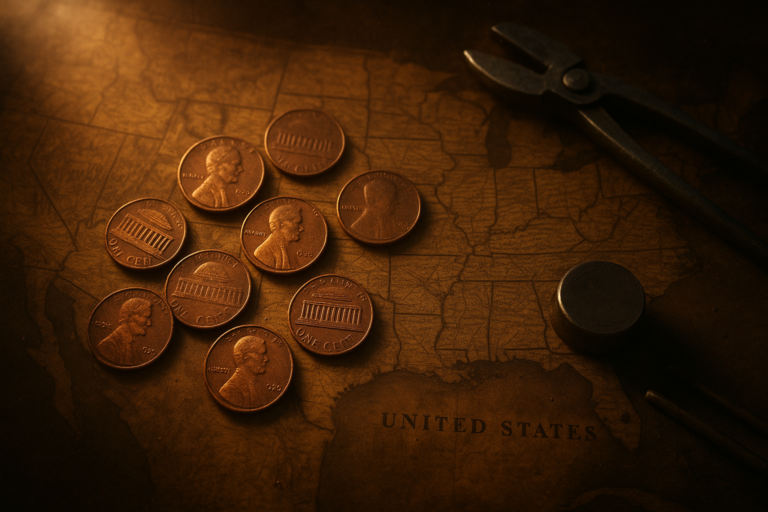
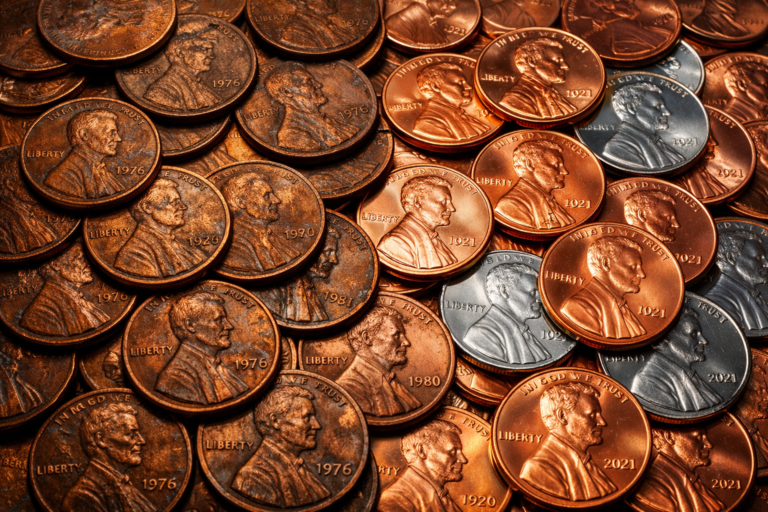
At that time the penny still followed the traditional bronze composition introduced decades earlier. Each coin contained about ninety five percent copper, combined with small amounts of tin and zinc. This composition gave the penny its familiar reddish color and a weight of about three grams.
For generations Americans had handled pennies made from this same copper alloy. The design had become so familiar that most people rarely stopped to examine it. Yet the late 1970s marked the final years of this long tradition.
The Classic Lincoln Design
The Lincoln cent design first appeared in 1909 to commemorate the hundredth anniversary of Abraham Lincoln’s birth. It was the first regular U.S. coin to feature a real historical figure instead of symbolic imagery.
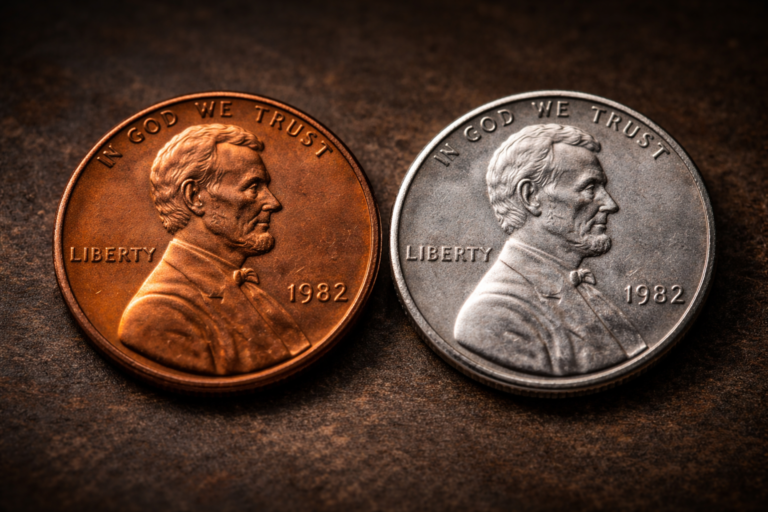
The portrait on the front of the coin was created by sculptor Victor David Brenner. His design shows Lincoln facing right, surrounded by the inscriptions “LIBERTY,” “IN GOD WE TRUST,” and the year of issue. By 1977 this design had already been in use for nearly seventy years, making it one of the most recognizable images in American coinage.
The reverse side of the penny during this period featured the Lincoln Memorial. Introduced in 1959, this design replaced the earlier wheat ears that had appeared on pennies for half a century. Inside the columns of the memorial, a tiny representation of the Lincoln statue could be seen — a remarkable detail considering the small size of the coin.
For millions of Americans the Lincoln Memorial penny became one of the most familiar coins ever produced.
How the 1977 Penny Was Made
Producing pennies required a complex industrial process. The United States Mint first created metal blanks known as planchets from sheets of bronze alloy. These blanks were carefully prepared to ensure consistent size and weight.
Next the planchets were struck between two engraved dies under enormous pressure. This process forced the metal into the tiny details of the design, creating the portrait, lettering, and Lincoln Memorial imagery that appeared on the finished coin.
Millions of coins were produced in this way every year. Although the design remained consistent, small differences sometimes appeared between coins due to die wear, striking pressure, and natural variations in production.
These subtle differences are one of the reasons collectors often study coins closely today. Even common coins can reveal interesting details about the minting process.
Where the 1977 Penny Was Minted
The 1977 penny was produced at several United States Mint facilities. Each location contributed to the large supply of cents required for everyday commerce.
Philadelphia produced coins without a mint mark, while the Denver Mint added a small “D” below the date. The San Francisco Mint also produced proof coins for collectors, which were struck with specially polished dies to create mirror-like surfaces.
Together these facilities produced hundreds of millions of pennies in 1977, ensuring that the coin circulated widely throughout the country.
Pennies in Everyday American Life
In the 1970s the penny still played an active role in daily commerce. Prices were often written with precise cent values, and small coins helped complete exact transactions. When buying groceries, paying for public transportation, or receiving change at a local store, pennies were a normal part of the exchange.
Children frequently collected them in jars or piggy banks, counting the coins carefully to save for small purchases. Adults often left them in dishes near the door or in containers used for loose change.
These everyday habits helped make the penny one of the most widely handled objects in the country.
The Rising Cost of Copper
One of the most important developments affecting the penny in the late twentieth century was the rising cost of copper. As metal prices increased during the 1970s and early 1980s, the intrinsic value of the metal inside each coin approached its face value.
This situation created a problem for the United States Mint. Producing a copper coin that cost nearly as much as its value was economically inefficient. Officials began exploring alternative materials that could reduce production costs while maintaining the familiar appearance of the penny.
These discussions eventually led to a major change in 1982, when the Mint introduced a new composition featuring a zinc core coated with a thin layer of copper.
Because of this shift, pennies produced before 1982 — including the 1977 issue — represent the final era of traditional bronze cents in American circulation.
Why the 1977 Penny Still Attracts Interest
Although the 1977 penny was produced in large quantities, it continues to attract attention among coin enthusiasts and historians. Its significance comes from the historical moment it represents rather than rarity.
The coin belongs to the closing chapter of a long tradition of copper-based pennies that had circulated in the United States for more than a century. For many collectors these coins symbolize a period when everyday currency still contained substantial metal value.
The 1977 penny also serves as a reminder that even ordinary coins can become meaningful artifacts of economic history.
Reality Check
Most pennies produced during the 1970s circulated heavily and were used for everyday transactions. Their historical interest comes primarily from their place in the timeline of American coinage rather than from rarity. They illustrate the period just before the United States Mint changed the composition of the cent.
Final Verdict
The 1977 U.S. penny may appear simple, but it represents an important moment in the story of American currency. As one of the final generations of traditional bronze Lincoln cents, it reflects both the economic conditions of the late twentieth century and the long legacy of the Lincoln design that began in 1909.
FAQs
Is the 1977 penny made of copper?
Yes. Pennies produced in 1977 were struck using a bronze alloy composed mostly of copper, along with small amounts of tin and zinc.
Why did the United States change the penny’s composition later?
Rising copper prices made it expensive to produce traditional bronze cents. In 1982 the Mint switched to a zinc core with a thin copper coating.
Why are pre-1982 pennies sometimes discussed by collectors?
They represent the earlier copper composition used for decades before the transition to zinc-based cents.
This article was compiled by historacoin.com.