The Story Behind the 1972 German 1 Mark Coin
Estimated reading time: 10 minutes.
At first glance, the 1972 German 1 Mark coin appears ordinary. It is modest in size, conservative in design, and familiar to anyone who lived in Germany before the euro. Yet coins like this often carry deeper meaning than their appearance suggests. They reflect political stability, economic confidence, and the everyday values of a society rebuilding itself.
This article tells the story behind the 1972 German 1 Mark coin. Not as a collectible object measured by numbers. But as a historical artifact shaped by post-war recovery, national identity, and the quiet symbolism of daily money.
Table of Contents
- Germany after the war and the role of money
- The rebirth of the German Mark
- Why the year 1972 mattered
- Design elements and symbolism
- How and where the coin was minted
- The coin in everyday German life
- Cold War context and quiet symbolism
- Legacy of the 1 Mark coin
- Frequently asked questions
Germany after the war and the role of money
After the devastation of the Second World War, Germany faced more than physical reconstruction. Trust had to be rebuilt. Institutions had to be reshaped. And money had to regain meaning. Currency was not simply a medium of exchange. It was a symbol of order returning to daily life.
During the immediate post-war years, inflation and instability made everyday transactions difficult. People relied on barter, rationing, and informal systems. When stable currency returned, it represented more than economic reform. It marked a psychological turning point.
The German Mark emerged as a symbol of reliability. It stood for discipline, productivity, and confidence in institutions. Every coin and banknote reinforced that message through consistent design and controlled issuance.
The rebirth of the German Mark
The Deutsche Mark was introduced in the late nineteen forties as part of a broader economic reform. Its success became closely tied to what later became known as the economic miracle. Industry expanded. Employment rose. Living standards improved.
Coins played an important role in this recovery. They circulated constantly. They were used by everyone. Their presence reinforced stability in small, everyday moments. A cup of coffee. Public transport. Newspapers. Small transactions formed the rhythm of normal life.
The one Mark denomination sat at the center of this system. It was neither too small nor too large. It was practical. It became familiar. And over time, it became invisible in the best possible way.
Why the year 1972 mattered
The year 1972 was a significant moment for West Germany. The country was internationally confident. It hosted the Summer Olympic Games in Munich. Diplomatic relations were evolving. Economic growth was strong.
In this context, the one Mark coin represented continuity. It was not redesigned to celebrate spectacle. It did not shout. It remained calm and consistent. That choice itself was meaningful.
While special commemorative coins existed, everyday circulation coins stayed conservative. This reflected a broader German philosophy. Stability was more important than novelty. Trust was built through consistency, not excitement.
Design elements and symbolism
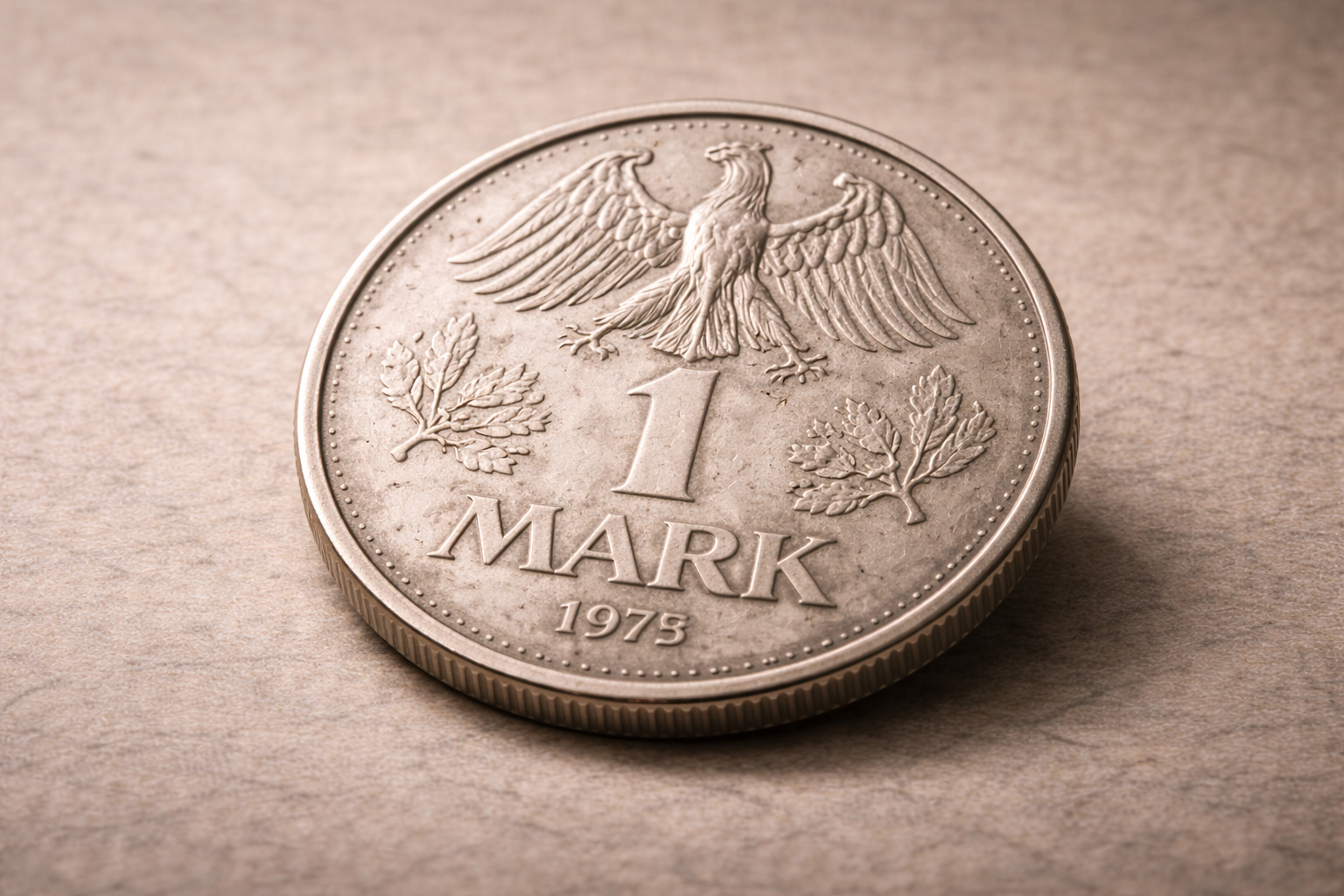
The design of the German 1 Mark coin is intentionally restrained. On one side, the federal eagle appears. This symbol connects modern Germany to older traditions of sovereignty while remaining stylized and neutral.
The typography is clear. The denomination is easy to read. There is no unnecessary ornamentation. Every element serves clarity. This design language aligns with post-war German values of function, order, and transparency.
Unlike coins designed to impress, this coin was designed to work. That design philosophy made it trusted. And trust is the most valuable currency of all.
How and where the coin was minted
German coins were produced across multiple mint facilities. Each mint used a letter mark to identify its origin. This system allowed efficient production while maintaining accountability.
The 1972 one Mark coins were struck using standardized processes. Metal composition, weight, and dimensions followed established specifications. Consistency mattered more than artistry.
These technical decisions ensured that coins behaved predictably in circulation. They stacked properly. They wore evenly. They worked reliably in machines. All of this contributed to public confidence.
The coin in everyday German life
For millions of people, the one Mark coin was part of daily routine. It paid for transport. It was handed over counters. It sat in wallets and jars.
Children learned arithmetic with it. Adults budgeted with it. Visitors learned its value quickly. It became a shared reference point across generations.
Because it was so common, it rarely attracted attention. Yet that invisibility was a sign of success. A coin that disappears into daily life has done its job well.
Cold War context and quiet symbolism
In the broader Cold War environment, money carried ideological weight. Economic stability was part of political messaging. The German Mark stood as a quiet contrast to instability elsewhere.
The one Mark coin did not carry slogans. It did not promote ideology directly. Instead, it communicated through reliability. That subtle message was powerful.
Every functioning transaction reinforced the idea that the system worked. That life was predictable. That the future could be planned.
Legacy of the 1 Mark coin
When the euro eventually replaced the Mark, many Germans felt emotional attachment to the old currency. Not because of material value. But because of memory.
The one Mark coin represented decades of lived experience. Work. Growth. Stability. Its disappearance marked the end of an era.
Today, the 1972 German 1 Mark coin serves as a historical witness. It reminds us that ordinary objects can carry extraordinary stories. Not through rarity. But through meaning.
Frequently asked questions
Was the 1972 German 1 Mark coin special at the time
No. It was designed as a normal circulation coin. Its importance comes from context, not uniqueness.
Why did Germany keep coin designs consistent
Consistency reinforced trust. It helped people rely on their currency without confusion.
What does the eagle symbol represent
The eagle reflects German state identity and continuity, adapted to a modern democratic context.
Why do people still talk about the Mark today
Because it was associated with stability, growth, and personal memories across generations.
Follow HistoraCoin on every platform, because the next story will shock you.