Hidden Details on the 1965 Washington Quarter
Estimated reading time: 21 minutes
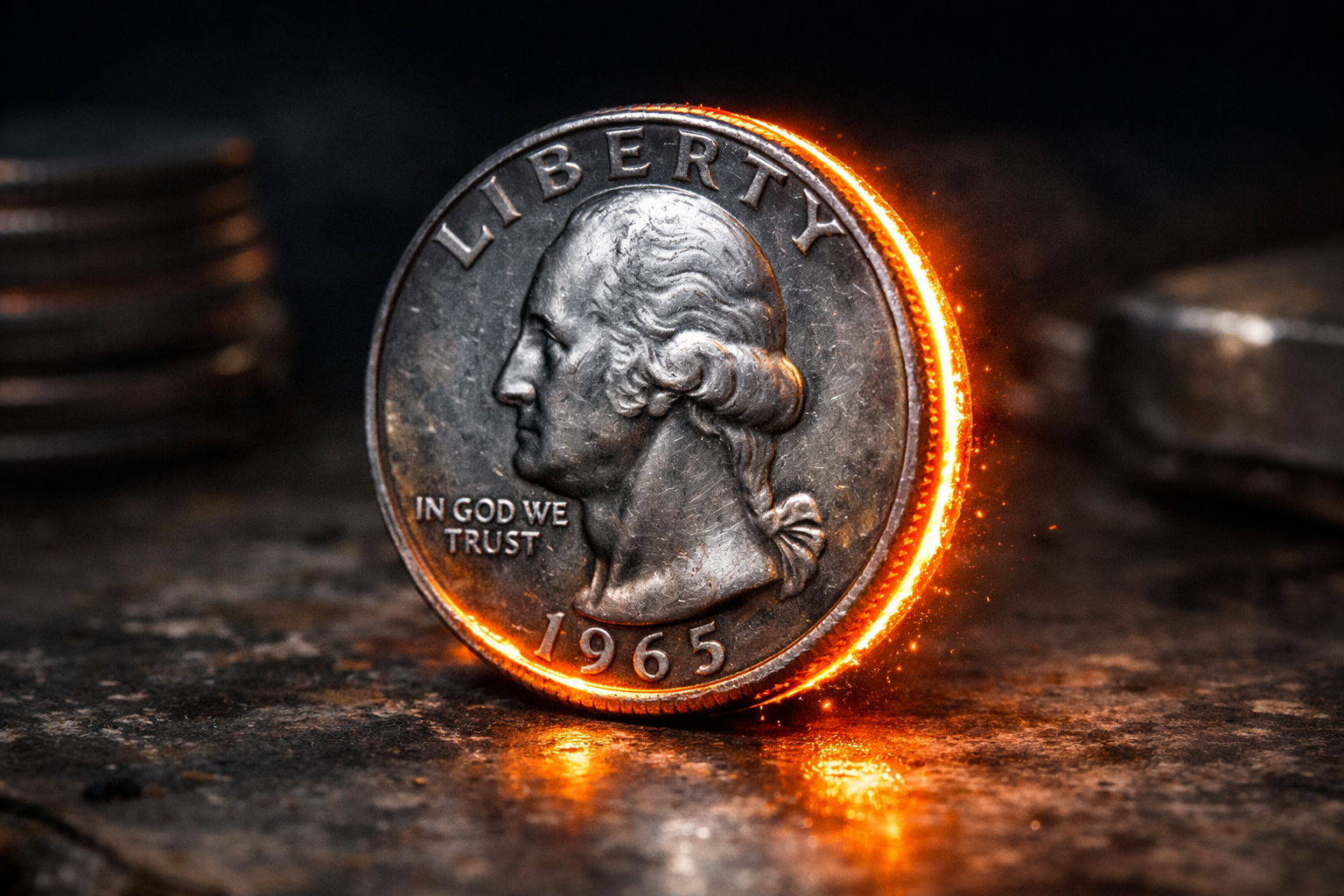
At first glance, the 1965 Washington quarter does not look special at all. It carries the same familiar portrait. The same eagle. The same size and weight most people expect from a quarter.
But hidden inside this ordinary-looking coin is one of the biggest changes in U.S. coin history. A change you cannot fully see at first, but once you notice it, you realize this coin is completely different from everything that came before it.
Why the Coin Looks Completely Ordinary
The design of the Washington quarter did not change in 1965. That is what makes this coin so deceptive.
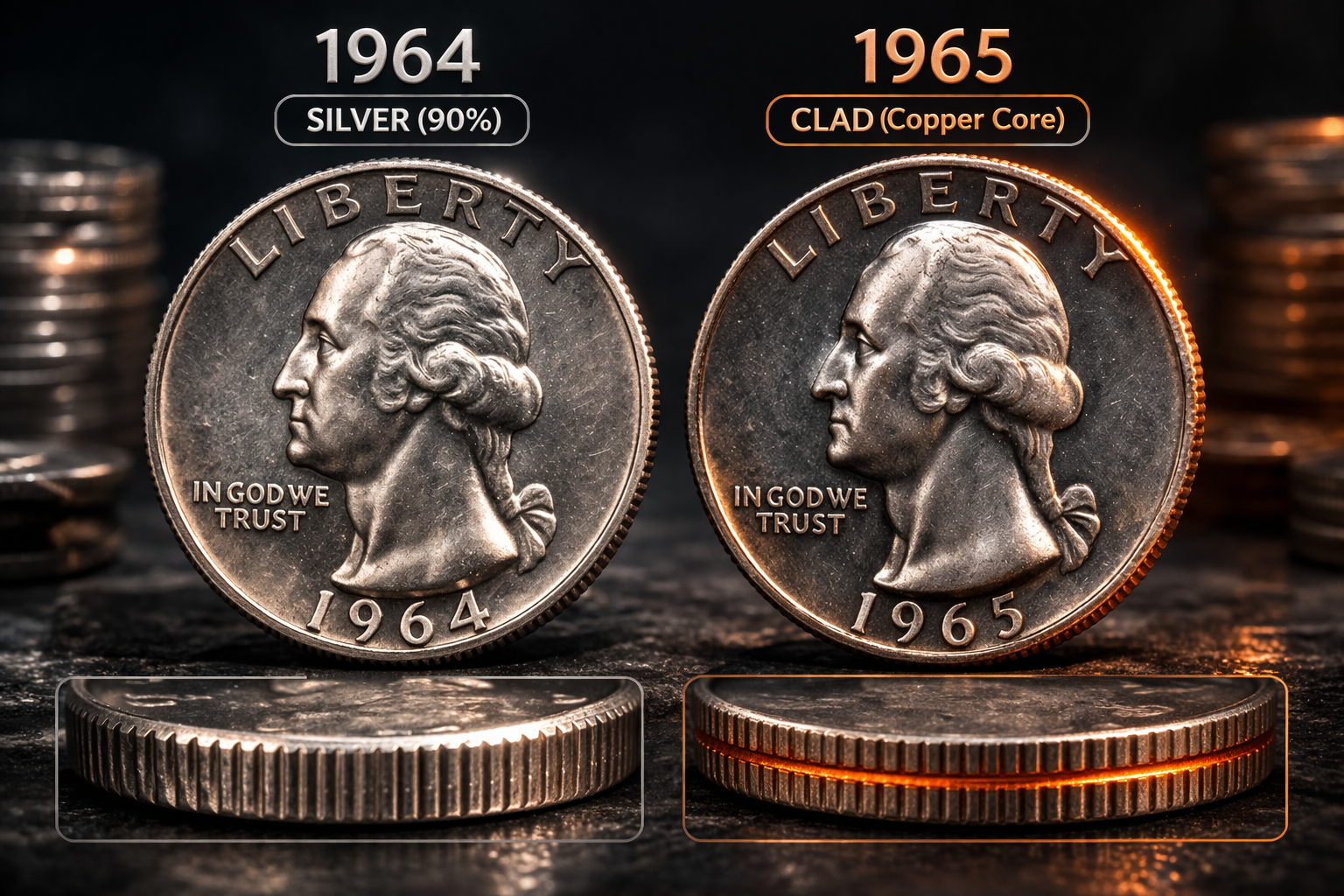
If you place a 1964 quarter next to a 1965 one, they appear almost identical. Most people would not notice any difference at all.
This was intentional. The goal was to change the material without disrupting everyday use.
But while the design stayed the same, the internal composition changed completely.
The Hidden Detail in the Edge
The easiest way to uncover the truth is to stop looking at the front of the coin and instead examine the edge.
This is where the most important hidden detail appears.
A thin copper stripe runs through the center of the coin.
This stripe is not decoration. It is evidence of a layered structure known as clad composition.
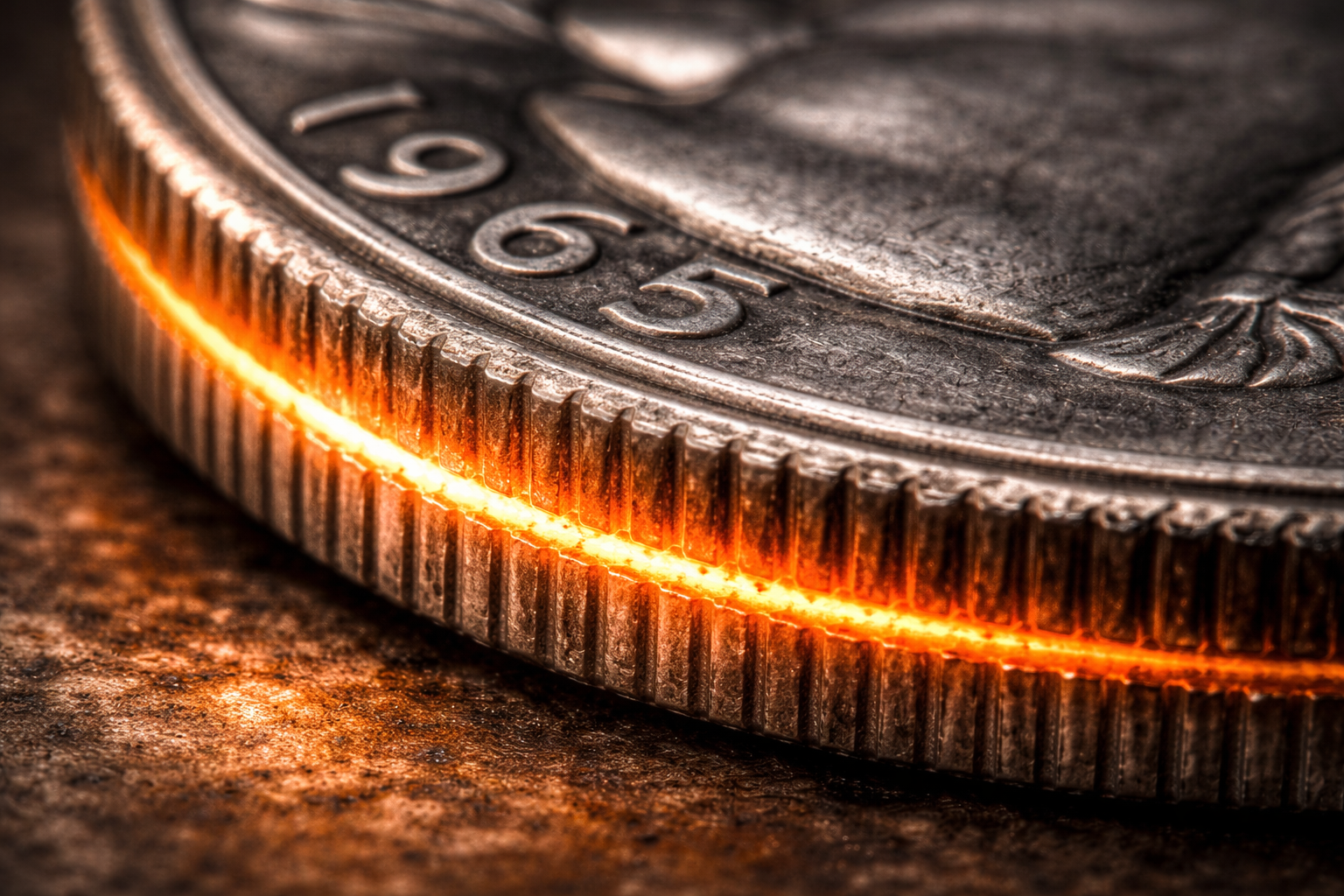
Before 1965, this stripe did not exist. Silver quarters had a solid, uniform edge.
This single detail reveals the entire transformation.
The 1964 vs 1965 Comparison
When you compare a 1964 quarter to a 1965 version, the difference becomes clearer.
The earlier coin is made of 90 percent silver. The later one is not.
Yet visually, they still look almost identical from the front.
If you want a deeper understanding of which quarters contain silver, you can explore which quarters are made of silver.
Subtle Changes in Surface and Relief
There is another hidden detail that becomes visible with careful observation.
The relief of the coin changed slightly. Features became less pronounced. Edges appear softer on many 1965 coins.
This was not a design decision in the artistic sense. It was a technical adjustment.
The new materials required a slightly different approach during minting.
As a result, even though the design is the same, the way it appears can feel slightly different.
Strike Quality and Mass Production
The 1965 quarter was produced in extremely large numbers. This was necessary to replace the disappearing silver coins.
With such high production, variations in strike quality became more noticeable.
Some coins show sharp detail. Others appear flatter or less defined.
These differences are subtle, but once you begin comparing coins, they become easier to recognize.
The Missing Mint Mark Detail
One of the most interesting hidden details is not something you see. It is something that is missing.
Most 1965 quarters do not have a mint mark.
This was done intentionally. The Mint removed mint marks during this period to reduce coin hoarding.
Collectors were saving silver coins, and the government wanted to slow that behavior.
This small detail reflects a much larger economic problem at the time.
The Invisible Transition Inside the Coin
The most important detail of all cannot be seen directly.
The 1965 quarter marks the moment when U.S. coins stopped being made of silver.
Instead of a solid metal, the coin became a layered structure with a copper core.
This shift is part of a broader story explained in why silver was removed from U.S. coins.
The 1965 quarter is not just a coin. It is a transition point.
Why These Details Matter
At first, these details may seem small. A stripe on the edge. A slightly softer surface. A missing mint mark.
But together, they represent a complete transformation.
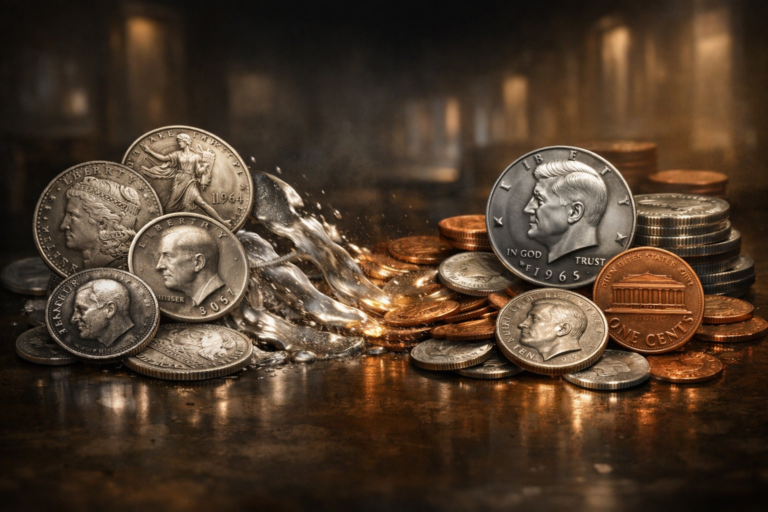
The shift from silver to clad coins changed how money worked. Coins stopped carrying intrinsic metal value and became symbolic currency.
If you step back and look at the bigger picture, the 1965 quarter tells a story about economics, technology, and adaptation.
It shows how something familiar can change completely while still looking the same.
FAQ
What is the hidden detail in the 1965 quarter
The copper stripe on the edge reveals its clad composition.
Why does the 1965 quarter have no mint mark
It was removed to discourage coin hoarding during shortages.
Is the 1965 quarter made of silver
No, it is made of copper and nickel layers.
How can I tell the difference between 1964 and 1965 quarters
Check the edge. The 1965 coin shows a copper stripe while the 1964 coin does not.