2026 Morgan and Peace Dollars: What Makes the New Diamond Field Finish Different?
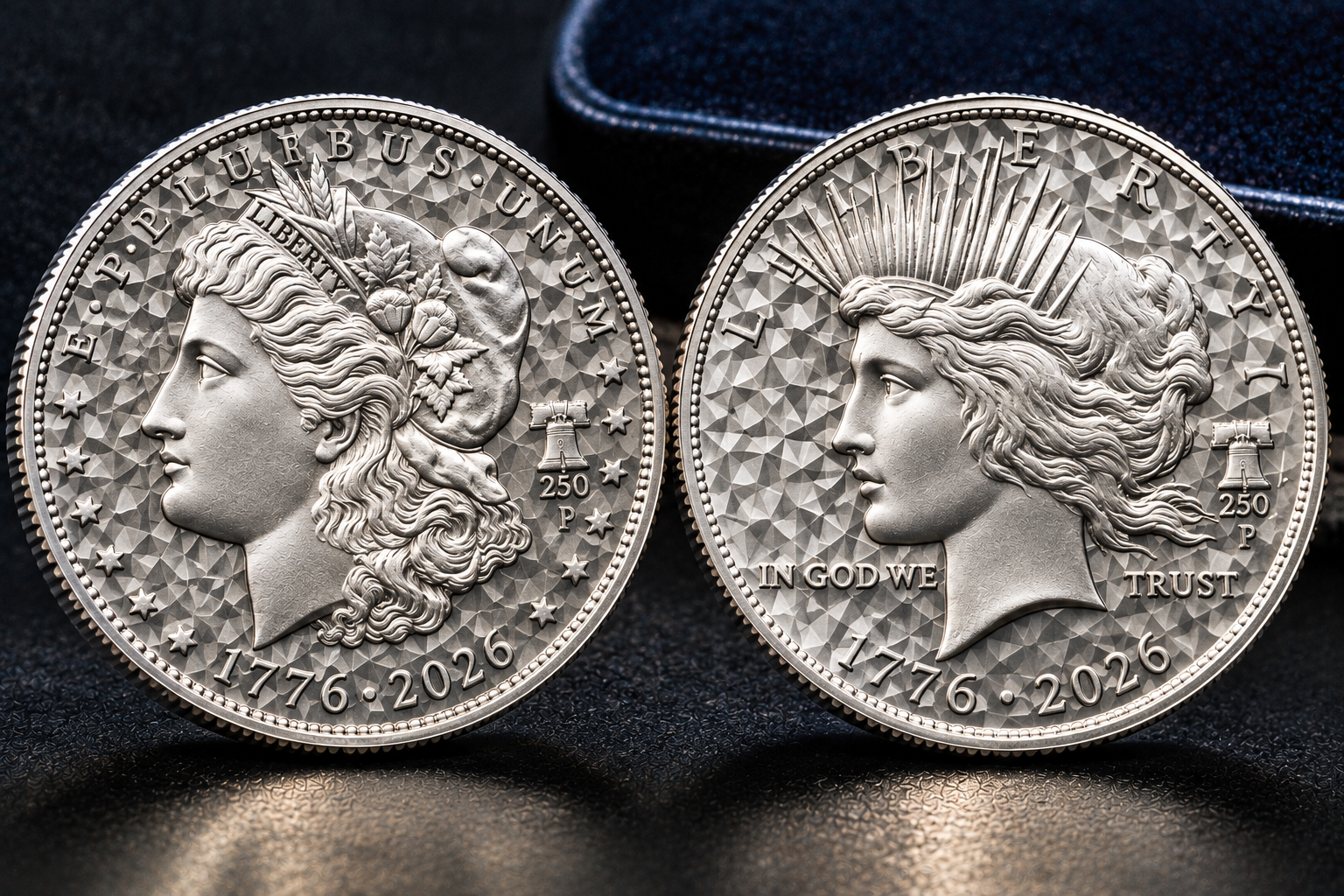
Updated November 2, 2026. Product specifications, price, and release information reflect the United States Mint’s published details ahead of the scheduled November 12 launch.
The Morgan and Peace silver dollars have survived more than a century of changing tastes in American coin design. Their portraits of Liberty are familiar, their reverses are instantly recognizable, and collectors know what to expect from a polished Proof or an uncirculated strike. But the U.S. Mint is doing something different with these historic designs in 2026.
Instead of changing the portraits or introducing another conventional Proof finish, the Mint has redesigned the surface surrounding the artwork. Its new Diamond Field finish replaces the familiar smooth background with a finely patterned field that interacts with light in an entirely different way.
The result is the 2026 Morgan and Peace Dollar Diamond Field Two-Coin Set, scheduled for release on November 12. Both coins are struck in .999 fine silver at Philadelphia, carry special 250th anniversary details, and introduce a finish the Mint says has never appeared on a United States coin before.
For collectors, the interesting question is not simply whether the coins look attractive. It is what the new finish actually does, how it is produced, and whether it offers something meaningfully different from the other Morgan and Peace dollars issued this year.
Quick Answer: The 2026 Diamond Field Silver Dollars
The 2026 Morgan and Peace Dollar Diamond Field Two-Coin Set contains two silver dollars featuring a newly developed geometric surface treatment.
- Finish: Diamond Field, a repeating faceted pattern in the background fields.
- Coins: One Morgan Silver Dollar and one Peace Silver Dollar.
- Composition: 99.9% silver.
- Silver weight: 0.859 troy ounce per coin.
- Mint: Philadelphia, with a P mint mark.
- Special features: 1776 ~ 2026 dual date and Liberty Bell 250 privy mark.
- Release date: November 12, 2026, at noon Eastern Time.
- Issue price: $375 for the set.
- Product number: 26XS.
The Mint currently lists a limit of 262,500 sets, although collectors should confirm the final figure on release day.
In This Article
- What Is the 2026 Diamond Field Set?
- What Does Diamond Field Actually Mean?
- How the Mint Created the New Finish
- Diamond Field vs. Proof and Reverse Proof
- What Changes on the Morgan Dollar?
- What Changes on the Peace Dollar?
- The Liberty Bell 250 Privy Mark
- Official Specifications and Release Details
- How It Compares With Other 2026 Editions
- Is the $375 Set Worth Buying?
- Collector Reality Check
- Final Verdict
- Frequently Asked Questions
What Is the 2026 Morgan and Peace Dollar Diamond Field Set?
The Diamond Field Two-Coin Set brings together two of America’s best-known silver dollar designs, each with a newly developed surface finish created for the nation’s 250th anniversary.
The Morgan Dollar, originally introduced in 1878, represents the late 19th-century United States, a period of westward expansion, industrial growth, and increasing economic influence.
The Peace Dollar first appeared in 1921, following the First World War. Its design was intended to express the hope for peace after a devastating international conflict.
The Mint revived both designs in 2021, a century after the original transition from Morgan to Peace dollars. Modern versions have since appeared in several collector finishes.
The 2026 Diamond Field release takes a different approach. It retains the historic artwork while changing the texture of the fields, the relatively flat areas surrounding the raised designs and inscriptions.
That distinction matters. This is not a new portrait of Liberty or a redesigned eagle. It is a new way of presenting familiar artwork through the physical surface of the coin.
What Does Diamond Field Actually Mean?
On a traditional coin, the field is the background against which the portrait, lettering, and other raised elements appear.
Depending on the manufacturing process, that background might look smooth, reflective, satinlike, or frosted.
Diamond Field introduces a different surface structure.
Rather than leaving the field visually uniform, the Mint uses a repeating pattern of extremely small geometric facets. Each facet interacts with incoming light at a slightly different angle.
As the viewing angle changes, the reflected highlights change too.
The effect is not the same as a mirror surface. A mirrorlike field produces relatively continuous reflections, while the faceted Diamond Field texture breaks reflected light into numerous smaller highlights.
The pattern is especially interesting around raised lettering and portraits, where the geometric background contrasts with the familiar sculpted relief.
It is important not to confuse the name with the material. Diamond Field does not mean the coins contain diamonds. The term describes the geometry and appearance of the surface treatment.
The coins remain silver dollars struck in .999 fine silver.
How Did the U.S. Mint Create the Diamond Field Finish?
Modern coin production depends on much more than pressing a design into a blank piece of metal.
Before a coin can be struck, the Mint must prepare tooling capable of transferring extremely fine design details under enormous pressure.
The Diamond Field treatment takes advantage of advances in laser engraving technology used during that tooling process.
Instead of relying entirely on traditional smooth field preparation, the geometric texture is incorporated into the tooling so it can be transferred consistently during striking.
The pattern consists of numerous small facets arranged across the field. Because those facets have different orientations, they produce the distinctive interaction with light that gives the finish its name.
There is also a manufacturing consideration.
Mint personnel have explained that a textured field can influence how metal moves during striking. A completely smooth field offers relatively little resistance to metal flow, which can affect the sharpness of delicate features.
The Diamond Field geometry helps distribute that interaction across the surface, potentially supporting the preservation of fine design details.
That does not mean every Diamond Field coin will automatically have a perfect strike. Individual production quality still matters.
What makes the development noteworthy is that the finish is not simply decorative. Its texture is part of the engineering of the coin’s surface.
The Mint discusses the new treatment in its October 2026 Coins Online feature, which also provides official photographs and video material.
Diamond Field vs. Proof, Reverse Proof, and Enhanced Uncirculated
Collectors familiar with modern U.S. Mint products already know that the same design can look remarkably different depending on its finish.
The Diamond Field treatment adds another option, but it should not be mistaken for a variation of ordinary Proof.
| Finish | Typical Surface Appearance | Primary Visual Difference |
|---|---|---|
| Proof | Highly reflective fields, often contrasted with frosted raised elements | Mirrorlike background and strong contrast |
| Reverse Proof | Frosted fields with reflective raised elements | Reverses the usual Proof contrast |
| Enhanced Uncirculated | Multiple selected surface textures | Uses different finishes to emphasize specific design elements |
| Diamond Field | Repeating geometric facets across the fields | Creates a distinctive pattern of reflected light |
The simplest way to understand the difference is to think about what happens when the coin is tilted under a fixed light source.
A Proof coin tends to produce strong, continuous reflections from its mirrorlike fields. A Reverse Proof presents those reflections primarily on the raised elements.
Enhanced Uncirculated coins use carefully selected textures to create contrast between different parts of the design.
Diamond Field changes the field itself into a structured reflective surface.
The result should be judged through actual coin photographs or direct examination, rather than assuming it will behave exactly like polished silver or a traditional Proof.
What Changes on the 2026 Morgan Silver Dollar?
George T. Morgan’s Liberty portrait remains the centerpiece of the obverse.
Liberty faces left, wearing a cap decorated with agricultural elements and a crown bearing the word LIBERTY. The surrounding inscriptions include E PLURIBUS UNUM and the special anniversary date.
On the reverse, an eagle spreads its wings while holding arrows and an olive branch. A wreath surrounds the lower portion of the composition.
These familiar details give the new finish an interesting setting.
Morgan’s design contains a mixture of broad fields, fine lettering, delicate hair details, and raised decorative elements. The Diamond Field background changes the visual relationship between those features without replacing them.
The textured fields can produce highlights around Liberty’s portrait and the surrounding stars, drawing attention to the boundary between the background and the raised design.
For collectors who own older Morgan Dollars, comparing the 2026 coin with a traditional example offers a useful illustration of how manufacturing technology can change the appearance of essentially the same artwork.
What Changes on the 2026 Peace Silver Dollar?
The Peace Dollar offers a different visual challenge.
Anthony de Francisci’s Liberty portrait features a radiant crown, with strong lines extending outward from the head.
Those rays are already an important part of the coin’s appearance. Introducing a geometric background creates a new contrast between the radiating design elements and the textured fields.
The obverse retains the inscriptions LIBERTY and IN GOD WE TRVST, along with the 1776 ~ 2026 anniversary date.
On the reverse, an eagle rests while holding an olive branch above the word PEACE.
The design is quieter than the Morgan Dollar’s more elaborate reverse. That relative simplicity makes the surrounding field especially important to the coin’s overall appearance.
With Diamond Field, the background is no longer merely a smooth surface behind the eagle. It becomes a visible part of the composition.
This is one reason the two-coin pairing is useful. The same new finish can be studied on two designs with noticeably different artistic characteristics.
The Liberty Bell 250 Privy Mark and Dual Date
Both Diamond Field dollars carry two features identifying them with America’s Semiquincentennial.
The first is the dual date 1776 ~ 2026, connecting the nation’s founding year with its 250th anniversary.
The second is a special privy mark featuring the Liberty Bell and the number 250.
A privy mark is different from a mint mark. The privy mark recognizes a particular occasion or program, while the mint mark identifies the facility where a coin was struck.
For these silver dollars, the mint mark is P, identifying Philadelphia.
The distinction is worth emphasizing because the Mint has used special privy marks on several 2026 coins, but not always in the same way.
For example, the 2026 July 4 Privy Mark Quarter is a limited circulating issue with a special July 4th inscription and no regular mint mark.
The Diamond Field dollars are different. They carry the Liberty Bell 250 privy mark and the Philadelphia P mint mark, and they are sold as a collector set rather than distributed through ordinary pocket change.
That makes the privy mark an anniversary feature, not evidence of a minting error or an indication that the coin was produced at a special facility.
Official Specifications and November 2026 Release Details
The U.S. Mint has scheduled the Diamond Field Two-Coin Set for November 12, 2026, at noon Eastern Time.
The announced issue price is $375 for the complete set.
| Specification | Official Detail |
|---|---|
| Product | Morgan and Peace Dollar 2026 Diamond Field Two-Coin Set |
| Product number | 26XS |
| Denomination | $1 per coin |
| Composition | 99.9% silver |
| Silver weight | 0.859 troy ounce per coin |
| Diameter | 38.10 mm |
| Edge | Reeded |
| Mint | Philadelphia |
| Mint mark | P |
| Finish | Diamond Field |
| Privy mark | Liberty Bell 250 |
| Release date | November 12, 2026 |
| Issue price | $375 per set |
The two coins are packaged together in a blue presentation box and accompanied by a certificate of authenticity.
As of November 2, the Mint’s product page lists both a mintage limit and product limit of 262,500, with no household order limit.
Some earlier numismatic reports cited a lower figure of 160,000 sets. Because the published numbers differ, collectors should treat the Mint’s current product listing as the controlling reference and check it again before placing an order.
Official product details are available on the U.S. Mint Diamond Field Two-Coin Set page.
How Does Diamond Field Compare With the Other 2026 Morgan and Peace Dollars?
The Diamond Field release completes a particularly varied year for the modern Morgan and Peace Dollar programs.
Earlier in 2026, the Mint issued Reverse Proof versions of both designs. Enhanced Uncirculated versions followed in August.
That gives collectors three distinct finishes to compare.
| 2026 Edition | Release | Mint | Key Difference |
|---|---|---|---|
| Reverse Proof Morgan and Peace Dollars | July 9 | Philadelphia (P) | Reflective raised designs against frosted fields |
| Enhanced Uncirculated Morgan and Peace Dollars | August 25 | West Point, no mint mark | Multiple specialized surface treatments |
| Diamond Field Two-Coin Set | November 12 | Philadelphia (P) | New geometric field texture |
One detail deserves attention: the Enhanced Uncirculated dollars were struck at West Point but do not display a W mint mark.
The Diamond Field dollars, by contrast, were struck at Philadelphia and carry P mint marks.
All three finishes retain the anniversary dual date and Liberty Bell 250 privy mark.
For a collector building a complete 2026 finish collection, the six coins provide a compact demonstration of how different manufacturing treatments can transform the appearance of two familiar designs.
Is the 2026 Diamond Field Set Worth $375?
That depends on what you want from a silver dollar collection.
At $375 for two coins, the set is clearly positioned as a premium numismatic product rather than an economical way to acquire silver.
Each coin contains 0.859 troy ounce of .999 fine silver, giving the pair a combined silver weight of 1.718 troy ounces.
The issue price includes a substantial premium beyond the value of the metal itself. Collectors are paying for the specialized finish, official anniversary issue, historic designs, and presentation packaging.
For someone who already collects modern Morgan and Peace dollars, the Diamond Field set may fill an important gap. It introduces a finish that differs visibly from the earlier Proof and Enhanced Uncirculated editions.
For a collector primarily interested in silver bullion, the calculation is different. A product with a high numismatic premium may not be the most efficient way to purchase silver by weight.
Neither perspective is wrong. The important thing is to understand what the product offers before ordering.
It is also too early to predict long-term resale performance. A new finish may generate strong initial interest, but that does not guarantee future scarcity or appreciation.
What Should Collectors Check Before Ordering?
The first step is to confirm the official release information on the Mint’s website.
Check the listed price, product limit, household order rules, and whether the product is still available when sales begin.
Collectors should also decide whether they want the set in original Mint packaging or plan to submit the coins for professional grading.
The Diamond Field texture may make surface preservation particularly interesting, but it does not eliminate the usual risks associated with handling collectible coins.
Leaving the coins in their protective capsules is generally preferable to touching the surfaces. Fingerprints, improper cleaning, and careless storage can affect their appearance.
Finally, distinguish the official issue price from secondary-market asking prices. If the set becomes unavailable from the Mint, reseller premiums may vary considerably.
Collector Reality Check
- Diamond Field is a surface finish, not a gemstone feature. The coins contain silver, not embedded diamonds.
- The historic designs remain recognizable. The major change is the geometric texture of the background fields.
- Both coins carry P mint marks. They were struck at Philadelphia.
- The Liberty Bell 250 mark is intentional. It commemorates the anniversary and is not a mint error.
- The set is not a bullion product. Its $375 issue price includes a significant numismatic premium.
- Published limits have differed. Check the official product page for the latest production and ordering information.
- A new finish does not guarantee future value. Collector demand and market supply determine secondary-market prices.
Why This Release Matters Beyond Its Appearance
The most interesting aspect of the Diamond Field dollars may be what they reveal about modern coin manufacturing.
For generations, the Morgan and Peace designs have been associated with particular historical periods. Their artwork has remained recognizable even as minting technology has changed dramatically.
In 2026, the Mint is using those same designs to demonstrate a new approach to surface preparation.
That creates an unusual connection between the past and the present.
A design originally created for the silver coinage of the late 19th century now serves as a showcase for laser-assisted tooling and precision surface textures.
The Peace Dollar, introduced after World War I, receives the same treatment.
Collectors can therefore examine not only the history represented by the designs but also the manufacturing technology used to produce their modern counterparts.
Whether Diamond Field becomes a recurring finish on future U.S. Mint products remains to be seen. The Mint has presented the 2026 treatment as a special innovation for the Semiquincentennial, but future use should not be assumed without an official announcement.
Final Verdict
The 2026 Morgan and Peace Dollar Diamond Field Two-Coin Set introduces a genuinely different way of presenting two familiar American silver dollar designs.
Its defining feature is not a new portrait, a rare mint mark, or a precious-metal composition that collectors have never seen before. It is the carefully engineered pattern across the fields, designed to change how light interacts with the surface.
Both coins carry the 1776 ~ 2026 anniversary date and Liberty Bell 250 privy mark, and both are struck at Philadelphia in .999 fine silver.
For collectors who appreciate coin design and minting technology, the Diamond Field finish is the strongest reason to consider the set.
For those focused mainly on precious-metal value, the $375 issue price deserves careful consideration.
Ultimately, the set offers something that conventional Proof and uncirculated editions cannot: an opportunity to see two classic silver dollar designs through a newly developed manufacturing process.
That makes it an interesting chapter in the continuing history of the Morgan and Peace dollars, regardless of how the secondary market eventually values the release.
Frequently Asked Questions
What is the Diamond Field finish on the 2026 Morgan and Peace dollars?
Diamond Field is a new surface treatment featuring a repeating geometric pattern of tiny facets in the background fields. The texture changes how light reflects around the raised designs and lettering.
How is Diamond Field different from a traditional Proof finish?
Traditional Proof coins generally feature mirrorlike fields contrasted with frosted design elements. Diamond Field uses a structured geometric texture in the fields rather than a conventional smooth mirror surface.
Are the 2026 Diamond Field Morgan and Peace dollars real silver?
Yes. Each coin is struck in .999 fine silver and contains 0.859 troy ounce of silver. Together, the two coins contain 1.718 troy ounces of silver.
When will the Diamond Field Two-Coin Set be released?
The U.S. Mint has scheduled the set for November 12, 2026, at noon Eastern Time.
How much does the 2026 Diamond Field set cost?
The announced issue price is $375 for the two-coin set. Buyers should confirm the current price on the official U.S. Mint product page before ordering.
How many 2026 Diamond Field sets will be produced?
As of November 2, 2026, the Mint’s product page lists a mintage and product limit of 262,500. Earlier reports cited a different number, so the official listing should be checked for updates.
Do the Diamond Field dollars have P mint marks?
Yes. Both coins are struck at the Philadelphia Mint and carry P mint marks.
What does the Liberty Bell 250 privy mark mean?
The Liberty Bell and number 250 commemorate the 250th anniversary of American independence. The mark is an intentional anniversary feature, separate from the P mint mark.
Can the Diamond Field Morgan and Peace dollars be purchased separately?
The Mint’s announced Diamond Field product is a two-coin set containing both designs. Collectors seeking individual coins may need to explore the secondary market after release.
Is the Diamond Field finish exclusive to 2026?
The Mint developed the finish specifically for the 2026 Semiquincentennial release and describes it as a first for United States coinage. That does not establish whether the technology will or will not appear on future coins.
Are Diamond Field coins worth collecting?
They may appeal to collectors interested in Morgan and Peace dollars, unusual finishes, or modern minting technology. Their long-term financial performance is uncertain, so collecting interest should be distinguished from investment expectations.