2026-W Half Dollar: The 250,000 Coins Hidden in Circulation
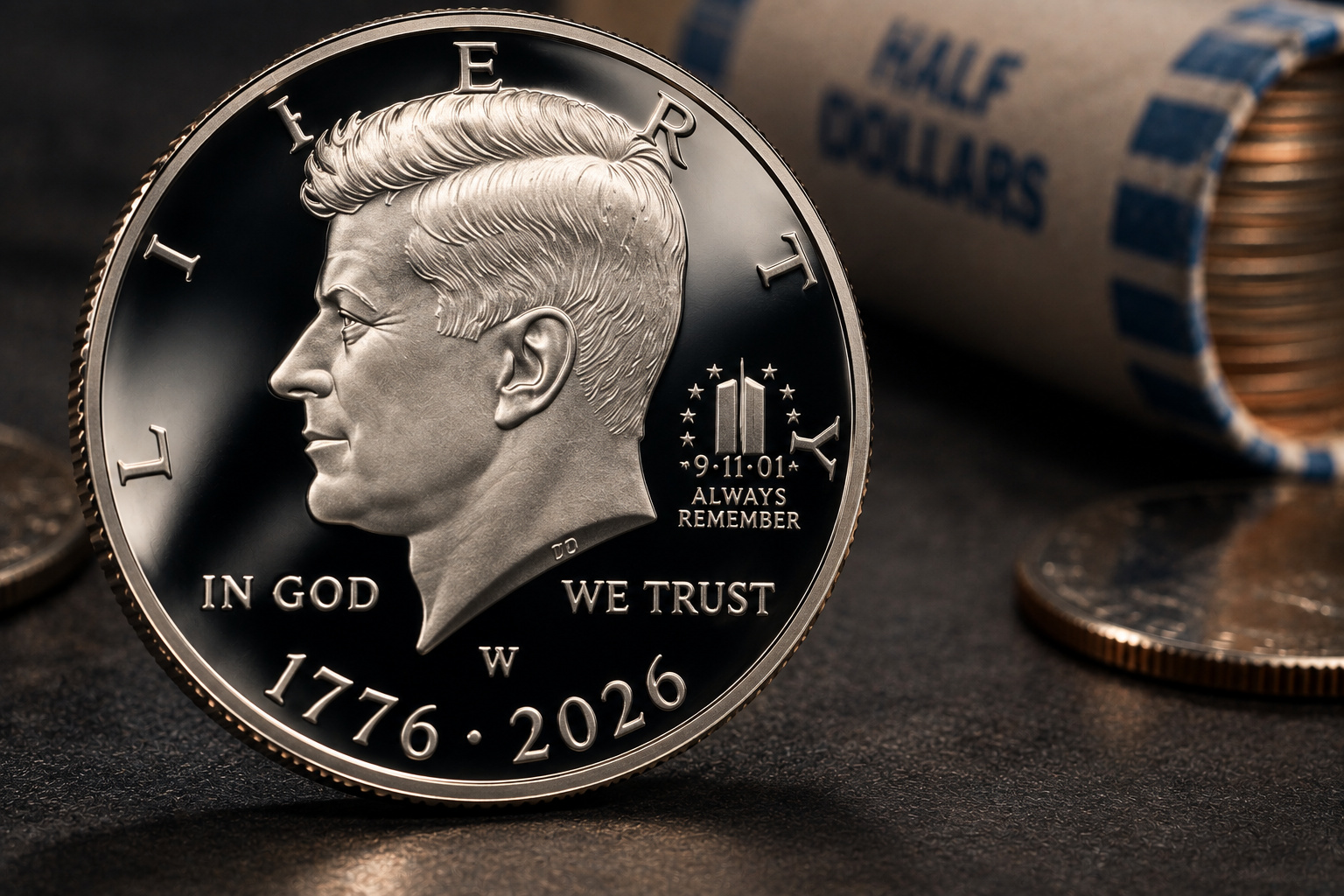
A 2026 half dollar struck at West Point is being mixed into ordinary American circulation, and only 250,000 of this special issue were produced. Unlike a coin sold only in a collector package, these half dollars were sent through Federal Reserve Banks for random distribution, creating the possibility that one could eventually turn up in a bank roll, cash drawer, or group of circulating coins.
But the date alone is not enough to identify one. The coin collectors are looking for has two important clues: a W mint mark for West Point and a special 9-11-01 privy mark surrounded by the words ALWAYS REMEMBER. Those details separate the special 2026-W half dollar from other 2026 Enduring Liberty half dollars.
Quick Answer: How to Identify the 2026-W Half Dollar
A genuine special-issue 2026-W Enduring Liberty Half Dollar has a W mint mark identifying the West Point Mint and a 9-11-01 privy mark surrounded by the words ALWAYS REMEMBER. The U.S. Mint produced 250,000 of these coins for random distribution into circulation.
- Date: 1776 ~ 2026
- Mint: West Point
- Mint Mark: W
- Special Mark: 9-11-01 / ALWAYS REMEMBER
- Special-Issue Quantity: 250,000
- Denomination: Half Dollar
- Design: Enduring Liberty
Table of Contents
- What Exactly Is the 2026-W Half Dollar?
- Why Are There Only 250,000?
- Why the W Mint Mark Matters
- The 9-11-01 ALWAYS REMEMBER Privy Mark
- How Did a West Point Coin Enter Circulation?
- Can You Really Find One?
- 2026-W vs. 2026-P vs. 2026-D
- Is the 2026-W Half Dollar a Mint Error?
- Why Condition Could Matter
- Does 250,000 Make It Rare?
- Reality Check
- Final Verdict
- Frequently Asked Questions
What Exactly Is the 2026-W Half Dollar?
To understand why this coin stands out, you first need to understand what happened to the half dollar in 2026.
America’s 250th anniversary brought temporary changes to several familiar U.S. coins. The Kennedy portrait normally associated with the half dollar stepped aside for the special Enduring Liberty Half Dollar.
Its obverse features a close view of the Statue of Liberty, while the reverse develops the Liberty theme by depicting the passing of Liberty’s torch to a new generation.
The change belongs to the broader Semiquincentennial coin program. You can see how the half dollar fits alongside the anniversary dime, five quarters, penny, nickel, and Native American dollar in our guide to the 2026 U.S. Proof Set coins.
The special coin discussed here goes one step further.
Instead of coming from Philadelphia or Denver, it was struck at the West Point Mint. It carries the W mint mark and an additional commemorative privy mark connected with September 11, 2001.
That combination creates a distinct variety of the 2026 Enduring Liberty Half Dollar that can be identified without guessing from color, shine, or condition.
Why Are There Only 250,000?
The figure comes directly from the U.S. Mint’s special circulation release.
The Mint announced that it had struck 250,000 Enduring Liberty Half Dollars at West Point bearing the special 9-11-01 privy mark and transferred them to Federal Reserve Banks for random distribution.
That number deserves some context.
It refers specifically to this special W-mint-mark issue. It should not be confused with the total number of all 2026 half dollars, nor does it mean only 250,000 examples of the Enduring Liberty design exist across every Mint facility and product.
Collectors should also be careful with the word “rare.” A production quantity is an objective fact. Rarity is more complicated because it can involve availability, survival, demand, condition, and how many examples collectors can actually obtain.
What we can say confidently is much simpler: the Mint deliberately limited this special circulation issue to 250,000 pieces.
Why the W Mint Mark Matters
The letter W identifies the United States Mint facility at West Point, New York.
For someone examining a 2026 half dollar, this is one of the first details to check. You do not need to judge whether the coin “looks special.” The mint mark provides a specific diagnostic.
This is especially useful because the basic Enduring Liberty design is not exclusive to the W coin. Seeing the Statue of Liberty on a 2026 half dollar does not automatically mean you have found the 250,000-piece special issue.
You need the correct identifying features.
That distinction is one of the most important lessons in modern coin collecting. A coin’s design, date, mint mark, finish, and special marks can all identify different versions of what initially appears to be the same coin.
The Detail That Makes It Instantly Different: 9-11-01
The second major diagnostic is even more distinctive.
The special West Point issue carries a privy mark featuring 9-11-01, surrounded by the words ALWAYS REMEMBER.
A privy mark is an intentional symbol, inscription, or small design element placed on a coin for a particular purpose. It is not the same thing as accidental damage, a die crack, or another minting error.
That means if you find the correct 9-11-01 marking on a genuine 2026-W half dollar, you are not looking at something someone stamped onto the coin after it left the Mint. It belongs to the official special issue.
The inscription commemorates the September 11, 2001 terrorist attacks and serves as an intentional remembrance feature on the coin.
For collectors, the key point is identification: W plus the official 9-11-01 ALWAYS REMEMBER privy mark is the combination to look for.
How Did a West Point Coin End Up in Circulation?
This is where the story becomes particularly unusual.
Many special modern U.S. coins reach collectors through Mint products, direct sales, Proof Sets, commemorative programs, or other numismatic channels.
The 2026-W special half dollars followed a different path.
After striking the coins at West Point, the Mint transferred the 250,000 pieces to Federal Reserve Banks. From there, they were intended for random distribution into normal circulation.
In simplified form, the path looks like this:
West Point Mint → Federal Reserve Banks → normal coin distribution → circulation
The Mint did not announce that every region would receive an equal number, nor should collectors assume a particular bank has them simply because it handles half dollars.
“Random distribution” is the important part.
The concept gives ordinary collectors a chance to encounter a special Mint issue through circulation rather than requiring every example to be purchased directly as a collector product.
Can You Really Find One in Pocket Change?
Yes, because the coins were released for circulation. But there is an important practical limitation: half dollars are not encountered in everyday transactions nearly as often as quarters, dimes, nickels, or pennies.
So “released into circulation” should not be interpreted as “easy to find in your change tomorrow.”
Some collectors search half-dollar rolls obtained through banks. Others encounter half dollars in accumulated change, old collections, cash drawers, or businesses where the denomination still occasionally circulates.
The special distribution means any genuine circulation encounter is possible, but there is no reliable shortcut that tells you exactly where one of the 250,000 coins will appear.
That uncertainty is part of what makes the release interesting.
If you do examine 2026 half dollars, check the actual diagnostics rather than relying on how bright or new the coin looks.
2026-W vs. 2026-P vs. 2026-D Half Dollar
The easiest way to avoid confusion is to compare the identifying features rather than the overall appearance.
| Feature | 2026-W Special Issue | 2026-P | 2026-D |
|---|---|---|---|
| Mint | West Point | Philadelphia | Denver |
| Mint Mark | W | P | D |
| Enduring Liberty Design | Yes | Yes | Yes |
| 9-11-01 Privy Mark | Yes | No | No |
| ALWAYS REMEMBER Inscription | Yes, as part of the special privy feature | No | No |
| Special W Issue Quantity | 250,000 | Not part of the 250,000 W issue | Not part of the 250,000 W issue |
This comparison also explains why a photograph of the Statue of Liberty alone cannot confirm the special coin.
The Enduring Liberty design identifies the 2026 anniversary half dollar. The W mint mark and special privy mark identify the circulation release collectors are searching for.
Is the 2026-W Half Dollar a Mint Error?
No.
Neither the W mint mark nor the 9-11-01 privy mark is an error. Both are intentional features of the special issue.
This distinction matters because unusual-looking modern coins are frequently described online as “errors” simply because they differ from the version someone normally sees.
A genuine mint error results from something going wrong during the coin-production process. A planned mint mark, commemorative design element, or authorized privy mark is different.
The 2026-W coin is better understood as a special issue, not an error coin.
Of course, it is theoretically possible for an individual 2026-W half dollar to have a genuine minting error in addition to its normal special features. But that would require separate diagnostics. The presence of W or 9-11-01 is not evidence of an error.
Why Condition Could Matter
These coins were deliberately placed into circulation channels, which means individual examples may not remain in identical condition.
A coin removed quickly from a fresh roll might retain strong original luster and show relatively few contact marks. Another example could spend time moving through bags, counting machines, bank rolls, cash drawers, and actual transactions.
That second coin may acquire marks or wear even though it is exactly the same special issue.
This creates an important distinction between identity and condition.
The W mint mark and privy mark tell you which issue you have. They do not tell you its grade.
Likewise, a coin does not need to look perfect to be a genuine 2026-W special issue.
If you find one, avoid trying to improve its appearance. Polishing, rubbing, dipping, or aggressively cleaning a coin can permanently alter its original surfaces.
A dirty or toned coin does not become numismatically “better” simply because someone makes it brighter.
Does a Mintage of 250,000 Make the 2026-W Half Dollar Rare?
The 250,000 figure is certainly one of the most notable facts about the issue, but it should be interpreted carefully.
Mintage and rarity are related concepts, but they are not identical.
Imagine two coins with the same original production quantity. If almost every example of one coin is immediately saved by collectors while most examples of the other are lost or heavily worn, their long-term availability can become very different.
Demand matters too.
A coin sought by a large number of collectors can behave differently in the marketplace from another coin with a similar mintage but little collector interest.
Condition can create another layer. Years from now, the number of well-preserved examples may matter differently from the total number originally struck.
For the 2026-W half dollar, it is far too early to turn the official 250,000 quantity into confident claims about future rarity or value.
What makes the number useful today is that it defines the size of this particular special circulation release.
Reality Check
Several details about the 2026-W half dollar are easy to exaggerate online, so keep the diagnostics separate from speculation.
- The W mint mark is intentional. It identifies West Point.
- The 9-11-01 privy mark is intentional. It is not damage or a mint error.
- 250,000 is the official special-issue quantity. It does not guarantee a particular future value.
- The Statue of Liberty design alone does not identify the W issue. Other 2026 Enduring Liberty half dollars use the anniversary design.
- A bright coin is not automatically uncirculated. Surface condition requires closer examination.
- Cleaning does not improve a collectible coin’s originality. Altered surfaces can be permanent.
What Should You Do If You Find One?
Start by confirming the coin rather than immediately trying to estimate what it is worth.
Check the date, then locate the mint mark. Confirm that it is a W. Next, look for the official 9-11-01 ALWAYS REMEMBER privy feature.
If those diagnostics match, handle the coin carefully by its edges whenever practical and avoid touching the main surfaces more than necessary.
Most importantly, do not clean it.
You can then examine the surfaces under good neutral lighting to understand its condition. Look for obvious circulation wear, contact marks, scratches, and remaining mint luster without assuming that every mark is a mint error.
This approach is much more useful than beginning with a viral price claim and working backward.
Final Verdict
The 2026-W Enduring Liberty Half Dollar is unusual for a simple reason: the U.S. Mint created a clearly identifiable special issue at West Point and then deliberately sent 250,000 examples into ordinary circulation channels.
That turns the coin into something collectors can actually search for rather than an issue available only through a special Mint package.
Identification is straightforward once you know what matters. Do not stop at the 1776 ~ 2026 date or the Statue of Liberty design. Look for the W mint mark and the 9-11-01 ALWAYS REMEMBER privy mark.
Those small details tell the real story.
And if one eventually appears in a bank roll or among a group of half dollars, there is no need to guess whether the unusual markings are damage or an error. They were put there intentionally, on a special issue whose journey began at West Point and continued through the Federal Reserve into circulation.
Frequently Asked Questions
How many 2026-W half dollars were made?
The U.S. Mint produced 250,000 of the special 2026-W Enduring Liberty Half Dollars carrying the 9-11-01 ALWAYS REMEMBER privy mark for distribution into circulation.
Were 2026-W half dollars really released into circulation?
Yes. The Mint transferred the special issue to Federal Reserve Banks for random distribution through normal circulation channels.
How can I identify a 2026-W half dollar?
Check for a W mint mark identifying West Point and the official 9-11-01 privy mark surrounded by the words ALWAYS REMEMBER. The Enduring Liberty design by itself is not enough to identify the special W issue.
What does the W mean on a 2026 half dollar?
The W mint mark means the coin was struck at the United States Mint facility at West Point, New York.
What does 9-11-01 mean on the 2026 half dollar?
The inscription refers to September 11, 2001. On the special 2026-W issue, it forms part of an intentional remembrance privy mark accompanied by the words ALWAYS REMEMBER.
Is the 9-11-01 mark a mint error?
No. It is an intentional feature of the special issue. It should not be confused with accidental damage, a post-Mint counterstamp, or a minting error.
Can I find a 2026-W half dollar in a bank roll?
It is possible because the coins were released through Federal Reserve Banks for random circulation. That does not guarantee that any particular bank, roll, or geographic area will contain one.
What is the difference between a 2026-W and a 2026-P or 2026-D half dollar?
The special W issue was struck at West Point and carries both the W mint mark and the 9-11-01 ALWAYS REMEMBER privy mark. Philadelphia and Denver examples do not carry that special combination.
Should I clean a 2026-W half dollar if I find one?
No. Cleaning can alter a coin’s original surfaces and may leave scratches, unnatural brightness, or other permanent evidence of alteration. If you find one, careful handling is preferable to attempting to improve its appearance.
Is the 2026-W half dollar rare?
The special issue has a known production quantity of 250,000 coins. That is an important numismatic fact, but it is too early to determine long-term rarity from the mintage alone. Availability, collector demand, survival, and condition can all matter.
Does the W mint mark make every 2026-W half dollar valuable?
The W identifies a special West Point issue, but a mint mark by itself does not establish a specific market value. Condition, demand, availability, and the market at the time of sale all affect what collectors may be willing to pay.