2026 U.S. Proof Set Coins: What’s Different in the 250th Anniversary Set?
Updated September 2026: Release information, pricing, and product limits reflect U.S. Mint information available before the scheduled October 6 launch and may be changed by the Mint.
The annual U.S. Proof Set is usually familiar territory for collectors. Take the year’s circulating coin designs, strike special proof versions at San Francisco, package them together, and you have one of the Mint’s most recognizable annual products. But the 2026 set breaks that familiar pattern in several remarkable ways.
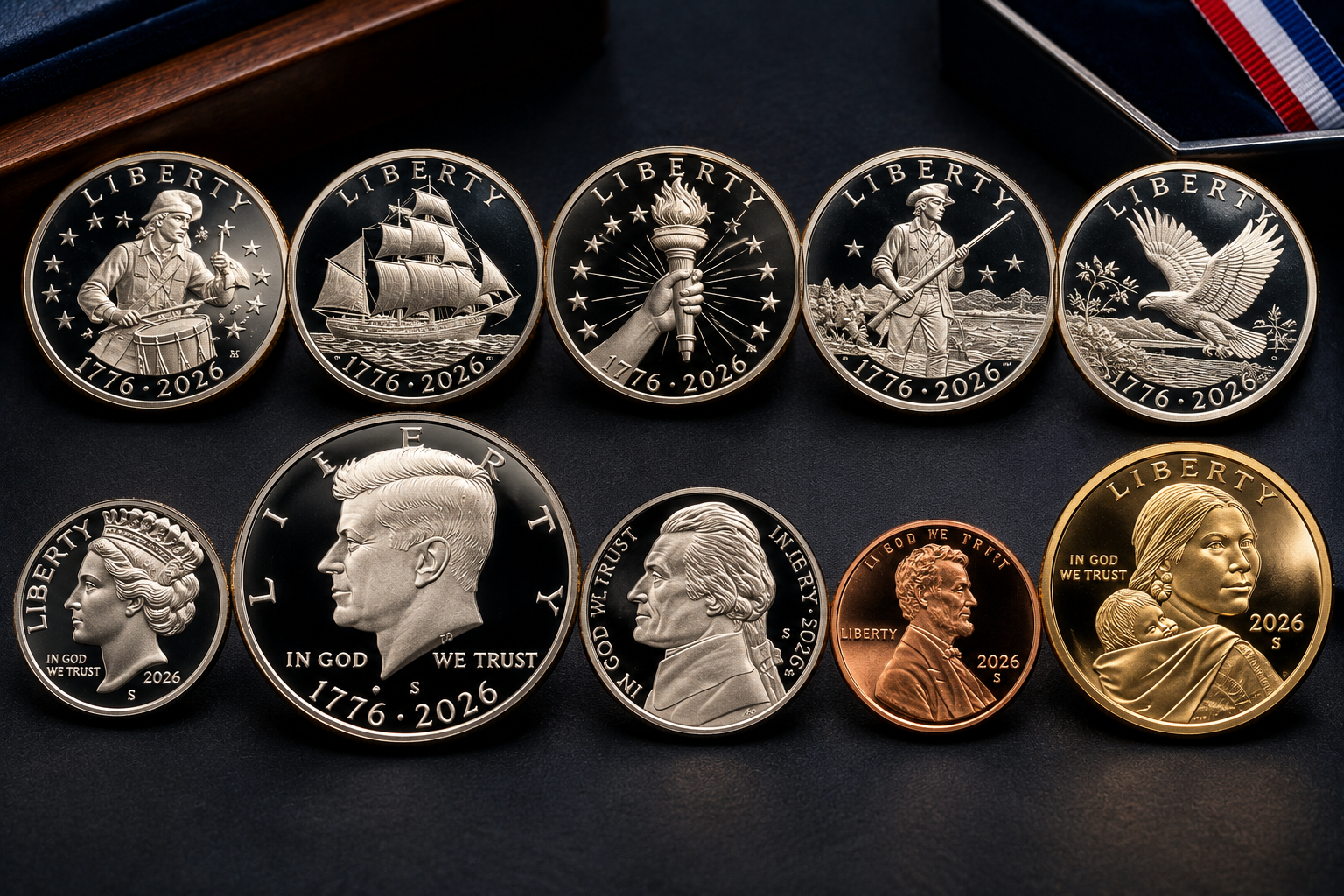
America’s 250th anniversary has brought one-year-only designs across much of the nation’s coinage. The 2026 Semiquincentennial Proof Set brings 10 proof coins together, including five different quarters, a Liberty dime, a Statue of Liberty half dollar, and something that may surprise many collectors most of all: a 2026 penny, even though pennies are no longer being produced for circulation.
Quick Context
The U.S. Mint currently schedules the 2026 Semiquincentennial Proof Set for release on October 6, 2026, at 12 noon Eastern Time. The listed price is $107, with a product limit of 480,000 sets and no stated mintage limit for the product’s coins. Each set contains 10 proof-quality coins struck at the San Francisco Mint and bearing the “S” mint mark. The Mint describes the set as a special one-year issue commemorating the 250th anniversary of the nation’s founding.
Table of Contents
- Why Is the 2026 Proof Set So Different?
- What’s Inside the 2026 U.S. Proof Set?
- Why Are There Five Quarters?
- Why Roosevelt Is Missing From the 2026 Dime
- Why Kennedy Is Missing From the 2026 Half Dollar
- If Penny Production Ended, Why Is There a 2026 Penny?
- The 2026 Native American Dollar
- Why the Coins Say 1776 ~ 2026
- What Makes These Coins Proof Coins?
- Regular Proof Set vs. Silver Proof Set
- Does the 480,000 Product Limit Make It Rare?
- Reality Check
- Final Verdict
- Frequently Asked Questions
Why Is the 2026 Proof Set So Different?
The easiest way to understand this set is to forget what a normal annual Proof Set usually looks like.
For America’s Semiquincentennial, the U.S. Mint redesigned most circulating coinage for 2026. These designs commemorate 250 years since 1776 and are intended specifically for this anniversary year.
That means the Proof Set captures a group of designs that will not simply become the standard lineup for 2027.
The dime is especially striking because the familiar Roosevelt portrait gives way to Liberty. The half dollar replaces the Kennedy portrait with the Statue of Liberty. Five separate quarters tell different chapters of American history, while the annual set also contains a collectible penny despite the end of penny production for circulation.
Together, those changes make 2026 far more than a routine date change on familiar Proof coins.
What’s Inside the 2026 U.S. Proof Set?
There are 10 coins in the set, all struck in Proof finish at San Francisco.
| Coin | What Makes It Notable in 2026? |
|---|---|
| Lincoln Penny | A collectible 2026 penny produced after the denomination stopped being made for circulation |
| Jefferson Nickel | Part of the anniversary coinage and annual Proof Set |
| Emerging Liberty Dime | Liberty replaces the familiar Roosevelt portrait for the anniversary year |
| Mayflower Compact Quarter | First of five historical Semiquincentennial quarter themes |
| Revolutionary War Quarter | Commemorates the struggle for American independence |
| Declaration of Independence Quarter | Connects the quarter series directly with the events of 1776 |
| U.S. Constitution Quarter | Focuses on the constitutional framework established after independence |
| Gettysburg Address Quarter | Moves the historical narrative forward to Lincoln and the Civil War |
| Enduring Liberty Half Dollar | The Statue of Liberty replaces the Kennedy portrait for 2026 |
| Native American $1 Coin | Honors Polly Cooper and the Oneida Indian Nation’s assistance at Valley Forge |
The unusual number of coins comes largely from the five quarters. Instead of a single quarter design, the set contains the complete five-coin 2026 Semiquincentennial quarter program.
Why Are There Five Quarters?
The five 2026 quarters are designed almost like a compact historical sequence.
The Mayflower Compact quarter begins with an early expression of self-government. The Revolutionary War design moves into the struggle for independence. The Declaration of Independence quarter focuses on the document announcing separation from Britain, while the U.S. Constitution quarter represents the framework of the new federal government.
The final design moves forward nearly a century to Abraham Lincoln’s Gettysburg Address and its enduring connection with equality, democracy, and the meaning of the Union.
This makes the five quarters fundamentally different from simply placing five artistic variations into the set. They are tied to specific episodes in the development of the United States.
For collectors, the Proof Set provides all five with the San Francisco “S” mint mark and Proof finish in one package.
Why Roosevelt Is Missing From the 2026 Dime
One of the easiest coins in the set to mistake for something completely new is the dime.
Franklin D. Roosevelt has been associated with the dime since 1946. For 2026, however, the familiar portrait steps aside for the Semiquincentennial Emerging Liberty design.
The obverse depicts Liberty facing forward with a liberty cap that incorporates stars and stripes, deliberately connecting the anniversary coin with imagery associated with early American coinage and the revolutionary era.
The change is temporary. It belongs to the special 2026 anniversary program rather than representing a permanent abandonment of the Roosevelt dime.
That distinction matters because decades from now, a 2026 dime will be immediately recognizable even before a collector reads its date. Its design itself identifies the anniversary year.
Why Kennedy Is Missing From the 2026 Half Dollar
The half dollar delivers another dramatic break with the design Americans have known for more than six decades.
For 2026, the Kennedy portrait is replaced by a close-up view of the Statue of Liberty on the obverse of the Enduring Liberty Half Dollar.
The reverse continues the theme by showing Liberty passing her torch to a new generation. The design is intended specifically for the 250th anniversary, and the U.S. Mint states that the Kennedy portrait returns in 2027.
That makes the 2026 half dollar an unusual interruption inside one of the longest-running presidential coin designs in modern American coinage.
It is not a new permanent “Liberty half dollar.” It is a one-year chapter in the Kennedy half dollar’s history.
If Penny Production Ended, Why Is There a 2026 Penny?
This may be the most confusing coin in the entire set.
The answer comes down to the difference between circulating coin production and numismatic production.
The penny is no longer being produced for circulation, but that does not prevent the U.S. Mint from producing collectible pennies for numismatic products.
That is exactly what happens in the 2026 annual sets.
The Mint specifically identifies the 2026 penny as part of these collector products. In other words, finding a 2026 penny in a Proof Set does not mean ordinary 2026 pennies were produced for banks and everyday circulation in the same way as earlier dates.
The Proof example is a purpose-made collector coin struck at San Francisco.
For Lincoln cent collectors, that distinction makes 2026 historically interesting. The denomination’s circulation story and its collector-product story have separated.
That continues a much longer history of change for the cent. The design itself has repeatedly evolved, including the major transition explored in how the Lincoln cent changed in 1959.
The 2026 Native American Dollar
The Native American $1 coin can be overshadowed by the radically changed dime and half dollar, but its 2026 reverse carries a distinct historical story.
The design honors Polly Cooper and the Oneida Indian Nation for assistance provided to American forces during the Revolutionary War.
The Oneida supported the American cause and provided desperately needed food to troops at Valley Forge. Oral tradition credits Polly Cooper with helping prepare the dried white corn and teaching soldiers how to prepare it properly. She remained to continue assisting the Continental Army during the difficult winter.
That gives the dollar a direct connection to the broader anniversary theme while highlighting a story that many Americans may not know.
Why the Coins Say 1776 ~ 2026
The dual date is one of the easiest ways to recognize the anniversary coinage.
The Mint’s 2026 annual-set material identifies the coins with the dates 1776 ~ 2026, marking the 250-year span being commemorated.
This should not be confused with an ordinary date range showing when a coin was produced. The coins themselves are 2026 issues. The 1776 reference is commemorative, connecting them with the year of American independence.
That distinction will be useful in the future because collectors encountering the coins outside their original packaging may initially wonder whether the dual date has some special minting or rarity meaning.
It identifies the Semiquincentennial program. By itself, it is not an error or variety.
What Makes These Coins Proof Coins?
“Proof” describes the method and finish used to produce these collector coins. It does not simply mean that an ordinary circulation coin happens to be unusually shiny.
Proof coinage is specially prepared for collectors, with manufacturing methods intended to produce highly detailed surfaces and strong visual contrast. Modern U.S. Proof coins commonly display reflective fields and frosted design elements.
The 2026 set is struck at the United States Mint facility in San Francisco, and each coin bears the “S” mint mark.
That means an S-mint 2026 Proof dime, for example, should not be treated as if it were simply the same object as a Philadelphia or Denver circulation strike with a different letter added. Its production purpose and finish are different.
The original Mint packaging also matters to collectors because the set is designed and sold as a complete numismatic product rather than assembled from pocket change.
Regular Proof Set vs. Silver Proof Set
Collectors searching for the 2026 Proof Set will encounter another product with an almost identical lineup: the 2026 Semiquincentennial Silver Proof Set.
They are not the same product.
| Feature | 2026 Proof Set | 2026 Silver Proof Set |
|---|---|---|
| Number of coins | 10 | 10 |
| Mint | San Francisco | San Francisco |
| Mint mark | S | S |
| Finish | Proof | Proof |
| Dime | Standard listed composition | 99.9% silver |
| Five quarters | Standard listed composition | 99.9% silver |
| Half dollar | Standard listed composition | 99.9% silver |
| Purpose | Regular annual Proof Set | Premium silver version of the annual set |
The regular Proof Set’s dime, quarters, and half dollar use copper-nickel compositions listed by the Mint, while those denominations in the Silver Proof Set are struck in 99.9% fine silver.
The penny is another useful reminder that “Silver Proof Set” does not mean every single coin in the package is made of silver. The silver specification applies to the designated silver denominations.
Does the 480,000 Product Limit Make It Rare?
Not automatically.
The U.S. Mint currently lists a 480,000 product limit for the regular 2026 Semiquincentennial Proof Set.
A product limit tells collectors how many units can be made available as that particular product. It should not be turned into a prediction about future rarity or value.
Collector demand, final sales, surviving sets, condition, future interest, and the availability of individual designs in other Mint products can all influence the market years later.
The Mint also currently lists no household order limit for the set. As with other Mint products, limits and availability can be adjusted.
Most importantly, a one-year design does not automatically mean a rare coin. Millions of coins can carry a design used for only one year.
“One-year-only” describes the design program. “Rare” describes availability relative to demand and other numismatic factors. They are not interchangeable terms.
Reality Check
The 2026 Proof Set is historically unusual, but collectors should separate that fact from predictions about investment performance.
The special dime, half dollar, quarters, dual date, and collectible penny give the set clear numismatic interest. None of those features guarantees that an unopened set or an individual coin will rise in value.
Likewise, Proof does not mean rare, an “S” mint mark does not automatically mean valuable, and 1776 ~ 2026 is an intentional anniversary date rather than a mint error.
The strongest reason to understand this set is the history captured by its designs. Future market value is a separate question.
Final Verdict
The 2026 U.S. Proof Set stands apart because several of America’s most familiar coins temporarily stop looking familiar.
Roosevelt gives way to Emerging Liberty on the dime. Kennedy gives way to the Statue of Liberty on the half dollar. Five quarters trace major chapters in American history. The Native American dollar honors Polly Cooper and the Oneida Indian Nation. And the penny continues in collectible form even though it is no longer being produced for circulation.
Then there is the detail tying the entire anniversary program together: 1776 ~ 2026.
For collectors, that combination makes the set more than an annual package with a new date. It captures a deliberate one-year interruption in several long-running American coin designs.
According to the U.S. Mint’s current schedule, collectors will be able to purchase the Semiquincentennial Proof Set beginning October 6, 2026, at noon Eastern Time for $107. The current product limit is 480,000 sets.
Those release details may eventually change. The historical distinction of the designs will not: 2026 was created to look different.
Frequently Asked Questions
When does the 2026 U.S. Proof Set go on sale?
The U.S. Mint currently schedules the 2026 Semiquincentennial Proof Set for October 6, 2026, at 12 noon Eastern Time. Mint schedules and prices can change, so collectors should verify the current information near the release date.
How much is the 2026 U.S. Proof Set?
The U.S. Mint currently lists the regular 2026 Semiquincentennial Proof Set at $107.
How many coins are in the 2026 Proof Set?
There are 10 coins: one penny, one nickel, one dime, five different quarters, one half dollar, and one Native American $1 coin.
Where are the 2026 Proof Set coins made?
The coins in the regular Semiquincentennial Proof Set are struck at the United States Mint facility in San Francisco and carry the “S” mint mark.
Why is Roosevelt not on the 2026 dime?
For America’s 250th anniversary, the Mint introduced the one-year Emerging Liberty dime design. It temporarily replaces the familiar Roosevelt portrait as part of the 2026 Semiquincentennial coin program.
Why is Kennedy not on the 2026 half dollar?
The 2026 Enduring Liberty Half Dollar uses the Statue of Liberty instead of Kennedy for the anniversary year. The U.S. Mint states that the Kennedy portrait will return in 2027.
Why is there a 2026 penny?
The penny is no longer produced for circulation, but the Mint continues to make collectible 2026 pennies for numismatic annual sets. The Proof Set therefore includes an S-mint Proof penny even though ordinary 2026 pennies are not being produced for circulation.
What does 1776 ~ 2026 mean on the coins?
The dual date commemorates 250 years from 1776 to 2026. It is an intentional feature of the Semiquincentennial coinage, not a minting error.
Are the 2026 Proof Set coins silver?
The regular Proof Set is not the silver version. The Mint lists standard copper-based or copper-nickel compositions for its regular denominations. A separate Semiquincentennial Silver Proof Set contains the dime, five quarters, and half dollar struck in 99.9% fine silver.
Will the 2026 Proof Set be rare?
It is too early to determine future rarity or collector value. The U.S. Mint currently lists a product limit of 480,000 sets, but a product limit by itself does not establish future rarity, demand, or market value.
Are the 2026 coin designs permanent?
No. The major Semiquincentennial redesigns are special 2026 anniversary issues. For example, the U.S. Mint specifically states that Kennedy returns to the half dollar in 2027.