2026 July 4 Privy Mark Quarter: How to Identify the Rare 250,000-Coin Release
Updated October 2026: Includes the official 250,000-coin release details, the claimed NGC discovery reward, and newly documented counterfeit warnings.
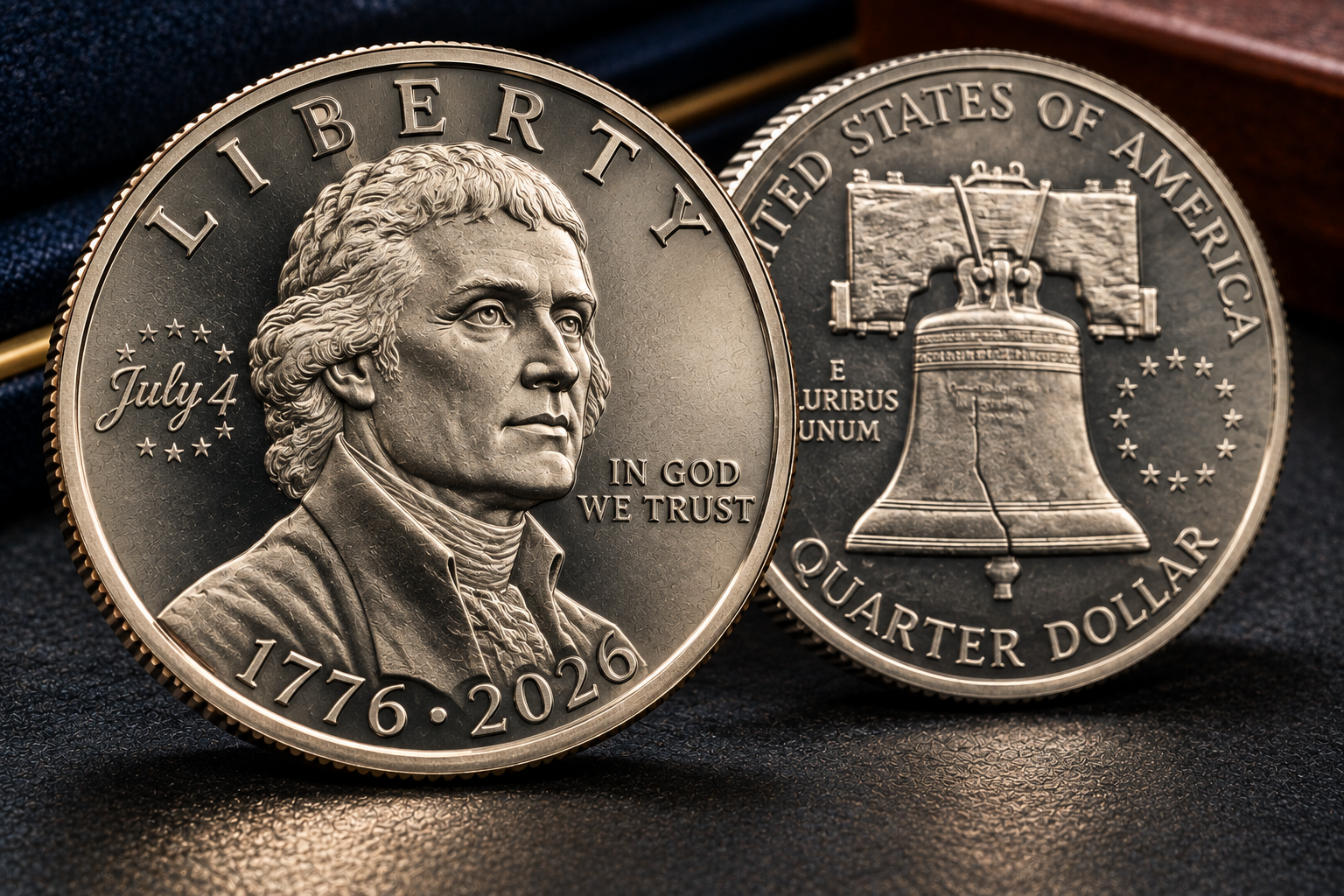
Most 2026 Declaration of Independence quarters have a familiar little letter identifying where they were struck. But 250,000 were deliberately made without one. Instead, they carry a tiny inscription beside Thomas Jefferson’s portrait: July 4th.
The United States Mint did not sell these special quarters in an exclusive collector set. It mixed them into ordinary coin shipments, giving people a chance to discover one in pocket change or a bank roll. That decision turned a modern circulating quarter into one of the year’s most intriguing coin searches.
Finding one, however, takes more than spotting the Liberty Bell on the reverse or noticing the unusual 1776 ~ 2026 date. Both features appear on regular 2026 Declaration of Independence quarters. The real distinction is much smaller, and knowing exactly what to examine can save collectors from a costly misidentification.
Quick Answer: How to Identify the 2026 July 4 Quarter
The special issue is a 2026 Declaration of Independence Quarter with two identifying characteristics:
- July 4th privy mark: A small inscription to the left of Thomas Jefferson’s head on the obverse.
- No mint mark: Unlike regular circulating P- and D-mint versions, the special quarter carries no mint mark.
- Reverse: The Liberty Bell, the same design used on regular Declaration of Independence quarters.
- Dual date: 1776 ~ 2026, commemorating America’s 250th anniversary.
- Official production: 250,000 special pieces.
- Distribution: Randomly mixed into circulation through the banking system.
Important: A missing mint mark alone is not enough. The genuine special issue must also have the correct July 4th privy mark and authentic coin details.
In This Article
- What Is the 2026 July 4 Privy Mark Quarter?
- Where to Find the July 4 Privy Mark
- Why the Special Quarter Has No Mint Mark
- Regular vs. July 4 Privy Mark Quarter
- Why Only 250,000 Were Produced
- How the Quarters Entered Circulation
- How to Search Pocket Change and Coin Rolls
- What to Do If You Find One
- Is the July 4 Privy Quarter Valuable?
- The First Certified Discovery and $2,500 Reward
- How to Avoid Counterfeit Examples
- Collector Reality Check
- Final Verdict
- Frequently Asked Questions
What Is the 2026 July 4 Privy Mark Quarter?
The July 4 privy mark quarter is a special version of the 2026 Declaration of Independence Quarter, one of five circulating quarter designs created for America’s Semiquincentennial.
Its obverse depicts Thomas Jefferson, the principal author of the Declaration of Independence and the nation’s third president. The reverse shows the Liberty Bell, one of the most recognizable symbols associated with American independence.
On June 23, 2026, the United States Mint announced that it would produce 250,000 examples carrying a special July 4th privy mark.
The unusual part was not simply the limited quantity. It was how the Mint planned to distribute them.
Instead of placing the coins in numbered presentation cases or selling them directly as a separate numismatic product, the Mint decided to release them through the ordinary circulation system.
That meant a collector searching a roll of quarters could potentially encounter the same special issue that another person might receive as change from a grocery store.
The Mint confirmed the production quantity and distribution plan in its June 23 announcement.
Where Is the July 4 Privy Mark on the 2026 Quarter?
Start with the side showing Thomas Jefferson.
The special privy mark appears to the left of Jefferson’s head. It is small enough that a quick glance may miss it, particularly on a coin that has already picked up fingerprints or circulation wear.
The inscription reads July 4th. It is an intentional part of the special design, not a scratch, a random counterstamp, or damage caused after minting.
A practical examination begins with the following details:
- Confirm that the obverse shows Thomas Jefferson, not Abraham Lincoln or another 2026 quarter portrait.
- Check the anniversary date, which should read 1776 ~ 2026.
- Examine the area immediately to the left of Jefferson’s head for the small July 4th inscription.
- Look for the absence of the regular P or D mint mark.
- Turn the coin over and verify that the reverse depicts the Liberty Bell.
A magnifier in the 5x to 10x range can make the inspection easier. Strong, indirect lighting is usually more helpful than an extremely bright light reflecting directly from the metal.
Do not clean the coin to make the inscription easier to read. Abrasive polishing, chemical dips, and even vigorous rubbing can damage the original surface and reduce collector appeal.
Why Does the 2026 July 4 Quarter Have No Mint Mark?
Ordinary 2026 Declaration of Independence quarters produced for circulation carry mint marks identifying their facilities. A P indicates Philadelphia, while a D identifies Denver.
The special July 4 issue is different by design.
The Mint deliberately omitted the usual mint mark, making the combination of the privy inscription and the missing mint mark distinctive.
It is important to understand the difference between these two types of markings.
A mint mark identifies a minting facility. A privy mark is a special symbol or inscription added for another purpose, often to recognize an event, anniversary, or particular coin program.
In this case, July 4th identifies the special anniversary issue. It does not indicate a separate minting facility.
That distinction also prevents a common misunderstanding. A collector should not describe the coin as a rare missing-mint-mark error. The absence of the letter is intentional.
And while some older American coins normally lack mint marks, the relevant comparison here is with the regular 2026 Declaration of Independence quarter, not with pennies or quarters from unrelated years.
2026 July 4 Privy Mark Quarter vs. Regular Declaration Quarter
At first glance, the two versions look remarkably similar. They share the same historical theme, portrait, reverse, denomination, and anniversary date.
The differences are concentrated in a small area of the obverse.
| Feature | Regular 2026 Quarter | July 4 Privy Mark Quarter |
|---|---|---|
| Historical subject | Declaration of Independence | Declaration of Independence |
| Obverse portrait | Thomas Jefferson | Thomas Jefferson |
| Reverse design | Liberty Bell | Liberty Bell |
| Date | 1776 ~ 2026 | 1776 ~ 2026 |
| July 4th privy mark | No | Yes |
| Mint mark | P or D on regular circulation strikes | None |
| Distribution | Regular circulation | Randomly mixed into circulation |
| Production | Standard circulating issue | 250,000 special pieces |
Notice that the Liberty Bell does not distinguish the special quarter. It appears on both versions.
That is particularly important in 2026 because the Mint introduced several different quarter designs. The 2026 Gettysburg Address Quarter, for example, features Abraham Lincoln and a reverse with clasped hands. It is a separate issue, not another version of the July 4 privy mark coin.
Why Were Only 250,000 July 4 Privy Mark Quarters Made?
The production figure was part of the Mint’s announced special release celebrating the nation’s 250th anniversary.
The number is unusually small compared with the quantities normally associated with modern circulating quarters, which can be produced in the tens or hundreds of millions.
But there is an important limitation to that comparison.
The figure of 250,000 refers specifically to the July 4th privy mark version. It does not mean the Mint produced only 250,000 Declaration of Independence quarters in total.
Regular examples were manufactured separately for everyday circulation.
The Mint’s stated approach was to give Americans a chance to discover the special issue in ordinary transactions. The limited production quantity made the search more interesting, while the distribution method allowed people outside traditional numismatic circles to participate.
The Mint has not provided a basis for treating every special quarter as equally valuable. Production quantity establishes the size of the issue, not the market price of an individual coin.
How Did the July 4 Quarters Enter Circulation?
The special quarters were randomly mixed with regular 2026 Declaration of Independence quarters in bulk coin shipments.
Those coins were then wrapped and sent through the Federal Reserve system for distribution to financial institutions.
This is different from the release of a collector product with a known sales channel and fixed packaging.
There was no public list of bank branches guaranteed to receive the special coins. Nor was there a designated state or city where collectors could reliably expect to find them.
The Mint also distributed special examples to visitors at its Philadelphia gift shop on Independence Day. According to its July 9 report, the first 250 eligible customers received one of the quarters, subject to a one-per-household limit.
That event was one part of the release, not the sole source of the coins.
The larger search unfolded through ordinary circulation. As the Mint explained in its account of the nationwide treasure hunt, the random distribution was intended to give people across the country a chance to participate.
How to Search Pocket Change and Quarter Rolls
If you enjoy searching circulating coins, the July 4 issue offers a straightforward challenge. The difficulty is not identifying a complicated die variety. It is finding one of a relatively small number of special pieces mixed among ordinary quarters.
Start With the Correct 2026 Design
Sort out the Declaration of Independence quarters first.
The reverse should show the Liberty Bell. If you see the Gettysburg clasped hands or another 2026 historical design, you are looking at a different quarter.
Once you have a Declaration quarter, examine Jefferson’s portrait side.
Check the Privy Mark Area
Look to the left of Jefferson’s head for the July 4th inscription. Compare its shape and spacing with an authenticated reference rather than relying on memory.
A genuine special issue should also lack the normal mint mark.
Handle Potential Finds Carefully
Hold coins by their edges whenever practical. Avoid touching the central design with bare fingers, particularly if the coin appears uncirculated.
If you find a promising example, place it in a clean, inert coin holder. Do not polish it or try to remove spots.
Keep Expectations Realistic
Searching rolls can be enjoyable, but the Mint’s random distribution does not guarantee that a particular bank roll contains a special quarter.
There is also no reliable way to calculate your personal odds from the 250,000 production figure alone. You would need to know how the coins were distributed and what inventory is available in the rolls you are searching.
Those details are not publicly established at the level needed for a meaningful individual probability.
What Should You Do If You Find a July 4 Privy Quarter?
The first priority is authentication, not immediately estimating its value.
Begin by comparing the coin with official Mint imagery and photographs of certified genuine examples. Check the privy mark, the anniversary date, Jefferson’s portrait, and the Liberty Bell reverse.
If the coin looks correct, preserve it in a suitable holder and record where and when you found it. That information may be personally interesting, although it does not establish a special pedigree or increase value by itself.
Professional grading may be worth considering for a particularly attractive example or one intended for resale, but grading fees, shipping, insurance, and turnaround time should be weighed against realistic market expectations.
A coin does not become more valuable merely because it has been placed in a grading holder. Authentication and grading provide an expert opinion on genuineness and condition; they do not guarantee a profitable sale.
Is the 2026 July 4 Privy Mark Quarter Valuable?
Unlike an ordinary new circulating quarter, the July 4 privy issue has a clearly documented limited production quantity. That gives it an identifiable collecting distinction.
But rarity and value are related without being interchangeable.
The market price of a genuine example depends on its condition, collector demand, the availability of competing examples, and whether buyers have confidence in its authenticity.
NGC reported in September 2026 that genuine examples had sold for hundreds of dollars at auction. That establishes that a collector market exists, but it should not be interpreted as a fixed value for every coin.
A worn example, an attractive uncirculated piece, and a high-grade certified specimen may attract very different offers.
Collectors should compare recent completed sales of coins in similar condition, rather than using the highest advertised asking price as a guide.
There is another reason to be cautious: the issue has already attracted counterfeiters. Paying a premium without examining authenticity can be a much greater mistake than passing over a coin that turns out to be ordinary.
The First Certified July 4 Quarter and the $2,500 Reward
One of the most widely discussed stories surrounding the coin involved a cash reward offered by Numismatic Guaranty Company, better known as NGC.
In June 2026, NGC announced a $2,500 bounty for the first eligible collector to submit an authentic July 4 privy mark quarter for certification.
The contest did not remain open for long.
On July 7, NGC announced that Mike Trout of Bennettsville, South Carolina, had claimed the reward. His coin passed through the grading process on July 6 and received a grade of NGC MS 66.
The distinction matters because the $2,500 payment was a discovery and submission reward. It was not a purchase price for the quarter, and it does not establish that every July 4 privy mark coin is worth $2,500.
NGC returned the certified coin to its owner under the terms of the promotion.
Collectors can read the official NGC announcement for the original result.
The first-submission reward has already been claimed. Anyone advertising the same bounty as an active opportunity is relying on outdated information.
Counterfeit July 4 Quarters: A Warning Collectors Should Not Ignore
The July 4 privy mark quarter is unusual for another reason: counterfeit examples appeared remarkably quickly.
In September 2026, NGC published a counterfeit-detection report describing a fake submitted for examination.
The differences were not limited to the privy mark. The counterfeit showed multiple design and manufacturing inconsistencies.
Among the warning signs documented by NGC were:
- Incorrect weight: The counterfeit weighed 5.86 grams, compared with the expected standard quarter weight of 5.67 grams.
- Wrong date separator: The fake used a simple dash between 1776 and 2026 instead of the correct tilde-style separator.
- Privy mark problems: The characters in the special inscription were crowded together.
- Jefferson portrait differences: Details of his jacket and tied-back hair were missing or incorrectly reproduced.
- Reverse inaccuracies: The Liberty Bell and the sculptor’s initials showed discrepancies from the genuine design.
NGC also identified suspicious horizontal lines on Jefferson’s cheek associated with the counterfeit manufacturing process.
These details are valuable because a fake can appear convincing in a small online photograph. A counterfeit may reproduce the general portrait, date, and reverse while failing under closer inspection.
Weight is a useful diagnostic, but it should not be treated as a stand-alone authentication test. Circulation wear, measurement conditions, and manufacturing tolerances must be considered, and a counterfeit could be produced closer to the correct weight.
For a valuable-looking example, compare multiple design details and consider professional authentication.
The NGC counterfeit-detection report includes side-by-side images of genuine and counterfeit examples.
Collector Reality Check
Before buying, selling, or submitting a July 4 quarter for grading, keep these distinctions clear.
- The July 4th inscription is not a mint error. It was intentionally added to the special issue.
- The missing mint mark is intentional. It is part of the coin’s official identification, not evidence of a striking accident.
- Not every Liberty Bell quarter is special. Regular 2026 Declaration of Independence quarters share the same reverse.
- 250,000 is the special issue’s production figure. It is not the total mintage of all 2026 Declaration of Independence quarters.
- The $2,500 NGC bounty is over. It was a one-time reward, not a universal valuation.
- Counterfeits have been documented. A visible July 4th inscription alone is not proof of authenticity.
- Asking prices are not confirmed market values. Comparable completed sales provide stronger evidence.
Why This Quarter Stands Out in the 2026 Coin Program
America’s 250th anniversary has brought changes to several familiar denominations, including new quarter designs, anniversary dates, and special collector products.
The July 4 privy mark quarter stands apart because its most important feature is not a completely different design. It is a small addition to an otherwise familiar circulating issue.
That makes it an appealing target for collectors who enjoy looking closely at coins rather than simply purchasing complete sets.
It also illustrates two different approaches the Mint is taking in 2026. The 2026 Lincoln penny continues as a collector issue after production for general circulation ended, while the July 4 quarter was deliberately released into everyday commerce.
One is obtained through a numismatic program. The other might be discovered in change.
Both reflect how the Mint is using the anniversary year to connect American history with the coins people collect.
Final Verdict
The 2026 July 4 privy mark quarter is a genuine limited-production circulating issue, and its identifying details are unusually specific.
Look for Thomas Jefferson on the obverse, the Liberty Bell on the reverse, the 1776 ~ 2026 anniversary date, and the small July 4th inscription to the left of Jefferson’s head. The special version also has no mint mark.
Only 250,000 were produced, and the Mint intentionally mixed them into circulation rather than offering them as a separate retail product.
That makes finding one an interesting achievement. It does not eliminate the need for authentication or guarantee a particular resale price.
For collectors searching rolls or pocket change, the best strategy remains simple: learn the design, examine each promising coin carefully, and preserve any genuine discovery without cleaning it.
Sometimes the difference between an ordinary quarter and a notable collectible really is just a few tiny characters beside a portrait.
Frequently Asked Questions
Where is the July 4 privy mark on the 2026 quarter?
The special July 4th inscription appears on the obverse, to the left of Thomas Jefferson’s head. A magnifier can help reveal the small lettering.
How many 2026 July 4 privy mark quarters were made?
The United States Mint produced 250,000 examples with the special July 4th privy mark. This figure applies to the special issue, not all 2026 Declaration of Independence quarters.
Why does the July 4 quarter have no mint mark?
The absence of a mint mark was an intentional part of the special release. It distinguishes the privy mark version from ordinary circulating P- and D-mint quarters.
Is a 2026 quarter without a mint mark rare?
A genuine July 4 privy mark quarter is a limited-production issue, but the missing mint mark alone is not sufficient for identification. The coin must also have the correct special inscription and authentic design details.
Can you still find a July 4 quarter in circulation?
Yes. The Mint randomly distributed the special quarters through the banking system, and examples may still be encountered in pocket change or coin rolls. There is no guaranteed location or method for finding one.
Is the July 4 privy mark a mint error?
No. It is an official, intentionally applied privy mark celebrating the nation’s 250th anniversary.
What is the difference between the July 4 quarter and the regular Liberty Bell quarter?
Both feature Thomas Jefferson, the Liberty Bell, and the 1776 ~ 2026 date. The special version has the July 4th privy mark and no mint mark, while regular circulating examples have P or D mint marks.
How much is a 2026 July 4 privy mark quarter worth?
Its face value is 25 cents, but genuine examples can sell for collector premiums. The actual market value depends on condition, authentication, demand, and comparable completed sales.
Should I get my July 4 quarter professionally graded?
Professional grading may be worthwhile for an especially attractive or valuable example, but collectors should compare grading and shipping costs with realistic market prices before submitting a coin.
Has the NGC $2,500 discovery reward been claimed?
Yes. NGC announced on July 7, 2026, that Mike Trout of Bennettsville, South Carolina, had received the reward for the first eligible authenticated submission. His coin was graded NGC MS 66.
Are there counterfeit 2026 July 4 quarters?
Yes. NGC documented a counterfeit in September 2026. Warning signs included incorrect weight, an improper date separator, crowded privy mark lettering, and inaccurate details on Jefferson’s portrait and the Liberty Bell.