Why America Removed Nickel From Nickels
Estimated reading time: 15 minutes
At first, the question sounds impossible. How can America remove nickel from a nickel? The name itself seems to answer the question. A nickel should contain nickel. That feels obvious. Yet during World War II, the United States Mint did exactly that. For several years, millions of five-cent coins were produced without using the traditional nickel alloy Americans had carried in their pockets for decades.
The decision was not made because the Mint wanted a new design or a different looking coin. It happened because the country faced a much larger challenge. Nickel metal suddenly became too important to keep using in everyday circulation. The result was one of the most fascinating chapters in American coin history and the birth of the famous wartime Jefferson nickel.
Between 1942 and 1945, the United States temporarily removed nickel metal from the five-cent coin to conserve strategic resources for World War II. A special silver, copper, and manganese alloy replaced the traditional composition and created the wartime Jefferson nickel.
Table of Contents
The Strange Question Behind The Nickel
Most coin names are easy to understand.
A dime is a dime. A quarter is a quarter. A cent is a cent.
But the five-cent coin carries a name connected directly to one of the metals used in its composition.
That is why the wartime story feels so unusual.
People naturally assume that if a coin is called a nickel, it must contain nickel. For many years that assumption was completely correct. The traditional five-cent coin relied on a copper and nickel alloy that had proven durable and practical for circulation.
The composition worked.
The public was familiar with it.
The Mint had little reason to change it.
Then global events intervened.
What seemed permanent suddenly became temporary. The metal that gave the coin its common name became a resource the government needed elsewhere.
That simple fact set the stage for one of the most unusual composition changes in American coinage history.
What Nickels Were Made Of Before The War
Before wartime production began, Jefferson nickels followed a straightforward formula.
The coin used a composition built around copper and nickel. This alloy provided durability, resistance to wear, and the strength necessary for daily circulation.
Millions of coins passed through pockets, stores, vending machines, and cash registers without people giving much thought to the metal inside.
That is usually how successful coinage works.
When a composition performs well, people stop noticing it.
The Jefferson nickel had become a familiar part of everyday life by the early 1940s. Few Americans expected the coin to change.
The design looked stable. The composition looked stable. The system worked.
Yet events unfolding far beyond the Mint would soon make those assumptions obsolete.
When World War II Changed Everything
World War II affected nearly every part of American life.
Factories changed what they produced. Industries adjusted priorities. Materials once considered ordinary became strategically important.
The war demanded enormous quantities of raw resources.
Steel, copper, rubber, aluminum, and nickel all became part of a much larger national effort.
Government agencies constantly evaluated where materials could be conserved and redirected.
The goal was simple.
If a resource could help military production, every possible supply mattered.
That pressure eventually reached American coinage.
Coins may seem small compared with ships, aircraft, and military equipment, but they still consumed metal.
When millions of coins are produced every year, even a small composition change can save significant amounts of material.
The Mint suddenly found itself involved in a wartime resource problem.
And nickel metal was at the center of it.
Why Nickel Metal Suddenly Became Important
Nickel was not just another industrial metal.
It played an important role in producing strong alloys that could withstand demanding conditions. Military manufacturers relied on nickel for a variety of applications connected to wartime production.
As demand increased, conserving nickel became increasingly attractive.
Every pound redirected away from civilian uses represented material that could support larger wartime priorities.
That did not automatically mean the five-cent coin would change.
But it forced officials to ask an uncomfortable question.
Was it really necessary to continue placing nickel metal into millions of circulating coins while the military needed the same resource?
The answer gradually became clear.
The traditional composition had to be reconsidered.
The challenge was finding a replacement that would allow the coin to remain practical while reducing the use of nickel metal.
The Problem Facing The U.S. Mint
The Mint could not simply stop producing five-cent coins.
America still needed them.
Stores required change. Businesses handled daily transactions. Consumers relied on familiar denominations.
The economy continued operating despite wartime pressures.
That meant officials faced a difficult balancing act.
They needed to conserve nickel metal while maintaining production of a widely used coin.
Removing nickel entirely was only half the challenge.
The replacement alloy also had to work in circulation. It needed to strike properly, survive handling, and function in everyday commerce.
Finding that balance required experimentation.
The solution would ultimately create one of the most recognizable coins in the Jefferson nickel series.
Searching For A Replacement
Officials explored multiple possibilities before settling on a final formula.
Any replacement needed to satisfy several requirements at the same time.
The alloy had to reduce dependence on nickel. The coin had to remain practical. Production needed to continue efficiently.
The answer eventually came in the form of a completely different metal mixture.
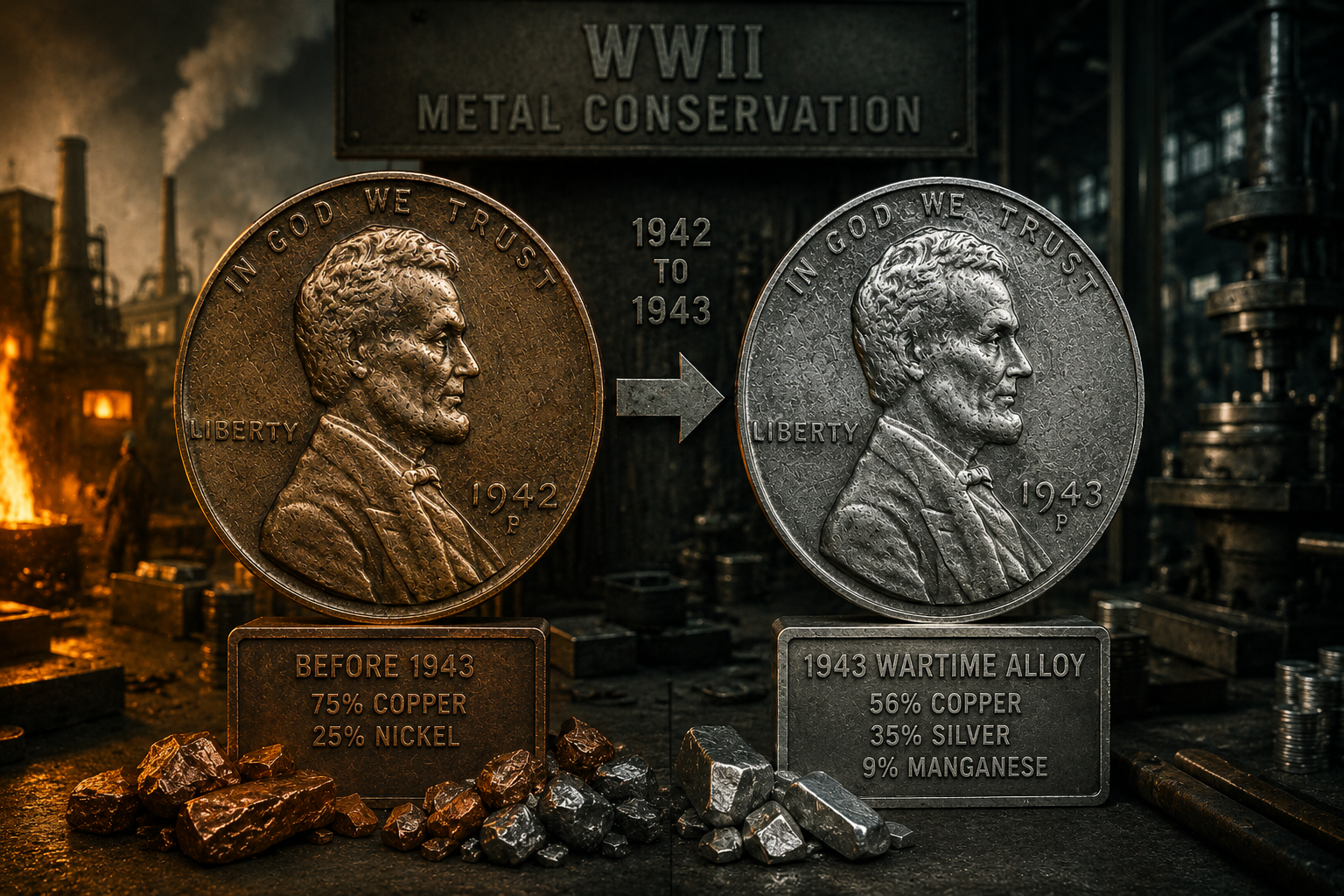
Instead of relying on the traditional copper and nickel composition, wartime nickels would use a special alloy containing silver, copper, and manganese.
This decision solved the immediate resource problem while allowing five-cent coin production to continue throughout the war.
It also created a coin unlike any Jefferson nickel that had come before it.
The Wartime Alloy That Replaced Nickel
The final wartime composition looked very different from the traditional formula.
| Metal | Percentage | Role |
|---|---|---|
| Silver | 35% | Helped replace nickel metal during wartime production. |
| Copper | 56% | Provided structure and durability. |
| Manganese | 9% | Completed the wartime alloy formula. |
For modern collectors, this composition creates an interesting contradiction.
The coin continued being called a nickel even though nickel metal was no longer part of the alloy.
The name survived. The metal changed.
That contradiction is one reason wartime Jefferson nickels remain so memorable today.
They remind us that a coin’s identity is not always tied directly to the material inside it.
Sometimes history forces temporary changes that leave behind fascinating stories.
The Coin That Emerged From The Crisis
The wartime Jefferson nickel became the visible result of these decisions.
Millions entered circulation during one of the most challenging periods in American history. Most people using them probably never thought much about the composition change.
The coin still bought the same goods. It still carried the same denomination. It still looked broadly familiar.
Yet hidden inside was a completely different metal story.
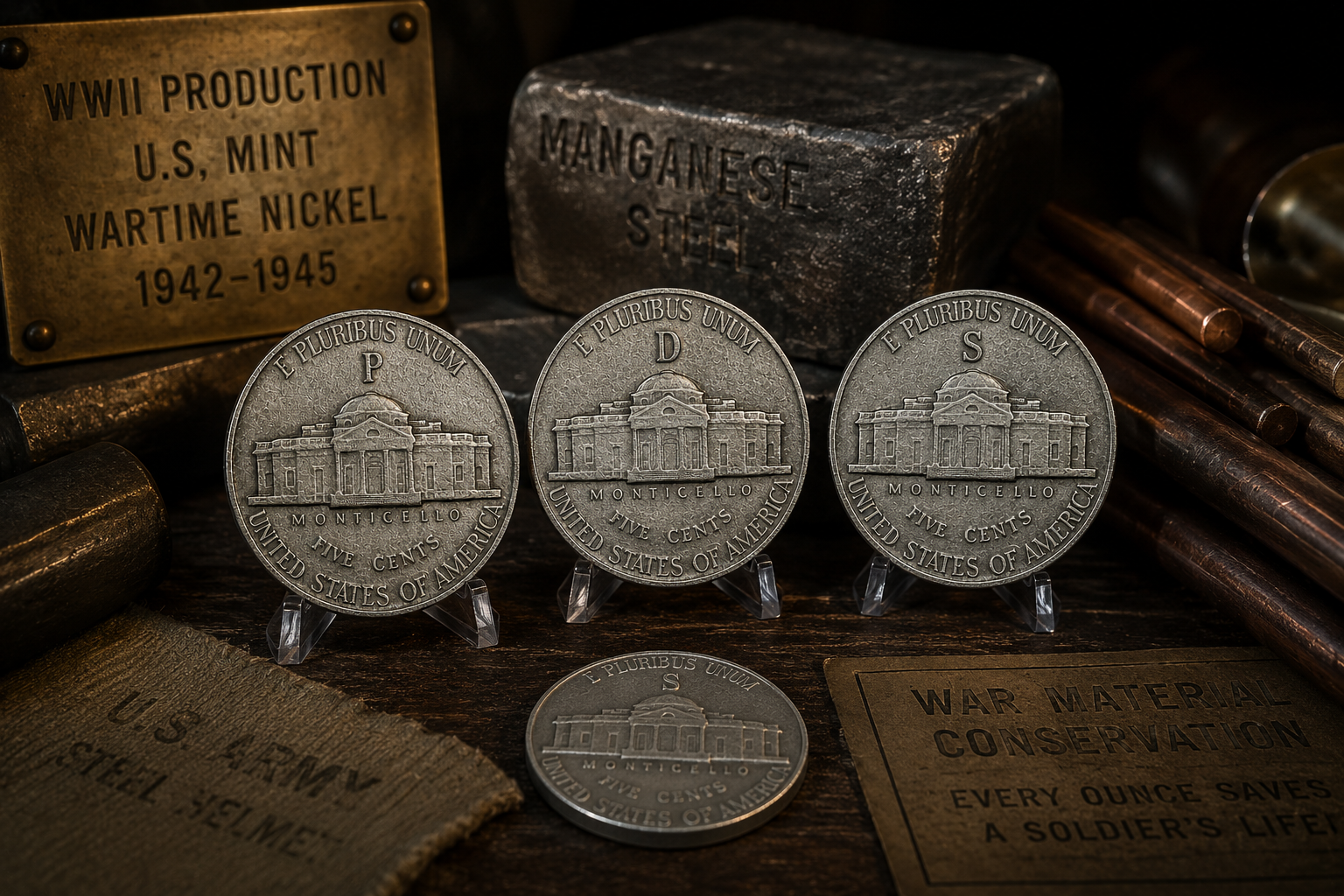
The wartime Jefferson nickel became the visible result of a nationwide effort to conserve strategic materials during World War II.
An Unexpected Result Of The Wartime Decision
The original goal was simple.
Conserve nickel metal.
Yet the decision produced consequences that reached far beyond wartime resource management.
The new alloy changed the way the coin looked. It changed the way the coin aged. It even changed the way future generations would identify wartime issues.
Many people today discover wartime nickels because they notice something unusual about them.
Sometimes the coin appears grayer than expected.
Sometimes the large mint mark immediately attracts attention.
Sometimes collectors simply realize that the coin feels different from other Jefferson nickels in the same box or collection.
All of those observations trace back to the same wartime decision.
A temporary effort to save nickel metal ended up creating one of the most distinctive chapters in American coinage.
Why The Mint Added A Large Mint Mark
The composition change created another challenge.
How would the Mint distinguish the new wartime alloy from ordinary Jefferson nickels?
Officials wanted an easy identification method. The solution was simple but highly effective.
The mint mark was enlarged and moved above Monticello on the reverse of the coin.
The change was impossible to miss.
For the first time, even casual coin users could quickly identify wartime issues if they knew where to look.
This large mint mark eventually became one of the defining visual characteristics of the wartime nickel series.
Today it remains one of the easiest ways to recognize these historic coins.
Why Silver Became Part Of The Solution
One of the most surprising aspects of the wartime nickel story is the use of silver.
Many people expect silver to appear in dimes, quarters, and half dollars from earlier generations. They do not expect to find it inside a five-cent coin.
Yet silver became part of the wartime solution because the Mint needed an alternative composition that could function effectively in circulation.
The goal was never to create a collectible coin.
The goal was practicality.
Officials needed a formula that worked.
The resulting alloy allowed production to continue while helping conserve nickel metal for more urgent wartime uses.
In hindsight, the decision created one of the most interesting composition changes ever seen in a circulating American coin.
Comparing A Regular Nickel To A Wartime Nickel
The differences become easier to understand when both coins are viewed together.
A standard Jefferson nickel represents the familiar pre-war and post-war composition.
The wartime version represents a temporary but historically significant departure from that formula.
Both coins carried the same denomination. Both circulated alongside each other during different periods. Both featured Jefferson and Monticello.
Yet their stories could not be more different.
One reflects normal coin production.
The other reflects the pressures of a world at war.
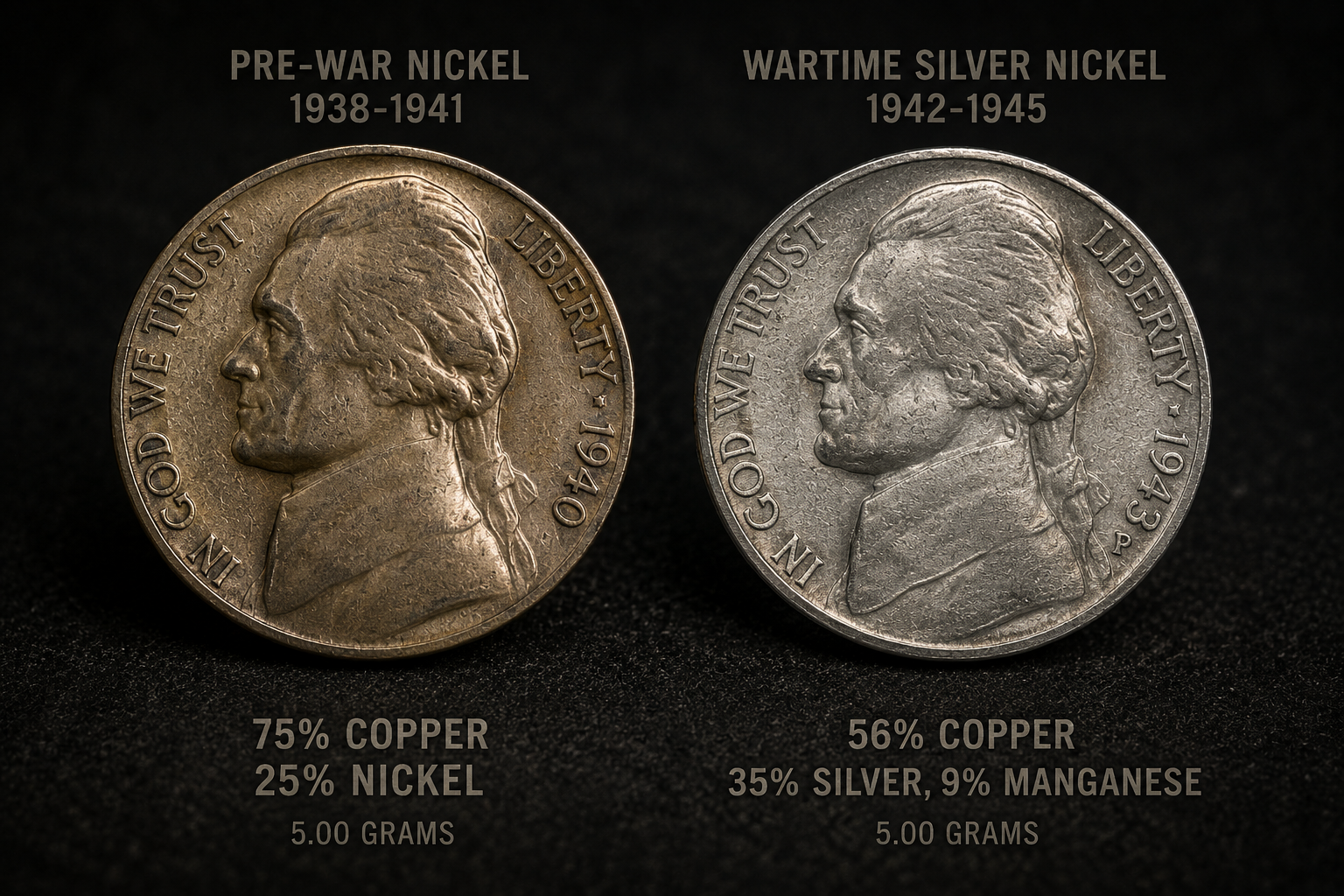
Although both coins carried the same denomination, the wartime version contained a very different metal mixture created specifically to conserve strategic resources.
The Lasting Impact On American Coinage
World War II eventually ended, and the need for wartime conservation measures declined.
The Mint returned to more traditional compositions for the Jefferson nickel. The emergency alloy disappeared from production.
Yet the wartime issues remained in circulation for years afterward.
Millions survived.
Some entered collections. Some remained in circulation long enough for several generations to encounter them.
Today, these coins provide a direct connection to a moment when national priorities reshaped even the smallest details of everyday life.
A five-cent coin may seem insignificant compared with the larger events of World War II.
But the wartime nickel demonstrates how deeply those events influenced American society.
Even the metal inside a coin became part of the war effort.
Why This Story Still Matters Today
The wartime Jefferson nickel is more than a curiosity.
It represents an important lesson about history.
Major events often leave traces in unexpected places.
People usually think of history through battles, speeches, treaties, and political decisions. Those events matter, but history also appears in ordinary objects.
Coins are among the best examples.
A small change in composition can reveal larger economic pressures, industrial priorities, and national challenges.
The wartime nickel does exactly that.
Its unusual alloy reminds us that World War II affected not only governments and armies but also the objects Americans carried in their pockets every day.
That connection gives the coin significance far beyond its face value.
Reality Check
America did not permanently remove nickel from nickels. The change was a temporary wartime measure used between 1942 and 1945 to conserve strategic resources during World War II.
After the war, the Mint returned to a more traditional composition and ended production of the wartime silver alloy nickels.
The wartime issues remain historically important because they represent one of the few times a major circulating U.S. coin underwent such a dramatic composition change due to global events.
Related HistoraCoin Stories
Final Verdict
America removed nickel from nickels because World War II transformed nickel metal into a strategic resource needed for military production.
Rather than stop making five-cent coins, the Mint adopted a temporary alloy containing silver, copper, and manganese. This solution conserved nickel while allowing normal coin production to continue throughout the war.
The decision created one of the most unusual coins in American history.
Wartime Jefferson nickels looked different, aged differently, and carried distinctive identification features that still attract attention today.
More than eighty years later, these coins remain tangible reminders of how global events can influence even the smallest objects in everyday life.
The wartime nickel was born from necessity, but it became an enduring piece of American history.
FAQ
| Question | Answer |
|---|---|
| Why did America remove nickel from nickels? | To conserve nickel metal for military and industrial uses during World War II. |
| When were wartime nickels produced? | Wartime Jefferson nickels were produced between 1942 and 1945. |
| What replaced nickel metal in wartime nickels? | A special alloy consisting of silver, copper, and manganese replaced the traditional composition. |
| Did wartime nickels contain silver? | Yes. Wartime Jefferson nickels contained 35 percent silver. |
| Why do wartime nickels have a large mint mark? | The large mint mark helped identify coins struck using the special wartime alloy. |
| Did the Mint permanently stop using nickel metal? | No. After World War II, the Mint returned to more traditional nickel-based compositions. |