The Year the Nickel Stopped Being a Nickel
Estimated reading time: 15 minutes
For most Americans, the nickel never seemed mysterious. It was simply one of those coins people stopped noticing after childhood. Small enough to disappear into pockets. Common enough to feel permanent. The Jefferson nickel looked stable, predictable, and almost boring compared to silver coins or older American designs.
But during World War II, something strange quietly happened inside that familiar little coin. Without changing its name or completely redesigning its appearance, the United States Mint transformed the nickel into something it had never been before. For a few short years, the American nickel stopped truly being a nickel at all.
• Why the U.S. government removed nickel metal during World War II.
• How wartime Jefferson nickels quietly changed composition.
• Why these coins look and feel different today.
• The hidden story behind the giant mint mark above Monticello.
• How wartime pressure changed even everyday American pocket change.
Table of Contents
- The Most Ordinary Coin in America
- When War Changed Everything
- The Metal Crisis Behind the Nickel
- The Strange Wartime Alloy
- Why Wartime Nickels Have Giant Mint Marks
- Why These Nickels Feel Different Today
- How Americans Used Them During WWII
- What Happened After the War Ended
- The Hidden Story Most People Miss
- Reality Check
- Final Verdict
- FAQ
The Most Ordinary Coin in America
Before World War II, the Jefferson nickel was never considered dramatic or exciting. Introduced in 1938 after the Buffalo nickel series ended, the coin represented a cleaner and calmer version of American design. Thomas Jefferson appeared on the front, while Monticello quietly occupied the reverse side.
The coin felt dependable. Americans carried it everywhere without thinking much about it. It paid for newspapers, bus rides, candy bars, and small grocery purchases. Children stacked them on kitchen tables. Shop owners counted them into wooden cash registers. Soldiers carried them in uniform pockets before boarding trains.
That everyday familiarity is what makes the wartime story so fascinating now.
Nobody expected the nickel to become connected to military manufacturing, industrial shortages, and wartime survival. Yet by the early nineteen forties, even the smallest American coin could no longer escape the pressure of global conflict.
The world was changing rapidly, and suddenly the metal inside ordinary coins mattered more than most people realized.
When War Changed Everything
After the United States entered World War II following Pearl Harbor, American industry shifted almost overnight into wartime production mode.
Factories changed priorities. Materials became strategic resources. Entire industries reorganized themselves around military needs. Steel, copper, aluminum, rubber, and nickel suddenly became part of a larger national emergency.
Nickel metal itself was especially important.
It was used in armor plating, industrial machinery, weapons manufacturing, aircraft components, and other military equipment that needed strength and resistance under pressure.
The government quickly realized something uncomfortable:
Millions of five cent coins were consuming nickel metal that the military urgently needed elsewhere.
That created an unusual dilemma.
America still needed nickels in circulation because daily commerce depended on them. Stores could not suddenly stop using five cent coins. Vending machines, transportation systems, restaurants, and businesses still relied on small change every single day.
The Mint needed a solution that would preserve the coin while removing the strategic metal inside it.
And that solution became one of the strangest composition changes in American coin history.
The Metal Crisis Behind the Nickel
Most people imagine wartime shortages affecting large industrial objects like tanks, ships, or airplanes. Few imagine a simple pocket coin becoming part of that same story.
But wartime governments think differently.
During global conflict, every material becomes part of a larger calculation. Even tiny amounts matter when multiplied across hundreds of millions of coins.
The traditional Jefferson nickel contained copper and nickel alloy. Under normal circumstances, that composition worked perfectly. The coin resisted wear well, survived years of circulation, and functioned reliably inside vending machines.
Yet wartime conditions forced the Mint to rethink everything.
Officials experimented with alternative metals and tested different combinations to find a composition that could preserve the coin’s physical behavior without consuming strategic nickel supplies.
That search eventually produced an unusual compromise.
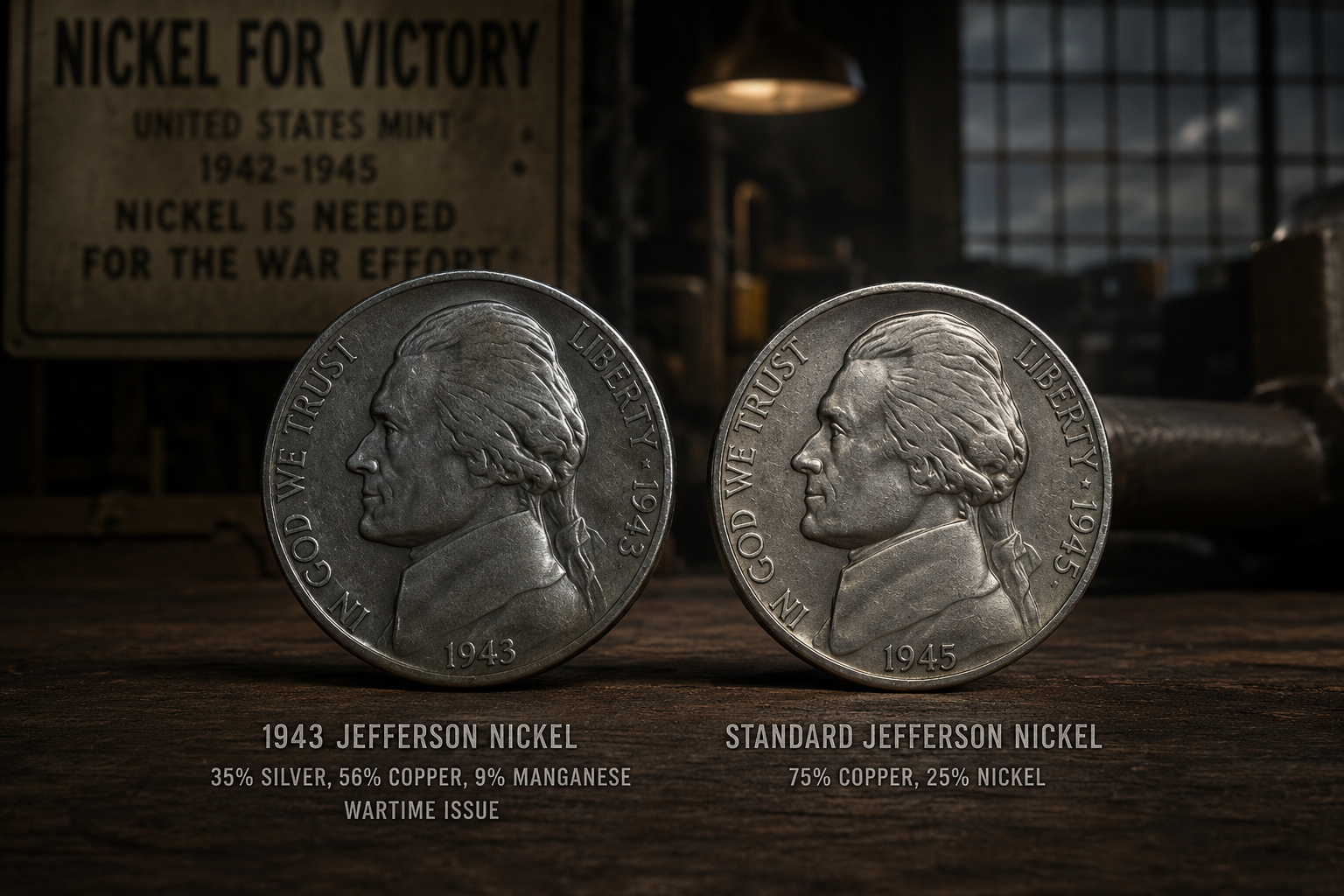
Instead of using nickel metal, the Mint created a wartime alloy made of:
| Metal | Percentage |
|---|---|
| Silver | 35% |
| Copper | 56% |
| Manganese | 9% |
It still sounds strange today.
A nickel containing silver feels almost contradictory because silver is normally associated with dimes, quarters, and half dollars. Yet during World War II, the five cent coin quietly became part silver simply because America needed nickel metal elsewhere.
The Strange Wartime Alloy
The wartime Jefferson nickel first appeared during 1942, though some early coins from that year still used the original composition before the transition fully took effect.
What makes these coins fascinating is how subtle the change initially appeared.
The government did not redesign the coin dramatically. Americans did not suddenly receive futuristic wartime tokens with patriotic slogans or military symbols. The Jefferson portrait remained familiar. Monticello stayed on the reverse. The coin size remained identical.
At first glance, everything looked normal.
But underneath the surface, the coin had completely changed identity.
That quiet transformation gives wartime nickels a very unusual emotional atmosphere today. They feel like ordinary coins carrying hidden tension inside them.
Many developed darker gray surfaces over time. Others toned unevenly because manganese behaved differently than traditional nickel alloy. Some wartime nickels appear smoky under certain lighting conditions, while others show silver-like reflections that standard Jefferson nickels never developed.
Collectors often describe them as feeling softer or visually quieter compared to normal nickels.
Even people who know almost nothing about coins sometimes notice that wartime nickels simply look different.
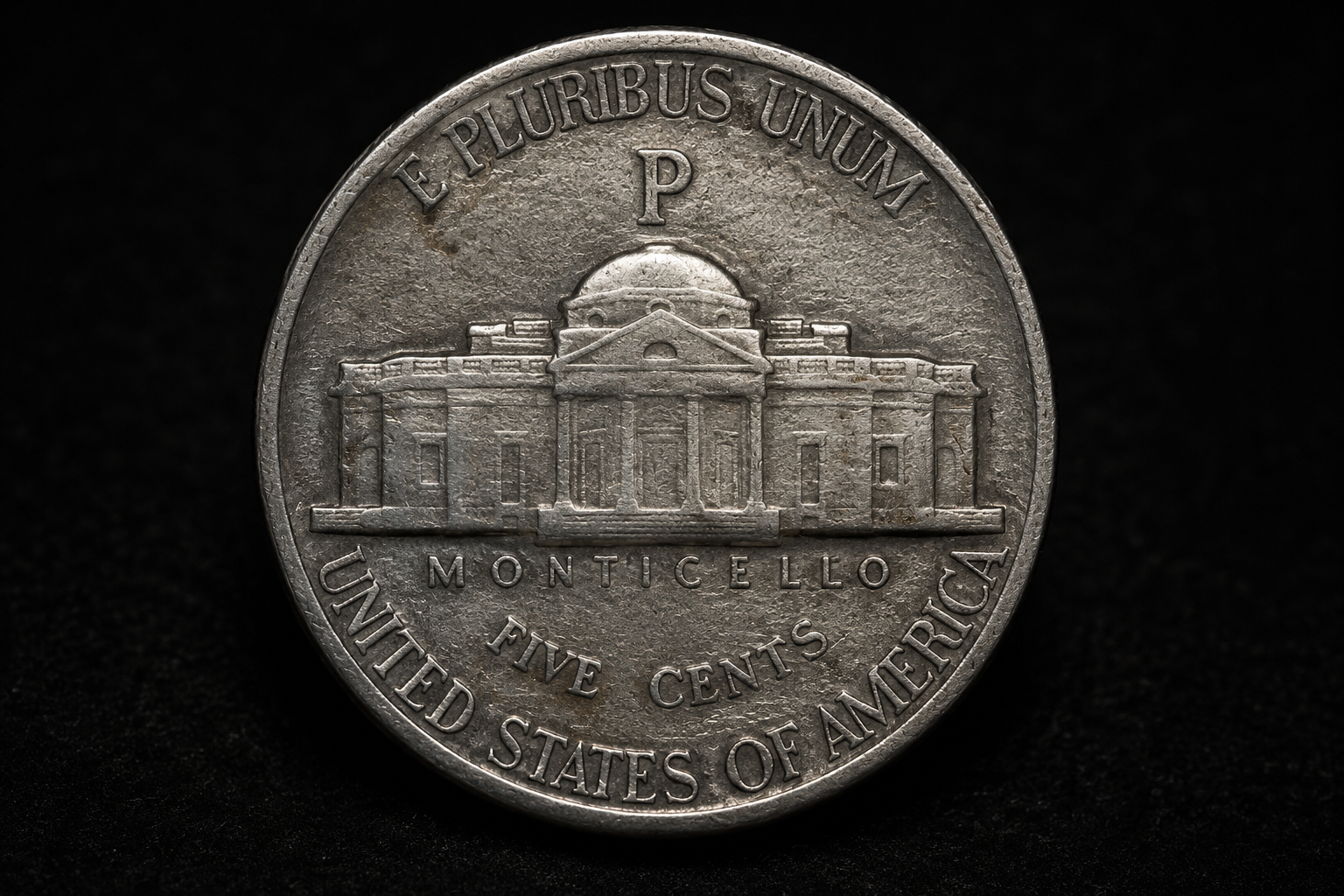
The oversized mint mark above Monticello became the easiest way to recognize wartime Jefferson nickels.
Why Wartime Nickels Have Giant Mint Marks
One of the most famous details on wartime Jefferson nickels is the oversized mint mark placed above Monticello on the reverse side.
Before World War II, mint marks on nickels were much smaller and positioned differently. But once the silver wartime alloy appeared, the Mint needed a fast way to distinguish the new composition from earlier versions.
So officials introduced something completely new.
Large mint marks appeared directly above Monticello, making wartime nickels instantly recognizable once people knew where to look.
This detail mattered for more than appearance.
The government expected these wartime coins might eventually need identification and separation later because of their silver content and unusual alloy. The larger mint marks made that process easier.
Even more historically interesting, wartime nickels marked the first time the Philadelphia Mint used a large “P” mint mark on a circulating U.S. coin.
That tiny detail changed American coin history permanently.
Today, the giant mint mark creates immediate visual curiosity. Many people spot it before they understand why it exists at all.
And honestly, that oversized letter is part of what gives wartime nickels their strange personality.
Why These Nickels Feel Different Today
People often describe wartime nickels as feeling different from ordinary Jefferson nickels, and surprisingly, that reaction is not entirely imaginary.
The wartime alloy aged differently over decades of circulation. Silver, copper, and manganese interact with moisture, air, skin oils, and environmental conditions in ways that traditional nickel alloy does not.
As a result, many wartime nickels developed unusual surfaces and textures.
Some became darker. Some turned pale gray. Some developed soft cloudy toning. Others kept a strange metallic brightness.
The sound can even feel slightly different when dropped onto hard surfaces.
There is also a psychological side to this experience.
Once people know a coin secretly contains silver and wartime history, they begin noticing details they previously ignored. Texture suddenly feels important. Tone becomes meaningful. The coin transforms from everyday pocket change into a physical artifact connected to a global historical crisis.
That emotional shift changes perception.
And maybe that is why wartime nickels continue attracting attention today even among people who are not serious coin collectors.
The coin carries atmosphere.
It feels like an object that remembers something difficult.
How Americans Used Them During WWII
One of the easiest mistakes people make today is imagining wartime nickels as collectible objects from the beginning.
But during the nineteen forties, these coins were simply money.
Workers carried them into factories producing military equipment. Children used them for snacks and comic books. Families dropped them into jukeboxes and vending machines. Soldiers encountered them inside train stations and cafes across the country.
Most Americans probably never paused to think about the metal composition hidden inside their pocket change.
And that is what makes these coins historically powerful.
The wartime nickel quietly connected ordinary daily life to the larger machinery of World War II. Even the smallest financial transaction became part of the wartime economy in ways people rarely noticed.
That hidden connection still exists today whenever someone picks up one of these coins and notices the giant mint mark staring back above Monticello.
| Period | Jefferson Nickel Composition | Main Purpose |
|---|---|---|
| 1938-1942 | Copper and nickel alloy | Standard circulation |
| 1942-1945 | Silver, copper, manganese alloy | Conserve wartime nickel metal |
| 1946 onward | Return to traditional alloy | Postwar normalization |
What Happened After the War Ended
Once World War II ended, the industrial pressure behind wartime nickels slowly disappeared.
America no longer needed to conserve nickel metal at emergency wartime levels, so the Mint eventually returned the Jefferson nickel to its traditional copper-nickel composition.
The wartime alloy quietly vanished.
But the coins themselves remained in circulation for years afterward.
That long overlap created something fascinating.
For decades, wartime nickels mixed together with ordinary nickels across the United States. Some became heavily worn. Others disappeared into jars, drawers, and family collections. Many survived almost accidentally.
And unlike commemorative coins produced to celebrate history afterward, wartime nickels were genuine participants in the wartime years themselves.
They moved through the hands of people actually living during World War II.
That gives them a different emotional weight compared to later historical collectibles.
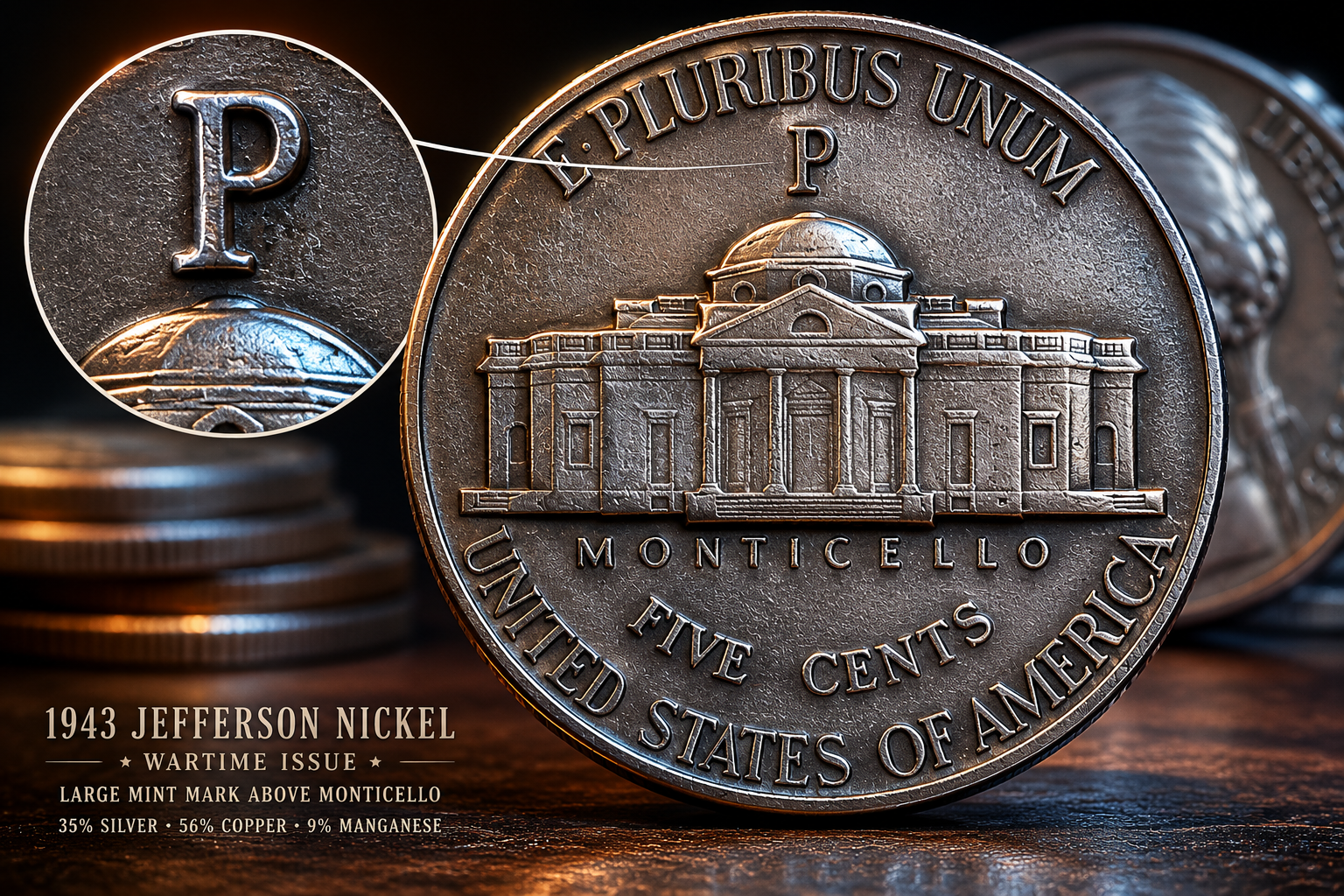
Between 1942 and 1945, the Jefferson nickel quietly became one of America’s most unusual circulating coins.
The Hidden Story Most People Miss
Most discussions about wartime nickels focus only on silver content.
But honestly, the deeper story is not really about silver at all.
It is about adaptation.
The wartime Jefferson nickel reveals something fascinating about how societies respond to pressure. During moments of crisis, governments often try to preserve normal appearances even while major changes happen underneath.
That is exactly what happened here.
America needed to conserve strategic metal during a global war, but daily life still needed to feel stable. So instead of completely redesigning the coin, the Mint quietly changed the composition while preserving the familiar face Americans already trusted.
The nickel looked normal.
But internally, everything had changed.
That hidden contradiction is what makes wartime nickels feel strangely human even today.
A small five cent coin became evidence of industrial pressure, wartime compromise, and national adaptation without ever openly announcing itself as historical.
And maybe that is why these nickels continue fascinating people decades later.
Not because they are flashy. Not because they are dramatic. But because they quietly carry the atmosphere of a world under pressure.
Reality Check
Not every wartime Jefferson nickel immediately looks silver or unusual. Many circulated heavily for decades, which softened their appearance and darkened the surfaces. The easiest way to identify them remains the large mint mark above Monticello on coins dated 1942 through 1945.
It is also important to remember that these coins were created for practical wartime reasons rather than collectible purposes. Their unusual composition reflects industrial necessity during World War II, not an attempt to create special coins for the public.
Final Verdict
The wartime Jefferson nickel remains one of the quietest yet most fascinating transformations in American coin history.
On the surface, the coin looked ordinary and familiar. But underneath, it carried the pressure of World War II, industrial shortages, and national adaptation. For a few short years, America continued spending nickels that were no longer truly made from nickel metal.
That hidden contradiction gives these coins their strange emotional atmosphere today.
The wartime nickel was never designed to become a dramatic historical symbol. It simply existed because the country needed a practical solution during an extraordinary moment in history.
Yet decades later, the giant mint mark, the darker alloy tones, and the unusual composition still quietly remind people that even everyday pocket change can carry the story of an entire era.
FAQ
| Question | Answer |
|---|---|
| Why did the U.S. stop using nickel metal during World War II? | The government needed nickel metal for military manufacturing, including machinery and armor production. |
| Did wartime Jefferson nickels contain silver? | Yes. Wartime nickels from 1942 to 1945 contained 35 percent silver. |
| How can you identify a wartime nickel? | Look for the large mint mark above Monticello on the reverse side. |
| Why do wartime nickels sometimes look darker? | The wartime alloy aged differently because of its silver, copper, and manganese composition. |
| When did the wartime nickel period end? | The Mint returned to the traditional nickel alloy after World War II ended in 1945. |