Why Does This Nickel Have a Giant Letter Above Monticello
Estimated reading time: 15 minutes
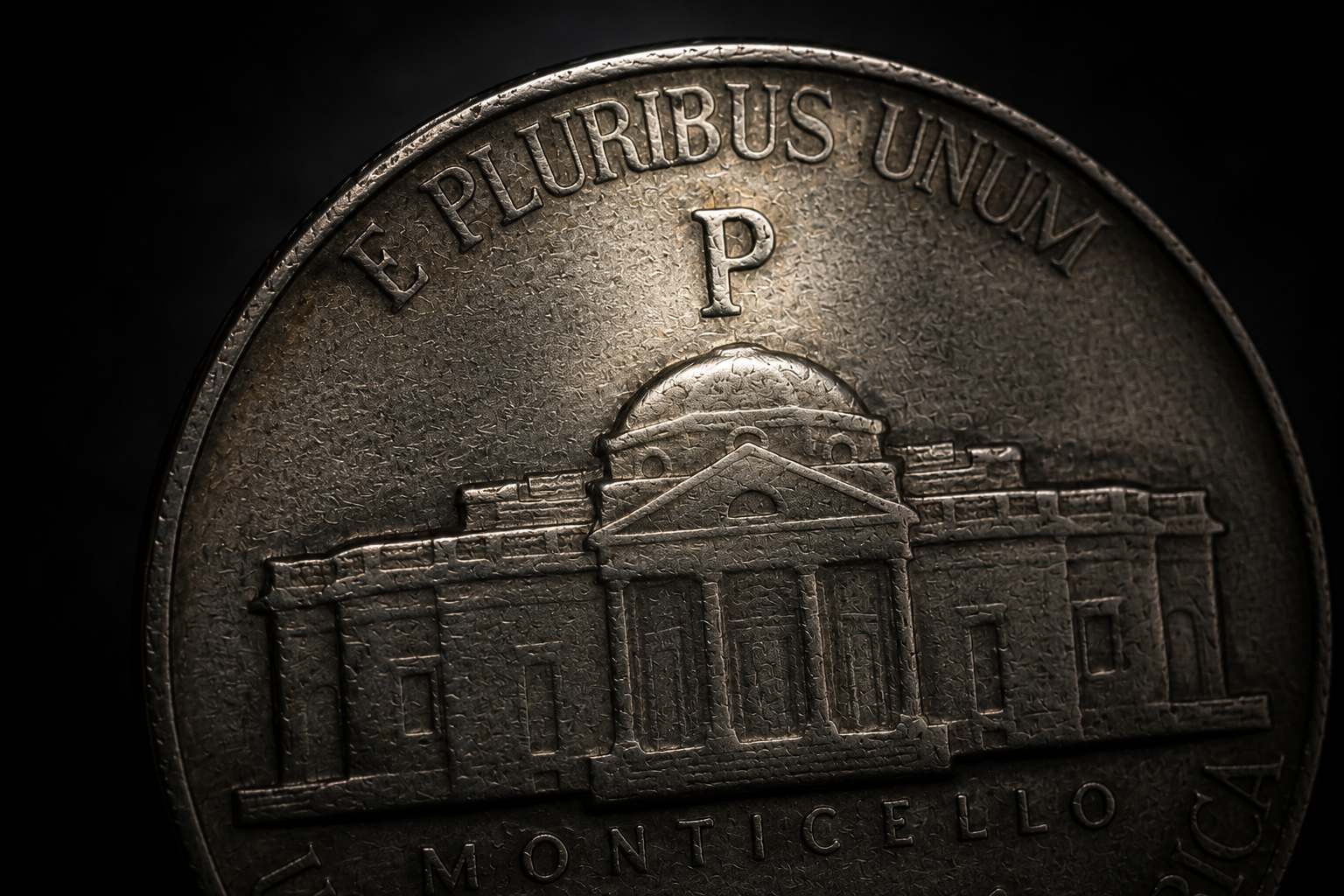
Some coin details whisper. Others almost shout. The giant letter above Monticello on certain Jefferson nickels belongs to the second group. It sits in a place where most people do not expect to see such a bold mark, and once the eye catches it, the coin suddenly feels different from every ordinary nickel in the drawer.
At first, it can look like a mistake, a strange stamp, or a design choice that does not quite belong. But that oversized letter was placed there for a very practical reason. It was born during World War II, when the United States Mint had to change the metal inside the nickel and make those wartime coins easy to recognize at a glance.
The giant letter above Monticello appears on wartime Jefferson nickels from 1942 through 1945. These coins were made with a special silver, copper, and manganese alloy because nickel metal was needed for wartime production. The large mint mark made the new wartime composition easy to identify.
Table of Contents
- The Detail That Makes People Stop
- How Mint Marks Usually Worked
- When World War II Reached The Nickel
- Why The Coin Needed A New Metal
- Why The Letter Became So Large
- The Historic Philadelphia P
- Why It Was Placed Above Monticello
- A Visual Identity For A Wartime Coin
- Regular Nickel vs Wartime Nickel
- Why People Misread This Detail Today
- The Human Side Of One Giant Letter
- Reality Check
- Related HistoraCoin Stories
- Final Verdict
- FAQ
The Detail That Makes People Stop
Most people do not inspect nickels carefully. They pass through pockets, coin jars, cash drawers, and old boxes without much attention. A nickel is small, familiar, and easy to ignore.
But a wartime Jefferson nickel can interrupt that habit.
When the coin is flipped over, the reverse side shows Monticello, just as expected. Then the eye moves upward and notices something unusual. A large letter appears above the building.
That letter may be P, D, or S, depending on the mint that produced the coin. But the size and placement are what make it stand out.
It does not feel like a normal mint mark. It feels almost like a sign.
That is why so many people ask about it. The detail is large enough to create instant curiosity, but not obvious enough to explain itself. It invites the viewer into the story before they even know they are looking at a wartime coin.
And that is the strength of this design feature. It turns a simple production mark into a doorway to history.
How Mint Marks Usually Worked
A mint mark is a small letter placed on a coin to show where it was produced.
On many U.S. coins, D identifies Denver, S identifies San Francisco, and P identifies Philadelphia in later periods. But for much of American coin history, Philadelphia often used no mint mark at all because it was considered the main mint.
Before the wartime nickel period, mint marks were usually modest details.
Collectors cared about them. Mint officials cared about them. But the average person spending coins in daily life rarely noticed them.
That is important because the wartime Jefferson nickel completely changed the visual role of the mint mark.
Instead of being a small technical clue, the mint mark became one of the most noticeable parts of the reverse design.
It moved from the background to the spotlight.
That shift did not happen because the Mint wanted to make the coin more decorative. It happened because the coin itself had changed in a way that needed to be recognized quickly.
When World War II Reached The Nickel
World War II reshaped far more than battlefields. It changed factories, transportation, food systems, household habits, and even the small coins people used every day.
After the United States entered the war, industrial materials became national priorities. Metals that once seemed ordinary suddenly became strategic.
Nickel was one of those metals.
It was important for military manufacturing because it helped create strong, durable, and resistant alloys. It could be used in equipment, machinery, armor-related applications, and other wartime production needs.
That created a quiet but serious problem for the United States Mint.
The five cent coin traditionally used nickel metal. Under peaceful conditions, that was normal. The alloy was strong, practical, and familiar. But under wartime pressure, every pound of nickel mattered.
The government needed nickel metal for the war effort.
At the same time, Americans still needed five cent coins for ordinary commerce.
Stores needed change. Workers needed coins. Transportation, small purchases, and daily cash transactions still depended on the familiar nickel.
The Mint could not simply stop making five cent coins.
So it had to solve a strange problem.
How could the country keep using nickels while saving nickel metal for war?
Why The Coin Needed A New Metal
The solution was one of the most unusual metal changes in American coin history.
Beginning in 1942, the United States Mint introduced a special wartime Jefferson nickel alloy made of 35 percent silver, 56 percent copper, and 9 percent manganese.
This change allowed the Mint to reduce the use of nickel metal while keeping five cent coins in circulation.
To most people, the coin still looked like a Jefferson nickel. It had the same basic size, the same portrait of Jefferson, and the same Monticello reverse.
But inside, the coin was no longer the same object.
That is the hidden tension of wartime nickels. They looked familiar because Americans needed normal life to continue, but their composition reflected the pressure of a world at war.
The Mint had created a coin that was visually ordinary and physically unusual at the same time.
That created another challenge.
If wartime nickels looked too similar to regular nickels, how would anyone identify them?
| Nickel Type | Metal Composition | Main Identifier |
|---|---|---|
| Regular Jefferson nickel | Copper and nickel alloy | Normal mint mark style |
| Wartime Jefferson nickel | Silver, copper, and manganese alloy | Large mint mark above Monticello |
| Postwar Jefferson nickel | Return to traditional alloy | Wartime mint mark style removed |
Why The Letter Became So Large
The large letter was not an artistic accident.
It was a practical answer to a wartime identification problem.
The Mint needed these new silver alloy nickels to be recognized quickly and easily. A small, hidden mint mark would not have solved the problem well enough. The mark had to be obvious.
That is why the wartime mint mark became large and visible.
It allowed people to identify the special alloy without weighing the coin, testing the metal, or comparing tiny details under magnification.
The oversized letter made the coin speak for itself.
A person only needed to flip the nickel over and look above Monticello.
That simplicity is why the feature still works today. More than eighty years later, collectors and beginners can recognize wartime Jefferson nickels almost instantly because of that large mark.
The design did exactly what it was meant to do.
The Historic Philadelphia P
The most famous version of this detail is the large P above Monticello.
That P stands for Philadelphia, and it matters more than many people realize.
For a long time, Philadelphia coins were often produced without a visible mint mark. Philadelphia was treated as the default mint, while branch mints like Denver and San Francisco used letters to identify their coins.
The wartime Jefferson nickel changed that tradition.
For the first time, Philadelphia placed a P mint mark on a circulating U.S. coin.
That small historical fact gives the large P a deeper meaning.
It was not just identifying where the coin was made. It was showing that wartime conditions had become serious enough to change old minting habits.
In normal times, Philadelphia could remain unmarked.
During the wartime nickel program, every mint needed to be clearly identified.
That made the P more than a letter. It became a visible break from tradition.
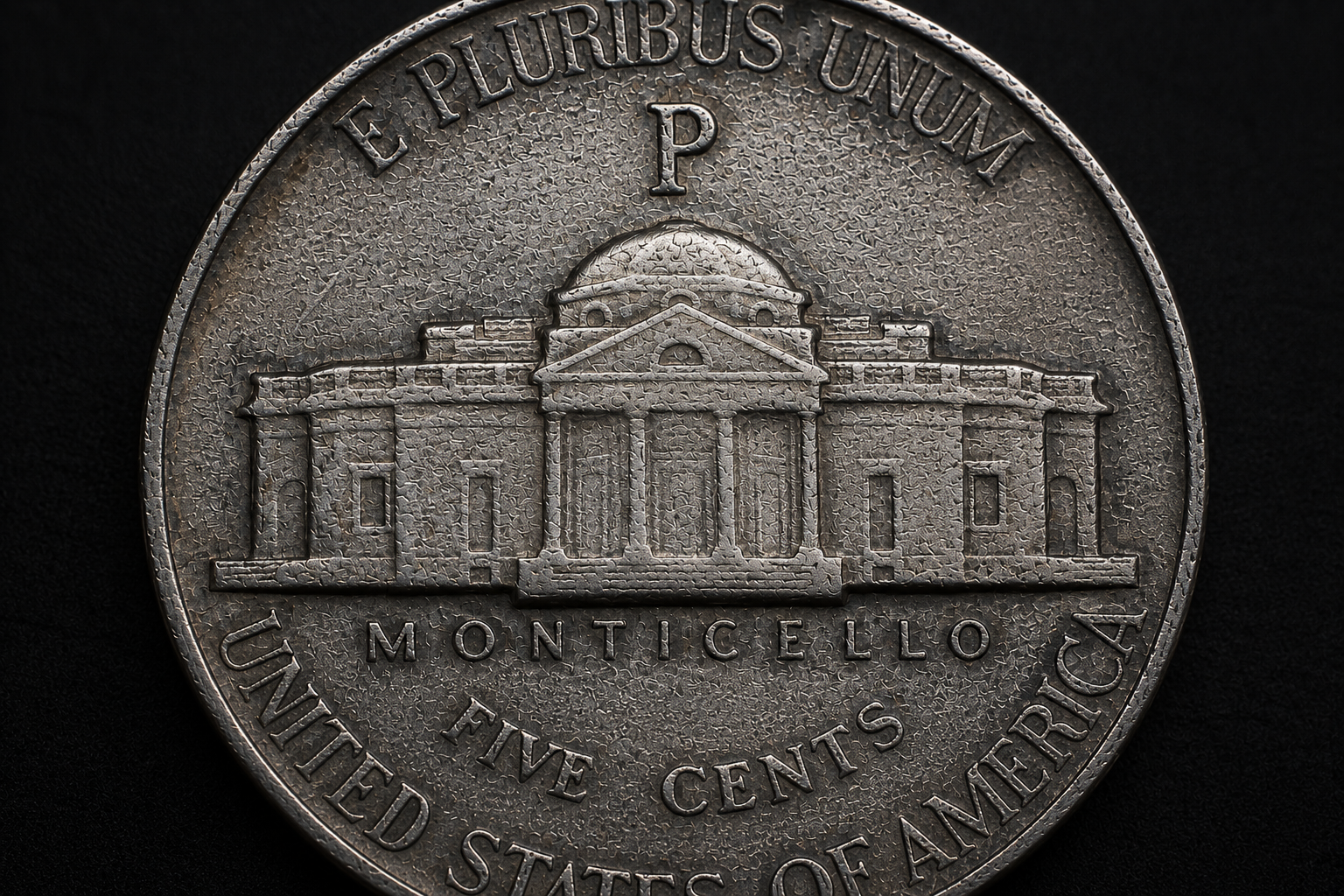
The oversized P above Monticello became one of the clearest ways to recognize a wartime Jefferson nickel.
Why It Was Placed Above Monticello
The placement of the large mint mark is just as important as its size.
The Mint could have placed the letter in a smaller or quieter location. It could have used a traditional position that only experienced collectors would notice. Instead, the letter was placed directly above Monticello.
That position gave the mark immediate visual power.
Monticello had already been the central feature of the Jefferson nickel reverse since 1938. It represented Thomas Jefferson’s home, American architecture, and the stable identity of the coin.
By placing the wartime mint mark above the building, the Mint created a clear visual identifier without removing the familiar design.
This was a clever balance.
The coin still looked like a Jefferson nickel, but it also carried a new sign that separated it from regular issues.
In a way, the large mint mark sits above Monticello like a wartime label.
It tells the viewer that this coin belongs to a different moment.
Not a different denomination.
Not a different design series.
A different historical pressure.
A Visual Identity For A Wartime Coin
Many wartime changes are hidden in documents, production records, and factory orders. The wartime Jefferson nickel is different because its story is visible on the coin itself.
That giant letter gives the coin a visual identity.
It separates wartime nickels from ordinary Jefferson nickels in a way that is simple, direct, and memorable.
This is why people often remember the mint mark before they remember the exact composition.
The metal story is important, but the eye notices the letter first.
That is also why this detail works so well for beginners. A person does not need years of collecting experience to spot it. They only need to know where to look.
Once they see it, the rest of the story opens naturally.
The large letter becomes a bridge between the object and the history behind it.
It turns a five cent coin into a small artifact of World War II.
Regular Nickel vs Wartime Nickel
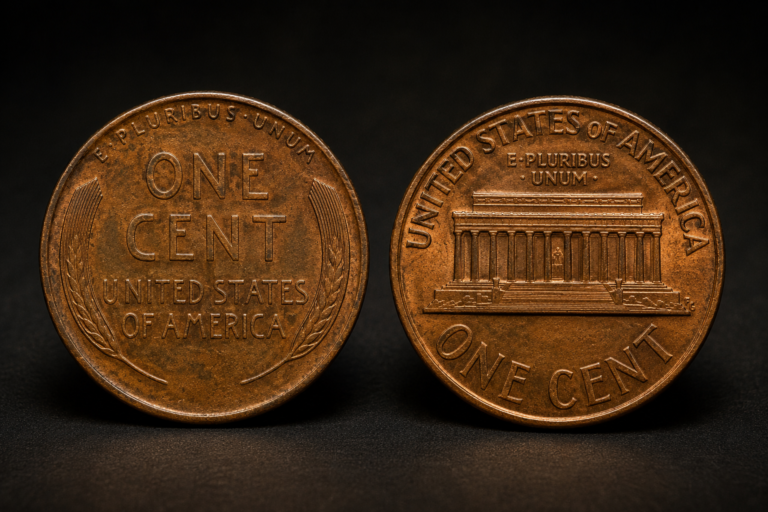
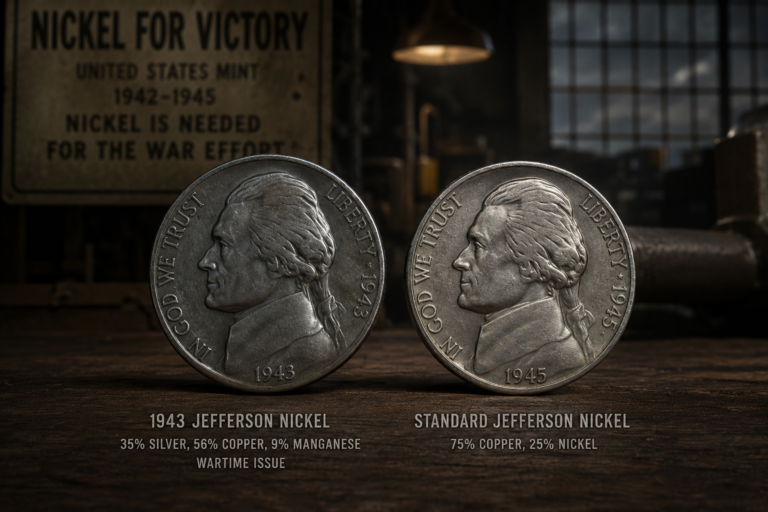
The difference becomes especially clear when a wartime Jefferson nickel is placed beside a regular Jefferson nickel.
A regular nickel feels quieter. Its mint mark, if present, does not dominate the reverse design. The eye usually moves first to Monticello and then to the surrounding lettering.
A wartime nickel behaves differently.
The large mint mark immediately attracts attention because it occupies a more important visual position. It almost changes the rhythm of the reverse side.
This is why people sometimes describe wartime nickels as looking strange even before they know the metal composition.
The difference is not only historical. It is visual.
The coin is telling the viewer that something changed.
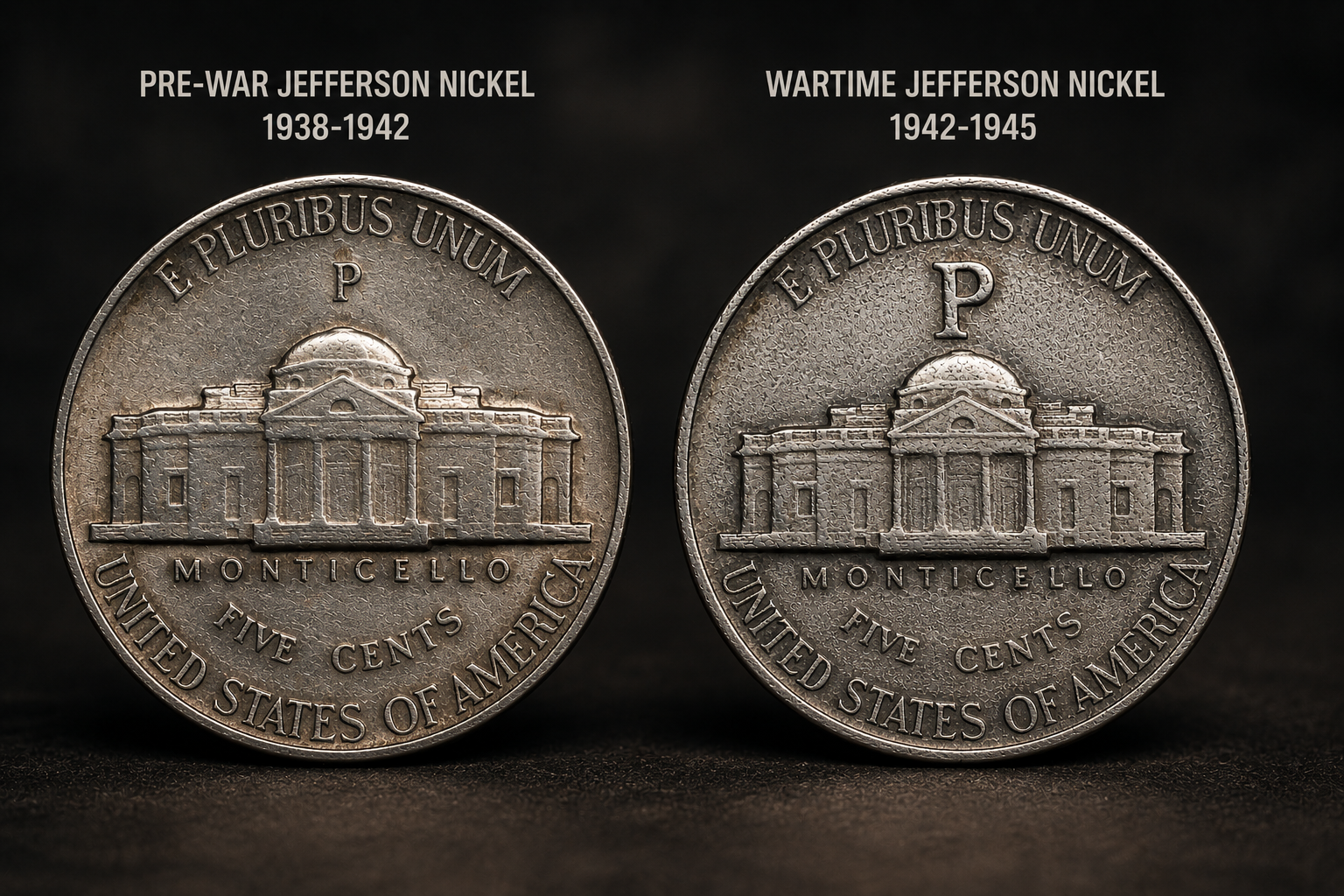
The contrast between a regular Jefferson nickel and a wartime nickel makes the oversized mint mark much easier to understand.
Why People Misread This Detail Today
Today, many people encounter wartime nickels outside their original context.
They may find one in an old jar, a family box, a small collection, or a group of coins passed down over time. Without background knowledge, the large letter can look confusing.
Some people assume it is an error.
Others think it was stamped after the coin left the Mint.
Some believe the letter means the coin was part of a special commemorative release.
These reactions are understandable because the mark is unusually bold compared to ordinary mint marks.
But the truth is simpler and more interesting.
The large letter was part of the original wartime design system. It was intentionally added to identify coins made with the special silver alloy composition.
So the detail is not damage.
It is not random.
It is not a later alteration.
It is the exact feature that makes the wartime nickel recognizable.
The Human Side Of One Giant Letter
What makes this detail so powerful is not only the technical explanation.
It is the human story behind it.
During World War II, Americans were asked to adapt in countless ways. Materials were redirected. Factories changed purpose. Families adjusted habits. Everyday objects began to reflect the needs of a nation under pressure.
The Jefferson nickel was part of that larger adjustment.
Most people using these coins in the 1940s probably did not stop to think deeply about the mint mark above Monticello. They used the coins for ordinary purchases, just as they had used nickels before.
But today, that large letter allows us to see the wartime change more clearly.
It reminds us that history does not always appear in large monuments or dramatic headlines.
Sometimes it sits quietly above a building on the back of a small coin.
That is why the wartime mint mark still matters.
It gives the coin a voice.
Reality Check
Not every Jefferson nickel with a visible mint mark is a wartime nickel. The key detail is the large mint mark placed above Monticello on coins dated 1942 through 1945. Regular Jefferson nickels may also have mint marks, but they do not use this same oversized wartime placement.
The large letter was not added for decoration or as a collector feature. It was a practical wartime identifier connected to the special silver alloy used when nickel metal was needed for World War II production.
Related HistoraCoin Stories
Final Verdict
The giant letter above Monticello is one of the simplest details on any wartime Jefferson nickel, but it carries a surprisingly deep story.
It exists because World War II changed the metal needs of the United States. Nickel became too important for military production to keep using it in ordinary five cent coins at the same level. So the Mint changed the coin’s composition and added a large, visible mint mark to identify the new wartime alloy.
That is why the letter looks so bold. It was meant to be seen.
Today, this detail remains one of the easiest ways to recognize wartime Jefferson nickels. It connects the coin to wartime production, Philadelphia’s historic P mint mark, and one of the most unusual moments in American coinage.
Once you understand why that giant letter appears above Monticello, the coin stops looking strange. It starts looking like exactly what it is. A small piece of World War II history hiding in plain sight.
FAQ
| Question | Answer |
|---|---|
| Why does this nickel have a giant letter above Monticello? | The giant letter is a large mint mark used on wartime Jefferson nickels to identify coins made with a special silver alloy. |
| What years have the large mint mark above Monticello? | Wartime Jefferson nickels from 1942 through 1945 feature large mint marks above Monticello. |
| What does the large P mean on a wartime nickel? | The large P means the coin was produced at the Philadelphia Mint. It was the first P mint mark used on a circulating U.S. coin. |
| Are nickels with giant mint marks made of silver? | Wartime Jefferson nickels contain 35 percent silver, along with copper and manganese. |
| Is the giant letter above Monticello an error? | No. The large mint mark was intentionally added by the U.S. Mint to identify wartime silver alloy nickels. |
| Why did the U.S. Mint change the nickel during World War II? | Nickel metal was needed for wartime manufacturing, so the Mint used a different alloy to conserve nickel for military production. |