Why This 1943 Nickel Looks Different From Every Other Nickel
Estimated reading time: 15 minutes
Every coin series has one date that seems to attract more attention than the rest. In the Jefferson nickel series, 1943 is one of those years. Even people who know very little about coin collecting often notice that a 1943 nickel feels different. The color may look different. The reverse design may seem unusual. The giant letter above Monticello immediately catches the eye. Something about the coin stands apart from ordinary nickels.
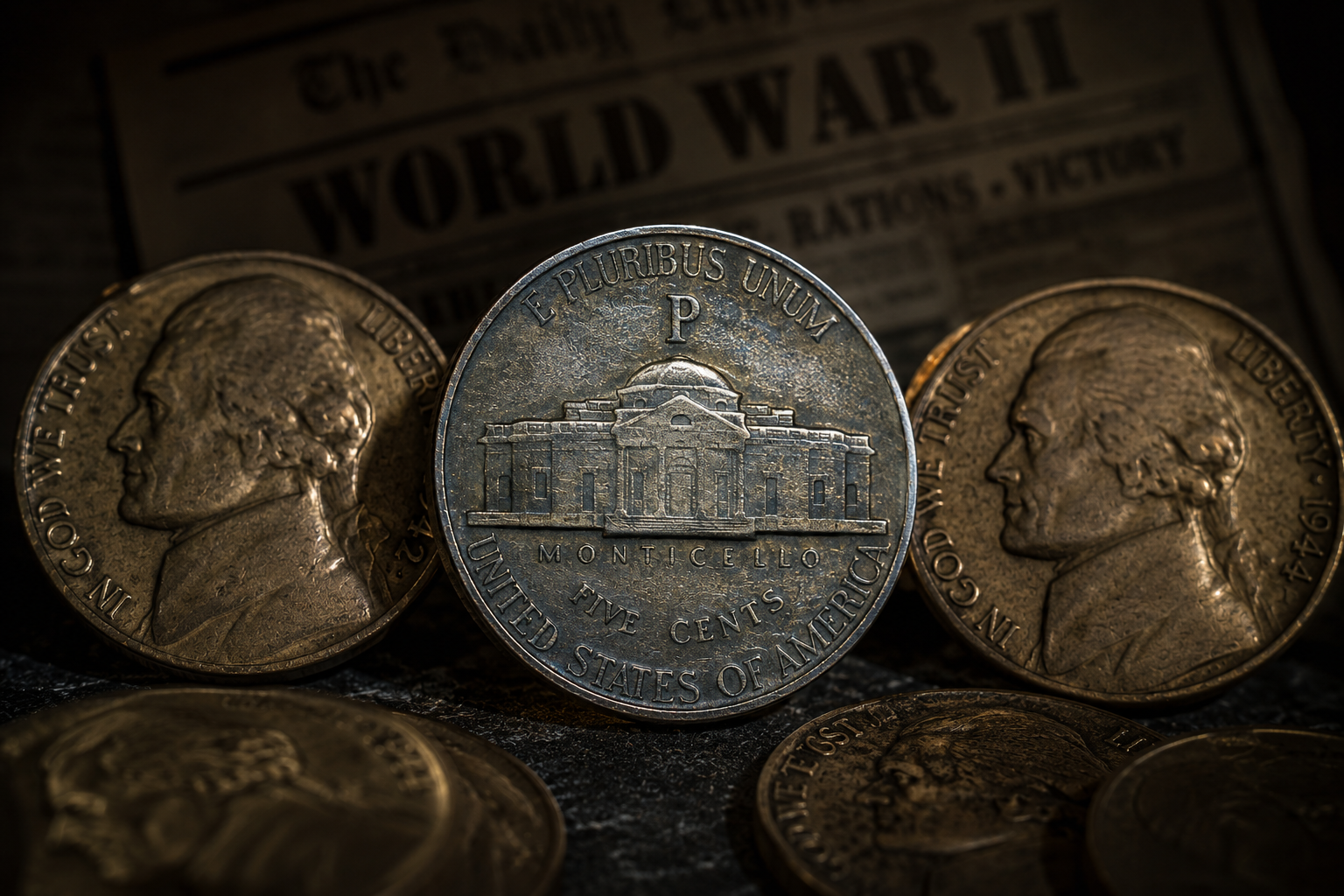
That impression is not an illusion. The 1943 Jefferson nickel really was different. It was created during one of the most dramatic periods in American history, when World War II forced the United States Mint to change the metal inside the coin. Those wartime decisions transformed the appearance of the nickel and left behind clues that collectors can still see more than eighty years later.
The 1943 Jefferson nickel was part of the wartime nickel program. Instead of using the traditional nickel alloy, the Mint produced these coins using a special silver, copper, and manganese mixture. The change created a coin that looked different, aged differently, and carried a large mint mark above Monticello.
Table of Contents
The First Thing People Notice
Most ordinary Jefferson nickels blend into the background. They look familiar because the design remained largely unchanged for many years. When people examine a 1943 nickel, however, something often feels different immediately.
Sometimes it is the color. Wartime nickels often show gray tones that are uncommon on standard Jefferson nickels. Sometimes it is the large mint mark above Monticello. Sometimes it is simply the overall appearance of the coin.
The important thing is that these reactions are not imagined.
The 1943 nickel truly belongs to a different chapter in American coinage history. It was created under circumstances that affected nearly every aspect of production. The result was a coin that looked familiar enough to circulate normally but different enough to stand apart decades later.
That balance between familiarity and change is what makes the 1943 nickel so fascinating.
A Coin Born During Wartime
To understand the 1943 nickel, it helps to remember what was happening in the United States at the time.
World War II had transformed American industry. Factories shifted priorities. Materials that once seemed ordinary suddenly became strategically important. Production decisions were no longer guided only by cost or convenience. They were influenced by military needs.
The United States required enormous quantities of raw materials for equipment, transportation, machinery, and wartime manufacturing.
Nickel metal became one of those valuable resources.
That created an unexpected problem for the Mint.
The five-cent coin depended on nickel as part of its traditional composition. Yet the military also needed nickel. The government had to decide how to balance both demands.
The answer would change the Jefferson nickel forever.
Why The Mint Changed The Nickel
Before the wartime period, Jefferson nickels used a copper and nickel alloy that had proven durable and practical. Under normal circumstances, there was little reason to change it.
War changed those circumstances.
Officials wanted to conserve nickel metal for military production. At the same time, the economy still needed five-cent coins. Businesses required change. Consumers needed coins for everyday purchases. The Mint could not simply stop producing nickels.
Instead, it created a temporary solution.
The denomination remained the same. The design remained largely the same. But the metal composition inside the coin changed dramatically.
This decision produced the wartime Jefferson nickel, including the famous 1943 issue that collectors recognize today.
The New Alloy Inside The Coin
The wartime nickel was not made from the traditional composition people expected.
| Metal | Percentage | Purpose |
|---|---|---|
| Silver | 35% | Helped replace nickel metal during wartime production. |
| Copper | 56% | Maintained strength and usability. |
| Manganese | 9% | Part of the special wartime alloy formula. |
This mixture created a coin that behaved differently from ordinary Jefferson nickels.
It aged differently. It toned differently. It often developed gray surfaces that many collectors still notice today.
The alloy also explains why some wartime nickels look unusual when placed beside later issues.
Although the design appears familiar, the metal underneath tells a very different story.
The Giant Letter Above Monticello
Perhaps the most famous visual difference on the 1943 nickel is the large mint mark positioned above Monticello.
On ordinary Jefferson nickels, mint marks were generally smaller and less noticeable. Wartime nickels changed that approach completely.
The Mint wanted the new wartime composition to be easily identifiable. Rather than hiding the mint mark in a less visible location, officials enlarged it and moved it directly above Monticello.
The result was impossible to miss.
Even people with no collecting experience often notice the oversized letter immediately.
That is exactly what the Mint intended.
The large mint mark became a quick visual signal that the coin belonged to the wartime alloy program.
The Historic Philadelphia Mint Mark
The large P found on many 1943 nickels carries special historical importance.
For much of American coin history, Philadelphia coins often carried no mint mark at all. Philadelphia was considered the default mint, so its products usually remained unmarked.
The wartime nickel program changed that tradition.
For the first time, Philadelphia used a P mint mark on a circulating U.S. coin. That seemingly simple decision became one of the most important mint mark milestones in American numismatic history.
Today, many collectors encounter a large P above Monticello without realizing they are looking at a historic first.
The letter is more than a production mark. It is a reminder of how wartime pressures altered long-standing minting traditions.
Why The Coin Looks Different Today
The differences did not stop when the coin left the Mint.
Over the decades, the wartime alloy aged in ways that ordinary Jefferson nickels often did not. The silver, copper, and manganese mixture reacted to storage conditions, air exposure, and environmental influences.
As a result, many 1943 nickels developed gray tones, smoky surfaces, or unusual coloration patterns.
This aging behavior is one of the reasons the coin still attracts attention today.
A person may notice the color first, then the mint mark, and only later discover the wartime story behind both details.
That combination of visual clues makes the 1943 nickel one of the easiest wartime coins to recognize.
The Wartime Mint Mark Up Close
Looking closely at the reverse side reveals the feature that changed the coin’s appearance more than any other design element.
The oversized mint mark dominates the area above Monticello and immediately separates the coin from most other Jefferson nickels.
It was designed to be seen.
And more than eighty years later, it still accomplishes that goal perfectly.
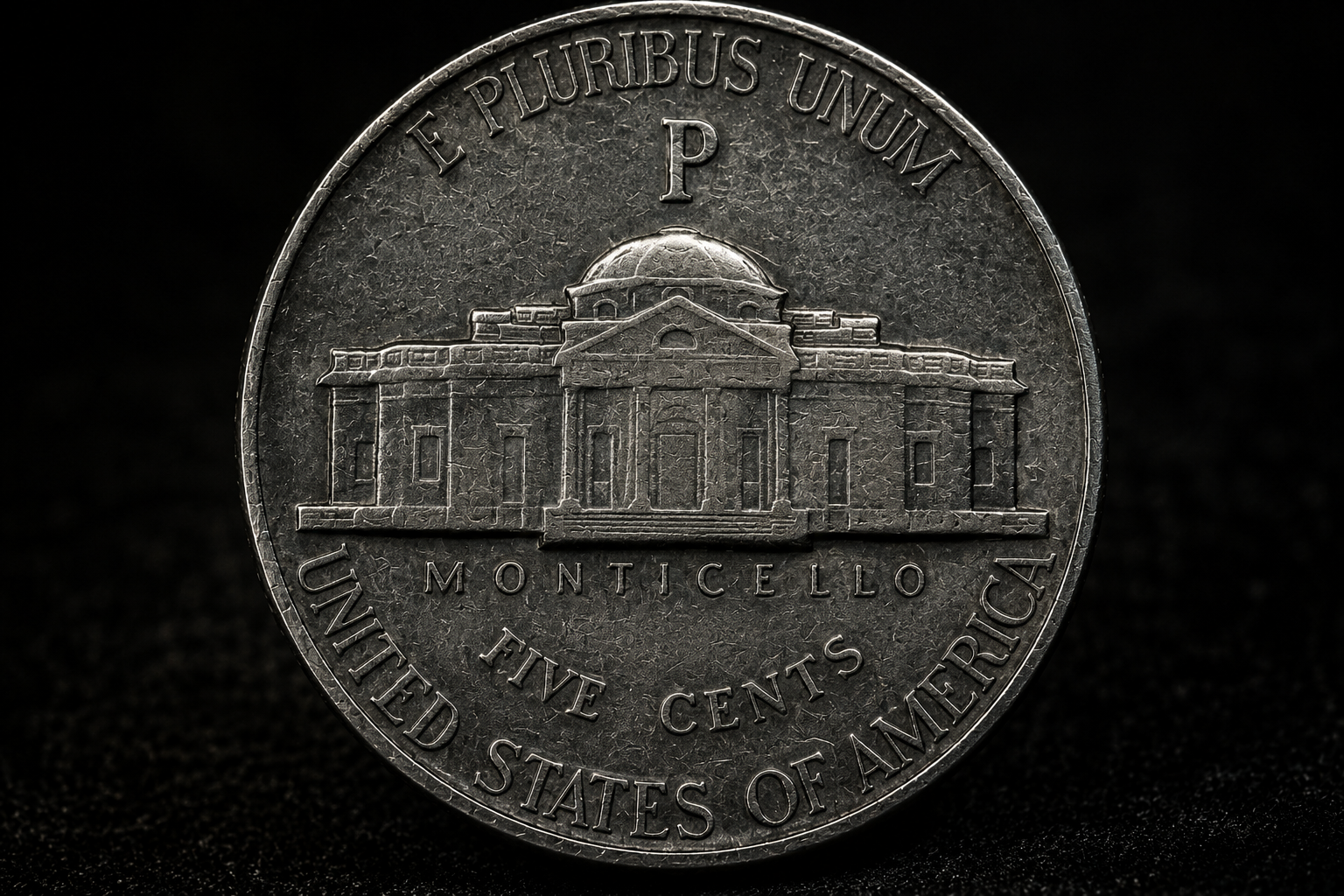
The oversized mint mark above Monticello became one of the most recognizable visual features of wartime Jefferson nickels.
Why It Looks Different Beside A Regular Nickel
The easiest way to understand the wartime nickel is to place one beside a regular Jefferson nickel from a different year.
At first glance, both coins share the same basic design. Jefferson still appears on the obverse. Monticello still appears on the reverse. The denomination remains unchanged.
Yet the differences quickly become obvious.
The wartime coin often shows a different surface color. The giant mint mark immediately attracts attention. The overall appearance feels distinct even before someone understands the history behind it.
This visual contrast explains why so many people discover wartime nickels by accident.
They are not searching for silver content. They are not studying mint records. They simply notice that one coin looks different from the others around it.
That observation often becomes the beginning of a much larger story.
The coin starts as a curiosity and eventually becomes a window into wartime America.
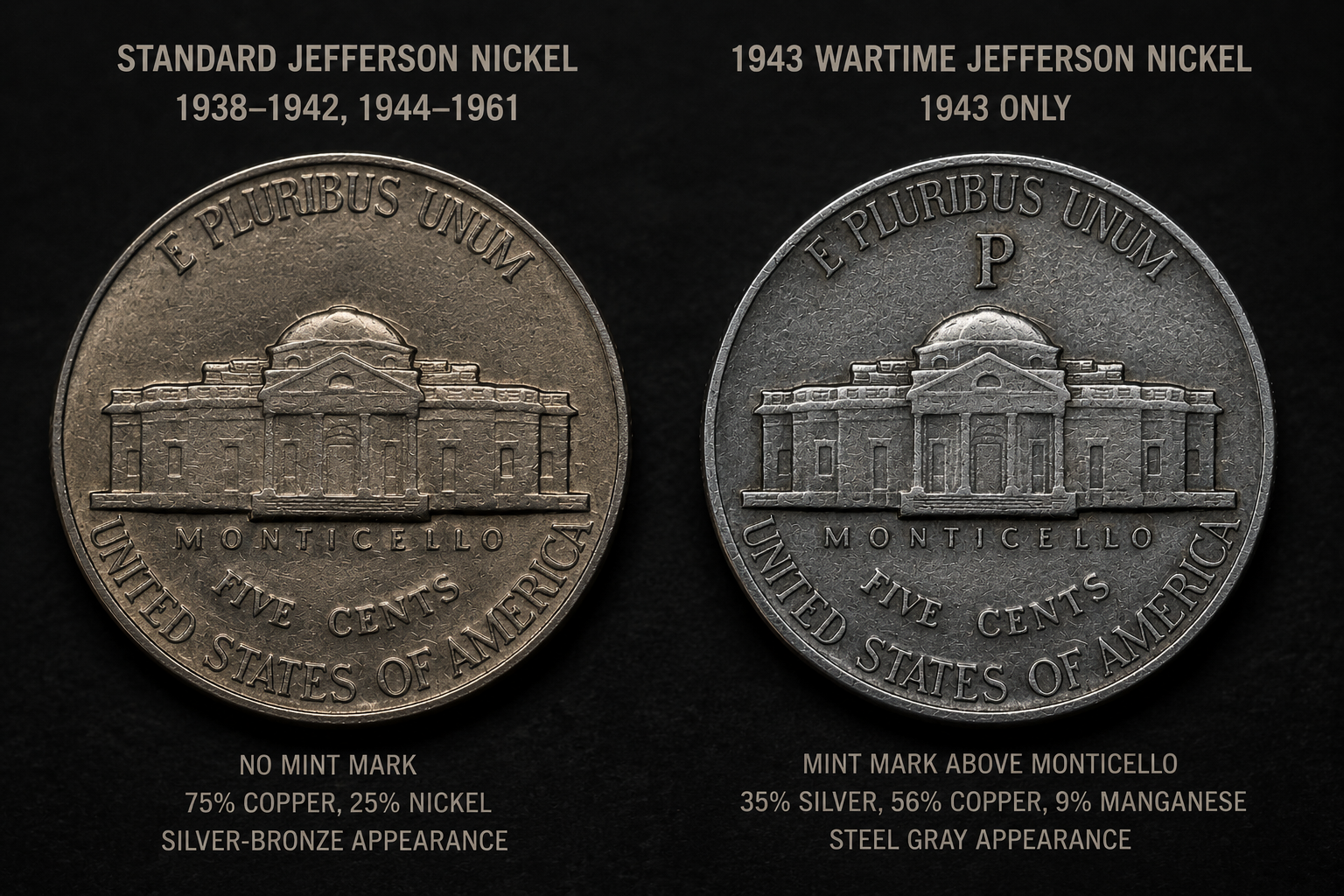
Although both coins share the Jefferson design, the wartime nickel contains a different alloy and several distinctive visual features.
More Than A Change In Metal
Many people assume the wartime nickel story is simply about replacing one metal with another.
The reality is more interesting.
The change affected the coin’s identity. It changed the way the coin looked, the way it aged, and the way future generations would recognize it.
Most circulating coins pass through history quietly. Their compositions remain relatively stable. Their appearance changes little from one year to the next.
The 1943 nickel did not follow that pattern.
It became part of a national effort to conserve strategic materials while maintaining normal economic activity.
That balance between necessity and continuity is visible in every surviving wartime nickel.
The coin still functioned as a nickel. It still looked enough like a nickel to circulate normally.
But hidden beneath that familiar design was an entirely different story.
Why Collectors Notice The 1943 Nickel Immediately
Experienced collectors often identify wartime nickels within seconds.
The reason is not rarity alone.
It is visibility.
The large mint mark, the wartime alloy, and the distinctive aging characteristics create a combination that stands out naturally.
Many coin series require close inspection to reveal important differences.
The wartime Jefferson nickel often announces itself immediately.
That visibility is one reason the series remains popular with beginners. A collector does not need specialized knowledge to notice that the coin looks unusual.
The clues are sitting directly on the surface.
Once those clues are understood, the wartime story becomes impossible to ignore.
The Lasting Legacy Of The Wartime Nickel
World War II eventually ended.
American manufacturing returned to peacetime priorities. The need for wartime metal conservation declined. The Mint eventually returned to more traditional compositions for the Jefferson nickel.
Yet the wartime nickels remained.
Millions entered circulation. Many survived. Some spent decades passing from hand to hand before finding their way into collections.
Today, they serve as small reminders of a period when global events reached into even the smallest parts of daily life.
A five-cent coin may seem insignificant compared to ships, aircraft, factories, or military equipment.
Yet the wartime nickel proves that major historical events often leave traces in unexpected places.
Sometimes history appears not in monuments or headlines, but in the metal composition of a coin.
Why The 1943 Nickel Truly Feels Different
The title of this article asks why the 1943 nickel looks different from every other nickel.
The answer is not a single feature.
It is the combination of several changes happening at once.
The wartime alloy changed the metal.
The oversized mint mark changed the appearance.
The silver content changed the way the coin aged.
The historical circumstances changed the meaning behind the coin.
Together, those factors created a Jefferson nickel unlike any ordinary issue.
That is why the 1943 nickel continues attracting attention today.
Even after decades, it still manages to look different the moment someone picks it up.
Reality Check
Not every 1943 nickel will appear dramatically different. Circulation, storage conditions, lighting, and environmental exposure can influence how the coin looks today.
The most reliable identifiers remain the wartime composition and the large mint mark above Monticello. These features were intentionally created to distinguish wartime nickels from ordinary issues.
A gray appearance may be common on wartime nickels, but color alone should never be used as the only identification method.
Related HistoraCoin Stories
Final Verdict
The 1943 Jefferson nickel looks different because it was created under extraordinary circumstances.
World War II forced the United States Mint to change the metal composition of the coin, creating a wartime alloy unlike the traditional nickel mixture used before the war.
To identify those new coins easily, the Mint added a large mint mark above Monticello. Over the decades, the alloy aged in distinctive ways, often producing gray surfaces and unusual toning patterns.
The result is a coin that still stands apart today.
It is not merely another Jefferson nickel from another year.
It is a small historical artifact that reflects wartime priorities, changing materials, and one of the most recognizable design adjustments in American coinage history.
That combination is exactly why the 1943 nickel continues to look different from almost every other nickel people encounter.
FAQ
| Question | Answer |
|---|---|
| Why does a 1943 nickel look different? | Because it was produced using a special wartime alloy containing silver, copper, and manganese rather than the traditional nickel composition. |
| What is the large letter above Monticello? | It is a wartime mint mark used to identify the special alloy nickels produced during World War II. |
| Does the 1943 nickel contain silver? | Yes. Wartime Jefferson nickels contain 35 percent silver. |
| Why do some 1943 nickels look gray? | The wartime alloy ages differently over time, often producing gray surfaces and distinctive toning patterns. |
| Was the large P mint mark important? | Yes. It marked the first time Philadelphia used a P mint mark on a circulating U.S. coin. |
| Are all 1943 nickels wartime nickels? | Yes. All 1943 Jefferson nickels were produced during the wartime alloy period. |