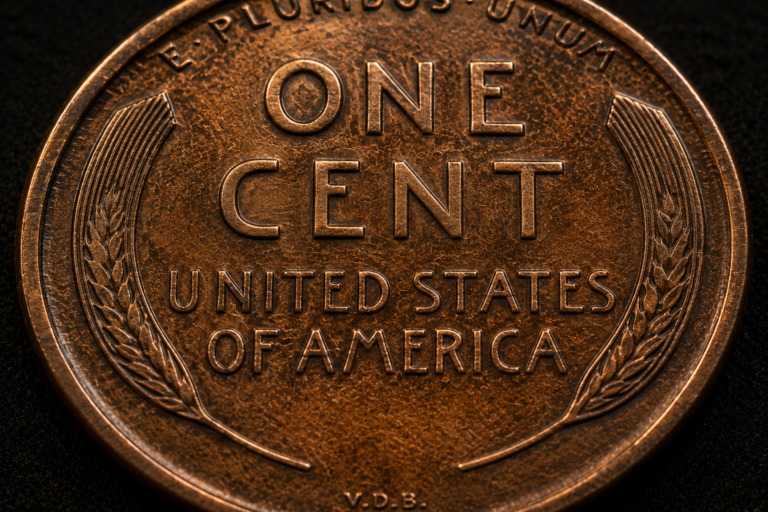
The Tiny Initials Most People Never Notice on the Lincoln Wheat Penny
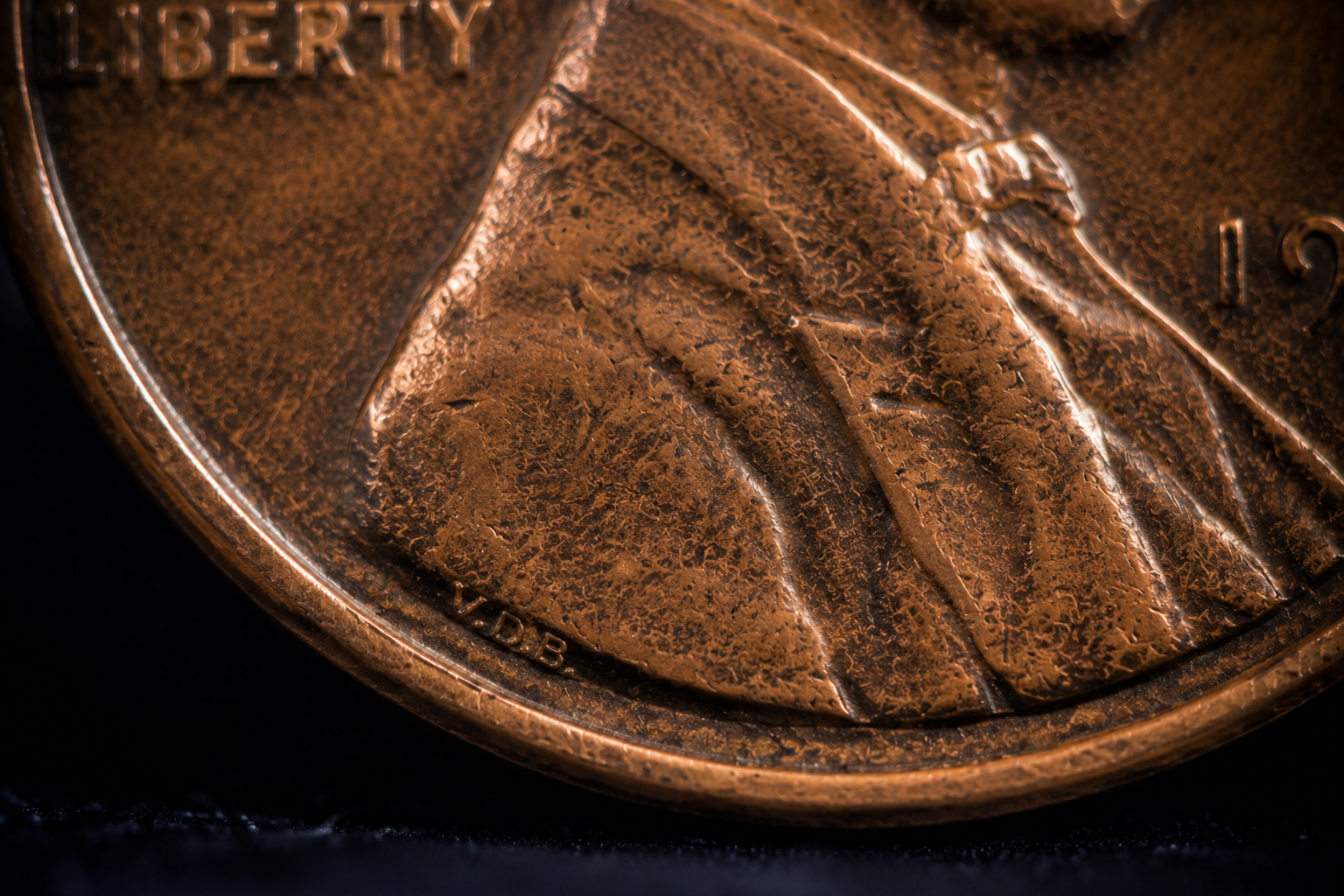
Three letters helped turn an ordinary one-cent coin into one of the most talked-about designs in American numismatic history. They are small enough to disappear beneath Lincoln’s shoulder, yet collectors still search for them with magnifying glasses more than a century after they first appeared.
The letters are VDB, the initials of sculptor Victor David Brenner. Their journey from a visible signature on the reverse of the first 1909 Lincoln cents to a nearly hidden mark on later coins is a story involving art, public criticism, government decisions, and one of the most famous key dates in the Lincoln Wheat Penny series.
Quick Context
VDB stands for Victor David Brenner, the artist who designed the original Lincoln cent. His initials appeared at the bottom of the reverse when the coin debuted in 1909. They were removed shortly afterward, remained absent for several years, and returned in 1918 in a much smaller position beneath Lincoln’s shoulder on the obverse.
Table of Contents
- Who Was Victor David Brenner?
- What Do the VDB Initials Mean?
- Where Were the Initials Originally Placed?
- Why Did Three Letters Cause a Controversy?
- Why Were the Initials Removed?
- When Did VDB Return to the Penny?
- How to Find the Tiny Initials
- Why Collectors Pay Attention to VDB
- Reality Check
- Related Stories
- Final Verdict
- Frequently Asked Questions
Who Was Victor David Brenner?
Victor David Brenner was a sculptor, engraver, and medalist known for creating realistic portraits in metal. Born in the Russian Empire in 1871, in a region that is now part of Lithuania, he later moved to the United States and developed a reputation for detailed medallic work.
Brenner’s artistic connection to Abraham Lincoln began before the Lincoln cent existed. He had created a bronze plaque featuring Lincoln’s profile, and the portrait attracted the attention of President Theodore Roosevelt. Roosevelt had been pushing for more artistic American coin designs, and Brenner’s Lincoln portrait fit the growing interest in commemorating the one-hundredth anniversary of Lincoln’s birth in 1909.
The final cent design was adapted from Brenner’s earlier Lincoln portrait. It showed the president in profile, facing right, with a serious and reflective expression. The result looked very different from earlier American cents, which had traditionally used symbolic images of Liberty rather than recognizable historical figures.
When the new cent entered circulation, Lincoln became the first identifiable historical person to appear on a regular-issue United States coin made for everyday circulation. Brenner’s portrait became so familiar that its artistic origins are now easy to overlook.
What Do the VDB Initials Mean?
The letters VDB are the initials of Victor David Brenner. They are the artist’s signature, reduced to three letters so they could fit within the limited space of a one-cent coin.
Artist initials were not unusual on coins. Designers had signed American coins before 1909, and later U.S. coin designs would also include small initials. What made Brenner’s mark controversial was not simply that it existed. The disagreement centered on its size and placement.
To modern collectors, the letters may not seem especially large. On the first Lincoln cents, however, they were placed in a clear central position on the reverse. Anyone who turned the coin over could see them beneath the denomination and between the two wheat ears.
| Detail | Meaning | Why It Matters |
|---|---|---|
| VDB | Victor David Brenner | Identifies the designer of the Lincoln cent |
| Original location | Bottom center of the 1909 reverse | Created the famous first-year VDB varieties |
| Later location | Beneath Lincoln’s shoulder on the obverse | Made the initials much less noticeable |
| Year of return | 1918 | Restored credit to the designer after years of absence |
Where Were the Initials Originally Placed?
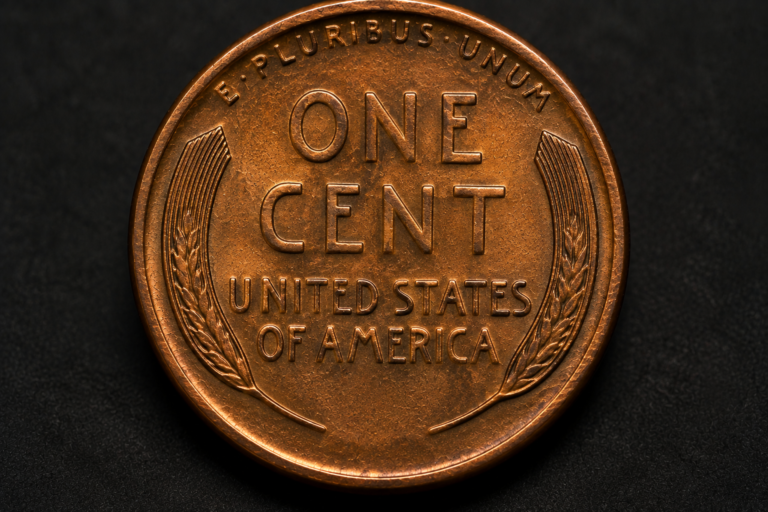
On the original 1909 Lincoln Wheat Penny, VDB appeared at the bottom center of the reverse. The letters sat just above the rim, between the lower ends of the two wheat stalks.
This location was visually important. The reverse already had a symmetrical layout, with one wheat ear on each side and the denomination in the middle. Placing the initials at the bottom center completed that symmetry, but it also made Brenner’s signature one of the most noticeable small features on the coin.
The initials were not hidden inside a fold of clothing or tucked beside the rim of the portrait. They stood alone in open space. That visibility helped trigger the criticism that followed the coin’s release.
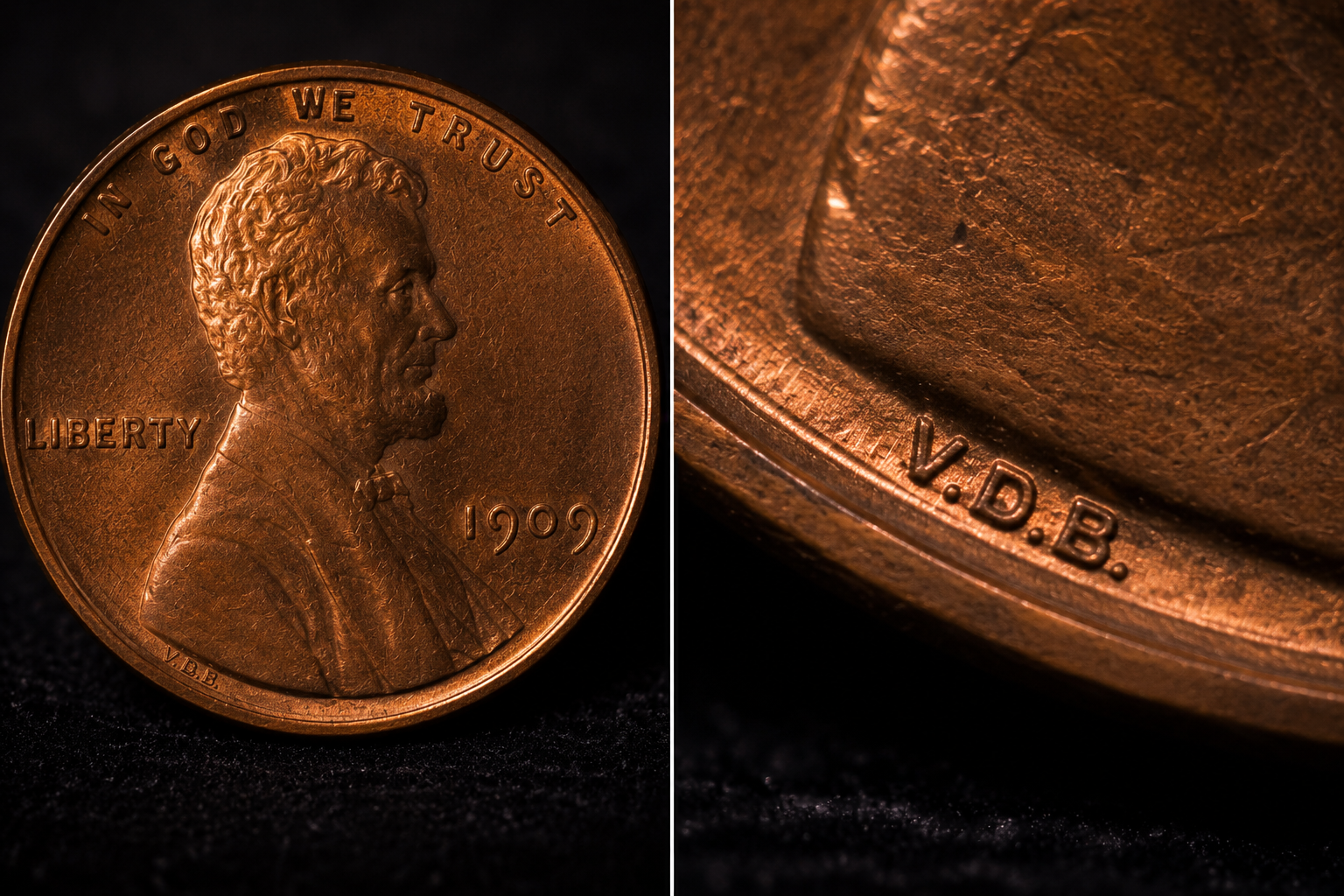
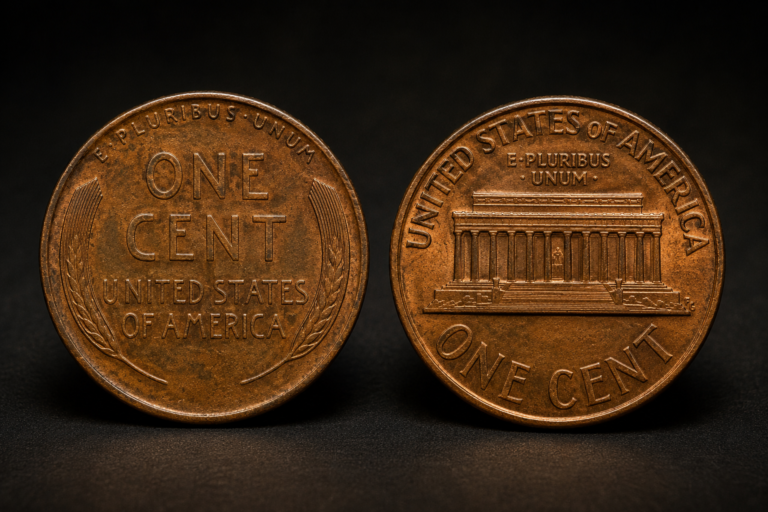
The original VDB initials appeared at the bottom center of the reverse, while later versions placed the letters beneath Lincoln’s shoulder.
Collectors examining a 1909 Wheat Penny should therefore check the reverse first. If VDB appears between the wheat ears, the coin belongs to the earliest version of the design. The mint mark, if present, must then be checked on the obverse beneath the date.
Why Did Three Letters Cause a Controversy?
The Lincoln cent was officially released in August 1909 and immediately attracted public attention. Americans were eager to see the new portrait coin, and crowds gathered at distribution points to obtain examples.
As people examined the reverse, some newspaper writers and government officials began criticizing Brenner’s initials. They argued that the letters were too prominent for a coin intended to honor Abraham Lincoln. To critics, the initials looked less like a quiet artist’s mark and more like an advertisement for the designer.
The reaction may seem excessive today, especially because the letters are still small compared with the main inscriptions. The issue, however, involved more than physical size. It reflected different beliefs about how much personal credit an artist should receive on a national coin.
Some officials reportedly preferred a single letter, such as a small B, instead of all three initials. Changing the design that way would have required additional work, and a single B could also have been confused with the initials of other Mint engravers. Removing the initials completely became the fastest solution.
Why Were the Initials Removed?
Production of the original VDB reverse stopped soon after the coin’s release. New dies were prepared without the initials, and Lincoln cents continued to be struck during the rest of 1909 with a blank space between the wheat ears.
This created two major design types within the coin’s first year. Some 1909 Lincoln cents have VDB on the reverse, while others do not. Both Philadelphia and San Francisco struck VDB cents, but the numbers produced were very different.
| 1909 Lincoln Cent Type | Mint | Reverse Initials | Collector Significance |
|---|---|---|---|
| 1909 VDB | Philadelphia | VDB present | Popular first-year type with a relatively large surviving population |
| 1909-S VDB | San Francisco | VDB present | Major key date because of its low original mintage |
| 1909 | Philadelphia | No VDB | Represents the modified design introduced later that year |
| 1909-S | San Francisco | No VDB | Scarcer first-year issue without the designer’s initials |
The most famous of these coins is the 1909-S VDB. Only 484,000 were struck at the San Francisco Mint before the initials were removed. That small production total made it one of the essential key dates for anyone trying to build a complete Lincoln cent collection.
The Philadelphia 1909 VDB is much more available because more than 27 million were produced. It is still historically important, but the presence of VDB alone does not automatically make every 1909 coin rare.
The controversy created an unusual collecting situation. A design feature that officials wanted to make less important became the feature collectors remember most clearly.
When Did VDB Return to the Penny?
After the initials disappeared from the reverse in 1909, Lincoln cents were produced without Brenner’s visible signature for several years. The letters finally returned in 1918.
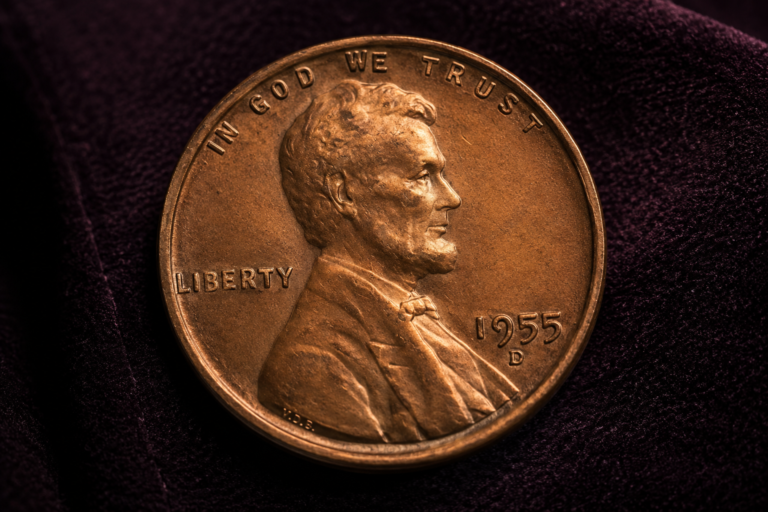
This time, the initials were placed on the obverse beneath Lincoln’s shoulder, close to the lower edge of the portrait. The new location was far less noticeable than the original reverse position.
The letters are tiny and can blend into the surrounding design, especially on circulated coins. Wear, weak striking, dirt, corrosion, or dark toning can make them difficult to see. On sharply struck examples, however, the three letters can still be identified with careful lighting and magnification.
The return of VDB restored credit to Brenner without recreating the controversy of 1909. The solution was simple: keep the artist’s signature, but place it where it would not compete with the main design.
How to Find the Tiny Initials
Finding VDB depends on the date of the coin. A 1909 VDB cent carries the initials on the reverse between the wheat ears. Coins dated 1918 and later place them beneath Lincoln’s shoulder on the obverse.
Start by holding the coin under a single directional light. Tilt it slowly until the lower edge of Lincoln’s shoulder catches the light. A magnifying glass can help, but strong contrast is often more useful than extreme magnification.
Do not scrape, clean, or polish the area to make the initials easier to see. Cleaning can permanently alter the surface and reduce collector appeal. A naturally worn VDB is preferable to a damaged coin with artificially brightened details.
On circulated examples, the V may appear first because of the way the letters sit against the surrounding relief. The D and B may look weaker or merge with nearby metal. Comparing the coin with a clear reference image can help confirm the correct location.
“`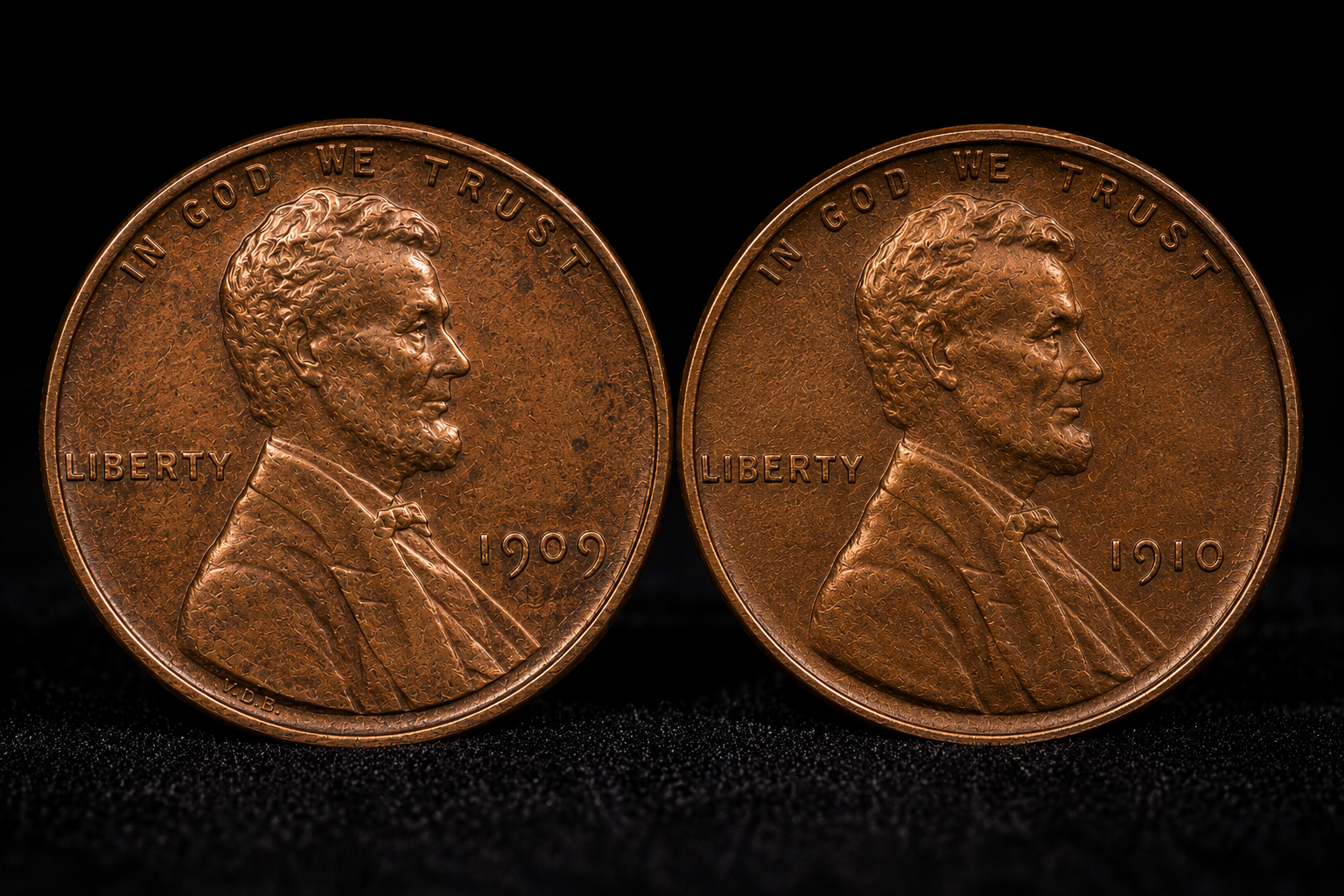
Early Lincoln cents preserve the moment when three small initials became one of the most debated details in American coin design.
Why Collectors Pay Attention to VDB
Collectors check for VDB because the initials can identify a specific design type, confirm the work of the original artist, and sometimes separate a common coin from a much scarcer issue. On a 1909 cent, the letters are especially important because they immediately place the coin among the earliest Lincoln cents released to the public.
The initials are only one part of identification, however. A collector must also check the date, mint mark, condition, color, surface quality, and authenticity. A 1909 VDB from Philadelphia is historically significant, but it is not the same coin as a 1909-S VDB from San Francisco.
The tiny S beneath the date is what transforms the second coin into one of the major keys of the Lincoln cent series. This is why experienced collectors never identify a valuable Wheat Penny from one detail alone.
The 1909 VDB and the 1909-S VDB
Both coins carry Brenner’s initials on the reverse, but their production numbers were dramatically different. Philadelphia struck more than 27 million 1909 VDB cents, while San Francisco produced only 484,000.
That difference explains why the 1909-S VDB receives so much attention. It combines four qualities collectors often value: a first-year design, a famous controversy, a low mintage, and a place in one of America’s most widely collected coin series.
The Philadelphia issue remains desirable because it represents the original version of the Lincoln cent. It is often chosen by collectors who want an affordable example of the reverse VDB design without paying the much higher cost associated with the San Francisco coin.
Why Condition Still Matters
The presence of VDB does not erase the importance of condition. A coin with heavy wear, scratches, corrosion, or cleaning may be less appealing than a better-preserved example of the same date and mint.
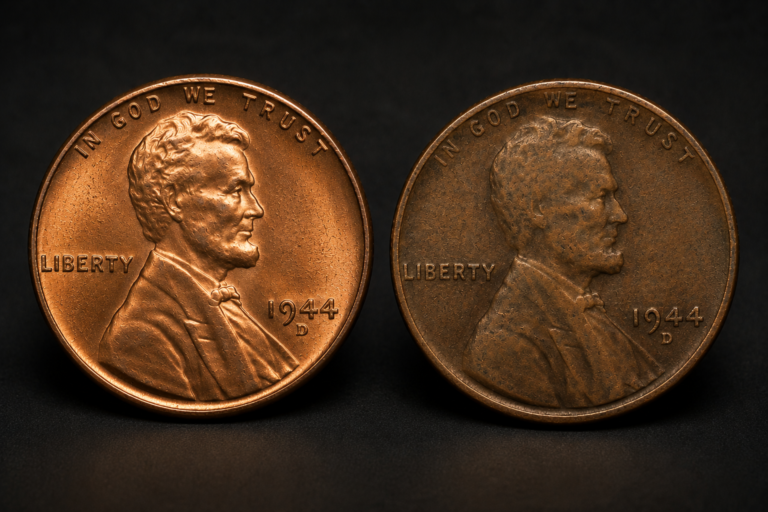
Collectors examine Lincoln’s hair, cheek, jaw, shoulder, lettering, wheat lines, and rim to judge how much detail remains. They also study the color and surface texture. Original copper surfaces usually appear more natural than coins that have been polished or chemically cleaned.
On a 1909 VDB cent, the initials themselves may show wear because they sit close to the rim. Their visibility can vary depending on strike quality, circulation, and the condition of the dies used to produce the coin.
| What to Check | Why It Matters | Common Mistake |
|---|---|---|
| Date | Determines whether the coin belongs to the original 1909 issue or a later year | Assuming every visible VDB means the coin is from 1909 |
| Mint mark | Separates Philadelphia coins from Denver or San Francisco issues | Missing a weak or worn S beneath the date |
| Location of VDB | Helps distinguish the original reverse placement from the later obverse placement | Searching beneath Lincoln’s shoulder on a 1909 coin |
| Surface condition | Strongly affects collector appeal and value | Cleaning the coin to make the initials easier to see |
| Authenticity | Important because valuable dates are frequently altered or counterfeited | Judging authenticity from photographs alone |
Why the Initials Are Sometimes Hard to See
On later Wheat Pennies, the initials beneath Lincoln’s shoulder may be extremely faint. This does not necessarily mean they are missing. The area is small, and the letters can be weakened by circulation, dark toning, shallow striking, or worn dies.
Lighting often solves the problem. A coin viewed under flat overhead light may appear featureless, while the same coin tilted beneath a directional lamp can reveal all three letters. The goal is to let shadows define the raised design rather than forcing the surface to shine.
Collectors should also remember that coins are struck from working dies that gradually wear. Early strikes from a fresh die may show sharper initials than later strikes produced after the die had already made thousands of coins.
How the VDB Story Changed American Coins
The VDB controversy became an early lesson in how closely the public watched national coin designs. A coin may be small, but it carries official symbols, words, portraits, and artistic decisions into millions of homes.
The debate also influenced how designer initials were treated. Later artists continued to receive credit, but their signatures were generally placed in less prominent positions. Small initials became accepted features rather than central elements competing with the principal design.
Brenner’s initials eventually survived the controversy because the basic idea was never unreasonable. Artists had long signed medals and sculpture, and the Lincoln cent was a major artistic achievement. The compromise reached in 1918 allowed the designer to be recognized without distracting from Lincoln’s portrait.
There is also a deeper irony in the story. Officials removed the initials because they seemed too noticeable. That decision created a short-lived design, and short-lived designs are exactly the kinds of objects collectors remember.
A Small Signature With a Large Legacy
Victor David Brenner could not have known that collectors would still examine his initials more than a century later. Yet VDB became inseparable from the identity of the Lincoln cent.
For beginners, the initials provide an easy entry point into coin study. They encourage people to look beyond the date and discover how small design changes can reveal production history. For advanced collectors, the letters connect to die varieties, counterfeits, grading, mintages, and the complex market surrounding key-date Lincoln cents.
The VDB story is therefore not merely about an artist signing a coin. It demonstrates how one tiny detail can preserve the full history of a design decision.
Reality Check
Seeing VDB on a Lincoln cent does not automatically mean the coin is rare. Cents dated 1918 and later normally carry the initials beneath Lincoln’s shoulder, and millions of these coins were produced.
Even a 1909 VDB is not automatically the famous 1909-S VDB. The mint mark must be present beneath the date, and valuable examples should be examined carefully because added mint marks, altered dates, and counterfeit coins exist.
Never clean a coin while searching for the initials. Cleaning cannot reveal genuine missing detail, and it may permanently damage the original surface.
Final Verdict
The letters VDB may be among the smallest elements on a Lincoln cent, but they carry one of the largest stories in the series. They identify Victor David Brenner, connect the penny to Theodore Roosevelt’s campaign for more artistic coinage, and preserve the controversy that changed the design only weeks after its release.
On the original 1909 cents, the initials appeared between the wheat ears. After their removal, they remained absent until 1918, when they returned beneath Lincoln’s shoulder in a location so discreet that many people still overlook them.
That journey transformed a simple designer’s signature into a collecting landmark. Once you know where to look, VDB becomes more than three letters. It becomes evidence of how art, public opinion, and minting history can survive on a piece of copper small enough to fit on the tip of a finger.
Frequently Asked Questions
What does VDB stand for on a Lincoln Penny?
VDB stands for Victor David Brenner, the sculptor and medalist who designed the original Lincoln cent introduced in 1909.
Where are the VDB initials on a 1909 Wheat Penny?
On an original 1909 VDB cent, the initials appear at the bottom center of the reverse, just above the rim and between the two wheat ears.
Where are the initials on later Lincoln cents?
Beginning in 1918, VDB was placed beneath Lincoln’s shoulder on the obverse. The letters are very small and may require directional light or magnification to see clearly.
Why were the initials removed in 1909?
Critics argued that Brenner’s initials were too prominent and looked like personal advertising. The Mint responded by removing them from the reverse shortly after the coin entered circulation.
Are all 1909 VDB pennies rare?
No. The Philadelphia 1909 VDB is popular and historically important, but more than 27 million were struck. The 1909-S VDB is much scarcer because only 484,000 were produced.
How can I tell whether I have a 1909-S VDB?
Check the reverse for VDB between the wheat ears, then inspect the obverse beneath the date for an S mint mark. Because this issue is valuable and often altered or counterfeited, professional authentication is recommended for potentially genuine examples.
Can wear make the VDB initials disappear?
Yes. Circulation wear, weak striking, dark toning, corrosion, and worn dies can make the initials difficult to see, especially on coins dated 1918 and later.
Should I clean the coin to reveal the initials?
No. Cleaning can permanently alter the surface, reduce collector appeal, and make authentication more difficult. Use careful lighting and magnification instead.
Why is the 1909-S VDB so famous?
It combines the first year of the Lincoln cent, the original VDB reverse, a famous design controversy, and a low mintage of 484,000 coins. Those factors made it one of the major key dates in the Lincoln cent series.