Why Wheat Pennies Changed Forever in 1959
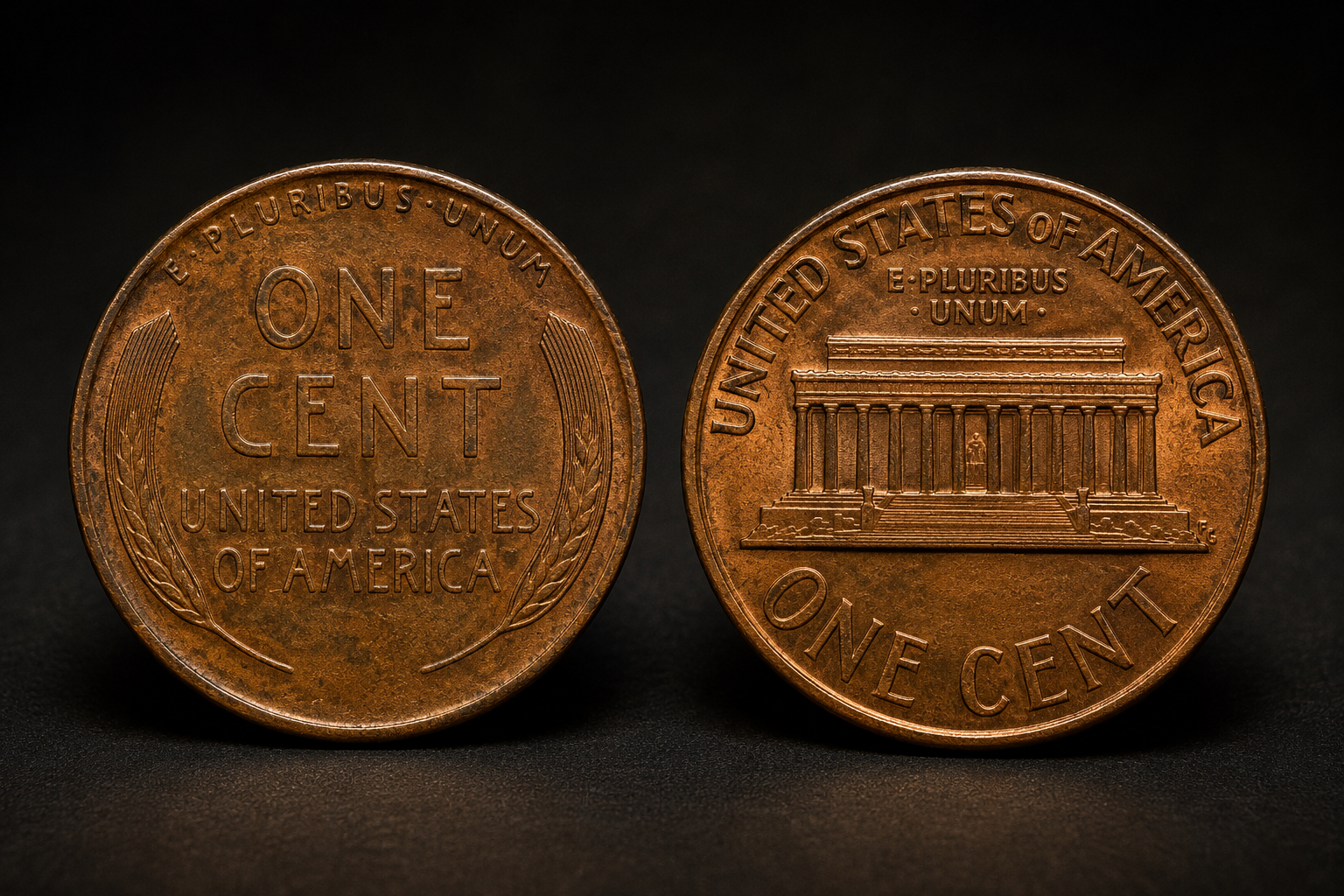
If you place a 1958 Lincoln cent beside a 1959 cent and look only at Lincoln’s portrait, the two coins seem almost unchanged. Turn them over, however, and you are looking at the end of one era and the beginning of another. The familiar wheat ears that had framed the penny for fifty years were suddenly gone.
In their place stood the Lincoln Memorial, rendered in remarkable detail on a coin barely three-quarters of an inch across. The change was not caused by the wheat design failing, nor did it mean America was abandoning the original Lincoln cent. The year 1959 marked the 150th anniversary of Abraham Lincoln’s birth, and the occasion gave the United States Mint a reason to transform the reverse while preserving Victor David Brenner’s famous portrait on the front.
Quick Context
The original Lincoln Wheat Penny was produced from 1909 through 1958. In 1959, the Wheat Ears reverse was replaced by Frank Gasparro’s Lincoln Memorial design to commemorate the 150th anniversary of Abraham Lincoln’s birth. Brenner’s Lincoln portrait remained on the obverse, creating a coin that looked familiar from the front but completely different from the back.
Table of Contents
- 1958: The Last Year of the Wheat Penny
- Why 1959 Was the Perfect Year for a Change
- Frank Gasparro Had to Design a New Reverse
- The Memorial Wasn’t the Only Idea
- What Actually Changed in 1959?
- The Tiny Lincoln Hidden Inside the Memorial
- Why 1958 and 1959 Belong Together
- What the Wheat Penny Left Behind
- Reality Check
- Related Stories
- Final Verdict
- Frequently Asked Questions
1958: The Last Year of the Wheat Penny
By 1958, the Wheat Penny hardly looked revolutionary. Americans had been carrying it for half a century. Yet when Victor David Brenner’s Lincoln cent first appeared in 1909, it represented a major departure from traditional American coinage.
Lincoln became the first president portrayed on a regular U.S. circulating coin. On the reverse, Brenner placed the denomination between two stylized wheat elements. That simple arrangement became so familiar that collectors eventually began calling the entire series Wheat Pennies or Wheat Cents.
The design survived enormous changes in American history. Wheat cents circulated through two world wars, the Great Depression, changes in metal composition, and the extraordinary one-year switch to zinc-coated steel in 1943.
Yet the basic visual identity survived. Lincoln remained on the front. Wheat remained on the back.
Then came 1959.
Why 1959 Was the Perfect Year for a Change
Abraham Lincoln was born on February 12, 1809. That made 1959 the 150th anniversary of his birth.
The anniversary created an obvious opportunity to refresh the cent that had carried his portrait since the centennial celebration fifty years earlier. The U.S. Mint’s historical timeline specifically records that the wheat design was replaced by the Lincoln Memorial in 1959 for Lincoln’s 150th anniversary.
This is an important distinction for collectors. The Wheat Ears reverse did not disappear because it had become technically unusable or because the Lincoln cent itself was being replaced. The change was commemorative in purpose while still being applied to an everyday circulating coin.
That meant the Mint could honor another milestone in Lincoln’s life without abandoning the portrait Americans already recognized.
Frank Gasparro Had to Design a New Reverse
The artist responsible for the new reverse was Frank Gasparro, an engraver at the Philadelphia Mint who would later become Chief Engraver of the United States Mint.
Gasparro faced an unusual design problem. The Lincoln Memorial is a large neoclassical building filled with columns, steps, shadows, and architectural details. A real memorial can be monumental. A cent is tiny.
He had to reduce the building to a design that remained recognizable after being transferred to dies and struck repeatedly onto circulating coins.
The final composition placed the Memorial in the center, with UNITED STATES OF AMERICA above, E PLURIBUS UNUM beneath that inscription, and ONE CENT across the bottom. The architecture became the visual focus, replacing the agricultural frame that had defined the reverse since 1909.
It was a dramatic change, but the coin still unmistakably belonged to the Lincoln cent family.
The Memorial Wasn’t the Only Idea
The finished coin can make history look inevitable. Once we know that the Lincoln Memorial appeared on the cent in 1959, it is easy to assume that this was always the only design under consideration.
Surviving artwork tells a more interesting story.
The Smithsonian’s National Museum of American History preserves Gasparro sketches connected with the redesign, including an image of Lincoln’s birthplace. The museum describes that drawing as one of several ideas developed for the new reverse before the Mint selected the Lincoln Memorial.
This glimpse into the design process matters because it shows that the 1959 cent could have looked very different. Gasparro explored imagery connected to Lincoln’s life rather than simply drawing the Memorial and stopping there.
Coin designs often emerge from a series of sketches, revisions, and rejected concepts. The coin that reaches circulation is only the final survivor of that process.
What Actually Changed in 1959?
From a collector’s perspective, the transition is easy to identify because the major change happened on only one side of the coin.
| Feature | 1958 Lincoln Cent | 1959 Lincoln Cent |
|---|---|---|
| Obverse portrait | Victor David Brenner’s Lincoln | Victor David Brenner’s Lincoln |
| Reverse | Wheat Ears | Lincoln Memorial |
| Reverse designer | Victor David Brenner | Frank Gasparro |
| Design era | Final year of 1909–1958 Wheat reverse | First year of 1959–2008 Memorial reverse |
| Historical significance | End of the original Wheat Penny era | 150th anniversary redesign |
This continuity is what makes the change so fascinating. The Mint did not replace Lincoln. It changed the environment around his story.
The front still carried Brenner’s original Lincoln portrait, while the back moved from agricultural imagery to one of the most recognizable monuments dedicated to him.
For anyone learning to identify Wheat Pennies, the dividing line is therefore simple: 1958 is the final regular Wheat Ears year, while 1959 begins the Memorial era.
The Tiny Lincoln Hidden Inside the Memorial
One of the best details on the 1959 redesign is easy to miss without magnification.
Look carefully between the columns of the Lincoln Memorial. Inside the building is a tiny representation of the seated Lincoln statue.
That means Abraham Lincoln appears twice on the same coin: Brenner’s large portrait is on the obverse, while the Memorial reverse contains a miniature representation of the statue of Lincoln inside the building.
The Smithsonian notes that the Lincoln Memorial cent became the first U.S. coin to show a portrait of the same person on both sides in this way.
For collectors who enjoy small details hidden on Lincoln cents, this is a perfect continuation of the tradition. The wheat disappeared, but the new reverse introduced tiny features of its own.
Why 1958 and 1959 Belong Together
Neither date automatically means a cent is rare. Their importance comes primarily from what they represent in the design timeline.
A 1958 cent is the last regular issue carrying the Wheat Ears reverse. A 1959 cent is the first regular issue carrying the Lincoln Memorial reverse. Placed together, they tell the entire transition in two coins.
This makes the pair especially useful for beginning collectors. You do not need an expensive rarity to see a major moment in American coin design. Two ordinary cents can show exactly where a fifty-year series ended and another fifty-year reverse began.
Condition still matters, of course. Original color, surface preservation, strike quality, marks, and other characteristics can make individual examples more or less desirable. But historical importance and monetary rarity are not the same thing.
What the Wheat Penny Left Behind
Although the wheat ears disappeared, much of the original Lincoln cent survived.
Most importantly, Brenner’s portrait remained. Lincoln continued facing right, surrounded by the familiar inscriptions on the obverse. Even Brenner’s small VDB initials, which had their own complicated history, remained associated with the portrait.
The Wheat Penny also left behind a collecting culture. By the time the reverse changed, generations of Americans had searched rolls, jars, and pocket change for dates and mint marks. The series had already become one of the easiest gateways into American numismatics.
Its reverse may have ended in 1958, but the Wheat Penny did not disappear from collecting. If anything, the clear endpoint made the series easier to define. A collector could now look backward at a complete fifty-year design era stretching from 1909 through 1958.
Understanding the original Wheat Ears reverse makes the 1959 transition even more striking. A design that had once been completely new had finally become history itself.
Reality Check
A 1958 Wheat Penny is historically interesting because it is the final regular year of the Wheat Ears reverse, but the date alone does not make every example rare or highly valuable. The same applies to ordinary 1959 Lincoln Memorial cents.
Collectors should separate design significance from rarity. Date, mint, variety, condition, original surfaces, and authentication can all matter when evaluating an individual coin.
And if a coin dated 1959 appears to have a Wheat reverse, do not assume you have discovered an unknown transitional rarity. Extraordinary combinations require expert authentication because altered coins, manipulated pieces, and misleading images can exist.
Final Verdict
The year 1959 changed the Lincoln cent forever because it ended the original Wheat Penny design after fifty years. The reason was not a failure of the wheat reverse but a new milestone: the 150th anniversary of Abraham Lincoln’s birth.
Frank Gasparro’s Lincoln Memorial replaced Victor David Brenner’s wheat design, while Brenner’s famous portrait remained on the obverse. The result connected two generations of American coin art on a single cent.
That is why 1958 and 1959 make such an interesting pair. One closes the Wheat Penny story. The other begins the Memorial era. And between them, you can see a major chapter of American coin history change in the space of a single year.
Frequently Asked Questions
Why did Wheat Pennies stop in 1958?
The Wheat Ears reverse was replaced in 1959 as part of the commemoration of the 150th anniversary of Abraham Lincoln’s birth. The Lincoln Memorial became the new reverse design.
Is a 1959 penny a Wheat Penny?
No. Regular Lincoln cents dated 1959 carry the Lincoln Memorial reverse. The last regular Wheat Ears cents are dated 1958.
Who designed the Lincoln Memorial penny?
Frank Gasparro designed the Lincoln Memorial reverse introduced in 1959. He later became Chief Engraver of the United States Mint.
Did Lincoln’s portrait change in 1959?
The fundamental obverse portrait did not change. The cent continued to use Victor David Brenner’s Lincoln design while the reverse was replaced.
How long did the Lincoln Memorial reverse last?
The Lincoln Memorial reverse appeared on regular Lincoln cents from 1959 through 2008. Four special Bicentennial reverses replaced it in 2009.
Is Lincoln really visible inside the Memorial on the penny?
Yes. The reverse includes a tiny representation of the seated Lincoln statue between the Memorial’s columns, meaning Lincoln is represented on both sides of the coin.
Are 1958 Wheat Pennies rare because they were the last year?
Not automatically. Their final-year status gives them historical and collecting interest, but rarity and value depend on the specific issue, variety, condition, and preservation.