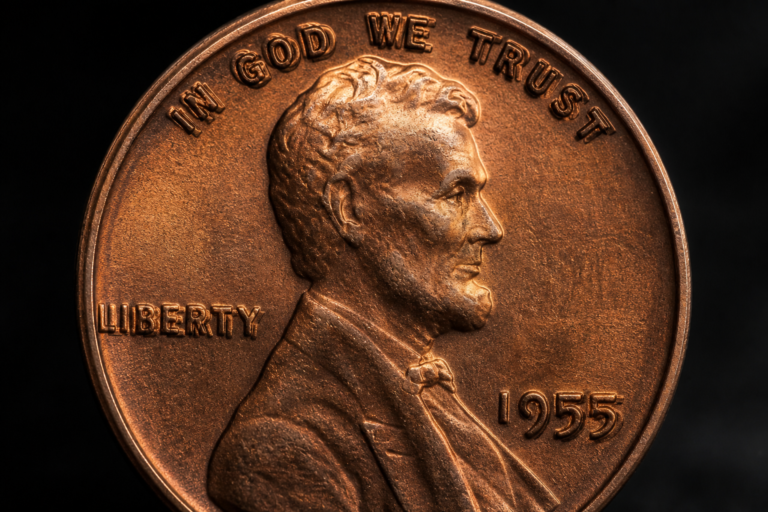
The Secret Hidden Between the Wheat Ears on the Lincoln Penny
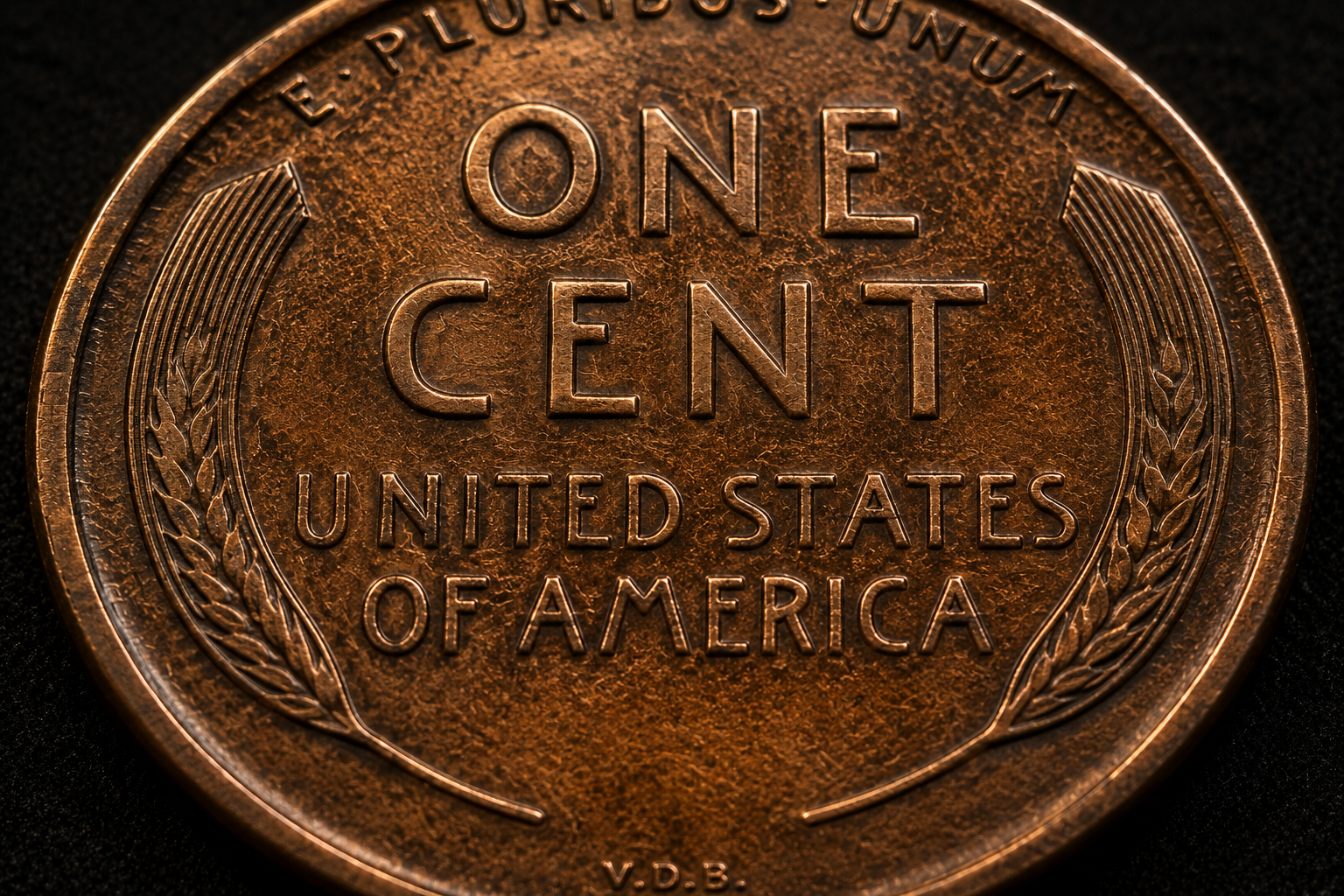
Turn over an early Lincoln Wheat Penny and your eyes naturally go to the large ONE CENT in the middle. Then you notice the two wheat ears rising along the edges. But on some of the very first Lincoln cents, there is something else hiding in the small open space near the bottom: three tiny letters that became one of the most famous details in American coin collecting.
Those letters are V.D.B., the initials of designer Victor David Brenner. They appeared between the wheat stalks when the Lincoln cent debuted in 1909, then disappeared almost immediately. That tiny change created a first-year variety collectors still chase more than a century later. But the space between the wheat ears tells an even larger story about how the original Lincoln cent was designed.
Quick Context
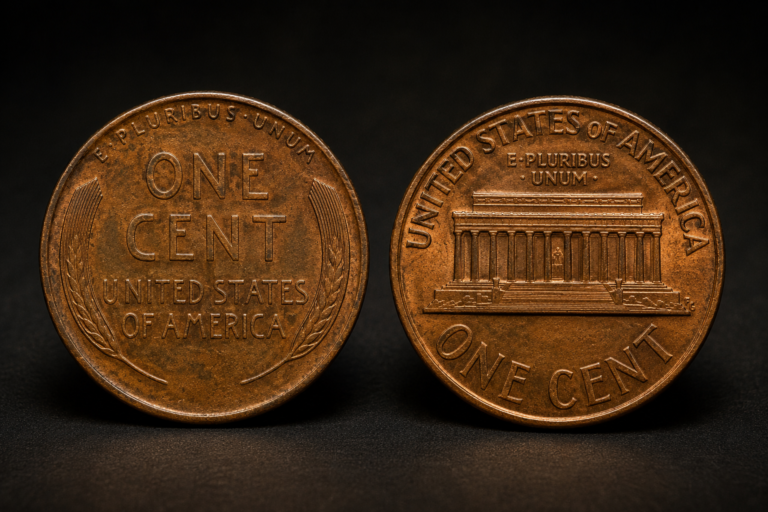
Victor David Brenner designed both sides of the original Lincoln cent introduced in 1909. The reverse featured two wheat elements framing ONE CENT and UNITED STATES OF AMERICA, with E PLURIBUS UNUM above. On the earliest version, Brenner placed his V.D.B. initials at the bottom center between the wheat stalks. After criticism of their prominence, the initials were removed later in 1909. The Wheat Ears reverse itself remained in use through 1958.
Table of Contents
- What Is Hidden Between the Wheat Ears?
- Why Did Brenner Put His Initials There?
- Why Did VDB Suddenly Disappear?
- Look Beyond VDB: How the Wheat Reverse Works
- What Did the Wheat Represent?
- What Should Collectors Actually Look For?
- What Happened to the Empty Space After 1909?
- Why the Wheat Ears Finally Disappeared
- Reality Check
- Related Stories
- Final Verdict
- Frequently Asked Questions
What Is Hidden Between the Wheat Ears?
On an original 1909 VDB Lincoln cent, look at the very bottom of the reverse. Between the lower ends of the wheat stalks, just above the rim, you will find the letters V.D.B.
They stand for Victor David Brenner, the sculptor and medalist responsible for the original Lincoln cent. The Smithsonian’s National Museum of American History documents the initials in exactly this location on the 1909 design and notes that criticism of their prominence led to their removal later that year.
That detail matters because not every 1909 Lincoln cent has it. Coins were also struck after the initials were removed, creating VDB and non-VDB versions during the very first year of the Lincoln cent.
For collectors, three tiny letters therefore reveal which version of the original design they are holding.
Why Did Brenner Put His Initials There?
Brenner was an artist, and placing a signature or initials on medallic work was not unusual. The challenge was finding a location where his credit could appear without interfering with the principal elements of the coin.
The reverse was highly symmetrical. A wheat stalk rose on each side while the denomination occupied the center. Beneath the main lettering was a small open area between the stalks, making it a natural place for the designer’s initials.
Visually, the decision made sense. The problem was that V.D.B. stood alone in that open space. Instead of disappearing into the design, the initials were easy enough to notice that critics considered them too prominent.
That distinction is important. The controversy was not simply about Brenner receiving credit. It was about how visible that credit appeared on a national coin.
Why Did VDB Suddenly Disappear?
The Lincoln cent entered circulation in August 1909 and attracted enormous attention. It commemorated the centennial of Abraham Lincoln’s birth and introduced his portrait to regular U.S. circulating coinage.
Almost immediately, Brenner’s initials became part of the discussion surrounding the new coin. Critics objected to the three-letter signature, and Mint officials moved quickly to eliminate it from the reverse.
The result was unusual: the original version of a brand-new American coin survived only briefly before being modified.
| Lincoln Cent Version | What Appears Between the Wheat Stalks? | Why Collectors Care |
|---|---|---|
| 1909 VDB | V.D.B. initials | Original version of Brenner’s design |
| 1909-S VDB | V.D.B. initials | Famous low-mintage key date |
| Later 1909 issue | No VDB | Shows the modified first-year reverse |
| 1910–1958 Wheat reverse | No large VDB in this location | Uses the familiar Wheat Ears layout without the original reverse signature |
The San Francisco version became especially famous. Only 484,000 1909-S VDB cents were struck, making it one of the classic key dates of the Lincoln cent series. The Philadelphia 1909 VDB had a far larger mintage, so the initials alone do not automatically make a coin rare.
For the full story of the designer’s signature, see The Tiny Initials Most People Never Notice.
Look Beyond VDB: How the Wheat Reverse Works
It is easy to become so focused on the initials that the rest of the reverse gets ignored. Yet Brenner’s design is a remarkably efficient piece of coin art.
ONE CENT dominates the center because the denomination needed to be immediately readable. UNITED STATES OF AMERICA appears beneath it, while E PLURIBUS UNUM stretches across the upper portion. The wheat elements frame everything without overwhelming the lettering.
The result is a reverse that remains readable even at the small diameter of a cent. There is very little wasted space, but the design does not feel crowded.
This balance is one reason the Wheat Penny remains instantly recognizable. Brenner created a reverse that could be understood in a second, yet still rewarded closer inspection.
What Did the Wheat Represent?
The U.S. Mint describes the original reverse as featuring two sheaves of wheat. The agricultural imagery suited an era when farming remained deeply connected to American economic life and the public imagination.
The wheat can reasonably be read as imagery of agricultural abundance and prosperity, but collectors should be careful about turning that interpretation into an elaborate hidden message. There is no need for a secret code to make the design historically meaningful.
Brenner needed a simple framing device that worked around the denomination and national inscriptions. Wheat was recognizable, visually balanced, and well suited to the narrow curved spaces along the sides of a coin.
We explore that design choice in greater depth in Why America Chose Wheat for the Penny.
What Should Collectors Actually Look For?
If you find a 1909 Lincoln cent, start with the date and mint mark on the obverse. An S beneath the date means the coin was struck in San Francisco. Then turn the coin over and inspect the bottom center of the reverse.
On a genuine VDB example, the initials should occupy the small space between the wheat stalks. Magnification and directional lighting can make them easier to examine.
Do not clean the coin to reveal the letters. Dirt, toning, and circulation wear can make small details difficult to see, but polishing or chemically cleaning the surface can permanently alter the coin.
Extra caution is warranted with a possible 1909-S VDB because its desirability has encouraged counterfeiting and alteration. A valuable candidate should be authenticated by a reputable third-party grading service rather than identified from one feature alone.
What Happened to the Empty Space After 1909?
Once VDB was removed, the bottom center of the reverse became visually quieter. The two wheat stalks still approached each other near the rim, but there was no longer a prominent designer signature between them.
Brenner did eventually receive visible credit again. In 1918, his initials returned in a much more discreet location on the obverse, at the lower edge of Lincoln’s shoulder.
That change effectively solved the original controversy. The designer was credited, but the signature no longer occupied its own obvious space on the reverse.
This is one of the hidden details on the Lincoln Wheat Penny that becomes much easier to understand once the entire design is examined rather than only the date.
Why the Wheat Ears Finally Disappeared
The removal of VDB did not end the Wheat Penny. Brenner’s Wheat Ears reverse continued for decades, surviving two world wars, the Great Depression, the temporary 1943 steel cent, and enormous changes in American life.
Its final regular year was 1958. In 1959, the reverse was replaced by Frank Gasparro’s Lincoln Memorial design to commemorate the 150th anniversary of Lincoln’s birth. The U.S. Mint records the Wheat Ears design as running from 1909 through 1958 and the Memorial reverse from 1959 through 2008.
The Wheat Penny had therefore lasted half a century. What began as a new design surrounded by controversy had become one of the most familiar coins in America.
That transition deserves its own story, which we cover in Why Wheat Pennies Changed Forever in 1959.
Reality Check
There is no mysterious symbol or secret message concealed between the wheat ears. The historically important detail is much more concrete: on the original 1909 VDB design, that space contained Victor David Brenner’s initials.
Those initials were removed after criticism of their prominence. Their short life on the reverse is what made the detail so important to collectors today. A normal Wheat Penny from a later year is not missing something simply because that space is empty.
Final Verdict
The small space between the wheat ears captures one of the most memorable chapters in Lincoln cent history. In 1909, it carried the initials V.D.B., giving Victor David Brenner visible credit for the new coin he had designed. Within a short time, criticism led to their removal.
That decision transformed three tiny letters into a collecting landmark. Today, finding VDB between the wheat stalks immediately identifies a coin as part of the original 1909 design, while the presence of an S mint mark can point to the celebrated 1909-S VDB.
But the real lesson goes beyond rarity. The Wheat Penny rewards close observation. A space only a few millimeters wide can reveal who designed the coin, how the design changed, and why collectors still examine these pennies more than a century after they entered circulation.
Frequently Asked Questions
What is hidden between the wheat ears on a 1909 Lincoln Penny?
On the original 1909 VDB version, the initials V.D.B. appear at the bottom center of the reverse between the wheat stalks. They represent designer Victor David Brenner.
Do all 1909 Wheat Pennies have VDB?
No. The initials were removed during 1909, so both VDB and non-VDB Lincoln cents exist from the first year of production.
Why were the VDB initials removed?
The initials attracted criticism because they were considered too prominent for a designer’s signature. The Mint responded by removing them from the reverse.
Is every 1909 VDB penny rare?
No. The Philadelphia 1909 VDB was produced in much larger numbers. The 1909-S VDB is significantly scarcer, with an original mintage of 484,000.
Where did VDB appear after it was removed from the reverse?
The initials returned in 1918 in a smaller location beneath Lincoln’s shoulder on the obverse.
How long was the Wheat Ears reverse used?
The Wheat Ears reverse was used from 1909 through 1958. It was replaced by the Lincoln Memorial reverse beginning in 1959.