The Strange Metal Hidden Inside Wartime Nickels
Estimated reading time: 15 minutes
Most people think they know what is inside a nickel. The answer seems obvious. After all, the coin is literally called a nickel. Yet one of the strangest facts in American coin history is that millions of wartime nickels were produced without using the traditional nickel alloy people expected. Hidden beneath the familiar Jefferson design was a completely different mixture of metals created during one of the most challenging periods in modern history.
At first glance, wartime nickels look ordinary. They still show Jefferson on the front. They still display Monticello on the reverse. They still circulated as five-cent coins. But inside, they carried an unusual combination of silver, copper, and manganese that transformed the coin into something unlike any other Jefferson nickel before or after World War II.
Wartime Jefferson nickels produced between 1942 and 1945 used a special alloy containing 35% silver, 56% copper, and 9% manganese. This temporary composition replaced traditional nickel metal during World War II and created one of the most unusual coins in American history.
Table of Contents
A Surprisingly Simple Question
If wartime nickels were not made from the traditional nickel alloy, what exactly was inside them?
That question sounds simple, yet it leads directly into one of the most fascinating stories in American coinage.
Most people never think about the metal hidden inside their coins. They focus on the design, the date, or perhaps the condition. The composition remains invisible.
Yet composition often explains why coins look different, age differently, and sometimes become historically important.
The wartime Jefferson nickel is a perfect example.
Its unusual appearance, distinctive aging patterns, and famous wartime mint marks all connect back to the metals hidden beneath the surface.
Understanding those metals helps explain why wartime nickels continue attracting attention more than eighty years after they were produced.
What Was Inside Ordinary Nickels
Before World War II, Jefferson nickels followed a familiar formula.
The five-cent coin used a copper and nickel alloy that had proven durable and practical for circulation. It survived years of handling, worked effectively in commerce, and provided the characteristics the Mint wanted from a circulating coin.
For most Americans, the composition was invisible because there was no reason to think about it.
The coin simply worked.
That stability made the wartime change even more unusual.
When a coin composition remains unchanged for years, people begin assuming it will stay that way forever.
World War II challenged that assumption.
Suddenly, the Mint faced a situation where traditional materials could no longer be taken for granted.
The Wartime Pressure That Changed Everything
By the early 1940s, military production had become a national priority.
Factories across the country increased output. Strategic resources became increasingly valuable. Government agencies looked for opportunities to redirect materials toward wartime manufacturing.
Nickel metal was one of those resources.
It played an important role in industrial applications connected to the war effort. Conserving available supplies became increasingly attractive as demand continued growing.
The Mint suddenly found itself facing a difficult problem.
The country still needed five-cent coins.
Businesses required change. Consumers continued making purchases. Normal commerce had to continue.
At the same time, officials wanted to reduce dependence on nickel metal.
The solution would require an entirely new alloy.
That search eventually produced one of the strangest compositions ever used in a circulating American coin.
The Strange Alloy Hidden Inside The Coin
The final wartime formula replaced traditional nickel with a completely different mixture of metals.
| Metal | Percentage | Purpose |
|---|---|---|
| Copper | 56% | Provided strength and structural stability. |
| Silver | 35% | Helped replace nickel metal during wartime production. |
| Manganese | 9% | Completed the special wartime alloy formula. |
At first glance, the mixture seems unusual.
Silver inside a five-cent coin feels unexpected. Manganese feels even more surprising because most people rarely associate it with coinage at all.
Yet together these three metals solved a major wartime problem.
The alloy allowed the Mint to continue producing nickels while conserving resources needed elsewhere.
That practical solution ultimately became one of the defining features of the wartime Jefferson nickel series.
Why Silver Became Part Of The Formula
Silver is usually the first metal people notice when discussing wartime nickels.
The reason is obvious.
Most Americans associate silver with dimes, quarters, and half dollars from earlier generations. Finding it inside a five-cent coin feels unexpected.
The Mint did not choose silver because it wanted to create a special collector coin.
The decision was practical.
Officials needed a workable replacement alloy that could function effectively in circulation while reducing reliance on nickel metal.
Silver became part of that solution.
Over time, it also became one of the reasons wartime nickels developed distinctive appearances. Many of the gray tones and unusual aging characteristics collectors notice today connect directly to the silver content hidden inside the alloy.
The Metal Most People Overlook
While silver receives most of the attention, copper actually made up the largest percentage of the wartime composition.
More than half of every wartime nickel consisted of copper.
Without copper, the alloy would not have functioned properly.
It provided strength, stability, and practical performance. In many ways, copper became the foundation of the wartime formula.
Silver may be the famous ingredient.
Copper did most of the heavy lifting.
That reality often surprises collectors who assume silver dominated the composition.
In truth, copper was the largest component hidden inside every wartime Jefferson nickel.
The Forgotten Ingredient
If silver attracts attention and copper provides structure, manganese remains the forgotten member of the alloy.
Many collectors know wartime nickels contain silver but cannot name the third metal.
Yet manganese played an important role in creating the final composition.
Its presence helped shape the way the alloy behaved, aged, and interacted with environmental conditions over the decades.
This is one reason wartime nickels often display appearances that differ from ordinary Jefferson nickels.
The unusual combination of silver, copper, and manganese created a coin with its own unique personality.
That personality remains visible more than eighty years later.
A Closer Look At The Wartime Alloy
Understanding the wartime composition becomes easier when the individual metals are viewed together.
Each contributed something important to the final alloy.
Together they replaced traditional nickel metal and created one of the most distinctive compositions in American coin history.
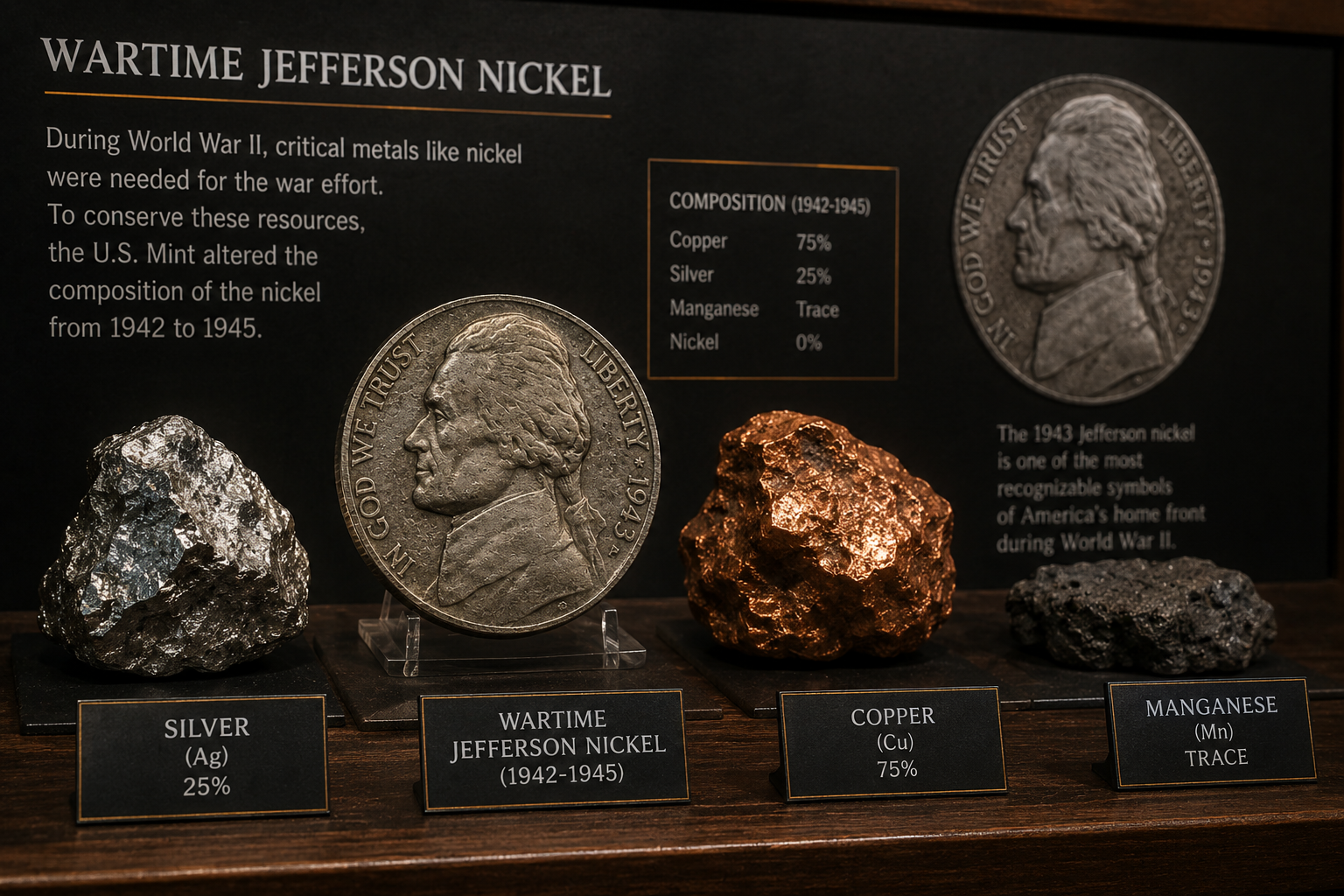
The wartime nickel alloy combined silver, copper, and manganese to replace traditional nickel during World War II.
Why The Alloy Changed The Way Wartime Nickels Look
One of the most interesting consequences of the wartime alloy appeared years after the coins were struck.
The Mint’s original goal was simply to conserve nickel metal. Officials were focused on wartime production, not on how collectors would view these coins decades later.
Yet the new composition changed the way the coins aged.
Silver, copper, and manganese each respond differently to environmental conditions. Over time, the interaction between these metals produced appearances rarely seen on standard Jefferson nickels.
Some wartime nickels developed soft gray surfaces.
Others acquired smoky tones.
Some remained relatively bright.
The variety surprised collectors because coins from the same year could end up looking dramatically different from one another.
That visual diversity became one of the defining characteristics of the wartime series.
The alloy did more than replace nickel.
It gave the coin a completely different aging personality.
How The Wartime Alloy Compared To Ordinary Nickels
The easiest way to understand the wartime composition is to compare it directly with the traditional Jefferson nickel alloy.
Both coins carried the same denomination. Both circulated in everyday commerce. Both featured the same basic design.
Yet beneath the surface they were fundamentally different.
| Feature | Traditional Jefferson Nickel | Wartime Jefferson Nickel |
|---|---|---|
| Main Composition | Copper and Nickel | Copper, Silver, and Manganese |
| Nickel Metal | Present | Removed |
| Silver Content | None | 35% |
| Purpose | Standard Circulation | Wartime Conservation |
| Aging Characteristics | More Consistent | Often More Variable |
This comparison helps explain why wartime nickels feel different even when the design remains familiar.
The changes happened beneath the surface, but their effects eventually became visible.
Seeing The Difference Side By Side
When a traditional Jefferson nickel is placed next to a wartime example, the composition story becomes much easier to understand.
The two coins may appear similar at first.
Both still feature Jefferson. Both still represent five cents. Both were created by the same Mint system.
Yet their metal stories are completely different.
One represents normal peacetime production.
The other reflects a period when national priorities forced the Mint to rethink what a nickel could be.
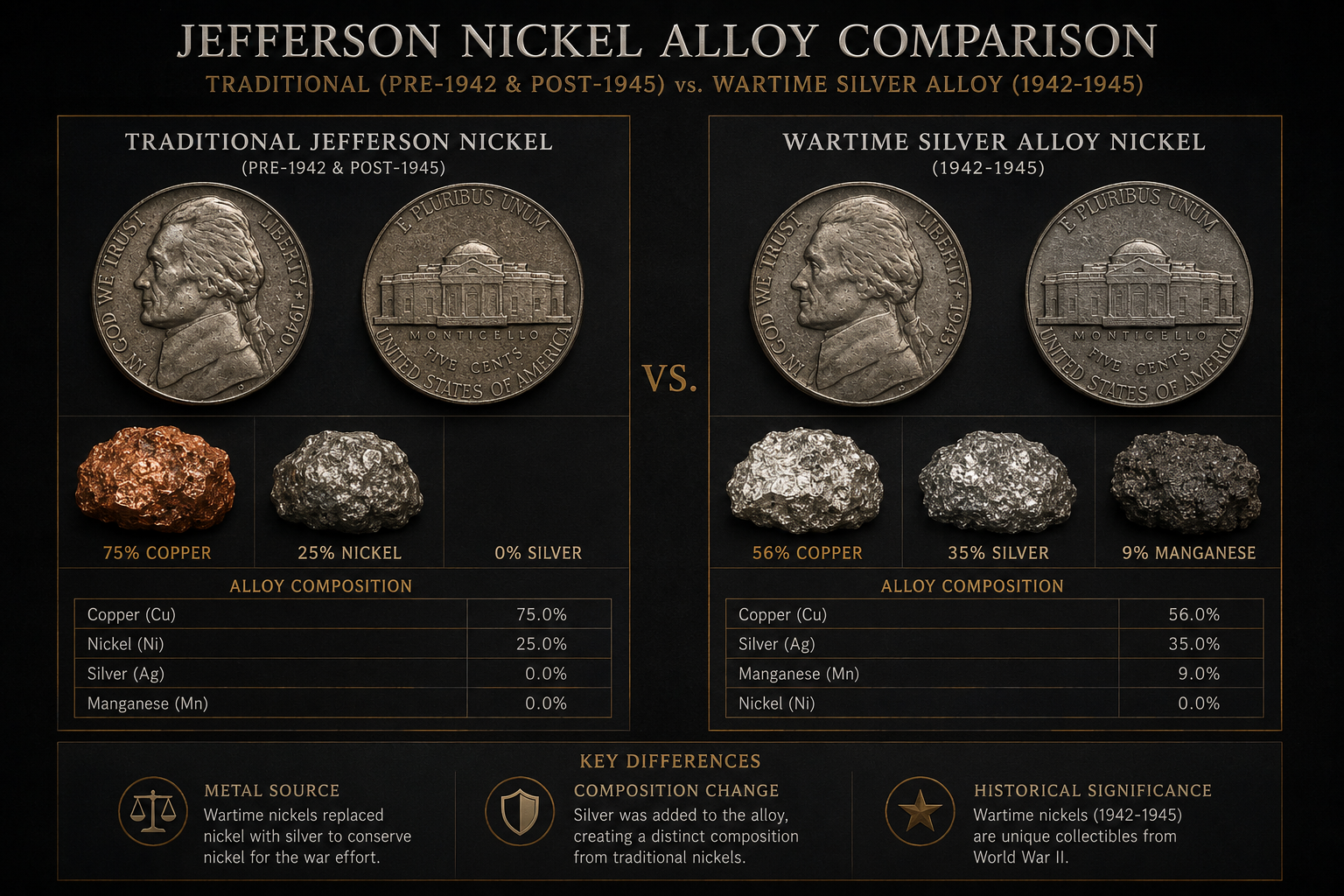
The wartime composition differed dramatically from the traditional nickel alloy Americans had used for decades.
The Legacy Of The Wartime Alloy
World War II eventually ended, and the need for emergency composition changes faded.
The Mint returned to more traditional nickel-based formulas, bringing the wartime experiment to a close.
Yet the coins survived.
Millions remained in circulation for years. Others found their way into collections where they continue to tell their story today.
What makes these coins remarkable is not just their silver content.
It is the fact that they represent a rare moment when a major American coin changed its identity because of world events.
The wartime alloy was never intended to become famous.
It was designed to solve a practical problem.
But decades later, that practical solution became one of the most fascinating chapters in the history of the Jefferson nickel.
Reality Check
Many people assume wartime nickels were simply silver coins. The reality is more complicated.
Silver made up only part of the alloy. Copper was actually the largest component, while manganese completed the formula. The interaction between all three metals created the unique characteristics collectors see today.
Understanding the full composition is essential because it explains why wartime nickels look, age, and behave differently from ordinary Jefferson nickels.
Related HistoraCoin Stories
Final Verdict
The strange metal hidden inside wartime nickels was not one metal at all.
It was a carefully designed wartime alloy made from silver, copper, and manganese. Each ingredient played a specific role in helping the Mint conserve nickel metal while continuing production of the five-cent coin during World War II.
That temporary solution created a coin unlike any other Jefferson nickel.
The unusual composition changed the way the coin aged, influenced its appearance, and left behind clues that collectors still study today.
More than eighty years later, the alloy remains one of the most fascinating hidden stories in American coinage.
The coin may still be called a nickel, but its true identity is far more complex than the name suggests.
FAQ
| Question | Answer |
|---|---|
| What metals were used in wartime nickels? | Wartime nickels contained 56% copper, 35% silver, and 9% manganese. |
| Why was nickel removed from wartime nickels? | Nickel metal was needed for military and industrial uses during World War II, so the Mint adopted a temporary replacement alloy. |
| Did wartime nickels really contain silver? | Yes. Wartime Jefferson nickels contained 35 percent silver. |
| Why do wartime nickels often look different? | The unusual alloy ages differently from ordinary nickel compositions, often producing gray tones and distinctive surface characteristics. |
| What role did manganese play? | Manganese helped complete the wartime alloy and contributed to its unique long-term behavior. |
| Were wartime nickels made only during World War II? | Yes. The special alloy was used from 1942 through 1945 as a wartime conservation measure. |