The Forgotten Coin of World War II
Estimated reading time: 13 minutes
When people think about World War II, they usually picture aircraft, ships, factories, ration books, and military equipment. Very few people think about a five-cent coin. Yet one of the most interesting wartime stories in American pocket change was carried quietly in millions of hands, cash drawers, lunch counters, and train stations.
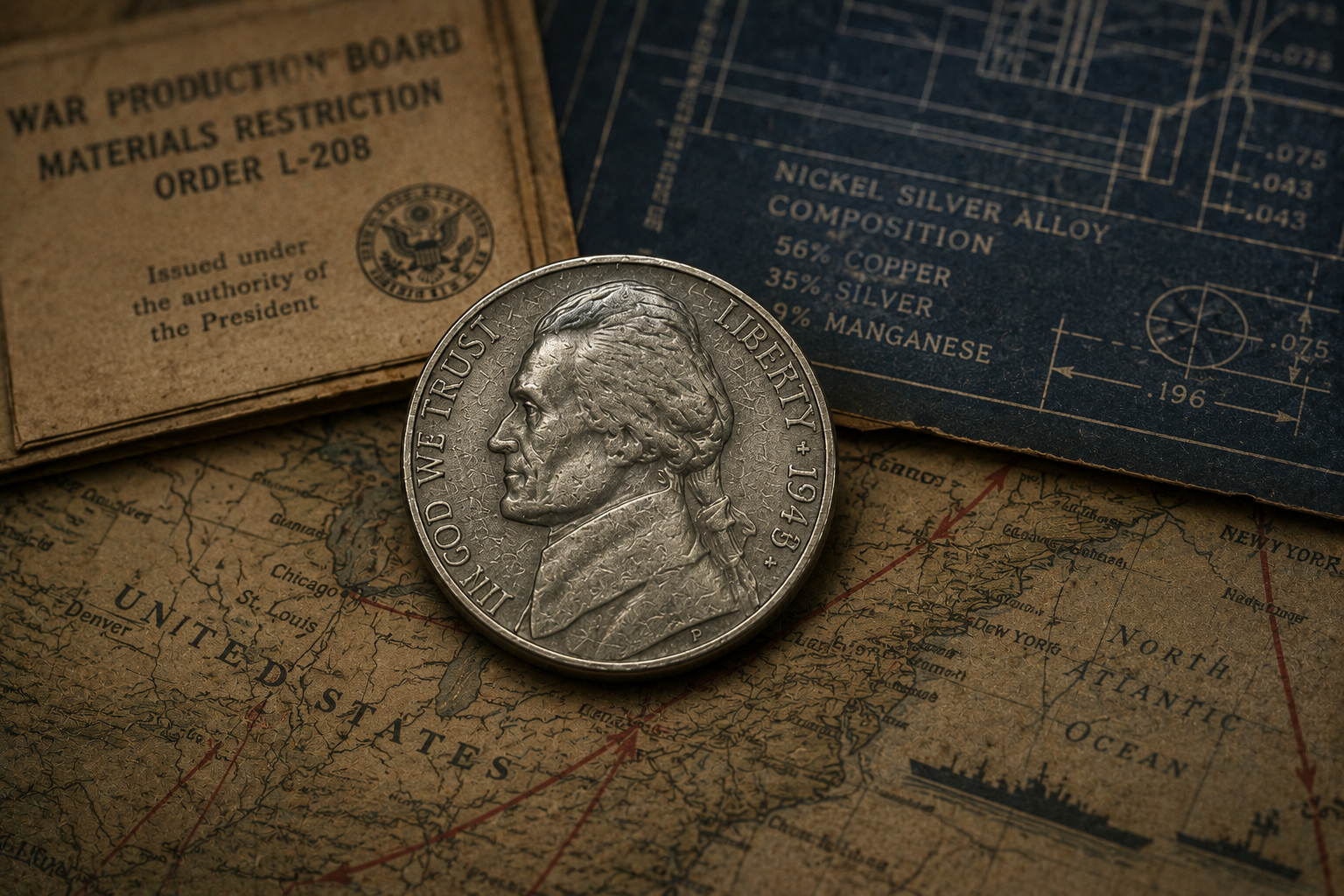
The wartime Jefferson nickel looked ordinary at first glance, but it was anything but ordinary. During the war years, America changed the metal inside the nickel, added a giant mint mark above Monticello, and created a coin that still feels different more than eighty years later. It may be one of the most overlooked witnesses to World War II in U.S. coin history.
Wartime Jefferson nickels were produced from 1942 through 1945 using a special alloy of silver, copper, and manganese. The change happened because nickel metal was needed for wartime production. These coins kept the familiar Jefferson design, but their metal, appearance, and historical meaning changed completely.
Table of Contents
- The Ordinary Coin That Was Not Ordinary
- How World War II Reached American Pocket Change
- Why Nickel Metal Became Too Important
- The Wartime Solution Hidden Inside The Coin
- Silver, Copper, And Manganese
- A Coin Built From Wartime Necessity
- The Giant Mint Mark Above Monticello
- The Coin Americans Used Without Thinking
The Ordinary Coin That Was Not Ordinary
The Jefferson nickel had already become familiar by the time World War II changed it.
Introduced in 1938, the design was calm and official. Thomas Jefferson appeared on the front. Monticello appeared on the reverse. The coin did not look dramatic. It was not meant to feel mysterious. It was a practical five-cent coin built for everyday circulation.
That ordinary appearance is exactly what makes the wartime version so interesting.
The coin did not announce itself as a wartime object. It did not show tanks, flags, aircraft, or battle scenes. It continued to look like a Jefferson nickel.
But beneath the surface, the coin had changed.
Its familiar design covered a completely different wartime composition. The name remained nickel, but the traditional nickel metal was temporarily removed. That quiet contradiction gives the wartime Jefferson nickel its strange historical power.
How World War II Reached American Pocket Change
World War II changed American life in ways large and small.
Factories shifted production. Materials were redirected. Industries adapted to military needs. People became used to the idea that ordinary objects could be affected by wartime priorities.
Coins were not separate from that reality.
The United States still needed circulating money. Stores needed change. Workers needed coins for daily purchases. Transportation systems, vending machines, shops, and cash registers still depended on small denominations.
But the materials used to make those coins now mattered in a different way.
Nickel metal was useful for industrial and military purposes. When millions of five-cent coins used that metal, the Mint had to reconsider whether the old composition still made sense during wartime.
The result was a quiet but important decision.
The coin would keep circulating, but its metal would change.
Why Nickel Metal Became Too Important
The strange part of the story is that the nickel stopped being a normal nickel because nickel itself became too important.
In peacetime, the traditional alloy worked well. It was durable, reliable, and familiar. There was no reason for the public to question it.
During wartime, the calculation changed.
Nickel metal had value beyond coinage. It could support larger industrial needs connected to military production. That placed pressure on the Mint to find a substitute.
The challenge was not simply removing nickel from the coin.
The replacement had to work. It had to strike properly, circulate normally, and remain recognizable as a five-cent piece. The Mint could not create confusion in everyday commerce.
So the solution had to be practical, not symbolic.
The Wartime Solution Hidden Inside The Coin
The Mint eventually adopted a special wartime alloy that replaced the traditional nickel composition.
This alloy contained silver, copper, and manganese.
That mixture may sound surprising today. Silver is usually associated with dimes, quarters, and half dollars, not five-cent coins. Manganese is even less expected because most people never connect it with American pocket change.
Yet together these metals solved a wartime problem.
They allowed the Mint to continue producing five-cent coins while conserving nickel metal for more urgent national needs.
The public still received nickels. Stores still made change. Daily life continued.
But the coin itself had become something unusual.
Silver, Copper, And Manganese
The wartime nickel alloy was not a simple silver coin.
It was a carefully chosen mixture designed for a specific emergency.
| Metal | Percentage | Role In The Wartime Nickel |
|---|---|---|
| Copper | 56% | Provided most of the alloy and helped the coin remain practical for circulation. |
| Silver | 35% | Helped replace nickel metal during the wartime composition change. |
| Manganese | 9% | Completed the special alloy and contributed to the coin’s unusual aging behavior. |
This composition explains many of the details collectors notice today.
It helps explain why wartime nickels can look gray instead of bright. It helps explain why some examples age differently from others. It also helps explain why this coin feels so distinct from regular Jefferson nickels.
The design stayed familiar, but the metal inside told a completely different story.
A Coin Built From Wartime Necessity
The wartime Jefferson nickel was not created to be famous.
It was not created as a commemorative coin. It was not designed to celebrate victory or honor a battle. It was created because the country needed a practical answer to a materials problem.
That practicality is what makes it powerful.
The coin is a small object, but it reflects a large national adjustment. It shows how World War II reached into ordinary life and changed even the metal inside everyday money.
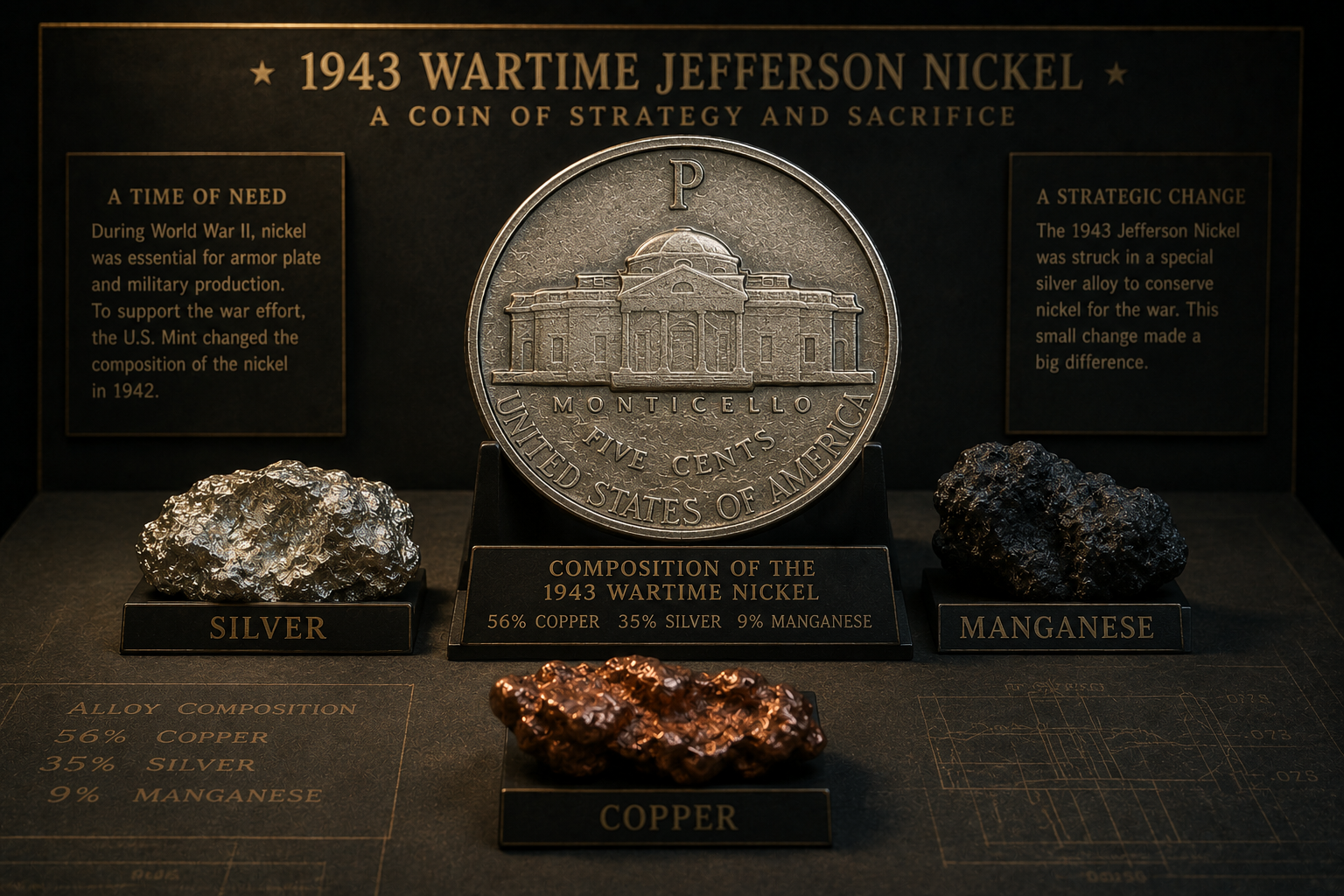
The wartime nickel combined three different metals into one temporary alloy that would never become the normal Jefferson nickel composition.
The Giant Mint Mark Above Monticello
The alloy change created another problem.
How could these wartime nickels be identified?
The Mint answered with one of the most visible design changes in the Jefferson nickel series: a large mint mark placed above Monticello.
This mark was not decorative. It was practical.
It allowed the wartime alloy coins to be recognized quickly. The large P, D, or S above Monticello told anyone who knew the system that this was not an ordinary Jefferson nickel.
The Philadelphia P was especially historic because it marked the first time Philadelphia used a P mint mark on a circulating U.S. coin.
That single letter became one of the easiest ways to identify the forgotten coin of World War II.
The Coin Americans Used Without Thinking
Most Americans who used wartime nickels probably did not stop to think about their unusual composition.
The coins bought small items, moved through stores, and passed from hand to hand like ordinary money. They appeared in pockets, cash drawers, lunch counters, bus fares, and family coin jars.
That is part of what makes them so fascinating now.
They were not preserved as museum objects at the time. They were used.
A wartime nickel was history in motion, not history behind glass.
It carried the pressures of a global war into ordinary daily transactions. It allowed people to continue normal routines while the metal inside quietly reflected a world under pressure.
When The War Ended, The Coin Changed Again
World War II eventually came to an end, but the wartime Jefferson nickel had already earned its place in American history.
Once the pressure on strategic materials eased, there was no longer a reason to continue using the emergency alloy. The United States Mint gradually returned the five-cent coin to its traditional copper and nickel composition.
From that moment forward, the wartime alloy became a closed chapter.
Millions of those special nickels remained in circulation, quietly mixing with newer coins. Most people never realized they were spending coins that represented one of the largest temporary changes ever made to an American circulating denomination.
The war ended.
The emergency alloy disappeared.
But the coins survived.
Why This Coin Became Forgotten
History tends to remember dramatic objects.
People remember military medals, famous weapons, aircraft, tanks, ships, and wartime propaganda.
A five-cent coin rarely attracts the same attention.
That is why the wartime Jefferson nickel is often called one of the forgotten coins of World War II.
Its story unfolded quietly.
It never celebrated victory. It never carried patriotic artwork. It never announced that it had changed.
Instead, it simply continued doing its job while hiding an extraordinary story beneath its familiar design.
Collectors today appreciate something that many Americans never noticed during the war years.
The wartime nickel was one of the few everyday objects that physically changed because of the conflict.
Every surviving example still carries evidence of that decision.
Three Different Eras In One Coin Series
The Jefferson nickel can almost be divided into three separate historical periods.
| Period | Main Composition | Historical Significance |
|---|---|---|
| Pre-War | Copper and Nickel | Traditional Jefferson nickel production before wartime material shortages. |
| Wartime (1942–1945) | Silver, Copper, and Manganese | Emergency alloy created to conserve nickel metal during World War II. |
| Post-War | Copper and Nickel | Return to the original composition after wartime production ended. |
Looking at these three periods together makes the wartime years stand out immediately.
They represent a brief interruption in an otherwise stable coin series.
That interruption lasted only a few years, yet it permanently changed the history of the Jefferson nickel.
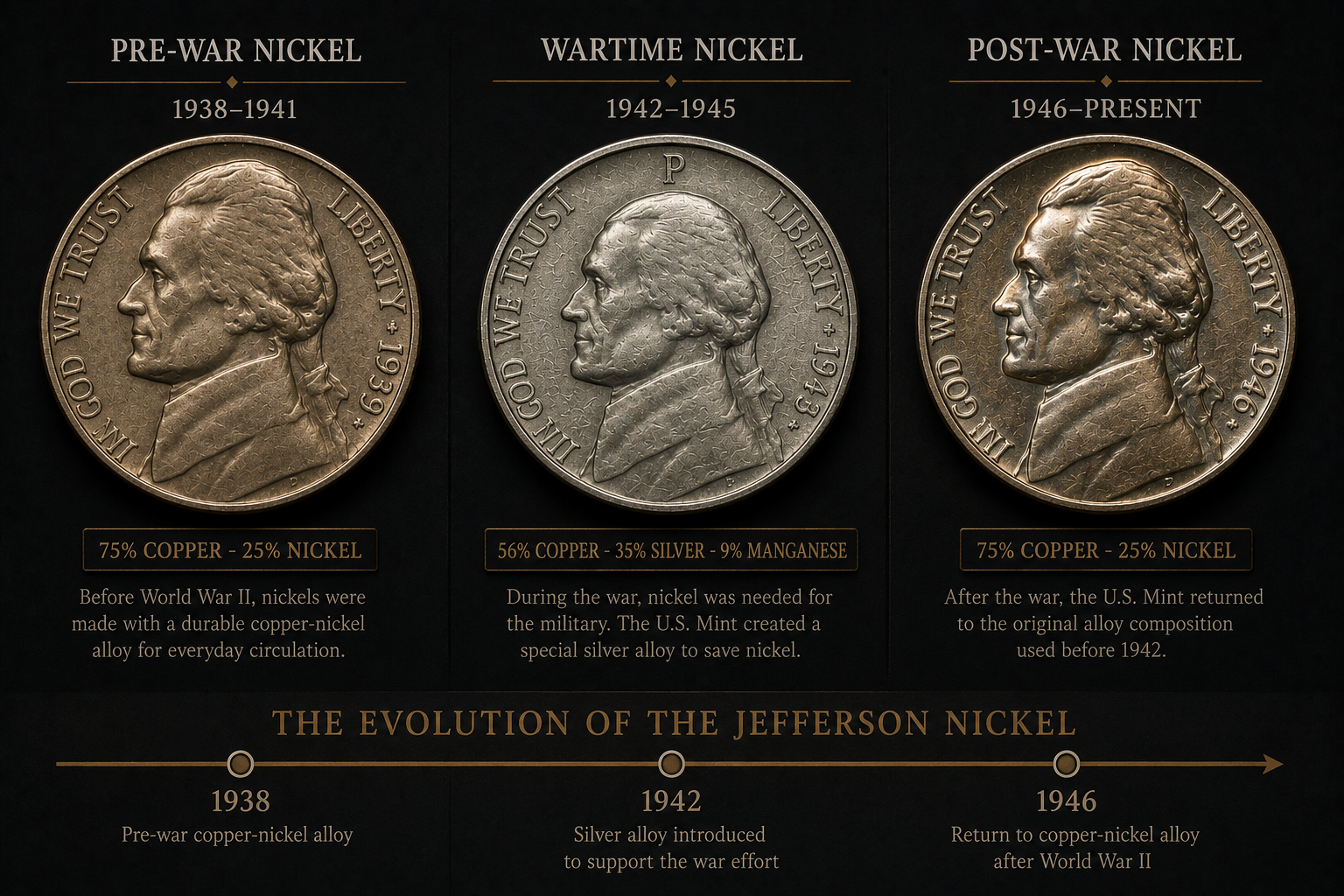
The wartime Jefferson nickel represents a unique chapter between two eras of American coin production.
A Small Coin That Tells A Much Bigger Story
The wartime Jefferson nickel reminds us that history is not always found in famous landmarks or battlefield artifacts.
Sometimes history survives inside ordinary objects that millions of people once ignored.
Every wartime nickel reflects a chain of decisions that connected economics, industry, military priorities, and everyday American life.
Its silver alloy tells the story of material shortages.
Its large mint mark tells the story of identification.
Its gray surfaces often tell the story of decades of natural aging.
Together, these details transform an ordinary five-cent coin into a remarkable historical document.
That is why the wartime Jefferson nickel deserves far more attention than it usually receives.
Everything We Learned From The Wartime Jefferson Nickel
Across this series, we explored how one small coin revealed an extraordinary amount of history.
We discovered why America removed nickel from nickels.
We learned why silver became part of a five-cent coin.
We examined the large mint mark above Monticello.
We explored why some wartime nickels look gray while others remain brighter.
We looked inside the alloy itself and explained why the coins continue aging differently today.
Taken individually, each topic tells part of the story.
Together, they reveal the complete picture of the wartime Jefferson nickel.
That complete picture is what makes this small coin one of the most fascinating products ever created by the United States Mint.
Reality Check
Wartime Jefferson nickels were never intended to become collectible coins. They were emergency circulating coins created to solve a practical wartime problem.
Their historical importance comes from the decisions behind their production rather than their rarity. Every surviving wartime nickel represents a brief period when global events directly changed the composition of everyday American money.
Related HistoraCoin Stories
Final Verdict
The wartime Jefferson nickel is easy to overlook because it looks so familiar.
Yet behind that familiar appearance lies one of the most remarkable stories in American coinage.
World War II forced the United States Mint to rethink the five-cent coin from the inside out. Nickel metal disappeared, a temporary silver alloy took its place, a large mint mark identified the new composition, and millions of Americans unknowingly carried this quiet piece of wartime history in their pockets.
More than eighty years later, these coins remain far more than old pocket change.
They are lasting reminders that even the smallest everyday objects can preserve the history of one of the world’s greatest conflicts.
Perhaps that is why the wartime Jefferson nickel truly deserves its title as The Forgotten Coin of World War II.
Frequently Asked Questions
| Question | Answer |
|---|---|
| Why is the wartime Jefferson nickel called the forgotten coin of World War II? | Because it quietly changed its composition during the war while keeping the same familiar design, causing many people to overlook its historical significance. |
| What years were wartime Jefferson nickels produced? | They were produced from 1942 through 1945 using a special wartime alloy. |
| What metals were used in wartime nickels? | The wartime alloy contained 56% copper, 35% silver, and 9% manganese. |
| Why was nickel removed from the five-cent coin? | Nickel metal became strategically important for military and industrial production during World War II. |
| Why do wartime nickels have a large mint mark? | The enlarged mint mark above Monticello identified coins struck with the special wartime alloy. |
| Why do wartime nickels often look gray? | The unique alloy of silver, copper, and manganese ages differently from the traditional nickel composition, producing distinctive natural toning over time. |